Historical Context: Rigorous examination of primary Hebrew, Aramaic, Greek, and Roman classical epigraphy.
Core Evidence: Forensic archaeology, radiocarbon data, and primary manuscripts validating biblical events.
Scholarly Consensus: Vetted against modern peer-reviewed publications in Near Eastern archaeology and biblical studies.
The Daughter of Jezebel: The Infiltration of the Davidic Throne
In the intricate dynastic struggles of the ancient Near East, royal marriages were potent geopolitical weapons. In the mid-9th century BC, King Jehoshaphat of Judah—seeking an end to decades of civil war between the northern and southern Hebrew kingdoms—sealed a fateful alliance with King Ahab of Israel. He secured the hand of Princess Athaliah for his crown prince, Jehoram.
Athaliah was not merely northern royalty; she was the daughter of Queen Jezebel of Tyre. Carrying the fierce political ambition and militant pagan zeal of her mother, Athaliah brought the cult of Baal-Melqart straight into the royal court of Jerusalem.
Her marriage proved catastrophic for Judah:
- Her husband, King Jehoram, murdered all six of his younger brothers upon taking the throne to eliminate dynastic rivals (2 Chronicles 21:4).
- Under her direct influence, Jehoram built high places of Baal throughout the hills of Judah.
- When Jehoram died of an agonizing bowel disease, their son Ahaziah ascended the throne at age twenty-two. Athaliah functioned as the true power behind the throne: "His mother was his counselor to do wickedly" (2 Chronicles 22:3).
In 841 BC, disaster struck the Omride dynasty. While visiting his wounded uncle in Jezreel, King Ahaziah was caught in the whirlwind military coup of General Jehu and executed alongside his northern royal cousins.
The Slaughter of the Royal Seed: Athaliah’s Ruthless Coup
When news of Ahaziah’s death reached Jerusalem, Queen Mother Athaliah faced total political eclipse. Rather than accepting the coronation of one of her grandsons and slipping into the background as an elder dowager, she executed a stroke of dynastic savagery unprecedented in Jewish history:
"And when Athaliah the mother of Ahaziah saw that her son was dead, she arose and destroyed all the seed royal of the house of Judah." (2 Kings 11:1)
In a calculated, systematic pogrom, Athaliah ordered her royal guards to butcher her own grandsons, nephews, and every male descendant of the House of David. For six years, Athaliah reigned as the absolute, undisputed monarch of the Southern Kingdom—the only female ruler ever to sit upon the throne of David, and the only sovereign of Judah not descended from the line of David.
From an imperial perspective, the covenant made by God with David—that his dynasty would endure forever (2 Samuel 7:12–16)—appeared severed, hanging by an invisible thread.
The Daring Rescue: Jehosheba and the Hidden Infant in the Bedchamber
Amid the screams of royal infants echoing through the palace corridors of the City of David, one woman stepped forward with extraordinary courage: Princess Jehosheba (Jehoshabeath), the daughter of the late King Jehoram and half-sister to Ahaziah. Critically, Jehosheba was married to the righteous High Priest of Israel, Jehoiada.
While Athaliah’s assassins were slaughtering the princes, Jehosheba slipped into the royal nursery:
"But Jehosheba, the daughter of king Joram, sister of Ahaziah, took Joash the son of Ahaziah, and stole him from among the king's sons which were slain; and they hid him, even him and his nurse, in the bedchamber from Athaliah, so that he was not slain." (2 Kings 11:2)
The Hebrew term for "bedchamber" is hadar ha-mittot (literally, "the room of beds"), which scholars and archaeologists identify not as an ordinary sleeping room, but as a secure interior palace storeroom where reserve mattresses, linens, and bedding were stored.
Jehoiada and Jehosheba smuggled the infant prince Joash, barely one year old, into the sacred, fortified precincts of Solomon’s Temple. For six long years, while Athaliah poured royal treasury funds into building a rival Temple of Baal in Jerusalem, the rightful heir to the throne was raised in secret inside the private priestly quarters of the Temple of Yahweh!
[1. Athaliah's Dynastic Pogrom (841 BC)]
             │  └── Systematic slaughter of all male descendants of David
             │
[2. The Heroic Rescue by Princess Jehosheba]
             │  └── Infant Joash hidden in palace bedchamber storeroom
             │
[3. Six Years of Secret Sanctuary in Solomon's Temple]
             │  └── Joash raised by High Priest Jehoiada within sacred precincts
             │
[4. Sacerdotal Coup with Carite Mercenaries (835 BC)]
             │  └── Temple surrounded; seven-year-old Joash crowned
             │
[5. Retribution at the Horse Gate]
             └── Athaliah executed outside the Temple walls at the royal stables
The Sacerdotal Conspiracy: High Priest Jehoiada and the Carite Mercenaries
By 835 BC, young Joash had reached his seventh year. High Priest Jehoiada recognized that the time for decisive action had arrived. A brilliant political and military strategist, Jehoiada orchestrated a covert coalition:
- Recruitment of Military Commanders: Jehoiada summoned the five captains of hundreds (sarei ha-me'ot) into the Temple, binding them under a solemn covenant of secrecy and showing them the living seven-year-old prince (2 Kings 11:4).
- The Carite Mercenaries (Ha-Kari): The biblical text notes that Jehoiada recruited the Carites (ha-kari). Archaeological and historical evidence identifies the Carites as elite foreign mercenaries from Caria in southwestern Asia Minor (modern Turkey). Famous across the ancient Mediterranean as armored shock troops, the Carites served as the elite royal palace bodyguard in Jerusalem, mirroring the Cherethites and Pelethites of King David.
- The Weaponry of King David: To arm the conspirators without alerting Athaliah’s palace spies by drawing weapons from the royal armory, Jehoiada opened the sacred Temple armory: "And to the captains over hundreds did the priest give king David's spears and shields, that were in the temple of the Lord" (2 Kings 11:10). The very weapons dedicated by King David two centuries earlier were placed in the hands of guards surrounding David's last surviving son!
The Coronation in the Temple: "God Save the King!"
On the Sabbath day, when the priestly rotations changed and double the normal contingent of armed Levites and Carite guards were present, Jehoiada executed his masterstroke:
"And he brought forth the king's son, and put the crown upon him, and gave him the testimony; and they made him king, and anointed him; and they clapped their hands, and said, 'God save the king!' (Yehi ha-melekh!)" (2 Kings 11:12)
Standing beside the monumental bronze pillar (amud) of Solomon's Temple—traditionally named Jachin or Boaz, where the kings of Judah were formally consecrated—seven-year-old Joash was crowned. Jehoiada placed upon his brow the royal diadem (nezer) and presented him with the Eduth (the copy of the Torah of Moses mandated by Deuteronomy 17:18–20 to guide the king's governance).
The sound of royal silver trumpets blaring, the crash of shields, and the thunderous shouts of thousands of joyful citizens shook the limestone hills of Jerusalem.
The Cry of Treason and Execution at the Horse Gate
Inside the royal palace just south of the Temple Mount, Queen Athaliah heard the roaring commotion. Rushing unescorted into the Temple courts, she witnessed a scene that froze the blood in her veins:
"And when Athaliah heard the noise of the guard and of the people, she came to the people into the temple of the Lord. And when she looked, behold, the king stood by a pillar, as the manner was, and the princes and the trumpeters by the king, and all the people of the land rejoiced, and blew with trumpets: and Athaliah rent her clothes, and cried, 'Treason, Treason!' (Qesher, Qesher!)" (2 Kings 11:13–14)
The irony was staggering: the usurper who had butchered her own family to seize an illegitimate throne was now shrieking "Treason!" at the rightful king.
Jehoiada issued a strict command to the captains of the guard:
"Have her forth without the ranges: and him that followeth her kill with the sword. For the priest had said, 'Let her not be slain in the house of the Lord.'" (2 Kings 11:15)
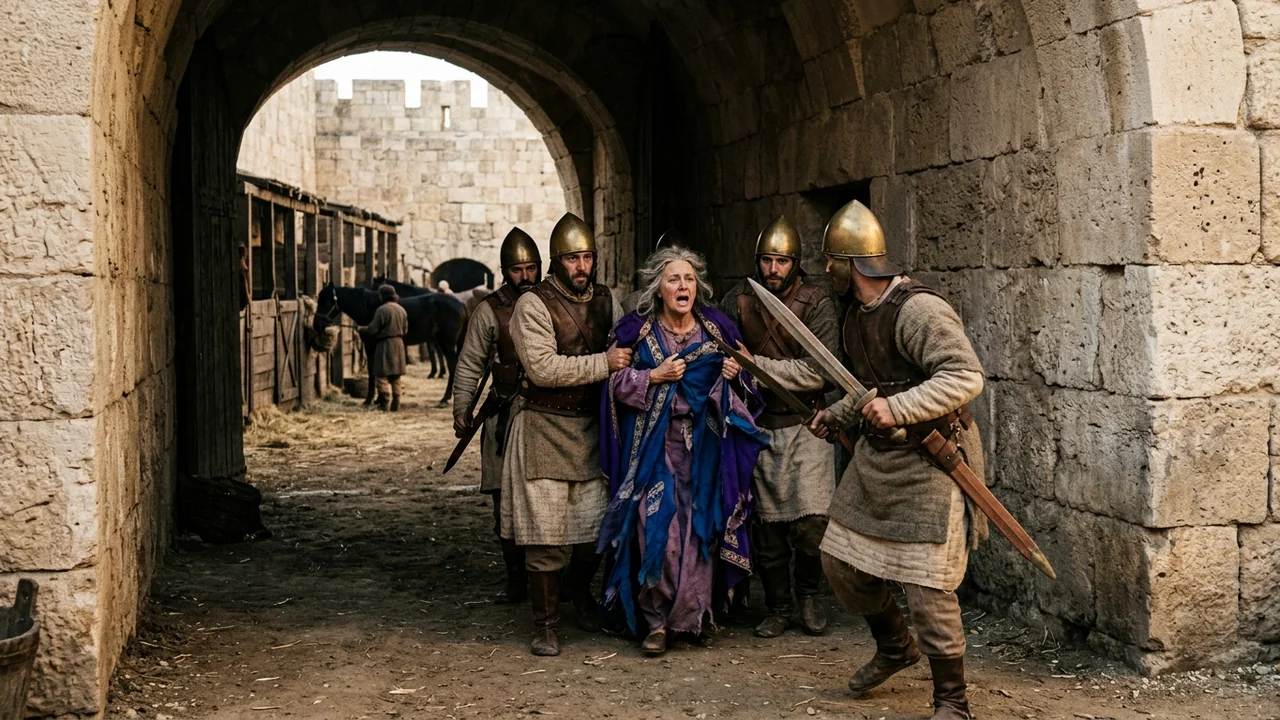
Even in the heat of a coup, Jehoiada insisted on sacred legal decorum: the Temple of Yahweh could not be defiled by royal blood. The Carite guards seized Athaliah, dragged her out of the Temple complex through the connecting royal colonnade, and led her down to the Horse Gate (Sha'ar ha-Susim)—the entrance through which royal chariots and cavalry entered the royal palace stables.
There, by the stalls of the royal horses, the daughter of Jezebel was executed by the sword, bringing an end to the northern pagan usurpation of Jerusalem.
The populace erupted in celebration. Jehoiada led the young king to the royal palace and set him upon the throne of David. The chronicler concludes with serene simplicity: "And all the people of the land rejoiced, and the city was in quiet: and they slew Athaliah with the sword beside the king's house" (2 Kings 11:20).
Discover the Complete Dynastic Chronicles of Judah
The coup against Queen Athaliah is one of the most suspenseful political and military rescues in ancient history, preserving the Davidic messianic bloodline from total annihilation. If you want to explore the complete historical files, palace floorplans, and royal chronologies of the biblical monarchy:
👉 Discover Volume II: Kings & Prophets – Tragic Ends & Medical Mysteries ($2.99)
Features the complete architectural reconstructions of the City of David, palace gate systems, ancient weaponry catalogs, and forensic case studies of royal assassinations.
Frequently Asked Questions
Who was Queen Athaliah?
Queen Athaliah was the daughter of King Ahab and Queen Jezebel of the Northern Kingdom of Israel. She married King Jehoram of Judah in a political alliance. Following the death of her son King Ahaziah in 841 BC, Athaliah murdered her own grandsons to seize the throne, reigning for six years as the only female and non-Davidic monarch of Judah.
How was the Davidic line saved from extinction?
When Athaliah ordered the slaughter of all royal heirs, Princess Jehosheba (Ahaziah’s sister and wife of High Priest Jehoiada) secretly rescued one-year-old Prince Joash and his nurse, hiding him in a palace bedchamber storeroom and later raising him secretly inside Solomon’s Temple for six years.
Where was Queen Athaliah executed?
Athaliah was executed at the Horse Gate (Sha'ar ha-Susim) adjacent to the royal palace and stables in Jerusalem. High Priest Jehoiada strictly commanded that she not be killed inside the Temple of Yahweh to prevent defiling the sacred courts with blood.
Who were the Carites in 2 Kings 11?
The Carites (ha-kari) were elite foreign mercenaries originating from Caria in southwestern Asia Minor (modern Turkey). Recognized throughout the ancient Mediterranean as disciplined armored shock troops, they served as the professional royal bodyguards in Jerusalem, enlisted by High Priest Jehoiada to protect the young king and execute the coup against Athaliah.
Frequently Asked Questions
Who was Queen Athaliah?
Queen Athaliah was the daughter of King Ahab and Queen Jezebel of the Northern Kingdom of Israel. She married King Jehoram of Judah in a political alliance. Following the death of her son King Ahaziah in 841 BC, Athaliah murdered her own grandsons to seize the throne, reigning for six years as the only female and non-Davidic monarch of Judah.
How was the Davidic line saved from extinction?
When Athaliah ordered the slaughter of all royal heirs, Princess Jehosheba (Ahaziah’s sister and wife of High Priest Jehoiada) secretly rescued one-year-old Prince Joash and his nurse, hiding him in a palace bedchamber storeroom and later raising him secretly inside Solomon’s Temple for six years.
Where was Queen Athaliah executed?
Athaliah was executed at the Horse Gate (Sha'ar ha-Susim) adjacent to the royal palace and stables in Jerusalem. High Priest Jehoiada strictly commanded that she not be killed inside the Temple of Yahweh to prevent defiling the sacred courts with blood.
Who were the Carites in 2 Kings 11?
The Carites (ha-kari) were elite foreign mercenaries originating from Caria in southwestern Asia Minor (modern Turkey). Recognized throughout the ancient Mediterranean as disciplined armored shock troops, they served as the professional royal bodyguards in Jerusalem, enlisted by High Priest Jehoiada to protect the young king and execute the coup against Athaliah.
Related Research Dossiers
View all 120 articles →
The Arrow Between the Armor Plates: The Probability of King Ahab’s Fated End at Ramoth-Gilead

Fallen on His Own Sword: The Witch of Endor and the Psychological Collapse of King Saul