Historical Context: Rigorous examination of primary Hebrew, Aramaic, Greek, and Roman classical epigraphy.
Core Evidence: Forensic archaeology, radiocarbon data, and primary manuscripts validating biblical events.
Scholarly Consensus: Vetted against modern peer-reviewed publications in Near Eastern archaeology and biblical studies.
The Architect of the Sanhedrin Trial
In the Passion narratives of the four Gospels, no religious authority plays a more calculating, politically astute, and determinative role than the reigning Jewish High Priest, Joseph Caiaphas (known in the New Testament simply as Caiaphas).
Presiding over the supreme council of the Sanhedrin from 18 to 36 AD, Caiaphas achieved an unprecedented eighteen-year tenure during a tumultuous era when Roman governors routinely deposed high priests every twelve to twenty-four months. Caiaphas survived the tenures of multiple Roman prefects, maintaining an ironclad political partnership with Pontius Pilate to preserve aristocratic Sadducean wealth, temple prestige, and civic tranquility.
Following the resurrection of Lazarus, it was Caiaphas who uttered the famous geopolitical calculation that sealed Jesus's fate:
"Ye know nothing at all, nor consider that it is expedient for us, that one man should die for the people, and that the whole nation perish not." (John 11:49–50)
On the night before Passover in 33 AD, Jesus was dragged bound to the palace of Caiaphas on Mount Zion. In a nocturnal interrogation that violated multiple rabbinic procedural statutes, Caiaphas placed Jesus under solemn judicial oath:
"I adjure thee by the living God, that thou tell us whether thou be the Christ, the Son of God. Jesus saith unto him, Thou hast said: nevertheless I say unto you, Hereafter shall ye see the Son of man sitting on the right hand of power, and coming in the clouds of heaven. Then the high priest rent his clothes, saying, He hath spoken blasphemy; what further need have we of witnesses?" (Matthew 26:63–65)
For centuries, secular historians treated Caiaphas as an elusive shadow—a literary antagonist remembered only through religious polemics. Skeptics questioned whether a single physical trace of this shadowy Sadducean ruler would ever emerge from the soil of Jerusalem.
Then, in November 1990, an accidental explosion during routine park construction in southern Jerusalem broke through the ceiling of an ancient subterranean tomb, revealing the physical bones of the High Priest.
The Accidental Bulldozer Discovery in Peace Forest (November 1990)
In late November 1990, municipal construction workers were operating heavy earth-moving equipment and bulldozers in the Peace Forest (near the neighborhood of Abu Tor), just south of the Old City of Jerusalem. The crew was clearing land for a new water park promenade when a bulldozer tread collapsed through the limestone bedrock roof of an ancient, sealed subterranean burial cave.
Work was immediately halted, and the Israel Antiquities Authority (IAA) was alerted. Archaeologists Dr. Zvi Greenhut (Jerusalem District Archaeologist) and Professor Ronny Reich arrived on the scene to direct an emergency rescue excavation.
       [THE DISCOVERY OF THE CAIAPHAS TOMB: JERUSALEM, 1990]
  ══════════════════════════════════════════════════════════════════
    Location:       Peace Forest (Abu Tor ridge, South of Jerusalem)
    Excavators:     Dr. Zvi Greenhut & Prof. Ronny Reich (IAA)
    Context:        First-century rock-cut burial chamber (kokhim tomb)
    Contents:       12 limestone ossuaries, ceramic oil lamps, coins
    Artifact ID:    Ossuary IAA 91-468 (Israel Museum, Jerusalem)
    Date of Tomb:   Late Second Temple Period (Early 1st Century AD)
  ══════════════════════════════════════════════════════════════════
Entering the burial chamber, the archaeologists discovered a classic loculus (kokhim) tomb characteristic of first-century Jewish funerary customs. In ancient Judea, burial followed a two-stage process (ossilegium):
- Primary Burial: The deceased was wrapped in linen shrouds and laid out upon a rock-cut bench in the tomb.
- Secondary Burial: Approximately one year later, after the flesh had completely decomposed, family members gathered the skeletal bones and placed them inside a rectangular chalk limestone box known as an ossuary, which was then sealed and deposited in a niche (kokh) in the wall.
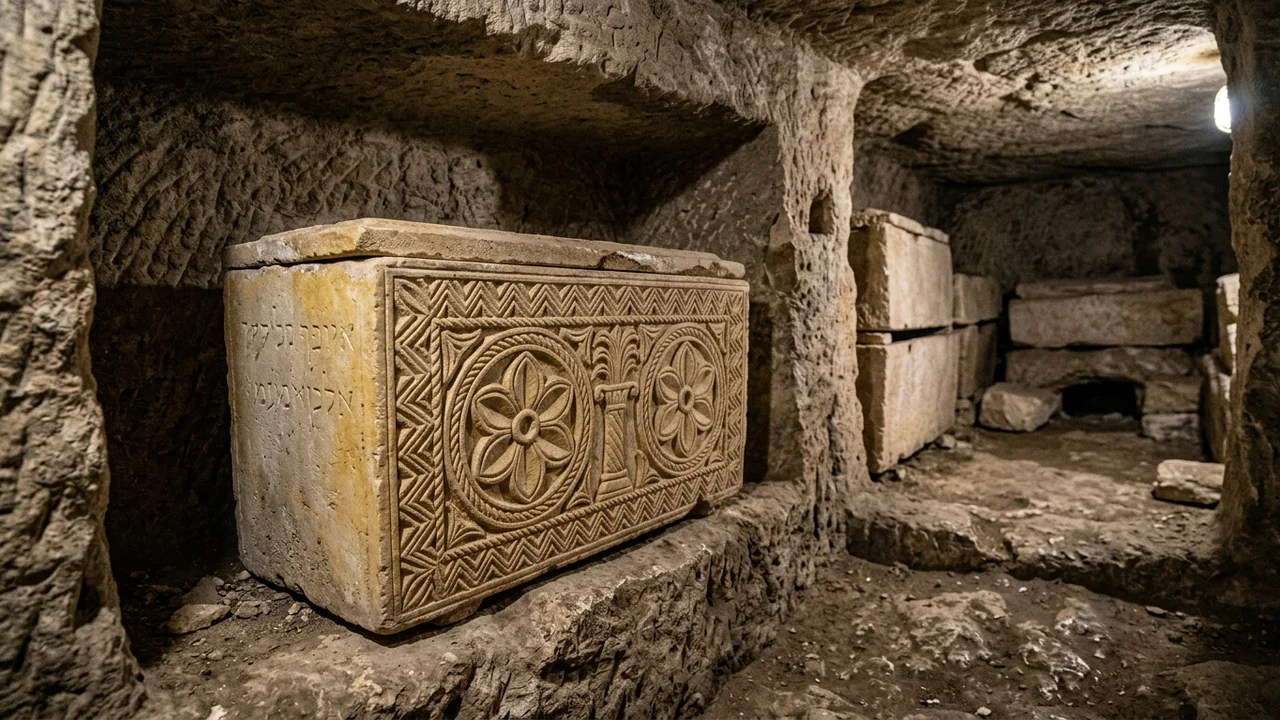
The tomb contained twelve limestone ossuaries. Most were plain, utilitarian chests typical of common citizens. But resting in one of the primary niches was an ossuary of breathtaking artistic elegance.
Epigraphic Anatomy of the Inscription: Yehosef bar Qayafa
Ossuary IAA 91-468 was immediately recognized as an artifact of exceptional aristocratic status:
- It was sculpted from fine Judean limestone, measuring 74 cm long, 29 cm wide, and 38 cm high.
- Unlike the plain chests, its entire exterior was decorated with intricate, deeply carved geometric rosettes, interlaced floral borders, and palmette motifs, executed by a master stone artisan.
- It possessed a distinctive gabled lid matching the highest level of royal and priestly luxury in first-century Jerusalem.
       [THE CARVED ROSETTE DECORATION OF THE CAIAPHAS OSSUARY]

      ┌─────────────────────────────────────────────────────────┐
      │  ╔═══════════════════════════════════════════════════╗  │
      │  ║   ( * * * )             ( * * * )                 ║  │
      │  ║  *    |    *           *    |    *                ║  │
      │  ║ *  --(*)--  *         *  --(*)--  *               ║  │
      │  ║  *    |    *           *    |    *                ║  │
      │  ║   ( * * * )             ( * * * )                 ║  │
      │  ║  6-Petal Rosette       6-Petal Rosette            ║  │
      │  ╚═══════════════════════════════════════════════════╝  │
      └─────────────────────────────────────────────────────────┘
On the narrow back end of the ossuary, and repeated on one of the long sides, the excavators discovered an inscription scratched into the soft limestone in ancient cursive Jewish Aramaic:
                     [THE ARAMAIC INSCRIPTIONS]

      INSCRIPTION 1 (Side):   יהוסף בר קיפא
                              Yehosef bar Qayafa
                              ("Joseph, son of Caiaphas")

      INSCRIPTION 2 (End):    יהוסף בר קפא
                              Yehosef bar Qafa
                              ("Joseph, son of Caiaphas")
  ══════════════════════════════════════════════════════════════════
Resolving the Name: Flavius Josephus
Why does the ossuary read "Joseph, son of Caiaphas" when the New Testament refers to the High Priest simply as Caiaphas?
The definitive historical answer is provided by the Jewish historian Flavius Josephus in his Jewish Antiquities. In multiple passages detailing the appointments and depositions of the Roman governors, Josephus records the full legal name of the high priest:
"Valerius Gratus [the Roman prefect who preceded Pontius Pilate] removed Ananus from the high priesthood, and appointed Ishmael... and not long after appointed Eleazar... and after a year, Simon... and when he also was removed, JOSEPH, WHO WAS CALLED CAIAPHAS, was appointed high priest." — Josephus, Antiquities XVIII.2.2
In Antiquities XVIII.4.3, Josephus confirms this name once more when Vitellius deposed him in 36 AD:
"Vitellius took away the priesthood from the high priest JOSEPH, WHO WAS CALLED CAIAPHAS, and appointed Jonathan, the son of Ananus."
Joseph was his personal Hebrew given name; Caiaphas was his family or clan nickname (cognomen). Just as the Apostle Simon was surnamed Peter, the High Priest Joseph was known throughout Jerusalem by his family moniker: Caiaphas!
The inscription on the ossuary matches the full legal name recorded by Flavius Josephus letter for letter: Yehosef bar Qayafa.
Forensic Osteology: The 60-Year-Old Aristocrat in the Bone Box
When the ornate gabled lid of Ossuary 91-468 was carefully removed in the laboratory, forensic anthropologists from the Israel Antiquities Authority and Hebrew University conducted a complete osteological examination of the skeletal contents:
       [FORENSIC SKELETAL INVENTORY: OSSUARY IAA 91-468]
  ══════════════════════════════════════════════════════════════════
  Total Individuals:      Six distinct skeletal sets (Common in family ossuaries)
  Demographic Profile:    - 1 Adult Male (Approx. 60 years of age)
                          - 1 Adult Female
                          - 2 Small Children
                          - 1 Young Child
                          - 1 Newborn Infant
  Primary Subject:        The complete skeleton of the ~60-year-old male
  ══════════════════════════════════════════════════════════════════
Anthropological analysis of the pelvic morphology, cranial suture closure, and dental attrition of the adult male skeleton determined that:
- The man had died at approximately sixty years of age—an advanced, mature age that perfectly matches a high priest who governed from 18 to 36 AD and died in the mid-first century AD.
- The bones exhibited no signs of hard physical labor or trauma, consistent with an aristocrat who enjoyed a luxurious, sedentary life in Jerusalem’s wealthy Upper City.
- The presence of younger family members and an infant in the same ossuary reflects standard first-century Jewish customs of utilizing ancestral bone boxes for direct family descendants.
In addition, an ancient Roman bronze coin was found tucked inside the skull of another individual in the tomb—a coin minted by Herod Agrippa I in 42/43 AD, providing an unbreakable archaeological terminus post quem demonstrating that the tomb was in active use during the exact decades immediately following the crucifixion of Jesus Christ!
Secondary Evidence: Flavius Josephus and the House of Caiaphas
In 2011, the Israel Antiquities Authority announced the recovery of another ossuary that had been looted from the Valley of Elah, bearing an authentic Aramaic inscription reading:
"Miriam, daughter of Yeshua, son of Caiaphas, priest of Maaziah from Beth Imri."
This discovery confirmed that Caiaphas was indeed the hereditary family name of a prominent priestly dynasty belonging to the Order of Maaziah—the twenty-fourth and final priestly division established under King David (1 Chronicles 24:18).
                  [THE HEREDITARY DYNASTY OF CAIAPHAS]
  ══════════════════════════════════════════════════════════════════
  Priestly Division:      Order of Maaziah (24th Priestly Course)
  Patriarchal Figure:     Ananus (Annas), High Priest (6–15 AD)
  Son-in-Law:             Yehosef bar Qayafa (Caiaphas, 18–36 AD)
  Familial Succession:    Five sons of Annas subsequently served as High Priest
  Archaeological Traces:  Caiaphas Family Tomb (Peace Forest, 1990)
                          Miriam Ossuary (Valley of Elah, 2011)
  ══════════════════════════════════════════════════════════════════
The biblical text in John 18:13 notes that Annas was the father-in-law of Caiaphas, revealing the nepotistic, oligarchic cartel that controlled the lucrative currency exchange booths and sacrificial animal trade in the Temple courts—the very commercial enterprise that Jesus violently overturned when He cleansed the Temple (Mark 11:15–18).
Comparative Analysis: The Biblical High Priest vs. The Archaeological Artifact
The forensic and epigraphic convergence surrounding the Caiaphas Ossuary is compelling:
| Historical / Funerary Metric | Biblical Account (Gospels & Acts) | Archaeological Find (Ossuary IAA 91-468) |
|---|---|---|
| Personal Identity | High Priest presiding over the Sanhedrin trial of Jesus | Inscribed: Yehosef bar Qayafa (Joseph, son of Caiaphas) |
| Historical Chronology | Governed 18–36 AD; active during Pontius Pilate’s rule | First-century tomb; Agrippa I coin (42 AD) inside tomb |
| Socio-Economic Class | Supreme Sadducean elite; controlled Temple wealth | Luxurious gabled chest; master-carved double-rosette relief |
| Geographic Location | Jerusalem (Upper City Palace & Sanhedrin Chamber) | Discovered directly south of Temple Mount in Peace Forest |
| Age at Death | Mature elder presiding over state affairs in 30s AD | Forensic osteology confirms adult male approximately 60 years old |
| Independent Witness | Flavius Josephus (Antiquities XVIII.2.2; XVIII.4.3) | Confirms legal name: "Joseph, who was called Caiaphas" |
While the physical bones of Caiaphas were subsequently reburied in a confidential location in accordance with Orthodox Jewish burial regulations (halakha), the magnificently carved limestone ossuary remains on permanent public display in the Israel Museum in Jerusalem, standing as physical testimony that the men who condemned Jesus of Nazareth were real, flesh-and-blood historical figures whose physical resting places can be located, measured, and photographed today.
Discover the Complete 4-Volume Master Study Dossiers
The excavation of the Caiaphas Ossuary is one of the most astonishing moments in modern biblical archaeology. To examine high-resolution epigraphic photographs of the Aramaic lettering, detailed cross-sections of the first-century Abu Tor burial caves, and comprehensive forensic analyses of Second Temple ossuaries:
👉 Unlock the Complete 4-Volume Master Bundle & Premium AI ($9.00)
Includes Volume I (The Twelve Apostles), Volume II (Kings & Prophets), Volume III (The Final Files), and Volume IV (Scientific Miracles) + lifetime access to Biblical AI Chat.
Frequently Asked Questions
What was found in the Caiaphas Ossuary?
The Caiaphas Ossuary (IAA 91-468) contained the skeletal remains of six individuals, including an adult male approximately sixty years of age. Its exterior is exquisitely decorated with carved geometric rosettes and bears two Aramaic inscriptions reading "Yehosef bar Qayafa" (Joseph, son of Caiaphas), the exact legal name of the biblical High Priest recorded by historian Flavius Josephus.
How was the Caiaphas Tomb discovered?
In November 1990, during construction of a water park promenade in the Peace Forest south of Jerusalem, a bulldozer accidentally broke through the bedrock roof of an intact first-century rock-cut burial chamber containing twelve stone bone boxes (ossuaries).
Why does the ossuary say "Joseph, son of Caiaphas" instead of just "Caiaphas"?
In first-century Jewish society, individuals were formally identified by their personal Hebrew given name followed by their father's or clan name. As Flavius Josephus explicitly documents in Jewish Antiquities (XVIII.2.2), the high priest's official legal name was "Joseph, who was called Caiaphas." "Caiaphas" was a family clan nickname, while Joseph was his personal name.
Where is the Caiaphas Ossuary today?
The original limestone ossuary is on permanent exhibition in the Archaeology Wing of the Israel Museum in Jerusalem. The skeletal remains were returned to religious authorities for reburial on the Mount of Olives in compliance with Israeli antiquities and religious burial laws.
Frequently Asked Questions
What was found in the Caiaphas Ossuary?
The Caiaphas Ossuary (IAA 91-468) contained the skeletal remains of six individuals, including an adult male approximately sixty years of age. Its exterior is exquisitely decorated with carved geometric rosettes and bears two Aramaic inscriptions reading "Yehosef bar Qayafa" (Joseph, son of Caiaphas), the exact legal name of the biblical High Priest recorded by historian Flavius Josephus.
How was the Caiaphas Tomb discovered?
In November 1990, during construction of a water park promenade in the Peace Forest south of Jerusalem, a bulldozer accidentally broke through the bedrock roof of an intact first-century rock-cut burial chamber containing twelve stone bone boxes (ossuaries).
Why does the ossuary say "Joseph, son of Caiaphas" instead of just "Caiaphas"?
In first-century Jewish society, individuals were formally identified by their personal Hebrew given name followed by their father's or clan name. As Flavius Josephus explicitly documents in Jewish Antiquities (XVIII.2.2), the high priest's official legal name was "Joseph, who was called Caiaphas." "Caiaphas" was a family clan nickname, while Joseph was his personal name.
Where is the Caiaphas Ossuary today?
The original limestone ossuary is on permanent exhibition in the Archaeology Wing of the Israel Museum in Jerusalem. The skeletal remains were returned to religious authorities for reburial on the Mount of Olives in compliance with Israeli antiquities and religious burial laws.
Related Research Dossiers
View all 120 articles →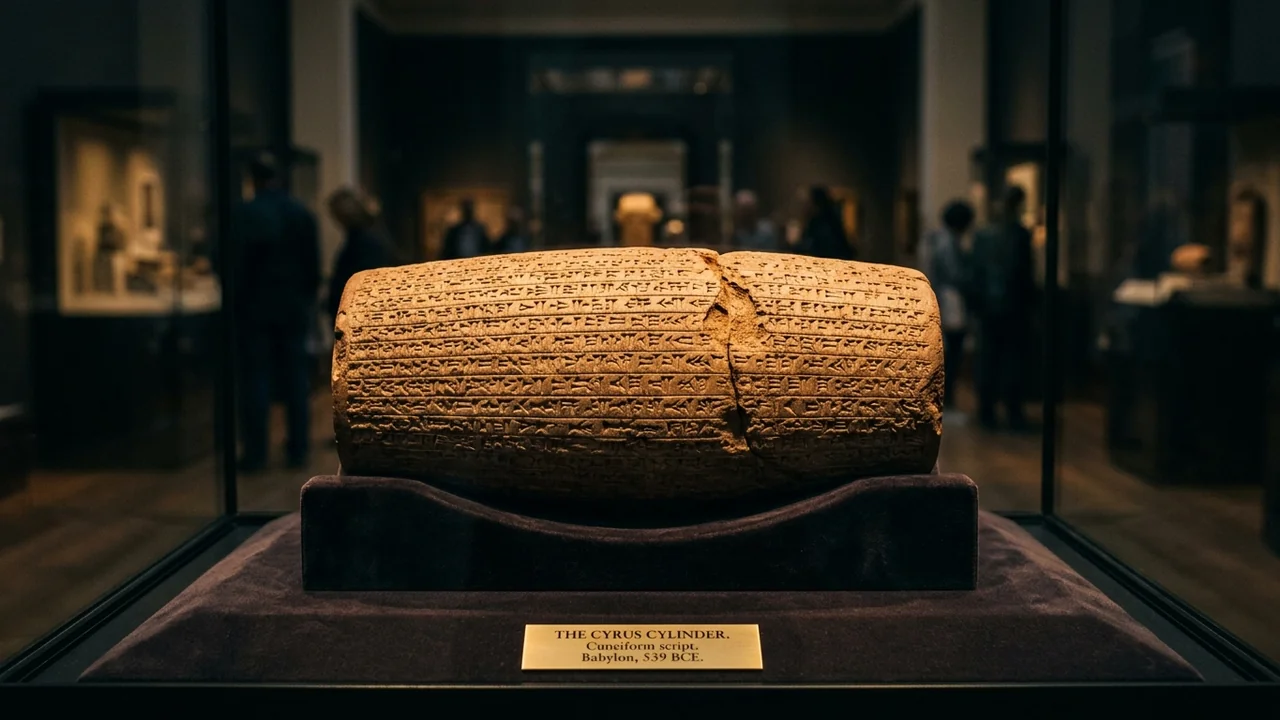
The Cyrus Cylinder: How a Clay Artifact in the British Museum Proved Isaiah’s 150-Year Prophecy
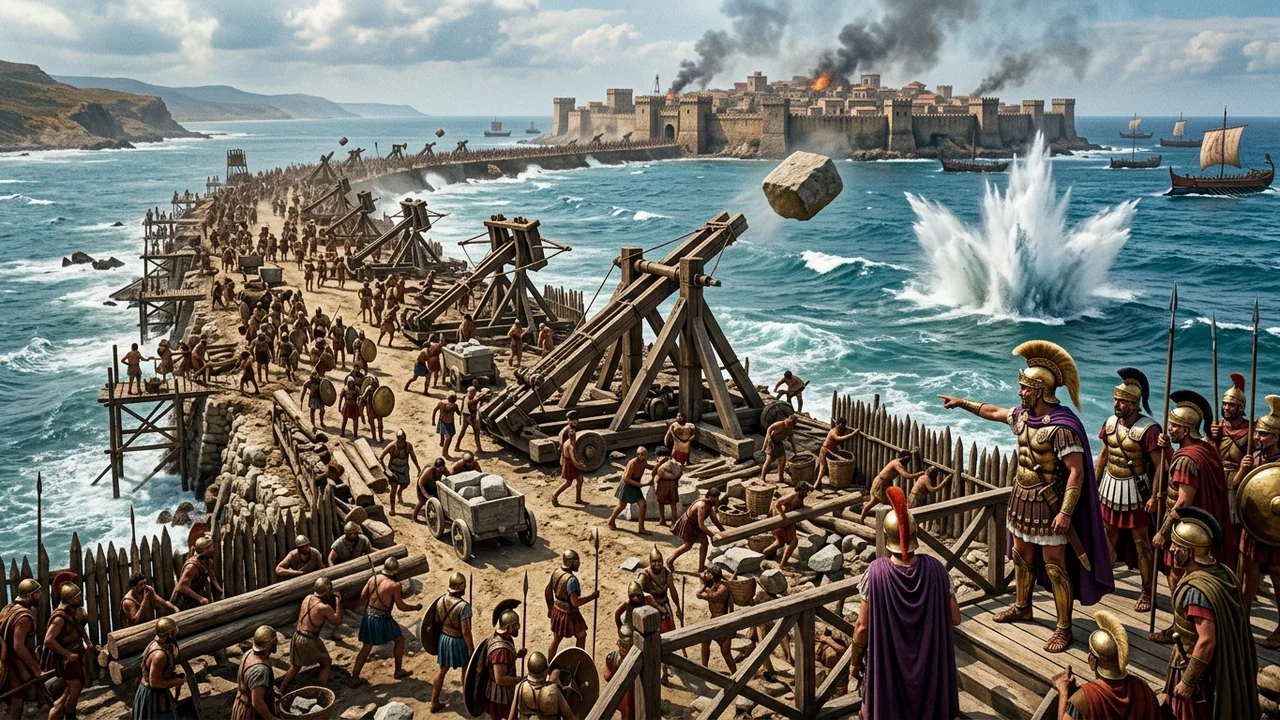
The Scraping of Tyre into the Sea: How Alexander the Great Fulfilled Ezekiel 26 Word for Word