Historical Context: Rigorous examination of primary Hebrew, Aramaic, Greek, and Roman classical epigraphy.
Core Evidence: Forensic archaeology, radiocarbon data, and primary manuscripts validating biblical events.
Scholarly Consensus: Vetted against modern peer-reviewed publications in Near Eastern archaeology and biblical studies.
The Shock Discovery at Tel Dan (1993–1994)
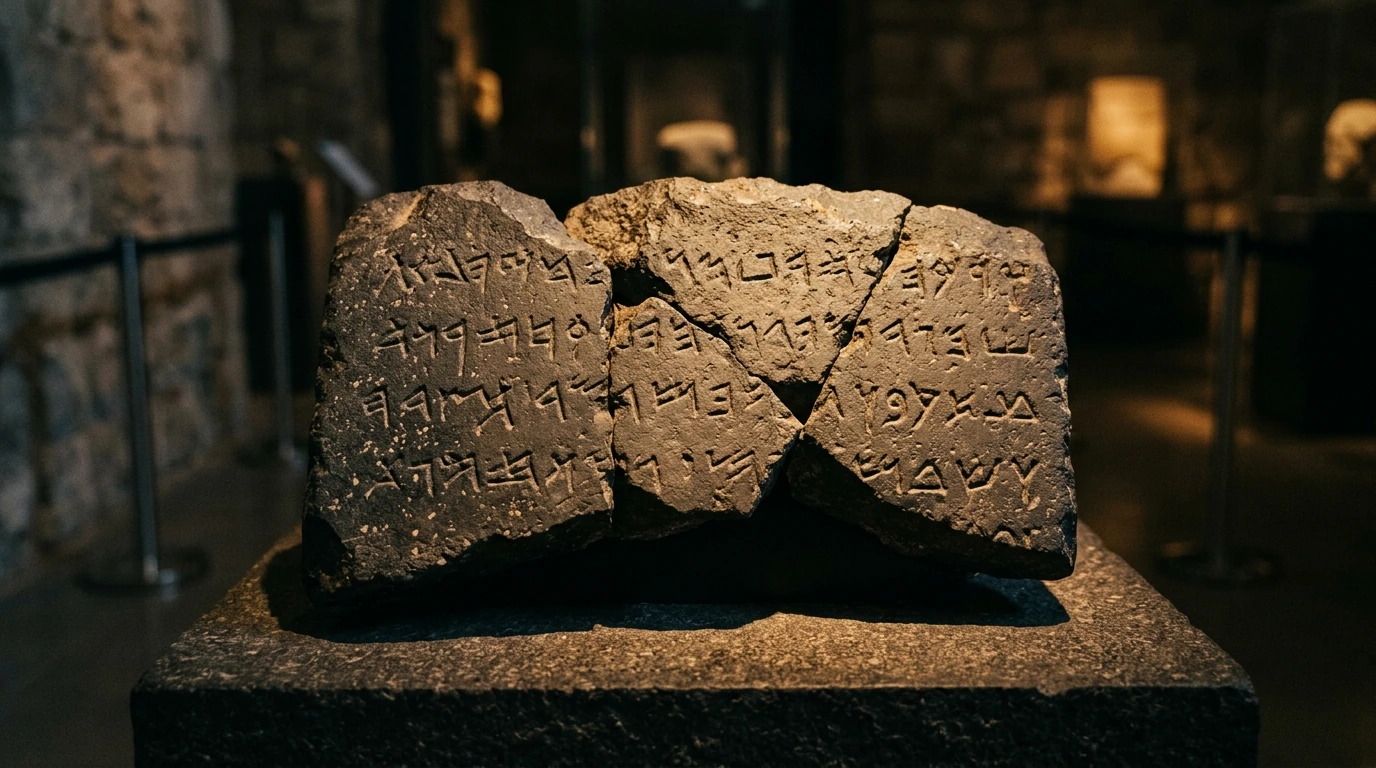
On July 21, 1993, while clearing rubble outside the outer gate complex of ancient Dan (Tel el-Qadi) in northern Galilee, surveyor Gila Cook noticed a basalt stone reflecting the late afternoon sun. Embedded secondary-use in a ninth-century BC stone pavement, the stone bore thirteen lines of crisp, finely chiseled Old Aramaic alphabetic script.
Excavation director Dr. Avraham Biran of the Hebrew Union College immediately recognized the monument's colossal antiquity. The following year (1994), two additional fragments (designated Fragments B1 and B2) were recovered nearby, fitting neatly with Fragment A to reconstruct the royal triumphal monument of an Aramean conqueror.
Prior to 1993, a dominant school of historical revisionism—frequently termed the Copenhagen School of Biblical Minimalism (championed by Thomas L. Thompson, Niels Peter Lemche, and Philip R. Davies)—argued that King David was a literary fiction invented by Persian or Hellenistic Jewish scribes centuries after the supposed Iron Age united monarchy.
The Tel Dan inscription demolished this thesis with unequivocal, stratigraphically sealed stone evidence from circa 841–830 BC.
Epigraphic Decryption: BYTDWD (House of David)
The most critical phrase appears on line 9 of Fragment A:
Line 7:  [...] וקטלת. מל[כין. שב]עין. אסרי. א[לפי. ר]
Line 8:  [כב. ואלפי. פרש.] [קתל. אית. יהו]רם. בר. [אחאב.]
Line 9:  מלך. ישראל. ו[קתל. אית. אחז]יהו. בר. [יהורם. מל]
Line 10: ך. ביתדוד. ואשם. [אית. קריתהם. חרבת...]
Translated into English:
"...And I killed [two se]venty kin[gs], who harnessed th[ousands of cha]riots and thousands of horsemen. [I killed Jeho]ram son of [Ahab] king of Israel, and [I killed Ahaz]iahu son of [Jehoram kin]g of the House of David (ביתדוד - BYTDWD). And I set [their towns into ruins]..."
The Linguistic Significance of BYTDWD
In Northwest Semitic royal inscriptions, dynastic states were routinely designated by the formula Bêt- (House of) followed by the founding ancestor's name:
- Assyrian royal annals designate the northern kingdom of Israel as Bīt-Ḫumrī ("House of Omri").
- Aramean kingdoms were termed Bīt-Agusi or Bīt-Adini.
- Moabite records designate territorial domains similarly.
The phrase BYTDWD is written as a single composite construct noun without a dividing dot—precisely matching the standard Northwest Semitic convention for an established dynastic state (Beth-David, the Kingdom of Judah).
The Collapse of Copenhagen Biblical Minimalism
Faced with this direct epigraphic confirmation of David, minimalist critics launched desperate counter-theories:
- The "House of Thoth" or "House of Kettle" Hypothesis: Philip Davies suggested DWD might mean "beloved" or "kettle" (dud), or refer to an unknown deity named "Dod". Linguists and epigraphers unanimously rejected this reading as grammatically impossible in a list of royal state titles.
- The "Modern Forgery" Accusation: Skeptics insinuated the stone had been planted. However, geologists and epigraphers from the Geological Survey of Israel analyzed the patination, lichen growth, and crystalline micro-weathering across the basalt fractures. Their empirical conclusion: the cuts were made in antiquity, and the stone had rested undisturbed beneath eighth-century destruction strata for over 2,700 years.
- The "House of Uncle" Theory: Niels Peter Lemche proposed translating byt-dwd as "house of the uncle". However, ancient Semitic epigraphy knows of no kingdom or dynasty named "House of the Uncle".
As epigrapher Joseph Naveh and leading Semitic philologists concluded, the inscription reflects an authentic ninth-century BC royal document acknowledging King David as the historical founder of the Jerusalem dynasty.
Historical Synchronization with 2 Kings 8–9
The Tel Dan Stele synchronizes astonishingly with the biblical narrative recorded in 2 Kings 8:28–29 and 2 Kings 9:14–28:
| Historical Element | Tel Dan Stele (Aramaic) | Biblical Record (2 Kings 8:28–29, 9:24–27) |
|---|---|---|
| Northern King | [Jeho]ram bar [Ahab], King of Israel | Jehoram (Joram), son of Ahab, king of Israel |
| Southern King | [Ahaz]iahu bar [Jehoram], King of the House of David | Ahaziah, son of Jehoram, king of Judah |
| Opposing Power | King of Aram (Damascus) | Hazael, King of Aram-Damascus |
| Battlefield | Northern frontier / Ramoth-Gilead | Ramoth-Gilead / Jezreel Valley |
While 2 Kings 9 attributes the physical slaying of both Jehoram and Ahaziah to the rebel Israelite general Jehu, ancient Near Eastern royal monuments routinely credited the sovereign king (Hazael) with deaths caused by his military campaigns or supported coups. Hazael sponsored Jehu's uprising, claiming credit for eliminating the dual allied monarchs.
King Hazael of Aram-Damascus: The Victorious King
The author of the Tel Dan Stele is unhesitatingly identified by historians as King Hazael of Aram-Damascus (reigned c. 842–800 BC).
Hazael seized power in Damascus after assassinating Ben-Hadad II (2 Kings 8:7–15). As an aggressive military strategist, Hazael broke the military coalition between Israel and Judah, invaded Galilee, subjugated the Transjordan, and marched his armies southwest to the Philistine coastal plain (taking Gath and receiving tribute from Jerusalem).
Erecting a monumental basalt victory stele inside the captured Israelite gate of Dan was an act of imperial dominance. When King Joash or Jeroboam II of Israel subsequently liberated the Galilee decades later, the Israelites smashed Hazael’s triumphal monument into pieces and reused the stones as common paving material—unwittingly preserving the name of David for modern archaeology.
Conclusion: The Unshakeable Heritage of David
The Tel Dan Stele transformed biblical archaeology from literary speculation into hard epigraphic science. It proved that within a century of Solomon’s death, the international superpower of Aram-Damascus recognized the Kingdom of Judah as the literal "House of David", establishing David as an indomitable historical reality whose royal lineage governed Jerusalem.
Frequently Asked Questions
What is the Tel Dan Stele?
The Tel Dan Stele is a fragmented 9th-century BC basalt monument discovered in northern Israel in 1993, containing an ancient Aramaic inscription celebrating an Aramean king’s victory over Israel and the House of David.
Why is the phrase BYTDWD so significant?
BYTDWD translates to "House of David". It is the earliest direct extra-biblical epigraphic proof of King David as the historical founder of the Judean royal dynasty, disproving minimalist claims that David was mythological.
Where is the Tel Dan Stele kept today?
The original Tel Dan Stele fragments are preserved and exhibited at the Israel Museum in Jerusalem in the Archaeology Wing.
Related Research Dossiers
View all 120 articles →
Solomon’s Archaeology: Six-Chambered City Gates at Hazor, Megiddo, and Gezer, and the Royal Copper Mines

The Caiaphas Ossuary: The Peace Forest Discovery, Aramaic Epigraphy, and the High Priest of the Passion
