Historical Context: Rigorous examination of primary Hebrew, Aramaic, Greek, and Roman classical epigraphy.
Core Evidence: Forensic archaeology, radiocarbon data, and primary manuscripts validating biblical events.
Scholarly Consensus: Vetted against modern peer-reviewed publications in Near Eastern archaeology and biblical studies.
The Gateway to Canaan: The Impregnable Fortress of Tell es-Sultan
Situated 670 feet below sea level in the lush oasis of the Jordan Rift Valley lies Tell es-Sultan—widely recognized as the site of ancient biblical Jericho, one of the oldest fortified cities in human history. Blessed by the perennial freshwater spring of Ein es-Sultan (Elisha’s Spring), Jericho was a formidable, strategic military stronghold barring the eastern gateway into the central highlands of Canaan.
Around 1400 BC, when the children of Israel crossed the miraculously parted Jordan River under the leadership of Joshua (Joshua 3–4), Jericho was on maximum military lockdown:
"Now Jericho was straitly shut up because of the children of Israel: none went out, and none came in." (Joshua 6:1)
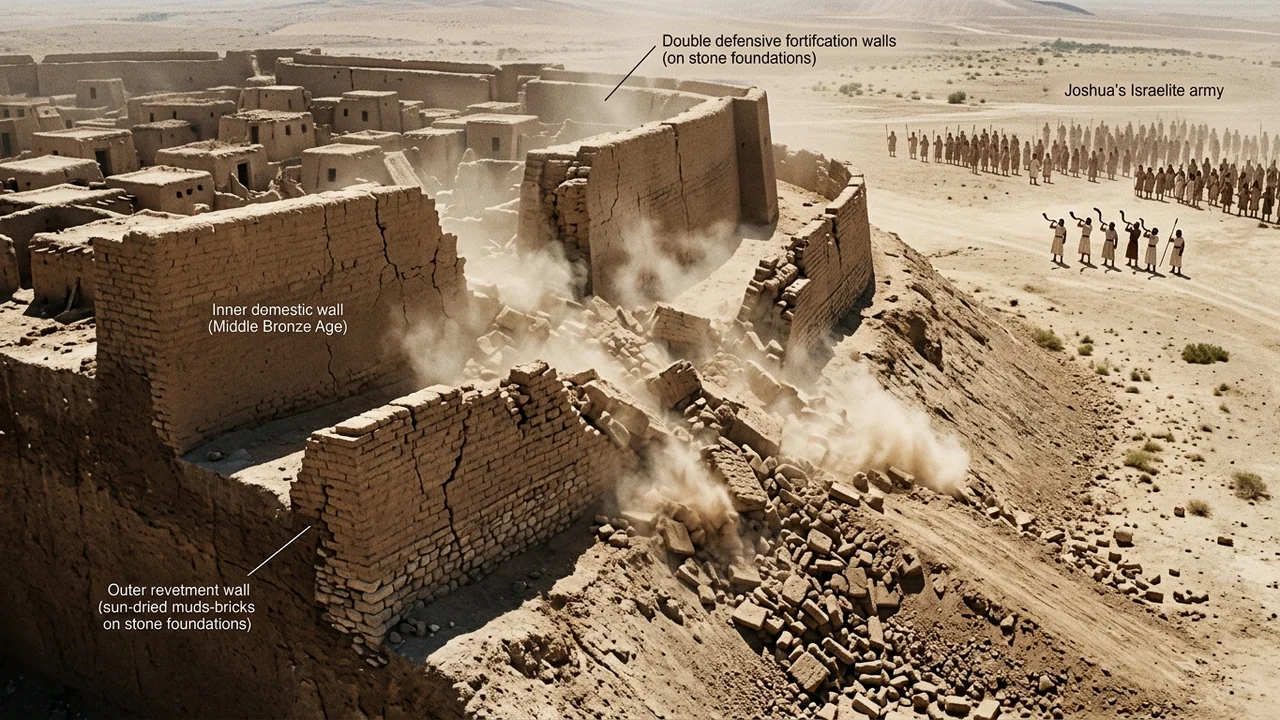
Jericho was defended by a sophisticated, state-of-the-art double fortification system:
- The Lower Retaining Wall: At the base of the mound stood a massive, vertical cyclopean stone revetment wall measuring 12 to 15 feet in height, constructed of colossal undressed limestone boulders.
- The Lower Mud-Brick Parapet: Perched directly atop this stone retaining wall was an upper wall of red sun-dried mud bricks, measuring 6 feet thick and rising another 20 to 26 feet into the air.
- The Upper Defensive Rampart: Behind this lower wall lay a steep, 35-degree earthen embankment (glacis) rising to an inner upper wall, creating an impenetrable defensive perimeter towering over 45 feet above the surrounding plain!
To an attacking army lacking siege engines or sapping technology, conquering Jericho was a physical impossibility.
The Seven-Day Siege of Joshua 6: The Wall Fell Down Flat
The military strategy revealed to Joshua was unlike any siege protocol in the annals of warfare:
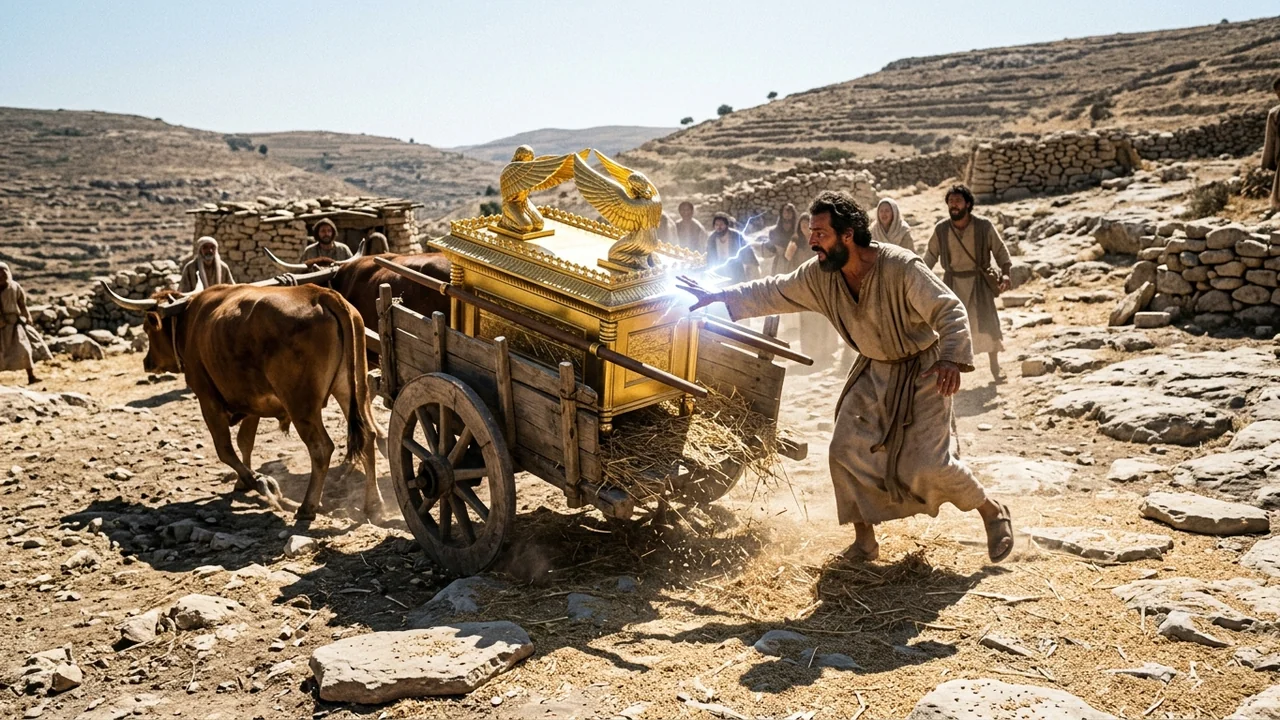
For six consecutive days, the armed men of Israel marched silently around the perimeter of the fortress once daily, preceded by seven priests bearing seven ram’s horns (shofarot) before the golden Ark of the Covenant. The city remained in eerie silence, save for the rhythmic blast of the horns.
On the seventh day, the Israelites encircled the city seven times starting at dawn. On the seventh circuit, Joshua commanded: "Shout; for the Lord hath given you the city!" (Joshua 6:16).
"So the people shouted when the priests blew with the trumpets: and it came to pass, when the people heard the sound of the trumpet, and the people shouted with a great shout, that the wall fell down flat, so that the people went up into the city, every man straight before him, and they took the city." (Joshua 6:20)
The Hebrew phrase translated as "the wall fell down flat" is va-tippol ha-chomah tachteyha (literally, "and the wall fell down beneath itself").
The text notes that the soldiers went "straight before him"—meaning that wherever an Israelite stood along the circumference of the siege line, he was able to march directly forward and up into the city without needing to funnel into a single breached gate!
The Century of Excavations: Sellin, Garstang, and Kenyon
Over the past century, Tell es-Sultan became the most intensively excavated tell in the Middle East:
- Ernst Sellin & Carl Watzinger (1907–1909): Uncovered the massive stone revetment wall and identified a collapsed mud-brick fortification layer.
- John Garstang (1930–1936): Excavated the "City IV" destruction stratum, identifying collapsed double walls, a violent burn layer, and dated the fall of Jericho to approximately 1400 BC, matching biblical chronology.
- Dame Kathleen Kenyon (1952–1958): Utilizing advanced trench stratigraphy, Kenyon confirmed the dramatic destruction of City IV by fire and collapsed walls. However, relying heavily on the absence of imported Cypriot bichrome pottery in her small trench, Kenyon controversially re-dated the destruction to 1550 BC (the end of the Middle Bronze Age), arguing that Jericho was an uninhabited ruin by the time Joshua arrived. For decades, Kenyon’s dating was cited by secular skeptics as definitive proof that the biblical conquest was a myth.
[Double Fortification Architecture of Ancient Jericho (City IV)]
                    Upper Mud-Brick Wall (20–25 ft)
                          │
                          ├──► Steep Earthen Embankment (35° Glacis)
                          │
                          └──► Lower Red Mud-Brick Wall (20–26 ft)
                                     │
                                     ▼  [OUTWARD COLLAPSE]
                               [Stone Revetment Wall (12–15 ft)]
                                     │
                                     ▼
                   [Massive Fallen Mud-Brick Earthen Ramp]
                                     ▲
                                     │
                   [Israelites March "Straight Before Them"]
Dr. Bryant Wood’s Archaeological Breakthrough: Re-Dating City IV
In 1990, biblical archaeologist and ceramic expert Dr. Bryant G. Wood published a landmark re-evaluation in the Biblical Archaeology Review and the Bulletin of the American Schools of Oriental Research (BASOR), systematically dismantling Kenyon’s chronological error:
- Local Canaanite Pottery Analysis: Wood demonstrated that Kenyon had based her date on a "negative argument" (the absence of luxury imported Cypriot ware) while completely ignoring the extensive local Canaanite pottery found in City IV, which dated exclusively to the Late Bronze I period (c. 1400 BC)!
- Scarabs of Egyptian Pharaohs: Garstang’s previous excavations in the Jericho cemeteries had recovered Egyptian royal scarabs inscribed with the cartouches of Hatshepsut, Thutmose III, and Amenhotep III (who reigned c. 1390–1352 BC)—proving that the city was thriving, populated, and burying its citizens precisely in the early 14th century BC!
- Carbon-14 Dating: Modern radiocarbon dating of short-lived organic material (cereal grains) from the destruction stratum yielded dates clustering between 1410 and 1380 BC, completely vindicating the biblical conquest timeline!
The Physics of the Outward Collapse: A Natural Assault Ramp
The most stunning archaeological revelation concerns the physical mechanics of how the walls fell:
In standard ancient warfare, when an invading army batters down a city wall with siege rams, the mud bricks fall inward into the city streets.
However, Kathleen Kenyon’s own meticulous excavation field notes and architectural section drawings revealed an astonishing structural reality:
- At the base of the 15-foot stone revetment wall, Kenyon uncovered a towering heap of collapsed red mud bricks measuring up to 10 feet high!
- The bricks were derived entirely from the upper mud-brick wall that had collapsed outward and downward off the top of the stone foundation!
- This outward collapse created a massive, natural inclined earthen ramp spanning from the ground level outside straight to the crest of the stone revetment wall!
The structural physics explains the biblical text with surgical precision: the wall collapsed outward and "fell beneath itself", creating an immediate earthen rampway all around the perimeter, allowing thousands of Israelite soldiers to storm the citadel simultaneously—"every man straight before him"!
Whether triggered by a localized tectonic earthquake along the active Jordan Rift fault, acoustic resonance, or direct divine power, the walls fell precisely as recorded in Joshua 6.
The Carbonized Grain Jars: Forensic Proof of a Spring Siege
Excavating inside the collapsed domestic houses of City IV, archaeologists uncovered dozens of large earthenware storage jars (pithoi) full of carbonized, burnt grain (barley and wheat).
From a forensic and military standpoint, these burnt grain jars provide three irrefutable historical confirmations:
- A Springtime Conquest: The jars were completely full to the brim with freshly harvested barley. Joshua 3:15 and 5:10 record that Israel crossed the Jordan during the spring barley harvest (immediately following Passover).
- A Brief Siege of Minimal Duration: In ancient siege warfare, an encircled city quickly consumes its grain reserves over months of starvation. The fact that the jars were completely full confirms that the siege was extremely short—lasting barely seven days, exactly as Joshua 6 records!
- The Ban on Plunder (Herem): In ancient warfare, grain was the most valuable commodity looted by victorious armies. Yet, Joshua 6:17–19 strictly placed Jericho under the Herem (the sacred ban): all silver and gold belonged to the Lord's treasury, and the entire city was to be burned without looting. The Israelite soldiers set fire to the city, leaving hundreds of bushels of precious food to incinerate in the ash layer—a detail confirmed by the thick one-meter layer of soot, charcoal, and vitrified clay uncovered in every excavation trench!
The Sector of Rahab: The Wall Section That Did Not Fall
Joshua 2 records that Rahab the harlot had hidden the two Hebrew spies in her home on the city wall, and was promised safety: "for her house was upon the town wall, and she dwelt upon the wall" (Joshua 2:15).
Did the entire wall collapse, or did a section survive?
During Ernst Sellin and Carl Watzinger’s excavations along the northern perimeter of Tell es-Sultan, archaeologists discovered an extraordinary anomaly:
- While the southern, eastern, and western walls had collapsed completely, a short section of the northern mud-brick wall remained standing intact!
- Houses had been built directly into the wall fabric, matching Joshua 2:15.
- Because the northern wall was connected directly to the surrounding hills, it was the only section of the wall spared from total collapse—physically preserving the home of Rahab and her family, whose scarlet cord hung from the window!
From Rahab’s lineage would come Boaz, King David, and ultimately Jesus of Nazareth (Matthew 1:5).
Deepen Your Study of the Archaeology of Joshua
The excavations of Tell es-Sultan stand as one of the greatest triumphs of biblical archaeology, confirming that the walls of Jericho fell outward in a sudden, catastrophic collapse. If you want to explore the complete stratigraphic section drawings, carbon-14 dating reports, and pottery analyses of the Conquest:
👉 Discover Volume III: The Final Files – Biblical Disasters & Ancient Wonders ($2.99)
Features high-resolution excavation diagrams of Tell es-Sultan, Dr. Bryant Wood’s full ceramic analyses, and forensic case studies of ancient siege warfare.
Frequently Asked Questions
Did archaeologists find the collapsed walls of Jericho?
Yes. Excavations by John Garstang and Dame Kathleen Kenyon at Tell es-Sultan uncovered the remains of Jericho’s City IV, revealing that the red mud-brick upper walls collapsed outward and downward to the base of the stone retaining wall, forming a massive earthen ramp that matches the description in Joshua 6:20.
Why did Kathleen Kenyon date the fall of Jericho to 1550 BC?
Kathleen Kenyon dated the destruction to c. 1550 BC based on the absence of imported Cypriot bichrome pottery in her small excavation trench. However, ceramic expert Dr. Bryant Wood proved that Kenyon overlooked extensive local Canaanite pottery dating to Late Bronze I (c. 1400 BC), Egyptian scarabs of 14th-century pharaohs, and carbon-14 data that confirm the biblical date of approximately 1400 BC.
What is the significance of the jars of burnt grain found at Jericho?
Archaeologists found dozens of storage jars completely full of carbonized grain in the destruction layer. This forensically proves that: (1) the city fell in the spring right after the harvest (matching Joshua 3:15); (2) the siege was very short (only 7 days), so the grain was not consumed by starvation; and (3) the attackers did not loot the grain, obeying the divine ban (Herem) to burn the city.
Did any part of the wall of Jericho survive?
Yes. On the northern side of the tell, archaeologists discovered a section of the lower mud-brick wall with domestic houses built directly against and into the wall that did not collapse, confirming Joshua 2:15, where Rahab's house was built upon the city wall and was miraculously spared from destruction.
Frequently Asked Questions
Did archaeologists find the collapsed walls of Jericho?
Yes. Excavations by John Garstang and Dame Kathleen Kenyon at Tell es-Sultan uncovered the remains of Jericho’s City IV, revealing that the red mud-brick upper walls collapsed outward and downward to the base of the stone retaining wall, forming a massive earthen ramp that matches the description in Joshua 6:20.
Why did Kathleen Kenyon date the fall of Jericho to 1550 BC?
Kathleen Kenyon dated the destruction to c. 1550 BC based on the absence of imported Cypriot bichrome pottery in her small excavation trench. However, ceramic expert Dr. Bryant Wood proved that Kenyon overlooked extensive local Canaanite pottery dating to Late Bronze I (c. 1400 BC), Egyptian scarabs of 14th-century pharaohs, and carbon-14 data that confirm the biblical date of approximately 1400 BC.
What is the significance of the jars of burnt grain found at Jericho?
Archaeologists found dozens of storage jars completely full of carbonized grain in the destruction layer. This forensically proves that: (1) the city fell in the spring right after the harvest (matching Joshua 3:15); (2) the siege was very short (only 7 days), so the grain was not consumed by starvation; and (3) the attackers did not loot the grain, obeying the divine ban (Herem) to burn the city.
Did any part of the wall of Jericho survive?
Yes. On the northern side of the tell, archaeologists discovered a section of the lower mud-brick wall with domestic houses built directly against and into the wall that did not collapse, confirming Joshua 2:15, where Rahab's house was built upon the city wall and was miraculously spared from destruction.
Related Research Dossiers
View all 120 articles →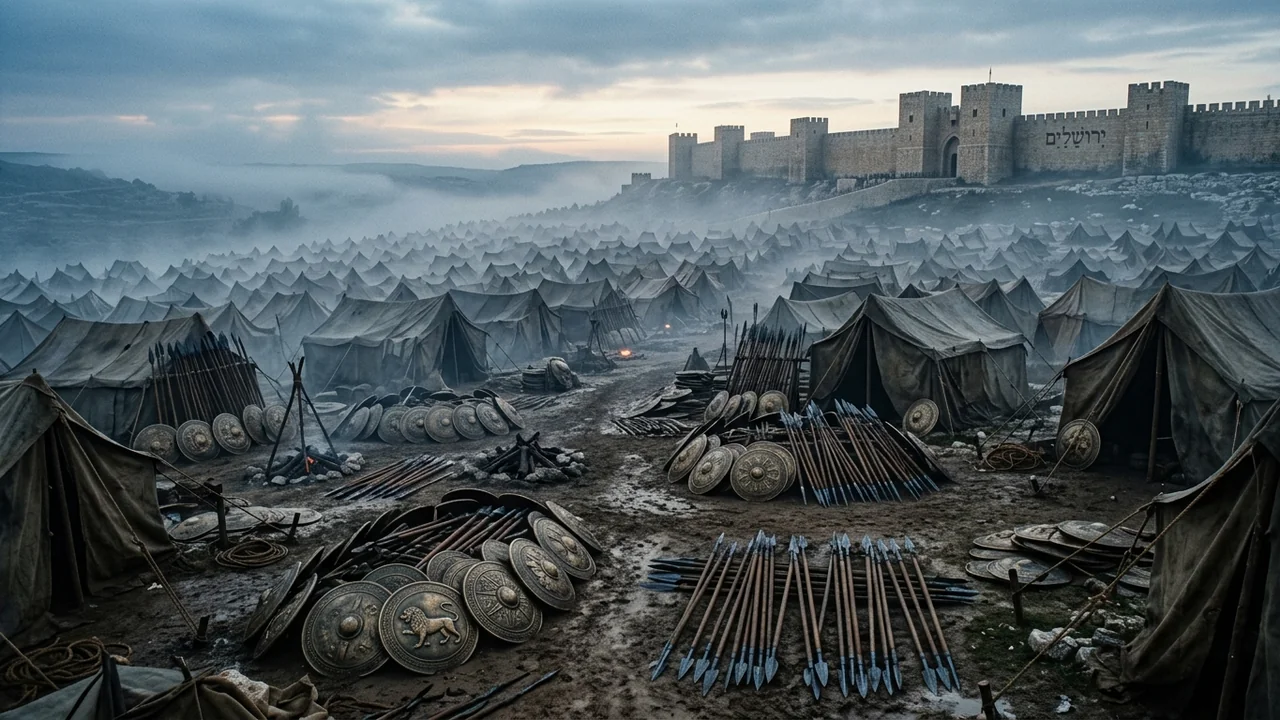
185,000 Assyrian Soldiers Wiped Out in One Night: The Pathology of Sennacherib's Siege Failure
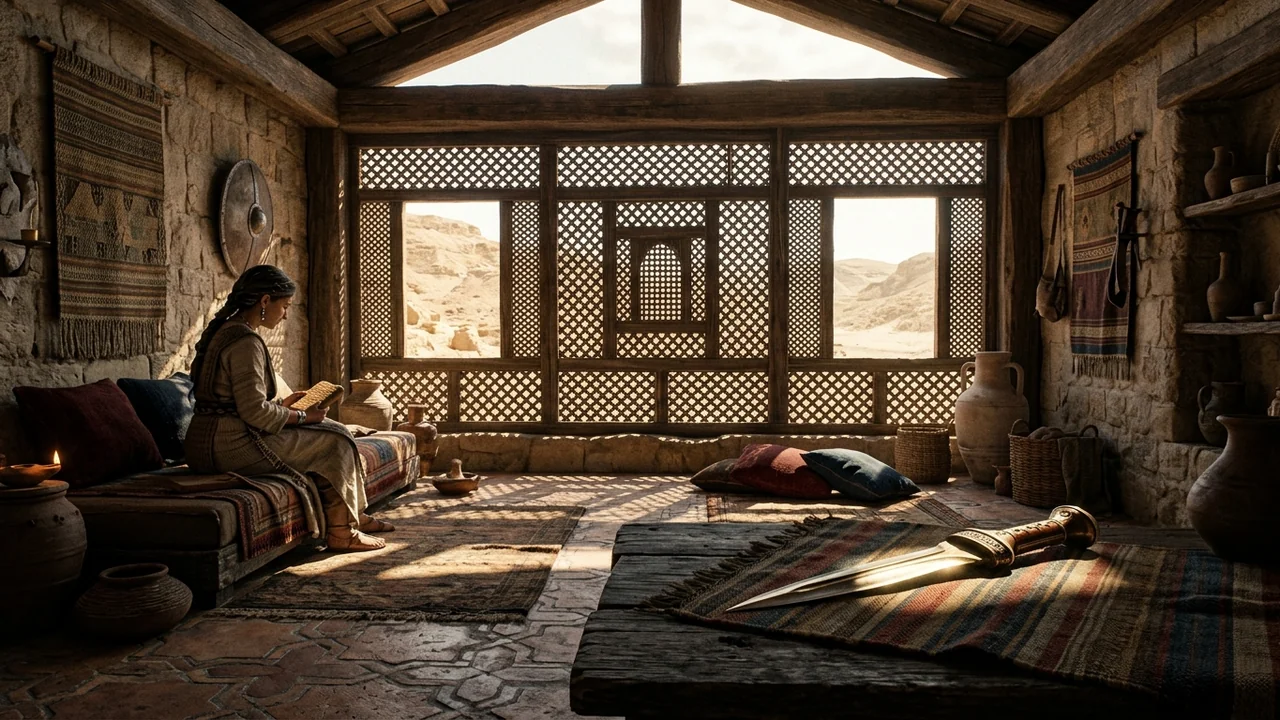
The Concealed Two-Edged Dagger: The Assassination of King Eglon of Moab