Historical Context: Rigorous examination of primary Hebrew, Aramaic, Greek, and Roman classical epigraphy.
Core Evidence: Forensic archaeology, radiocarbon data, and primary manuscripts validating biblical events.
Scholarly Consensus: Vetted against modern peer-reviewed publications in Near Eastern archaeology and biblical studies.
The Moabite Yoke: Eighteen Years of Tribute in Jericho
During the turbulent era of the Judges (c. 13th–12th century BC), the nascent confederation of Israelite tribes fell under the oppressive subjugation of Eglon, the King of Moab. Allied with the Ammonites and the marauding desert tribes of Amalek, Eglon crossed the Jordan River and captured Jericho, celebrated in scripture as the "City of Palm Trees" (Judges 3:13).
For eighteen grueling years, the children of Israel served the Moabite monarch, groaning under crushing annual tribute quotas of livestock, grain, silver, and precious commodities. Eglon established his royal winter headquarters at Jericho, controlling the vital trade fords of the Jordan River.
The biblical author introduces King Eglon with a rare, unflinching physiological description:
"And Ehud brought the present unto Eglon king of Moab: and Eglon was a very fat man." (Judges 3:17)
The Hebrew phrase ish bari me'od designates extreme, morbid obesity. In the ancient Near East, where the vast majority of peasants lived on the brink of subsistence agriculture, extreme obesity was a rare, grotesque physical mark of supreme imperial indulgence, predatory taxation, and physical indolence.
Desperate for deliverance, Israel cried out to Yahweh, who raised up an unlikely deliverer: Ehud son of Gera, a Benjamite.
Ehud the Benjamite: The Left-Handed Shock Operative
Ehud possessed an anatomical trait that would form the core of his lethal tactical operation:
"And the children of Israel cried unto the Lord, and the Lord raised them up a deliverer, Ehud the son of Gera, a Benjamite, a man lefthanded..." (Judges 3:15)
In biblical Hebrew, the phrase translated as "lefthanded" is strikingly descriptive: ish itter yad yamino (literally, "a man bound / restricted in his right hand").
In ancient Near Eastern military culture, left-handedness was considered a physical anomaly, but among the tribe of Benjamin (ironically meaning "Sons of the Right Hand"), left-handed warriors were systematically selected, cultivated, and trained as elite shock troops (Judges 20:16; 1 Chronicles 12:2).
Trained from childhood to fight with their left hand, Benjamite operatives enjoyed massive tactical advantages in combat:
- Opposing infantry shields protected the left side of the body, leaving the right torso exposed to left-handed sword angles.
- Weapon concealment patterns were inverted, confounding standard security frisk protocols.
Ehud was selected by the elders of Israel to lead the high-level diplomatic delegation carrying the heavy annual tribute into King Eglon’s heavily guarded palace.
Weapon Design: The Gomed-Length Dagger Without a Crossguard
Before embarking on the diplomatic mission, Ehud engineered a custom assassination weapon designed specifically for covert carry and lethal penetration:
"But Ehud made him a dagger which had two edges, of a cubit length; and he did gird it under his raiment upon his right thigh." (Judges 3:16)
Every detail of this weapon was mathematically calculated:
- Double-Edged Blade (Herev Pifiyot): Unlike single-edged slashing swords, a double-edged blade penetrates smoothly through dense tissue without dragging or binding, allowing rapid, effortless insertion and maximum vascular laceration.
- The "Gomed" Dimension: The Hebrew measurement used is gomed—a unique biblical hapax legomenon designating a short cubit, measured from the elbow to the knuckles of a clenched fist (approximately 38 to 45 centimeters / 15 to 18 inches). It was long enough to reach deep vital organs, yet compact enough to be concealed along the length of an adult human femur.
- No Crossguard (Haft): Crucially, Ehud’s custom dagger was fabricated without a protruding hilt crossguard or quillons. As the narrative later reveals, this allowed the entire weapon—blade, handle, and pommel—to slip completely inside the victim’s body without snagging on external tissue!
[Ehud's Custom Assassination Dagger]
                  Overall Length: 1 Gomed (~18 Inches / 45 cm)
       [Double-Edged Point] ══════════════════════ [Handle / Pommel]
             ▲                                            ▲
             │                                            │
       Deep Visceral Penetration                  No Protruding Crossguard
       (Slices through abdominal wall)            (Allows full hilt ingestion)
Security Bypass: Why the Palace Guards Missed the Weapon
In antiquity, military security protocols were standardized for a right-handed world:
- A right-handed soldier wears his sword on his left hip or thigh, allowing his right hand to reach across his body to draw the blade.
- Consequently, royal palace guards performing physical security frisks focused their pat-downs almost exclusively on the left side of visitors!
Ehud strapped his 18-inch dagger upon his right thigh beneath his flowing robes (al yerekh yamino mi-tachat l'maddav).
When the Moabite guards conducted their standard perimeter security search, they patted down his left hip and outer tunic. Finding no weapon, they cleared Ehud to enter the presence of the king.
Ehud and his delegation formally presented the heavy tribute to King Eglon. Having concluded the public ceremony, Ehud departed with his entourage. But upon reaching the quarries at Gilgal (ancient carved stone idols bordering the Jordan plain), Ehud dismissed his men and returned alone to the lion's den.
The Private Chamber: "A Secret Errand Unto Thee, O King"
Re-entering the palace compound alone, Ehud requested a private audience with the monarch:
"And Ehud came unto him; and he was sitting in a summer parlor, which he had for himself alone. And Ehud said, 'I have a secret errand unto thee, O king': who said, 'Keep silence.' And all that stood by him went out from him." (Judges 3:19)
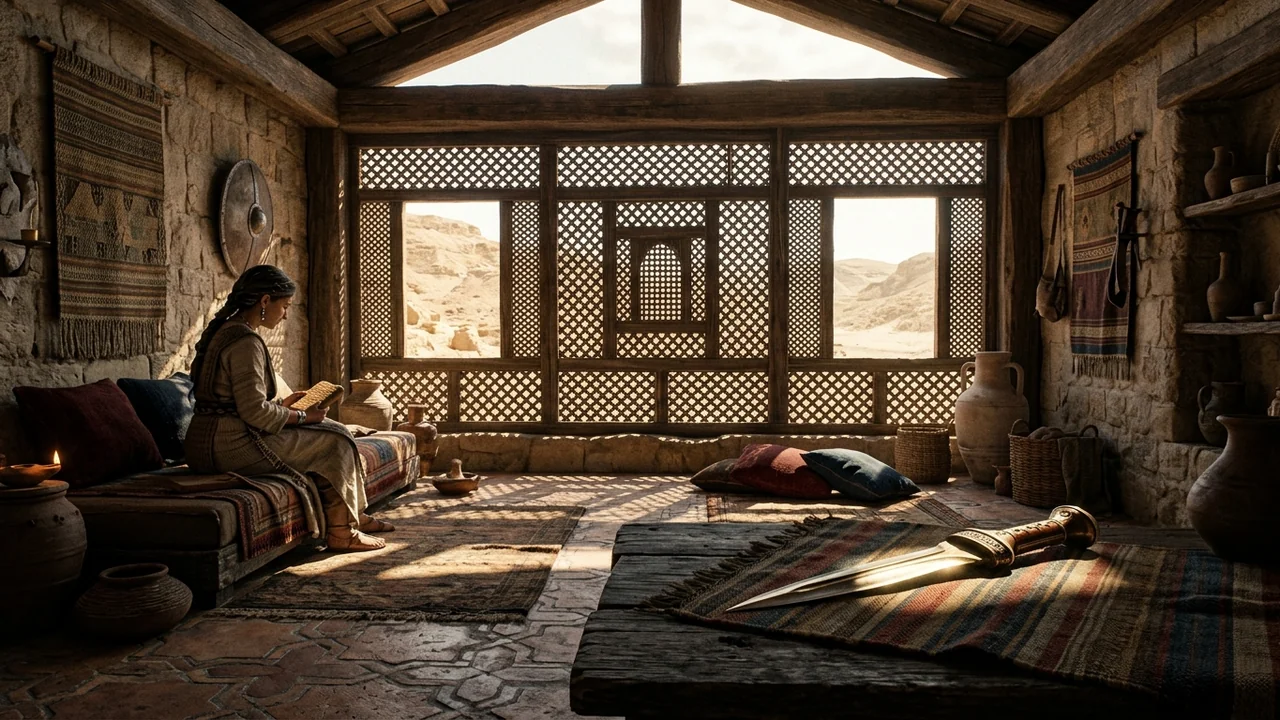
The architectural setting was Eglon’s private chedar ha-meqerah—an elevated, ventilated rooftop chamber designed to catch the prevailing desert breezes during the sweltering heat of the Jordan Valley.
Eglon assumed the lone Hebrew diplomat was bringing confidential political intelligence, perhaps betraying a rival Israelite faction. The king commanded absolute secrecy: "Keep silence!" (Has!). At the royal word, the armed Moabite bodyguards and chamberlains bowed and exited the room, closing the heavy wooden double doors behind them.
The monarch and the assassin were alone.
Forensic Pathology of the Thrust: Morbid Adipose Viscera
Ehud approached the seated king and whispered the ultimate psychological trigger:
"And Ehud said, 'I have a message from God unto thee.' And he arose out of his seat. And Ehud put forth his left hand, and took the dagger from his right thigh, and thrust it into his belly: And the haft also went in after the blade; and the fat closed upon the blade, so that he could not draw the dagger out of his belly; and the dirt came out." (Judges 3:20–22)
The text records a masterclass in forensic precision:
- The Left-Handed Draw: When Eglon rose in religious reverence from his throne at the mention of a divine message (devar Elohim), Ehud reached with his left hand across to his right thigh. Eglon, watching Ehud's inactive right hand, never anticipated an attack originating from the left!
- Deep Epigastric Penetration: Ehud drove the 18-inch blade upward with full body weight into Eglon’s lower abdomen.
- Visceral Adipose Encapsulation: Because the dagger lacked a crossguard, the enormous forward kinetic force drove the entire hilt (haft) into the abdominal cavity. Eglon’s extreme visceral adipose tissue (abdominal fat, helev) collapsed and closed immediately around the entry wound, sealing the blade inside the abdominal cavity like a vacuum!
- "And the Dirt Came Out": The Hebrew phrase va-yetse ha-parsedonah is a technical anatomical description meaning "and the fecal matter / intestinal contents spilled out." The long double-edged blade severed the colon and mesenteric arteries, releasing foul-smelling digestive contents into the peritoneal cavity and out through the wound.
Eglon experienced immediate catastrophic neurogenic shock and massive internal exsanguination, collapsing lifeless to the floor without uttering a single vocal scream to alert his guards outside.
The Escape Through the Latrine and the Liberation of Israel
Ehud’s tactical brilliance extended to his extraction:
"Then Ehud went forth through the porch, and shut the doors of the parlor upon him, and locked them." (Judges 3:23)
Ehud slipped out through the colonnaded porch (misderonah), locked the heavy rooftop doors from the outside using the sliding bolt key, and walked calmly past the palace guards at the main gate.
When the Moabite servants returned to attend the king, they found the doors bolted. Smelling the foul odor of severed bowels leaking from beneath the door, they concluded with natural embarrassment: "Surely he covereth his feet in his summer chamber" (Judges 3:24)—a polite Hebrew euphemism for relieving himself on the chamber latrine!
The guards waited until they were thoroughly ashamed. Finally grabbing a master key, they unlocked the doors:
"And, behold, their lord was fallen down dead on the earth." (Judges 3:25)
By the time the Moabite court discovered the assassination and mobilized, Ehud had crossed the border, blown the ram's horn (shofar) in the hill country of Ephraim, and mobilized the Hebrew militias. The Israelites seized the shallow fords of the Jordan River, cutting off all Moabite retreat routes and annihilating ten thousand Moabite shock troops.
Israel was liberated, and the land rested for eighty years.
Uncover the Untold Military Chronicles of the Judges
Ehud’s strike in Jericho is one of the most daring covert operations recorded in ancient military literature, combining weapon engineering, anatomical understanding, and tactical psychology. If you want to explore the complete historical dossiers, weapon blueprints, and tactical battle maps of the biblical Judges:
👉 Discover Volume III: The Final Files – Biblical Disasters & Ancient Wonders ($2.99)
Features complete archaeological site maps of Bronze Age Jericho, ancient weapon concealment diagrams, and forensic case studies of Old Testament assassinations.
Frequently Asked Questions
Why was Ehud's left-handedness so important?
In ancient times, weapon concealment and security frisk protocols were designed exclusively for right-handed men (who wore swords on the left hip). Because Ehud was left-handed, he strapped his 18-inch dagger to his right thigh beneath his robes, completely bypassing the Moabite guards' security pat-down. Additionally, King Eglon did not anticipate an attack coming from Ehud's left hand.
What does "a cubit length" mean for Ehud's dagger?
The Hebrew text uses the word gomed, a unique biblical measurement representing a short cubit (from the elbow to the knuckles of a clenched fist), roughly 15 to 18 inches (38 to 45 cm). It was engineered specifically to be long enough to penetrate deep vital organs, yet compact enough to be concealed along his thigh.
Why couldn't Ehud pull the dagger out of King Eglon's body?
Judges 3:22 explains that because Eglon was extremely morbidly obese and the dagger had no protruding crossguard (haft), the entire weapon, including the handle, was driven completely into his abdominal cavity, and the thick visceral abdominal fat closed over the hilt, sealing it inside.
What does "he covereth his feet" mean in Judges 3:24?
The phrase "he covereth his feet" (mesikh hu et-raglav) was a polite ancient Hebrew idiom meaning relieving oneself on the toilet. Because the severed bowels released a foul odor through the locked doors, the servants assumed King Eglon was using the private latrine in his summer chamber, delaying their discovery of his body and allowing Ehud to escape.
Frequently Asked Questions
Why was Ehud's left-handedness so important?
In ancient times, weapon concealment and security frisk protocols were designed exclusively for right-handed men (who wore swords on the left hip). Because Ehud was left-handed, he strapped his 18-inch dagger to his right thigh beneath his robes, completely bypassing the Moabite guards' security pat-down. Additionally, King Eglon did not anticipate an attack coming from Ehud's left hand.
What does "a cubit length" mean for Ehud's dagger?
The Hebrew text uses the word gomed, a unique biblical measurement representing a short cubit (from the elbow to the knuckles of a clenched fist), roughly 15 to 18 inches (38 to 45 cm). It was engineered specifically to be long enough to penetrate deep vital organs, yet compact enough to be concealed along his thigh.
Why couldn't Ehud pull the dagger out of King Eglon's body?
Judges 3:22 explains that because Eglon was extremely morbidly obese and the dagger had no protruding crossguard (haft), the entire weapon, including the handle, was driven completely into his abdominal cavity, and the thick visceral abdominal fat closed over the hilt, sealing it inside.
What does "he covereth his feet" mean in Judges 3:24?
The phrase "he covereth his feet" (mesikh hu et-raglav) was a polite ancient Hebrew idiom meaning relieving oneself on the toilet. Because the severed bowels released a foul odor through the locked doors, the servants assumed King Eglon was using the private latrine in his summer chamber, delaying their discovery of his body and allowing Ehud to escape.
Related Research Dossiers
View all 120 articles →
150 mph Ballistics: Why Goliath’s Bronze Helmet Was Useless Against David’s Sling

Turned to a Pillar of Salt: The Geological Thermal Blast Evidence at Mount Sodom