Historical Context: Rigorous examination of primary Hebrew, Aramaic, Greek, and Roman classical epigraphy.
Core Evidence: Forensic archaeology, radiocarbon data, and primary manuscripts validating biblical events.
Scholarly Consensus: Vetted against modern peer-reviewed publications in Near Eastern archaeology and biblical studies.
The Legal Prelude to the Cross: Verberatio in Roman Jurisprudence
In modern cinematic and artistic depictions of the Passion, the scourging of Jesus is frequently portrayed merely as an intense, painful prelude to crucifixion. However, in the clinical and legal reality of 1st-century Roman martial law, scourging was an execution in its own right—a brutal, scientifically calculated physical trauma known in Latin legal parlance as dimidia mors—the "halfway death."
Under Roman provincial jurisprudence, there were three distinct statutory levels of corporal punishment involving the whip:
- Fustigatio (Beating with Rods): A light punishment administered with wooden rods (fustes), reserved for minor public disturbances, non-violent civic offenses, and municipal discipline.
- Flagellatio (Scourging with Whips): A severe corporal punishment administered with leather thongs (flagella), inflicted upon provincials and criminals for major civil infractions.
- Verberatio (Terrible Flagellation): The most catastrophic form of scourging, administered exclusively with the flagrum taxillatum as the mandatory legal prologue to capital crucifixion (crucifixio).
[Roman Capital Sentence: Condemnatio ad Crucem]
       │
       ▼ (Mandatory Legal Precursor: Verberatio)
[Stripped Naked & Bound to Low Marble Column]
       │ Hands tied high above head; back, buttocks & calves arched under tension
       ▼
[Two Alternating Roman Lictors Wielding Flagra]
       │
       ├──► Repeated Traumatic Strikes with Heavy Lead Dumbbells & Bone Knuckles
       │         └── Massive shearing of skin, subcutaneous fat, and muscle fascia
       │
       └──► Catastrophic Systemic Collapse Prior to Crucifixion
                 └── Severe hypovolemic shock, traumatic pleurisy, and exhaustion
The Roman orator and statesman Marcus Tullius Cicero, in his famous legal orations against the corrupt Sicilian governor Verres (In Verrem V.62), declared Roman scourging to be so unspeakably vile that it was strictly forbidden from ever being inflicted upon a Roman citizen:
"To bind a Roman citizen is a crime; to scourge him is an abomination; to put him to death is almost parricide; what shall I say of crucifying him? No words can describe so horrible a deed!"
For non-citizens (peregrini) and slaves (servi), however, the scourge was applied with absolute, unrestrained imperial savagery. The primary military objective was to systematically destroy the victim's physical resistance, induce massive blood loss, and induce a state of advanced circulatory shock so that the condemned prisoner would succumb more rapidly upon the cross, preventing the crucifixion from dragging out over multiple days.
The Anatomy of the Weapon: The Flagrum Taxillatum
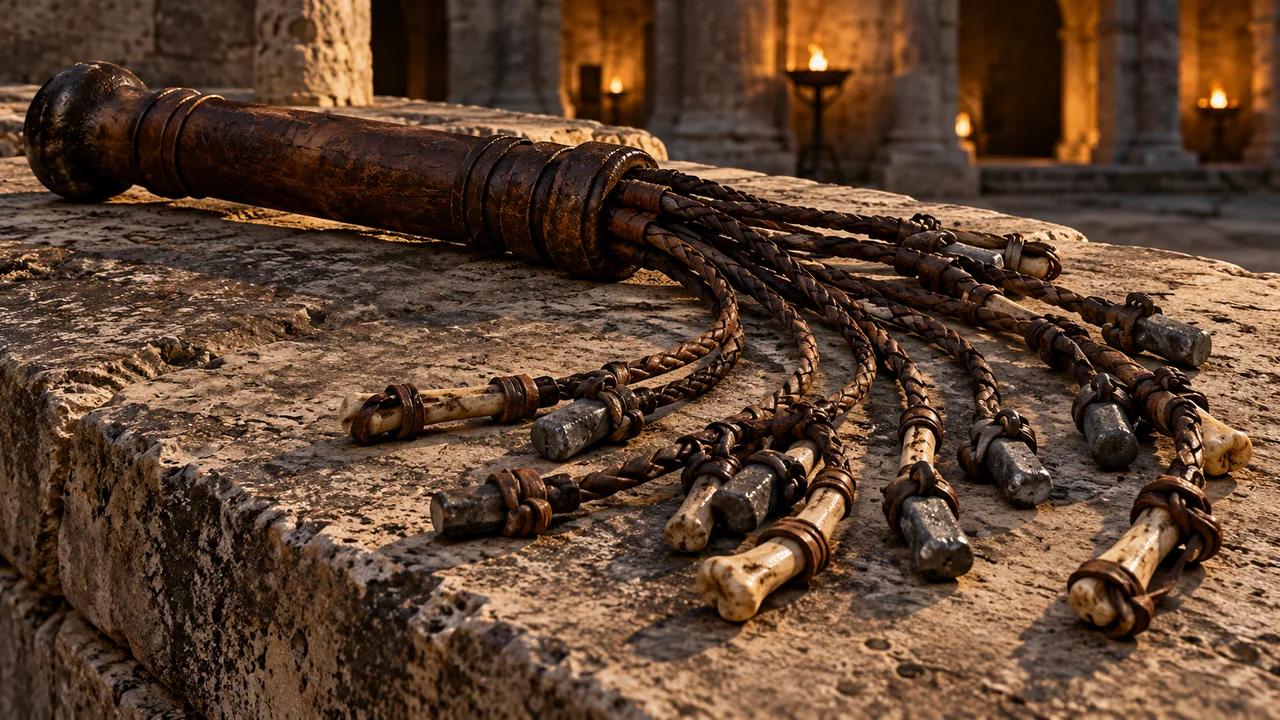
The weapon utilized by the Roman auxiliary soldiers in the Praetorium of Pontius Pilate was not an ordinary whip; it was an advanced instrument of surgical bludgeoning and laceration known as the flagrum taxillatum (or flagellum):
[Anatomy of the Roman Flagrum Taxillatum]
       │
       ├──► Solid Hardwood Handle (12 to 14 inches long)
       │         └── Bound with rough leather wraps for high-torque military grip
       │
       └──► Three to Six Braided Leather Thongs (18 to 24 inches long)
                 │
                 ├──► Dumbbell-Shaped Lead Pellets (Plumbatae)
                 │         └── Delivers crushing blunt-force kinetic energy deep into muscle
                 │
                 └──► Sharpened Sheep Bone Fragments (Astragali / Talbi)
                           └── Hooks into skin, tearing subcutaneous tissue on backward stroke
- The Handle and Thongs: The flagrum featured a heavy, short wooden handle (approximately 12 to 14 inches in length) attached to three or more braided rawhide leather thongs of graduated lengths.
- The Plumbatae (Lead Dumbbells): Embedded at intervals along the leather cords were heavy, dumbbell-shaped lead weights (plumbatae). Upon impact, these lead pellets acted as miniature kinetic hammers, delivering crushing blunt-force trauma deep into subcutaneous tissue, crushing capillary beds, and producing massive contusions within the muscle bellies.
- The Astragali (Sheep Bone Barbs): Tied to the terminal tips of the thongs were jagged fragments of sheep bone or iron hooks (astragali or talbi). When the whip cracked against the victim’s flesh, the sharp bone fragments cut into the epidermis and hooked into the deep fascia, ripping long strips of skin, adipose tissue, and muscle away with each backward stroke of the soldier's arm.
Roman poet Horace, in his Satires (I.3.119), referred to this horrifying device as the horribile flagellum—the "terrible whip"—distinguishing it sharply from ordinary canes and rods.
Pathological Traumatology: The Cascade of Tissue Destruction
The physical mechanics of Roman scourging were investigated extensively by world-renowned trauma specialists, including Dr. Pierre Barbet (Chief Surgeon at Saint Joseph Hospital in Paris), Dr. Frederick Zugibe (Chief Medical Examiner of Rockland County, New York), and Dr. William D. Edwards of the Mayo Clinic.
The prisoner was stripped completely naked and his wrists were secured with leather thongs to a low stone pillar (approximately two to three feet high), forcing his torso forward into an arched, vulnerable posture. This posture placed the skin and dorsal muscle groups—the latissimus dorsi, trapezius, and erector spinae—under maximum anatomical tension:
[Stages of Anatomical Destruction During Scourging]
       │
       ├──► 1. Initial Strikes (1-10):
       │         Severe subcutaneous hematomas, capillary rupture, skin welts
       │
       ├──► 2. Intermediate Strikes (10-25):
       │         Epidermis and dermis shredded; subcutaneous fat layers exposed
       │
       ├──► 3. Deep Muscular Laceration (25+):
       │         Muscle fibers torn into ribbons; intercostal arteries lacerated
       │
       └──► 4. Thoracic & Pleural Complications:
                 Traumatic pleuritis, hemothorax, pericardial fluid effusion
- Initial Strikes (Superficial Bruising & Laceration): The initial blows produced severe cutaneous contusions and linear welts. Within minutes, the dermal microvasculature collapsed, creating massive subdermal ecchymosis and localized edema.
- Intermediate Strikes (Fascial Stripping): As the scourging continued with two Roman soldiers (lictores) striking alternately from opposite sides, the bone barbs repeatedly gouged into the identical traumatized zones. The skin of the back was systematically shredded into ribbon-like strips, exposing the underlying superficial and deep fascia.
- Deep Muscular Destruction: Continued impact battered the underlying skeletal muscles, turning the dorsal muscle tissue into an unrecognizable mass of bleeding, torn flesh. The arterial branches of the posterior intercostal arteries and lumbar arteries were repeatedly severed, producing unceasing, arterial spurting.
- Pleural and Thoracic Trauma: The lead balls, striking with relentless kinetic energy over the thoracic cage, bruised the periosteum of the ribs and transmitted concussive shockwaves directly into the thoracic cavity. This provoked traumatic pleurisy—acute inflammation of the pleural membranes lining the lungs—and triggered the rapid accumulation of serous fluid within the pericardial sac surrounding the heart (pericardial effusion).
Ancient 4th-century church historian Eusebius of Caesarea, describing the scourging of early Christian martyrs in his Martyrs of Palestine, provides an eyewitness pathological description that matches modern clinical forensics:
"The sufferers' veins were laid bare, and the very muscles, sinews, and entrails of the body were exposed to view."
Cardiovascular Decompensation: Acute Hypovolemic and Traumatic Shock
The clinical consequence of this anatomical devastation was the rapid onset of severe hypovolemic and traumatic shock.
Modern clinical pathophysiology defines hypovolemic shock as an acute, life-threatening reduction in effective circulating intravascular blood volume:
- Massive Fluid Sequestration (Third-Spacing): In addition to the direct external hemorrhage from severed intercostal and cutaneous blood vessels, widespread tissue destruction caused massive capillary permeability breakdown. Liters of vital plasma fluid wept continuously into the interstitial tissue spaces (third-spacing), severely reducing the circulating blood volume.
- Compensatory Neuro-Endocrine Response:
- The carotid sinus and aortic arch baroreceptors detected a precipitous drop in mean arterial blood pressure.
- The sympathetic nervous system fired maximally, triggering a surge of epinephrine and norepinephrine.
- The heart responded with extreme compensatory tachycardia (heart rates soaring over 140–160 beats per minute) in a desperate physiological attempt to maintain cardiac output.
- Renal Shutdown and Unrelenting Thirst: Peripheral vasoconstriction shunted blood away from the skin, gastrointestinal tract, and kidneys to preserve perfusion to the brain and heart. The kidneys ceased urine production (pre-renal anuria). This acute hypovolemic dehydration generated an overpowering, burning metabolic thirst—explaining Christ’s cry from the cross hours later: "I thirst" (John 19:28).
- Physical Collapse Under the Patibulum: When Jesus was untied from the pillar, He was in a state of advanced pre-shock: trembling violently, shivering from acute hypothermia due to total loss of thermal regulation, lightheaded from cerebral hypoperfusion, and physically exhausted.
This advanced state of traumatic and hypovolemic shock explains the physiological reality recorded in Matthew 27:32: Jesus was physically incapable of carrying the heavy wooden crossbeam (patibulum, weighing 75 to 125 pounds) along the half-mile path of the Via Dolorosa to Golgotha, forcing Roman centurions to compel Simon of Cyrene to carry it behind Him.
Comparative Table: Ancient Scourging Protocols — Roman vs. Jewish vs. Greek
| Historical Feature | Jewish Scourging (Makkot) | Roman Military Scourging (Verberatio) | Greek Scourging (Virgae) |
|---|---|---|---|
| Biblical Mandate | Deuteronomy 25:1–3 (Torah statute) | Roman Martial / Provincial Law | Classical Hellenic Municipal Law |
| Strict Strike Limit | Maximum 40 lashes (customarily 39: forty minus one) | NO LEGAL LIMIT (Left entirely to executioner's discretion) | Variable; limited by civic magistrate |
| Weapon Employed | Triple-braided calf-hide leather strap | Flagrum taxillatum (lead balls & bone barbs) | Flexible wooden rods or birch canes (virgae) |
| Anatomical Target | 1/3 across chest, 2/3 across shoulders | Whole back, shoulders, buttocks, thighs, and calves | Shoulders, back, and soles of feet |
| Primary Objective | Ritual religious correction; preserve life | "Halfway death"; weaken victim prior to crucifixion | Humiliation and civic punishment |
| Fatality Rate | Extremely rare (strictly regulated) | Extremely high (frequently caused pre-cross death) | Rare |
Under Jewish Mosaic law, scourging was strictly limited to forty lashes so that "your brother may not be degraded in your sight" (Deut 25:3). To ensure they never accidentally violated this commandment, Jewish authorities stopped at thirty-nine lashes (as Paul endured five times: 2 Corinthians 11:24).
Under Roman military law, there was no limit whatsoever. Roman lictors scourged until they were physically exhausted or until the supervising centurion ordered them to halt before the prisoner expired on the pavement.
The JAMA Landmark Study: Dr. Edwards on the Physical Death of Christ
In March 1986, one of the most prestigious peer-reviewed medical publications on earth—the Journal of the American Medical Association (JAMA, Vol. 255, No. 11)—published a historic, landmark forensic investigation titled:
"On the Physical Death of Jesus Christ"
Authors: William D. Edwards, MD; Wesley J. Gabel, MDiv; Floyd E. Hosmer, MSBI
The Mayo Clinic medical team conducted an exhaustive pathological review of classical Roman execution methods, combining ancient literary sources, forensic trauma pathology, and human cardiovascular physiology.
[1986 JAMA Landmark Forensic Conclusion]
       │
       ├──► 1. Pre-Crucifixion Severity:
       │         "The severity of the scourging depended on the lictors...
       │          The physical and mental exhaustion, lack of food and water,
       │          and severe blood loss from scourging placed Jesus in a
       │          serious, pre-shock, hemodynamically unstable condition."
       │
       └──► 2. Cause of Rapid Death on the Cross (6 Hours vs. Typical 3 Days):
                 "The combination of severe hypovolemic shock, traumatic exhaustion,
                  and progressive positional asphyxia resulted in rapid heart failure."
Dr. Edwards and his team concluded:
- The scourging produced catastrophic systemic hypovolemia, high-output cardiac strain, and acute traumatic anemia.
- When Jesus was nailed to the cross, His body was already on the verge of total cardiovascular collapse.
- While typical crucifixion victims lingered for up to 72 hours, Jesus expired in six hours (from the third hour to the ninth hour, Mark 15:25, 34).
- The suddenness of His death astonished Pontius Pilate, who questioned the centurion to confirm whether He was already dead (Mark 15:44). The medical explanation was unequivocal: the lethal damage had already been decisively inflicted hours earlier at the whipping post.
The Theological Paradox: By His Stripes We Are Healed
Eight centuries before the first Roman lictor ever braided a lead ball into a leather thong, the Hebrew Prophet Isaiah recorded a staggering prophetic vision of the Suffering Servant of Yahweh:
"Surely He has borne our griefs and carried our sorrows; yet we esteemed Him stricken, smitten by God, and afflicted. But He was wounded for our transgressions, He was bruised for our iniquities; the chastisement for our peace was upon Him, and by His stripes we are healed." — Isaiah 53:4–5
The Hebrew term translated as "stripes" in Isaiah 53:5 is chabburah (חַבּוּרָה)—which specifically denotes a massive, bloody, blow-inflicted contusion and welt.
Herein lies the supreme spiritual paradox of Christian revelation:
- Roman lictors wielded the flagrum to inflict the ultimate degradation upon a condemned Galilean carpenter.
- In the sovereign plan of God, every strike that tore Christ's flesh was absorbing the holy wrath of divine justice against human sin.
- The very wounds that brought physical destruction to the Son of God became the fountain of eternal spiritual healing, reconciliation, and resurrection life for all who place their trust in Him.
The Roman whip was designed to crush humanity; on the pavement of the Antonia Fortress, it was transformed into the instrument that set humanity free.
Deepen Your Knowledge with the Medical and Forensic Dossier
The physical scourging of Christ is one of the most intensely analyzed events in forensic history. To explore the unabridged medical reports, high-resolution anatomical plates of the flagrum, and comprehensive physiological breakdowns:
👉 Download Volume I: The Twelve Apostles & Biblical Forensics ($2.99)
Features the complete text of historical medical investigations, archaeological diagrams of the Roman Praetorium, and forensic timelines of 1st-century Roman crucifixions.
Frequently Asked Questions
What was the Roman flagrum?
The Roman flagrum (or flagellum taxillatum) was a brutal execution whip consisting of a short wooden handle with multiple braided leather thongs embedded with dumbbell-shaped lead weights (plumbatae) and sharpened sheep bone barbs (astragali). It was designed to crush deep muscle tissue and tear skin away with each strike.
Was Roman scourging legally limited to 39 lashes?
No. While Jewish Mosaic law strictly limited scourging to 39 lashes (forty minus one, Deuteronomy 25:3) to preserve the victim's life, Roman martial law had no legal limit whatsoever. Roman soldiers scourged prisoners according to their own discretion or until the prisoner collapsed on the verge of death.
Why was scourging called the "halfway death"?
Roman scourging was termed dimidia mors ("halfway death") because the massive blood loss, muscular laceration, and acute hypovolemic shock it produced were frequently fatal on their own. It was a mandatory legal precursor to crucifixion designed to weaken the victim so they would die more quickly on the cross.
What did the 1986 JAMA medical study conclude about Christ's scourging?
The landmark 1986 study published in the Journal of the American Medical Association (JAMA) by Dr. William Edwards concluded that the Roman scourging placed Jesus in a severe, hemodynamically unstable pre-shock condition marked by massive blood loss, traumatic pleurisy, and exhaustion, explaining why He died after only six hours on the cross.
Frequently Asked Questions
What was the Roman flagrum?
The Roman flagrum (or flagellum taxillatum) was a brutal execution whip consisting of a short wooden handle with multiple braided leather thongs embedded with dumbbell-shaped lead weights (plumbatae) and sharpened sheep bone barbs (astragali). It was designed to crush deep muscle tissue and tear skin away with each strike.
Was Roman scourging legally limited to 39 lashes?
No. While Jewish Mosaic law strictly limited scourging to 39 lashes (forty minus one, Deuteronomy 25:3) to preserve the victim's life, Roman martial law had no legal limit whatsoever. Roman soldiers scourged prisoners according to their own discretion or until the prisoner collapsed on the verge of death.
Why was scourging called the "halfway death"?
Roman scourging was termed dimidia mors ("halfway death") because the massive blood loss, muscular laceration, and acute hypovolemic shock it produced were frequently fatal on their own. It was a mandatory legal precursor to crucifixion designed to weaken the victim so they would die more quickly on the cross.
What did the 1986 JAMA medical study conclude about Christ's scourging?
The landmark 1986 study published in the Journal of the American Medical Association (JAMA) by Dr. William Edwards concluded that the Roman scourging placed Jesus in a severe, hemodynamically unstable pre-shock condition marked by massive blood loss, traumatic pleurisy, and exhaustion, explaining why He died after only six hours on the cross.
Related Research Dossiers
View all 120 articles →
The Halved Cross of Thaddaeus: Forgotten Records of Apostolic Missions in Ancient Mesopotamia

Pierced by Arrows at Lake Sevan: What Russian and Armenian Manuscripts Say About St. Simon