Historical Context: Rigorous examination of primary Hebrew, Aramaic, Greek, and Roman classical epigraphy.
Core Evidence: Forensic archaeology, radiocarbon data, and primary manuscripts validating biblical events.
Scholarly Consensus: Vetted against modern peer-reviewed publications in Near Eastern archaeology and biblical studies.
The Assyrian Blitzkrieg of 701 BC: Judah on the Brink of Annihilation
In the scorching summer of 701 BC, the Neo-Assyrian military machine—commanded by King Sennacherib—descended upon the Kingdom of Judah like a swarm of locusts. King Hezekiah of Judah had joined an anti-Assyrian coalition alongside Egypt, Phoenician city-states, and Philistine Ashkelon, withholding imperial tribute.
The Assyrian response was merciless and devastating:
- Sennacherib’s armies systematically assaulted, battered, and burned forty-six fortified cities of Judah.
- Over 200,150 Judean citizens were captured and deported into Mesopotamian exile.
- The second-greatest fortified city of Judah, Lachish, was besieged with massive earthen ramps, breached by battering rams, and its defenders impaled alive on wooden stakes—a brutal military conquest immortalized on the colossal stone wall reliefs from Sennacherib's palace in Nineveh (now dominating Room 10 of the British Museum).
With Lachish reduced to a smoking heap of ruins, Sennacherib dispatched his supreme field commander (Tartan), his chief officer (Rabsaris), and his royal diplomatic spokesman (Rabshakeh) accompanied by a colossal army of 185,000 elite troops to surround the final fortress: Jerusalem.
The Siege of Lachish and the Rabshakeh’s Psychological Warfare
Stationing his army outside the walls by the conduit of the upper pool, the Rabshakeh launched a masterclass in psychological warfare. Refusing to speak in diplomatic Aramaic, he shouted in fluent Hebrew (Yehudit) directly to the terrified soldiers lining the city ramparts:
"Hear the word of the great king, the king of Assyria: Thus saith the king: Let not Hezekiah deceive you: for he shall not be able to deliver you out of his hand... Hath any of the gods of the nations delivered at all his land out of the hand of the king of Assyria? Where are the gods of Hamath, and of Arpad? where are the gods of Sepharvaim, Hena, and Ivah? have they delivered Samaria out of mine hand? Who are they among all the gods of the countries, that have delivered their country out of mine hand, that the Lord should deliver Jerusalem out of mine hand?" (2 Kings 18:28–35)
Inside the city, King Hezekiah tore his royal clothes, covered himself in sackcloth, and went into the Temple of Yahweh, spreading the blasphemous letter of Sennacherib before the Ark of the Covenant.
The prophet Isaiah delivered the divine response:
"Therefore thus saith the Lord concerning the king of Assyria: He shall not come into this city, nor shoot an arrow there, nor come before it with shield, nor cast a bank against it. By the way that he came, by the same shall he return, and shall not come into this city, saith the Lord. For I will defend this city, to save it, for mine own sake, and for my servant David's sake." (2 Kings 19:32–34)
The Catastrophe in the Night: 2 Kings 19:35 Decoded
That very night, the course of world history was irrevocably altered:
"And it came to pass that night, that the angel of the Lord went out, and smote in the camp of the Assyrians an hundred fourscore and five thousand: and when they arose early in the morning, behold, they were all dead corpses. So Sennacherib king of Assyria departed, and went and returned, and dwelt at Nineveh." (2 Kings 19:35–36)
In a single night, 185,000 elite Assyrian soldiers—the shock troops of the greatest superpower on earth—perished without a single arrow being fired from the walls of Jerusalem!
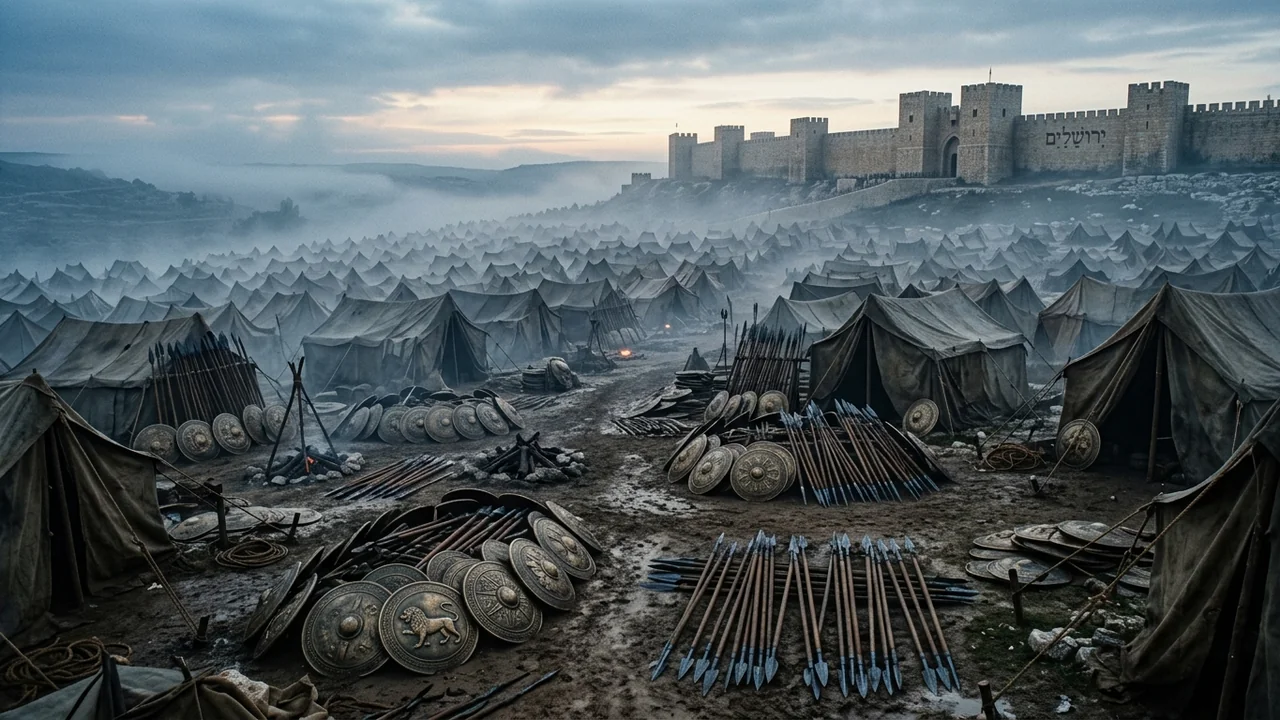
When the sentries of Jerusalem climbed the towers at dawn, expecting the thunder of Assyrian battering rams, they looked out over a silent, motionless plain. Abandoned tents flapped in the morning breeze. Thousands of bronze shields, iron spears, and royal chariots lay undisturbed beside 185,000 lifeless bodies.
Sennacherib broke camp, fled across the desert back to Nineveh, and never set foot in the land of Judah again.
[185,000 Assyrian Army Surrounds Jerusalem (701 BC)]
                         │
                         ├──► Prophetic Decree (Isaiah 37)
                         │         └── "He shall not shoot an arrow here"
                         │
                         ├──► Nocturnal Catastrophe in the Camp
                         │         └── Rapid fulminant mortality (185,000 dead)
                         │
                         ├──► Sudden Imperial Retreat
                         │         └── Sennacherib flees to Nineveh
                         │
                         └──► The Taylor Prism (British Museum)
                                   └── Conspicuously admits failure to capture city!
The British Museum Taylor Prism: The Boast That Confirms Failure
For centuries, secular historians wondered: Did Sennacherib's royal state annals record this humiliating military campaign?
In 1830, Colonel Robert Taylor excavated a magnificent 15-inch, six-sided baked clay prism in the ruins of Nineveh—now celebrated as the Taylor Prism (Sennacherib's Prism) in the British Museum. Written in Akkadian cuneiform in 691 BC, column 3 contains Sennacherib’s personal official dispatch regarding his siege of King Hezekiah:
"As for Hezekiah the Judahite, who had not submitted to my yoke: forty-six of his strong cities, walled forts and countless small villages in their neighborhood, I besieged and conquered... As for Hezekiah himself, I shut him up like a caged bird inside Jerusalem, his royal city. I erected watchposts against him, and he who came out of the city gate, I turned back to his misery."
Notice the extraordinary historical significance of what Sennacherib does NOT say:
- In every other military campaign recorded on the prism, Sennacherib boasts: "I stormed the city, I conquered it, I burned it with fire, I flayed the king, I deported the inhabitants."
- Yet, when describing Jerusalem, the mighty King of Assyria can only boast that he shut Hezekiah up "like a bird in a cage"!
- He never claims to have captured Jerusalem.
- He never claims to have breached the walls.
- He never claims to have captured or executed Hezekiah.
As world-renowned Near Eastern historian Prof. A.T. Olmstead famously observed: "No Assyrian king ever admitted a defeat. Sennacherib’s boast that he shut up Hezekiah like a bird in a cage is the clearest possible historical admission that he completely failed to take the cage!"
Herodotus and the Plague of Field Mice (The Histories II.141)
Is there any independent extrabiblical historical account of the sudden destruction of Sennacherib's army?
Yes! The Greek historian Herodotus, celebrated as the "Father of History", writing in the 5th century BC (The Histories, Book II, Chapter 141), records an astonishing Egyptian tradition regarding the sudden, miraculous collapse of Sennacherib’s army:
"The king of Egypt, Sethos, marched with his army against Sanacharib [Sennacherib], king of the Arabians and Assyrians... As the two armies lay here opposite one another, there came in the night a multitude of field mice, which devoured all the quivers and bowstrings of the enemy, and all the thongs by which they held their shields. The next morning, being left without arms, they fled, and many of them were slain. And there stands to this day in the temple of Hephaestus a stone statue of this king with a mouse in his hand, bearing this inscription: 'Look upon me, and learn to revere the gods.'"
In ancient Near Eastern and Mediterranean symbology (including 1 Samuel 6:4–5), field mice and rats were the universal medical emblem of virulent pestilence and bubonic plague!
Herodotus’s account preserves the authentic cultural memory that an overwhelming biological plague, associated with a sudden infestation of rodents, devastated the Assyrian army in a single night, leaving them completely incapacitated and forcing a chaotic retreat!
Clinical Epidemiology: Bubonic Plague, Epidemic Typhus, or Toxic Gas?
Modern military epidemiologists and forensic pathologists who study ancient siege warfare have analyzed the medical mechanics of the catastrophe:
- Pneumonic / Bubonic Plague (Yersinia pestis):
- In ancient siege camps containing over 200,000 men and horses crowded without sanitation around stagnant water sources, infectious disease was a catastrophic hazard.
- If an infected rat population introduced Yersinia pestis, and the disease mutated into pneumonic plague, the infection is transmitted directly via airborne respiratory droplets.
- Pneumonic plague has a near 100% case fatality rate within 24 to 36 hours. Patients suffer acute fever, massive hemoptysis (coughing blood), respiratory failure, and sudden death.
- Epidemic Typhus (Rickettsia prowazekii): Spread by body lice in overcrowded winter barracks, typhus causes high fever, delirium, cardiac collapse, and extensive mortality.
- The Angel of the Lord as Divine Vector: The biblical author recognizes the primary spiritual cause: the Angel of the Lord (Mal'akh Yahweh). Scripture consistently identifies the Angel of the Lord as the agent who executes divine judgment through physical pestilence (such as the three-day plague of 2 Samuel 24:15–16).
Whether through sudden virulent pneumonic plague, an acute toxic event, or direct supernatural cardiac cessation, 185,000 conquerors were silenced in the dark.
Twenty years later, while worshiping in the temple of his god Nisroch in Nineveh, Sennacherib was assassinated by his own sons Adrammelech and Sharezer (2 Kings 19:37)—a coup confirmed by the royal Babylonian chronicles—sealing the fate of the monarch who dared defy the God of Jerusalem.
Explore the Imperial Archives of Ancient Assyria
The failure of Sennacherib’s siege of Jerusalem is one of the most stunning historical vindications in biblical archaeology, confirmed by the Taylor Prism, the Lachish Reliefs, and classical Greek history. If you want to explore the complete cuneiform translations, site plans of Hezekiah’s Tunnel, and military battle maps:
👉 Discover Volume III: The Final Files – Biblical Disasters & Ancient Wonders ($2.99)
Features high-resolution photography of the Taylor Prism in the British Museum, epidemiological case studies of ancient plagues, and complete translations of the Nineveh palace reliefs.
Frequently Asked Questions
Did Sennacherib's army really lose 185,000 men outside Jerusalem?
Yes. Both 2 Kings 19:35 and Isaiah 37:36 record that the Angel of the Lord struck 185,000 Assyrian soldiers in a single night. Secular confirmation comes from the Taylor Prism in the British Museum (where Sennacherib boasts of locking Hezekiah up "like a caged bird" but conspicuously admits he never captured Jerusalem) and the Greek historian Herodotus (Histories II.141), who records that a plague of field mice destroyed Sennacherib’s army overnight.
What is the Taylor Prism?
The Taylor Prism is an ancient six-sided clay cuneiform cylinder discovered in Nineveh in 1830, now displayed in the British Museum. Inscribed by Assyrian King Sennacherib in 691 BC, it records his military campaigns, confirming his attack on 46 cities of Judah and his siege of Jerusalem, while conspicuously omitting any claim of capturing the city.
What did Herodotus write about Sennacherib's defeat?
Herodotus (The Histories II.141) records an ancient Egyptian tradition that when Sennacherib’s army camped on the border, a massive swarm of field mice invaded the camp at night, chewing their bowstrings, quivers, and shield handles, forcing them to flee in panic. In the ancient world, mice were the universal symbol of bubonic plague.
How did King Sennacherib die?
According to 2 Kings 19:37 and confirmed by the Babylonian Chronicles (Tablet BM 35382), Sennacherib returned to Nineveh and was murdered while worshiping in the temple of his god Nisroch by his own sons, Adrammelech and Sharezer, in 681 BC.
Frequently Asked Questions
Did Sennacherib's army really lose 185,000 men outside Jerusalem?
Yes. Both 2 Kings 19:35 and Isaiah 37:36 record that the Angel of the Lord struck 185,000 Assyrian soldiers in a single night. Secular confirmation comes from the Taylor Prism in the British Museum (where Sennacherib boasts of locking Hezekiah up "like a caged bird" but conspicuously admits he never captured Jerusalem) and the Greek historian Herodotus (Histories II.141), who records that a plague of field mice destroyed Sennacherib’s army overnight.
What is the Taylor Prism?
The Taylor Prism is an ancient six-sided clay cuneiform cylinder discovered in Nineveh in 1830, now displayed in the British Museum. Inscribed by Assyrian King Sennacherib in 691 BC, it records his military campaigns, confirming his attack on 46 cities of Judah and his siege of Jerusalem, while conspicuously omitting any claim of capturing the city.
What did Herodotus write about Sennacherib's defeat?
Herodotus (The Histories II.141) records an ancient Egyptian tradition that when Sennacherib’s army camped on the border, a massive swarm of field mice invaded the camp at night, chewing their bowstrings, quivers, and shield handles, forcing them to flee in panic. In the ancient world, mice were the universal symbol of bubonic plague.
How did King Sennacherib die?
According to 2 Kings 19:37 and confirmed by the Babylonian Chronicles (Tablet BM 35382), Sennacherib returned to Nineveh and was murdered while worshiping in the temple of his god Nisroch by his own sons, Adrammelech and Sharezer, in 681 BC.
Related Research Dossiers
View all 120 articles →
Sawn to Pieces in the River Kidron: The Purge of the Idols of Queen Maacah
150 mph Ballistics: Why Goliath’s Bronze Helmet Was Useless Against David’s Sling