Historical Context: Rigorous examination of primary Hebrew, Aramaic, Greek, and Roman classical epigraphy.
Core Evidence: Forensic archaeology, radiocarbon data, and primary manuscripts validating biblical events.
Scholarly Consensus: Vetted against modern peer-reviewed publications in Near Eastern archaeology and biblical studies.
The Grand Procession to Jerusalem: Thirty Thousand Chosen Men
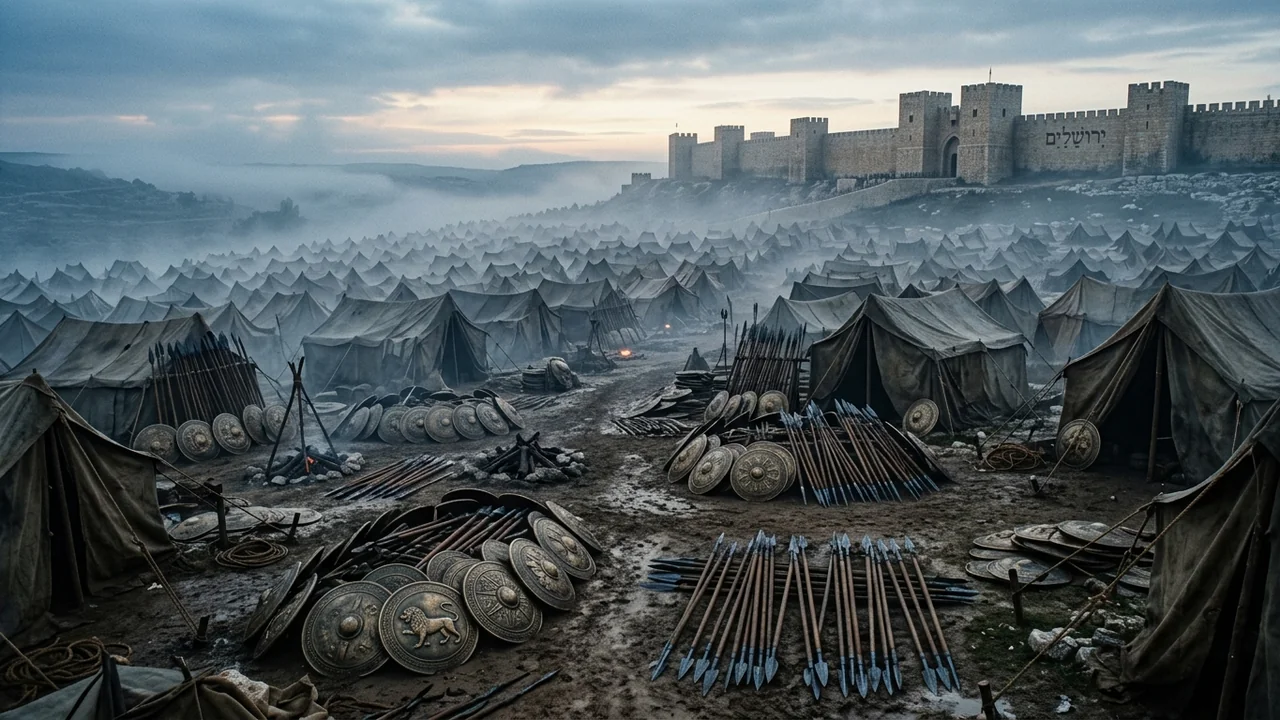
Around 1000 BC, newly crowned King David achieved the supreme military and political objective of his early reign: he captured the ancient Jebusite fortress of Zion, establishing Jerusalem as the united capital of all twelve tribes of Israel (2 Samuel 5).
Yet, David understood that a political capital without the physical presence of Yahweh was an empty shell. For over seventy years—since its catastrophic capture by the Philistines at the Battle of Aphek and subsequent return (1 Samuel 4–7)—the most sacred object on earth, the Ark of the Covenant, had remained secluded in relative obscurity in the border village of Kiriath-Jearim, housed in the private home of Abinadab.
David resolved to bring the Ark up to Jerusalem with unmatched royal splendor:
"Again, David gathered together all the chosen men of Israel, thirty thousand. And David arose, and went with all the people that were with him from Baale of Judah, to bring up from thence the ark of God, whose name is called by the name of the Lord of hosts that dwelleth between the cherubims." (2 Samuel 6:1–2)
The atmosphere was electric with national joy. Thirty thousand elite soldiers marched in formation. Royal musicians played harps, psalteries, timbrels, cornets, and cymbals crafted of fir wood.
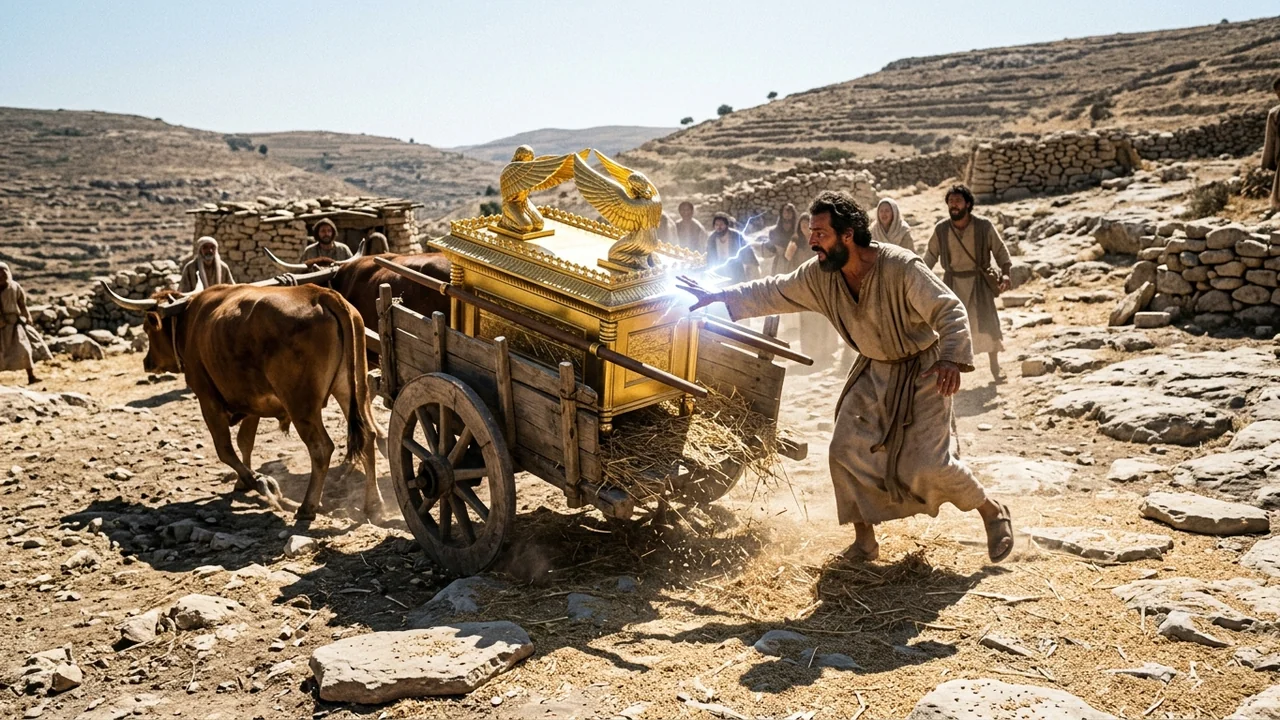
The Ark was placed upon a brand-new wooden cart (agalah chadashah), driven by Abinadab’s two sons: Ahio walked before the cart, while Uzzah walked beside the oxen.
The Catastrophe at the Threshing Floor of Nacon
The procession wound its way up the rugged limestone ridges ascending toward Jerusalem. Then, at a designated agricultural plateau known as the threshing floor of Nacon (or Chidon), disaster struck:
"And when they came to Nachon's threshingfloor, the oxen shook it, and Uzzah put forth his hand to the ark of God, and took hold of it; for the oxen stumbled. And the anger of the Lord was kindled against Uzzah; and God smote him there for his error; and there he died by the ark of God." (2 Samuel 6:6–7)
In an instinctive reflex of human goodwill, Uzzah reached out his hand to prevent the sacred gold chest from tumbling into the mud.
The moment his fingers made physical contact with the sacred gold, a blinding flash of divine energy terminated his life on the spot. Uzzah collapsed dead in the dirt beside the Ark.
Music ceased. Thirty thousand soldiers froze in stunned terror. David’s joy turned to bitter anger and overwhelming dread: "And David was displeased, because the Lord had made a breach upon Uzzah: and he called the name of the place Perez-Uzzah to this day. And David was afraid of the Lord that day, and said, 'How shall the ark of the Lord come to me?'" (2 Samuel 6:8–9).
[1. Good Human Intentions: Protecting the Sacred Object]
             │  └── Oxen stumble; Uzzah reaches out to steady the Ark
             │
[2. Fatal Covenant Breach: Direct Physical Contact with the Gold]
             │  └── Numbers 4:15: "They shall not touch any holy thing, lest they die"
             │
[3. Instantaneous Divine Arc Termination]
             │  └── Uzzah dies on the spot ("Perez-Uzzah")
             │
[4. Theological Correction (1 Chronicles 15)]
             └── "Because ye did it not at the first... we sought Him not after the due order"
The Legal Protocol Error: The Philistine Cart vs. Kohathite Shoulders
Why did a loving God execute a man whose only apparent motive was protecting the Ark from falling?
The answer lies in a tragic, systemic failure of biblical covenant law. Months later, after studying the scrolls of the Torah, King David himself openly confessed the fatal operational mistake that caused Uzzah’s death:
"Then David said, 'None ought to carry the ark of God but the Levites: for them hath the Lord chosen to carry the ark of God, and to minister unto Him forever.' ... And said unto them, 'Ye are the chief of the fathers of the Levites: sanctify yourselves... For because ye did it not at the first, the Lord our God made a breach upon us, for that we sought Him not after the due order.'" (1 Chronicles 15:2, 12–13)
David recognized that they had violated explicit, non-negotiable divine statutes established five centuries earlier at Mount Sinai:
- The Prohibition Against Carts (Numbers 7:9): When the leaders of Israel donated twelve oxen and six covered wagons to transport the heavy Tabernacle furnishings, Moses gave wagons to the Gershonites and Merarites. But to the sons of Kohath, Moses gave zero wagons: "Because the service of the sanctuary belonging unto them was that they should bear upon their shoulders." God’s presence was never meant to be hauled like freight; it was to be borne with trembling reverence upon consecrated human shoulders!
- Emulating the Philistine Method: Where did David get the idea to transport the Ark on a "new cart"? From the pagan Philistines! In 1 Samuel 6:7, the Philistine diviners placed the Ark on a new ox cart to send it away. Israel had adopted a worldly, pagan shortcut for handling the sacred things of God.
- The Capital Touch Prohibition (Numbers 4:15): The Torah explicitly warned: "When Aaron and his sons have made an end of covering the sanctuary, and all the vessels of the sanctuary... after that, the sons of Kohath shall come to bear it: but they shall not touch any holy thing, lest they die." The Ark was fitted with four gold rings holding long gold-plated acacia poles that were never to be removed (Exodus 25:12–15), precisely so that human hands would never make direct physical contact with the vessel!
Uzzah’s deeper sin was presumed familiarity: having grown up with the Ark in his family home for decades, he had lost his trembling awe of the consuming fire of God’s absolute holiness.
The Physics of the Sacred: Was the Ark an Electrical Capacitor?
Beyond the primary theological reality, modern physicists and electrical engineers—including Nikola Tesla and Louis Trenchard More—have noted the astonishing physical construction of the Ark of the Covenant:
From an electrostatics standpoint, the Ark of the Covenant matches the precise architectural blueprint of a colossal Leyden jar or electrical capacitor:
- Acacia Wood Core: Dense, dried acacia wood is an exceptional dielectric insulator.
- Gold Plating Inside and Out: Exodus 25:11 specifies: "thou shalt overlay it with pure gold, within and without shalt thou overlay it." Two conductive sheets of pure gold separated by an insulating wooden dielectric core form a classic multi-plate high-voltage capacitor!
- Cherubim Spark Gap: The two solid gold cherubim atop the solid gold Mercy Seat curved toward each other with extended wings, forming a natural high-voltage spark gap.
In the arid desert climate of the Middle East, continuous movement across dry terrain generates immense electrostatic charges. While physicists recognize this natural capacitance, the biblical text emphasizes that the lethal power of the Ark was not merely static electricity; it was the direct, conscious manifestation of the personal Shekinah Glory of Yahweh dwelling between the cherubim, executing sovereign covenant judgment.
The Theological Meaning of Perez-Uzzah: Irreversible Holiness
David named the tragic site Perez-Uzzah (literally, "The Outburst / Breach of Uzzah").
The theological message echoed down through the centuries:
- The holiness of God is not safe, malleable, or subject to human convenience.
- Good human intentions can never excuse direct disobedience to divine revelation.
- In the words of 19th-century theologian Charles Spurgeon: "God’s work must be done in God’s way, if we are to have God’s blessing."
Terrified to bring the Ark into Jerusalem, David diverted the procession to the nearby rural home of a Levite named Obed-Edom the Gittite.
The Blessing of Obed-Edom and the Joyful Sacerdotal Return
For three months, the Ark rested inside the home of Obed-Edom. Instead of judgment, an extraordinary outpouring of divine favor transformed the household:
"And the ark of the Lord continued in the house of Obed-edom the Gittite three months: and the Lord blessed Obed-edom, and all his household." (2 Samuel 6:11)
When David heard that God was blessing Obed-Edom’s cattle, crops, and family, his fear transformed into reverent worship. He realized that the Ark did not bring arbitrary death; it brought life and blessing to those who approached it in humble, consecrated obedience!
David returned with the consecrated Levites. Following the divine protocol, the sons of Kohath lifted the gold-plated acacia poles upon their shoulders. Every six paces, David halted the procession to sacrifice an ox and a fatling (2 Samuel 6:13).
Clothed in a humble linen ephod, King David danced with all his might before the Lord, leading the Ark through the gates of Jerusalem amid the blare of trumpets and the roar of the nation, enthroning the Ark in the tent of Zion!
Discover the Lost Mysteries of the Ark of the Covenant
The breach at Perez-Uzzah reveals the terrifying reality of divine holiness in ancient Israel. If you want to explore the complete metallurgical diagrams of the Ark, the archaeological excavations at Kiriath-Jearim, and the lost resting place of the sacred chest:
👉 Discover Volume III: The Final Files – Biblical Disasters & Ancient Wonders ($2.99)
Features complete architectural blueprints of the Ark of the Covenant, electrical capacitance physics studies, and archaeological field reports from Jerusalem and Shiloh.
Frequently Asked Questions
Why did God kill Uzzah for trying to help?
God struck Uzzah not because of malice, but because Uzzah violated explicit, sacred covenant laws given in Numbers 4:15: "they shall not touch any holy thing, lest they die." Uzzah’s instinctive action exposed a profound lack of reverent awe—presuming that his hand was cleaner than the dirt. Furthermore, King David had failed to transport the Ark on the shoulders of the Levites as commanded by the Torah, using a Philistine ox cart instead.
How was the Ark of the Covenant supposed to be moved?
According to Exodus 25:12–15 and Numbers 7:9, the Ark was designed never to be transported on wheeled carts. It was fitted with four gold rings through which two long gold-plated acacia wood poles were inserted, to be carried exclusively upon the consecrated shoulders of the Levites from the family of Kohath.
What does "Perez-Uzzah" mean?
"Perez-Uzzah" is a Hebrew name meaning "The Breach of Uzzah" or "The Outburst Against Uzzah." King David named the threshing floor where Uzzah died to commemorate the terrifying moment when God broke out in judgment against the violation of His covenant holiness.
Who was Obed-Edom?
Obed-Edom was a Levite (of the family of Korah, 1 Chronicles 26:1–4) in whose home near Jerusalem the Ark rested for three months following Uzzah's death. Because Obed-Edom treated the Ark with proper priestly reverence, God abundantly blessed his entire household and estate, inspiring David to complete the Ark’s journey to Jerusalem.
Frequently Asked Questions
Why did God kill Uzzah for trying to help?
God struck Uzzah not because of malice, but because Uzzah violated explicit, sacred covenant laws given in Numbers 4:15: "they shall not touch any holy thing, lest they die." Uzzah’s instinctive action exposed a profound lack of reverent awe—presuming that his hand was cleaner than the dirt. Furthermore, King David had failed to transport the Ark on the shoulders of the Levites as commanded by the Torah, using a Philistine ox cart instead.
How was the Ark of the Covenant supposed to be moved?
According to Exodus 25:12–15 and Numbers 7:9, the Ark was designed never to be transported on wheeled carts. It was fitted with four gold rings through which two long gold-plated acacia wood poles were inserted, to be carried exclusively upon the consecrated shoulders of the Levites from the family of Kohath.
What does "Perez-Uzzah" mean?
"Perez-Uzzah" is a Hebrew name meaning "The Breach of Uzzah" or "The Outburst Against Uzzah." King David named the threshing floor where Uzzah died to commemorate the terrifying moment when God broke out in judgment against the violation of His covenant holiness.
Who was Obed-Edom?
Obed-Edom was a Levite (of the family of Korah, 1 Chronicles 26:1–4) in whose home near Jerusalem the Ark rested for three months following Uzzah's death. Because Obed-Edom treated the Ark with proper priestly reverence, God abundantly blessed his entire household and estate, inspiring David to complete the Ark’s journey to Jerusalem.
Related Research Dossiers
View all 120 articles →
Turned to a Pillar of Salt: The Geological Thermal Blast Evidence at Mount Sodom
The Unholy Fire of Nadab and Abihu: What Chemical Incense Exploded Inside the Tabernacle?