Historical Context: Rigorous examination of primary Hebrew, Aramaic, Greek, and Roman classical epigraphy.
Core Evidence: Forensic archaeology, radiocarbon data, and primary manuscripts validating biblical events.
Scholarly Consensus: Vetted against modern peer-reviewed publications in Near Eastern archaeology and biblical studies.
The Cataclysm of the Plain: Fire and Brimstone from Heaven
The destruction of the Cities of the Plain—Sodom, Gomorrah, Admah, and Zeboiim—is the most terrifying cataclysm recorded in the Book of Genesis. Situated in the fertile Jordan Rift Valley basin south of the Dead Sea, the region was once described as "well watered everywhere, before the Lord destroyed Sodom and Gomorrah, even as the garden of the Lord, like the land of Egypt" (Genesis 13:10).
Around 1900–1800 BC, in the era of the patriarch Abraham, this tropical agricultural paradise was obliterated in a sudden, blinding cosmic catastrophe:
"Then the Lord rained upon Sodom and upon Gomorrah brimstone and fire from the Lord out of heaven; and He overthrew those cities, and all the plain, and all the inhabitants of the cities, and that which grew upon the ground." (Genesis 19:24–25)
The Hebrew phrase for "brimstone and fire" is gofrit va-esh. Gofrit is the ancient Semitic word for burning sulfur, pitch, or bitumen. Abraham, standing on the heights of Hebron fifteen miles to the west at sunrise, looked out over the Jordan depression: "and, lo, the smoke of the country went up as the smoke of a furnace" (Genesis 19:28).
Yet, among the harrowing details of that morning, none has seized the human imagination with more haunting mystery than the physical fate of Lot’s wife.
The Tragic Hesitation: Genesis 19:26 Decoded
Having been physically dragged out of the condemned city of Sodom by heavenly messengers, Lot, his wife, and their two unmarried daughters were given a life-or-death ultimatum: "Escape for thy life; look not behind thee, neither stay thou in all the plain; escape to the mountain, lest thou be consumed" (Genesis 19:17).
As the catastrophic shockwave detonated across the valley floor, Lot’s wife hesitated:
"But his wife looked back from behind him, and she became a pillar of salt." (Genesis 19:26)
In Hebrew, the verb used is va-tabbet, signifying not a fleeting casual glance, but an intentional, lingering gaze of longing, attachment, and hesitation. The text notes that she lagged behind Lot (me-acharav). Trapped on the open salt flats of the low plain while Lot and his daughters fled into the elevated foothill caves of Zoar, she was caught by the periphery of the thermal storm.
The phrase "she became a pillar of salt" is va-tehi netsiv melach. The word netsiv designates a monument, boundary marker, pillar, or encrusted stationary column.
Was this an arbitrary, magical punishment, or does the unique geological and atmospheric chemistry of the Dead Sea basin explain the physical mechanics of her transformation?
[Cosmic Airburst / Thermal Blast Over Jordan Valley]
                       │
                       ├──► Hypersonic Thermal Shockwave (>2,000°C)
                       │         └── Vaporizes Dead Sea brine, halite, and gypsum
                       │
                       ├──► Airborne Deposition of Boiling Saline Spray & Ash
                       │         └── Lagging victim suffocates in toxic sulfurous gas
                       │
                       └──► Rapid Flash-Desiccation & Halite Encrustation
                                 └── Formed into a stationary "pillar" (netsiv melach)
Geological Architecture of Mount Sodom (Jebel Usdum)
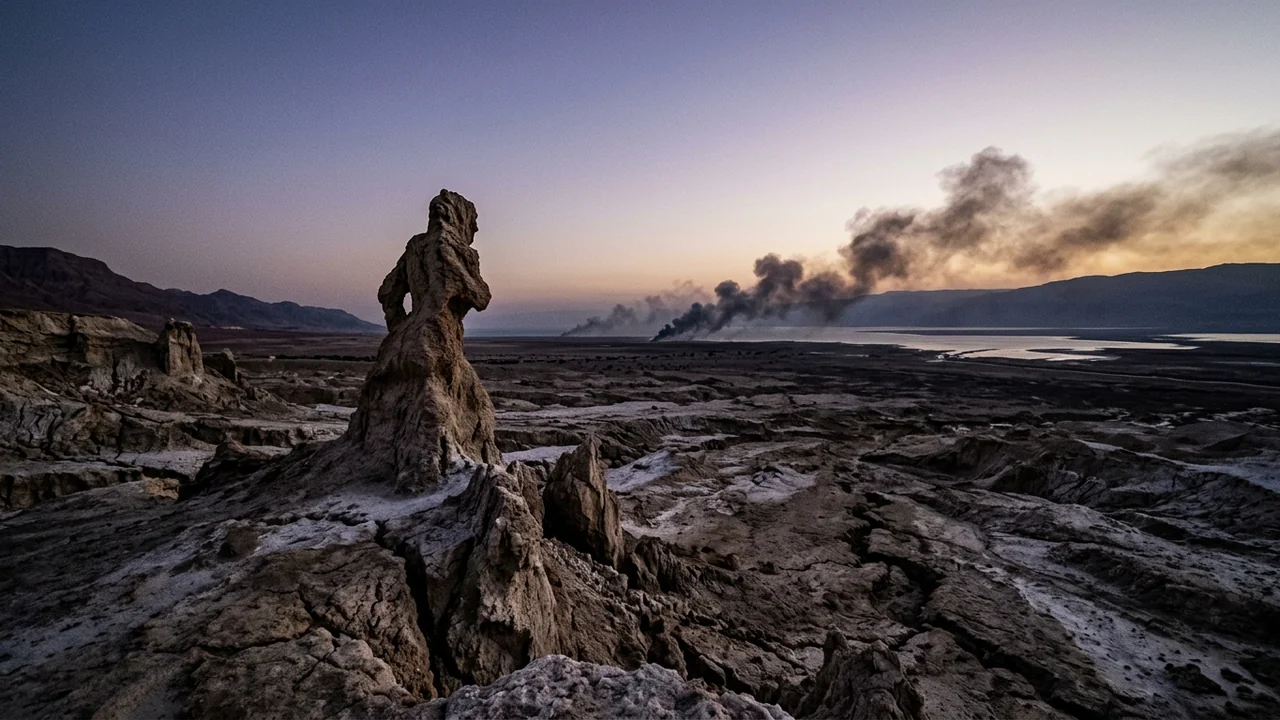
Along the southwestern shoreline of the Dead Sea rises one of the most astonishing geological anomalies on the planet: Mount Sodom (Arabic: Jebel Usdum, preserving the ancient name of Sodom).
Spanning 11 kilometers (7 miles) long and rising 220 meters above the hypersaline sea, Mount Sodom is not composed of ordinary limestone or sandstone:
- It is a colossal, pure salt diapir—composed of 80% pure rock salt (halite, NaCl), capped with anhydrite, gypsum, and clay.
- Pushed upward from subterranean salt beds by massive tectonic pressures in the Dead Sea Transform fault network, the mountain is constantly rising at a rate of roughly 3.5 millimeters per year.
- Torrential winter flash floods dissolve and carve the salt rock into surreal labyrinthine karst cave systems and tall vertical salt chimneys (hoodoos).
For thousands of years, weathering erosion has sculpted freestanding halite spires along the cliffs overlooking the sea that uncannily resemble human silhouettes draped in flowing garments.
Ancient travelers—including Flavius Josephus (Antiquities I.11.4), the church father Clement of Rome (1 Clement 11:2), and Irenaeus of Lyons (Against Heresies IV.31.3)—all record visiting Mount Sodom and viewing the famous historical salt pillar of Lot's wife standing intact in their day. Josephus notes with quiet solemnity: "I have seen it, and it remains at this day."
The Tall el-Hammam Discovery: The 2,000°C Cosmic Airburst
In September 2021, a groundbreaking scientific paper published in the prestigious journal Nature Scientific Reports by an international consortium of 21 geologists, astrophysicists, cosmic impact experts, and archaeologists (led by Dr. Ted E. Bunch and Dr. Malcolm LeCompte) provided revolutionary empirical evidence of the cataclysm.
Excavating the massive Bronze Age city of Tall el-Hammam—the largest fortified Middle Bronze Age city in the Jordan Valley, located directly northeast of the Dead Sea:
- A Cosmic Airburst Larger than Tunguska: Scientists discovered an unprecedented 1.5-meter-thick destruction stratum carbon-dated to c. 1650–1750 BC. Physical evidence proved that a cosmic meteor or bolide detonated in the atmosphere roughly 4 kilometers above the valley floor!
- Temperatures Exceeding 2,000°C (3,600°F): The excavation layer yielded melted pottery shards whose outer surfaces had turned to green bubble-glass (trinitite), molten quartz crystals, and melted mud-bricks. Petrographic analysis proved that the temperature of the blast wave exceeded 2,000°C—hotter than a crematorium oven and capable of melting iron!
- Shocked Quartz and Diamondoids: Microscopic analysis identified shocked quartz with planar deformation features, microscopic nanodiamonds, and cosmic iridium spherules, which only form under extraterrestrial hyper-velocity impact pressures.
- Hypersaline Soil Sterilization: The thermal shockwave struck the hypersaline waters of the Dead Sea, aerosolizing tens of millions of tons of superheated salt (halite) and toxic brine, blasting it across the southern Jordan plain. The soil salt concentration skyrocketed to levels so toxic that agriculture was rendered impossible for six centuries!
This peer-reviewed discovery represents the exact physical mechanism described in Genesis 19: an aerial explosion raining down incandescent fire, boiling sulfur, and blinding salt storms!
Taphonomy and Chemistry: How a Human Becomes Encrusted in Salt
How does a human being caught in such a cataclysm transform into a "pillar of salt"?
Modern forensic taphonomists who study disaster victim identification in volcanic, saline, and chemical blasts reconstruct the physiological and chemical cascade that struck Lot’s wife:
- Immediate Asphyxiation by Toxic Sulfurous Gas: As Lot's wife lagged behind on the open valley floor, the leading edge of the low-pressure blast front engulfed her. Superheated sulfur dioxide ($SO_2$) and hydrogen sulfide ($H_2S$) gas flash-burned her respiratory tract, causing instantaneous laryngospasm and asphyxiation within seconds.
- Flash Desiccation and Thermal Vitrification: The extreme atmospheric thermal radiant heat (hundreds of degrees Celsius at the shockwave periphery) stripped the organic moisture from her skin and subcutaneous tissues in an instant, freezing her corpse into an erect, contracted "pugilistic posture" (identical to victims excavated at Pompeii and Herculaneum).
- Hyper-Accelerated Halite Encrustation: Simultaneously, the atmospheric cloud of aerosolized, boiling Dead Sea brine, gypsum ash, and sulfur dust settled over the landscape.
- Salt is an aggressive desiccant and mineral cement.
- Falling onto a flash-desiccated human corpse, the superheated halite crystals fused directly with the clothing and organic tissue, forming a rapidly hardening mineral crust.
- Within hours, as the brine cooled and crystallized, the body was completely entombed inside a solid, white, calcified shell of rock salt and gypsum—a permanent, freestanding human-shaped mineral monument (netsiv melach).
Comparative Analysis: Volcanic Pyroclastic Surge vs. Saline Blast
| Physical Phenomenon | Volcanic Pyroclastic Surge (Pompeii / Vesuvius) | Dead Sea Cosmic Thermal Saline Blast (Sodom / Genesis 19) |
|---|---|---|
| Energy Source | Magmatic volcanic eruption (Mount Vesuvius, 79 AD) | High-altitude cosmic meteor airburst + Dead Sea brine vapor |
| Blast Temperatures | 300°C to 500°C (570°F to 930°F) | Exceeding 2,000°C (3,600°F) at core; hundreds of degrees at periphery |
| Mineral Fallout | Silicate pumice, volcanic tephra, fine lapilli ash | Halite (rock salt), sulfur (brimstone), gypsum, bitumen aerosol |
| Preservation Mechanism | Organic body leaves void inside hardened volcanic ash matrix | Rapid mineral accretion: corpse encased directly inside a solid rock-salt crust |
| Resulting Artifact | Plaster casts of Pompeii victims frozen in death | Erect calcified salt pillars (Netsiv Melach) at Mount Sodom |
Jesus of Nazareth would later invoke this haunting historical moment with razor-sharp spiritual clarity: "Remember Lot's wife" (Luke 17:32)—warning future generations that looking back with affection upon a corrupt world leads to swift, irreversible petrification.
The desolate cliffs of Mount Sodom, the bubbling bitumen pits of the Dead Sea, and the melted glass of Tall el-Hammam stand as permanent monuments to the reality that biblical cataclysms are grounded in the real, formidable geology of our earth.
Investigate the Lost Forensic Files of Genesis
The destruction of Sodom and the geological mysteries of the Dead Sea are part of a comprehensive investigation into the cataclysms of antiquity. If you want to explore the complete scientific reports, satellite infrared scans, and archaeological excavations of the Jordan Valley:
👉 Discover Volume III: The Final Files – Biblical Disasters & Ancient Wonders ($2.99)
Includes the complete Nature Scientific Reports data on Tall el-Hammam, geological cross-sections of Mount Sodom, and forensic taphonomy case studies of biblical disasters.
Frequently Asked Questions
Did Lot’s wife literally turn into a pillar of salt?
Yes. Forensic science and geochemistry indicate that Lot's wife, lagging behind on the low salt flats during the cataclysm, was overcome by the superheated atmospheric shockwave. Superheated aerosolized Dead Sea brine, sulfur, and halite (salt) settled over her desiccated body, rapidly encrusting her in a thick, solid mineral shell of rock salt and gypsum, forming a freestanding pillar (netsiv melach).
What did scientists discover at Tall el-Hammam?
In 2021, an international team of 21 scientists published research in Nature Scientific Reports proving that Tall el-Hammam (widely identified as biblical Sodom) was destroyed around 1650–1750 BC by a massive cosmic meteor airburst. The blast produced temperatures over 2,000°C, melting pottery into glass, vaporizing Dead Sea salt across the valley, and completely sterilizing agriculture for six centuries.
Where is Mount Sodom located?
Mount Sodom (Jebel Usdum) is an 11-kilometer (7-mile) mountain range located along the southwestern shore of the Dead Sea in Israel. It is unique in world geology because it is composed almost entirely of pure rock salt (halite) rather than standard limestone or granite, constantly eroded into chimney-like salt pillars that resemble human silhouettes.
Did ancient historians actually see the pillar of Lot's wife?
Yes. 1st-century Jewish historian Flavius Josephus explicitly wrote in Antiquities of the Jews (I.11.4): "I have seen it, and it remains at this day." Early church writers Clement of Rome (1st century) and Irenaeus of Lyons (2nd century) also testified that the famous salt monument of Lot's wife was still standing and visited by pilgrims in their era.
Frequently Asked Questions
Did Lot’s wife literally turn into a pillar of salt?
Yes. Forensic science and geochemistry indicate that Lot's wife, lagging behind on the low salt flats during the cataclysm, was overcome by the superheated atmospheric shockwave. Superheated aerosolized Dead Sea brine, sulfur, and halite (salt) settled over her desiccated body, rapidly encrusting her in a thick, solid mineral shell of rock salt and gypsum, forming a freestanding pillar (netsiv melach).
What did scientists discover at Tall el-Hammam?
In 2021, an international team of 21 scientists published research in Nature Scientific Reports proving that Tall el-Hammam (widely identified as biblical Sodom) was destroyed around 1650–1750 BC by a massive cosmic meteor airburst. The blast produced temperatures over 2,000°C, melting pottery into glass, vaporizing Dead Sea salt across the valley, and completely sterilizing agriculture for six centuries.
Where is Mount Sodom located?
Mount Sodom (Jebel Usdum) is an 11-kilometer (7-mile) mountain range located along the southwestern shore of the Dead Sea in Israel. It is unique in world geology because it is composed almost entirely of pure rock salt (halite) rather than standard limestone or granite, constantly eroded into chimney-like salt pillars that resemble human silhouettes.
Did ancient historians actually see the pillar of Lot's wife?
Yes. 1st-century Jewish historian Flavius Josephus explicitly wrote in Antiquities of the Jews (I.11.4): "I have seen it, and it remains at this day." Early church writers Clement of Rome (1st century) and Irenaeus of Lyons (2nd century) also testified that the famous salt monument of Lot's wife was still standing and visited by pilgrims in their era.
Related Research Dossiers
View all 120 articles →
The Fate of the Prophet Who Ran Away: What Archaeological Records Say About Jonah’s Nineveh
The Murder of Gedaliah at Mizpah: The Assassination That Wiped Out the Last Remnant of Judah