Historical Context: Rigorous examination of primary Hebrew, Aramaic, Greek, and Roman classical epigraphy.
Core Evidence: Forensic archaeology, radiocarbon data, and primary manuscripts validating biblical events.
Scholarly Consensus: Vetted against modern peer-reviewed publications in Near Eastern archaeology and biblical studies.
The Day of Triumph: The Eighth Day of Consecration
At the foot of Mount Sinai in the second year of the Exodus (c. 1445 BC), the children of Israel reached the climax of their spiritual journey. The Sacred Tabernacle (Mishkan)—constructed of gilded acacia wood boards, pure gold furnishings, and four layers of dyed tapestries—was fully assembled. For seven days, Moses had guided Aaron and his four sons (Nadab, Abihu, Eleazar, and Ithamar) through an elaborate week-long ritual of priestly ordination (Leviticus 8).
On the eighth day, Aaron stepped forward before the entire assembly of two million Israelites to offer the inaugural sacrifices upon the great Bronze Altar. The climax was breathtaking:
"And Moses and Aaron went into the tabernacle of the congregation, and came out, and blessed the people: and the glory of the Lord appeared unto all the people. And there came a fire out from before the Lord, and consumed upon the altar the burnt offering and the fat: which when all the people saw, they shouted, and fell on their faces." (Leviticus 9:23–24)
Supernatural fire descended from heaven, consuming the sacrifices in a blaze of divine acceptance. The people shouted with ecstatic joy and prostrated themselves in the dust. The presence of the Creator of the universe had physically taken up residence in the midst of Israel.
Yet, within minutes, this scene of transcendent spiritual triumph transformed into a sudden, terrifying tragedy.
The Strange Fire (Esh Zarah): Leviticus 10 Decoded
In the euphoria of the moment, Aaron’s two eldest sons—Nadab and Abihu—took matters into their own hands. Nadab was the crown prince of the priesthood, having ascended Mount Sinai alongside Moses, Aaron, and seventy elders of Israel, where they had beheld the God of Israel upon a pavement of sapphire stone (Exodus 24:1, 9–10).
Arming themselves with bronze censers, they rushed into the sacred court:
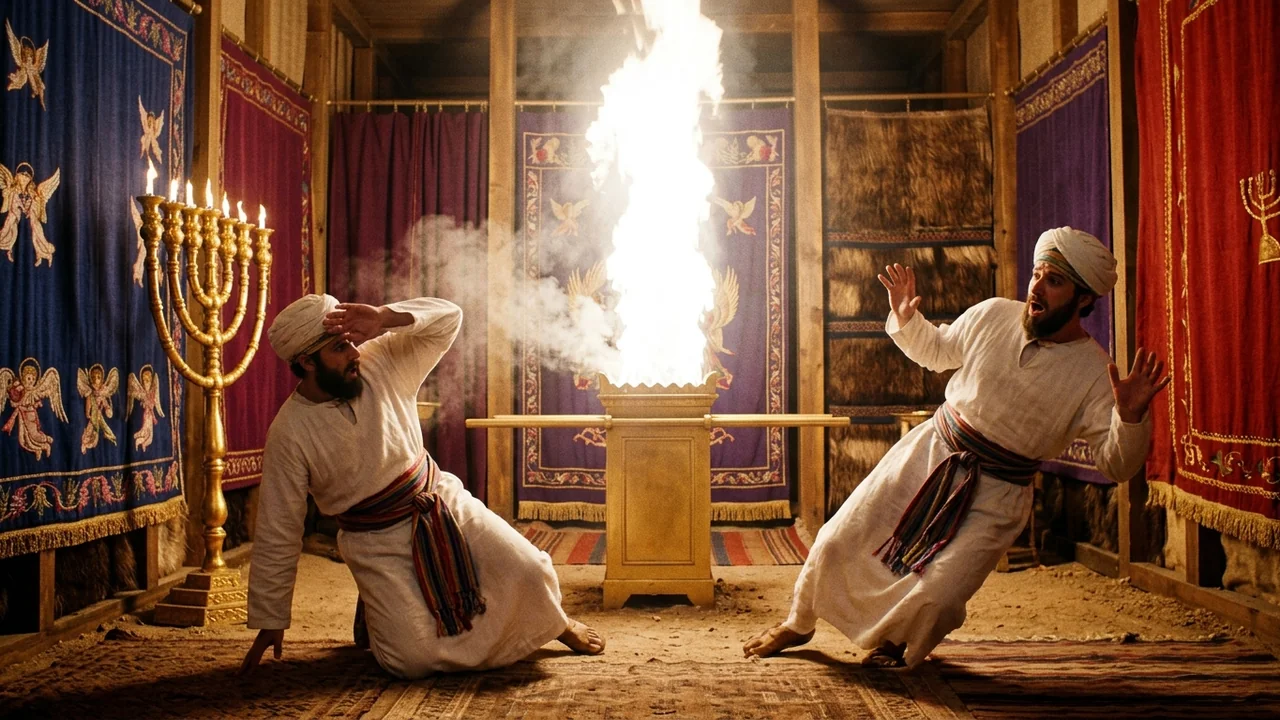
"And Nadab and Abihu, the sons of Aaron, took either of them his censer, and put fire therein, and put incense thereon, and offered strange fire before the Lord, which He commanded them not. And there went out fire from the Lord, and devoured them, and they died before the Lord." (Leviticus 10:1–2)
The Hebrew phrase for "strange fire" is esh zarah (literally, "alien", "unauthorized", or "profane fire").
What made their action so catastrophically offensive to God?
- Unauthorized Coals: Under Levitical law, incense coals were required to be taken exclusively from the perpetual, heaven-lit fire burning upon the Bronze Altar of Burnt Offering (Leviticus 16:12). Nadab and Abihu apparently gathered common domestic coals from an ordinary kitchen camp hearth, substituting human spark for divine fire.
- Unauthorized Timing and Access: Under strict Torah law, no priest—not even Aaron—was permitted to enter the Holy of Holies before the Mercy Seat (Kapporet) at will; it was restricted strictly to the High Priest once a year on the Day of Atonement (Yom Kippur), accompanied by a cloud of prescribed incense (Leviticus 16:2).
- Unbidden Initiative: The text explicitly notes that they offered that "which He commanded them not." In the presence of absolute holiness, self-styled religious innovation is not worship; it is rebellion.
The Chemistry of Sacred Incense (Ketoret) and Prohibited Formulas
In ancient Near Eastern ritual, incense was not an arbitrary fragrance; it was a precisely formulated chemical compound governed by strict divine patents:
In Exodus 30:34–38, God revealed the proprietary, classified formula for the Holy Incense (Ketoret):
"Take unto thee sweet spices, stacte, and onycha, and galbanum; these sweet spices with pure frankincense: of each shall there be a like weight: and thou shalt make it a perfume, a confection after the art of the apothecary, tempered together, pure and holy... Whosoever shall make like unto that, to smell thereto, shall even be cut off from his people."
The chemical composition was extraordinarily complex:
- Stacte (Nataf): A rare, aromatic resin extracted from the myrrh tree (Commiphora myrrha) or storax.
- Onycha (Shechelet): The pulverized operculum (claw) of a marine mollusk from the Red Sea, which emits an intense, musky, slow-burning aroma when ignited.
- Galbanum (Helbenah): An intensely pungent, bitter gum resin derived from Ferula galbaniflua, which acts as an organic fixative, binding the scents together and producing a thick, opaque white smoke cloud.
- Pure Frankincense (Levonah Zakkah): A fragrant gum resin from Boswellia sacra, rich in volatile boswellic acids and terpene hydrocarbons.
The compound was compounded with salt (memulach, "tempered with salt")—acting as an oxidizing agent and spark retardant to ensure a steady, smoldering burn rather than an open explosive flame.
If Nadab and Abihu introduced foreign chemical additives—such as sweet-scented sulfur-bearing aromatics, flash-burning oils, or pagan hallucinogenic botanicals common in Egyptian and Canaanite ecstatic cults—they created an unstable, volatile chemical mixture that could flash-ignite in the confined, oxygen-rich courtyard!
[1. Unholy Fire & Unauthorized Incense (Esh Zarah)]
             │  └── Kitchen hearth coals + unprescribed aromatic compounds
             │
[2. Supernatural Electrical Arc Discharge]
             │  └── Fire proceeds "from before the Lord" (The Ark of the Covenant)
             │
[3. Internal Thermal Transection]
             │  └── Soul and internal organs incinerated instantly
             │
[4. The Forensic Miracle of Unburned Linen]
             └── "In their coats" (kuttonot) — 100% spotless, uncharred tunics!
Forensic Physics: The Internal Arc That Spared the Linen Tunics
The most astonishing forensic detail in the entire account is recorded in Leviticus 10:4–5. Moses summoned their cousins, Mishael and Elzaphan:
"And Moses called Mishael and Elzaphan, the sons of Uzziel the uncle of Aaron, and said unto them, 'Come near, carry your brethren from before the sanctuary out of the camp.' So they went near, and carried them in their coats out of the camp; as Moses had said." (Leviticus 10:4–5)
The Hebrew word for "coats" is kuttonot—the fine-twined white flax linen tunics mandated for priestly vestments in Exodus 28:40.
Consider the forensic paradox:
- Nadab and Abihu were instantly killed by a blast of fire from heaven.
- Yet their linen tunics were not burned, charred, or singed! Their cousins carried the dead bodies by grasping the very fabric of their white linen coats!
Modern physicists and forensic pathology experts who analyze electrical arc and lightning trauma recognize this exact physical phenomenon:
- Supernatural Lightning / Plasma Arc Discharge: When a high-voltage electrical arc or ball lightning strikes a human body, current travels along lines of least electrical resistance—specifically the blood vessels, nerve sheaths, and electrolyte-rich internal fluids.
- Internal Thermal Electrocution: The current causes immediate ventricular fibrillation, brainstem vaporization, and internal vital organ incineration without necessarily igniting dry, non-conductive surface textiles like linen.
- Divine Precision: The fire that proceeded "from before the Lord" acted with surgical divine precision: it devoured the breath of life (neshamah) and biological vitality from within, leaving their outer sacred vestments completely unblemished—a terrifying demonstration that God judged the corrupt priests while preserving the purity of His holy office.
The Alcohol Hypothesis: The Warning of Leviticus 10:9
Why did two seasoned, highly trained priests commit such a brazen, reckless breach of liturgical protocol on the greatest day of their lives?
The biblical text provides a dramatic, immediate clue. In the very next sentence following their deaths, God speaks directly to Aaron for the first time in the book, issuing an urgent, unprecedented statutory prohibition:
"And the Lord spake unto Aaron, saying, 'Do not drink wine nor strong drink, thou, nor thy sons with thee, when ye go into the tabernacle of the congregation, lest ye die: it shall be a statute forever throughout your generations: and that ye may put difference between holy and unholy, and between unclean and clean.'" (Leviticus 10:8–10)
Ancient Jewish commentators, including Rashi and the Midrash (Leviticus Rabbah 12:1), recognized the direct causal link:
- During the celebratory banquet of the eighth day, Nadab and Abihu had indulged in excessive consumption of fermented wine (yayin) or strong date/barley liquor (shekhar).
- Under the influence of acute alcohol intoxication, their cognitive judgment, emotional inhibition, and solemn reverence were completely impaired.
- Stumbling into the Holy Place in a state of drunken euphoria, they arrogantly assumed they could perform high-priestly functions at will.
God immediately codified the rule: total alcohol abstinence was mandatory for any priest entering the Tabernacle, ensuring sober, razor-sharp discernment between the holy and the profane.
The Burial by the Coated Tunics: Sacerdotal Protocol
Moses issued a strict command to Aaron and his two surviving sons, Eleazar and Ithamar:
"Uncover not your heads, neither rend your clothes; lest ye die, and lest wrath come upon all the people: but let your brethren, the whole house of Israel, bewail the burning which the Lord hath kindled. And ye shall not go out from the door of the tabernacle of the congregation, lest ye die: for the anointing oil of the Lord is upon you." (Leviticus 10:6–7)
The high-priestly dignity could not be interrupted by personal family grief. To tear their holy garments or leave the sanctuary would be to endorse the rebellion of the slain sons and invite national judgment.
Aaron held his peace (va-yiddom Aharon). In silent, agonizing submission to the holiness of God, the grieving father watched his cousins carry the unburned linen coats containing the lifeless bodies of his two firstborn sons through the camp of Israel, burying them in the arid wilderness sands of Sinai.
The tragedy of Nadab and Abihu stands across millennia as a monumental warning: when humanity approaches the Sovereign God, we must do so on His terms, in His way, and with reverent awe: "I will be sanctified in them that come nigh Me, and before all the people I will be glorified" (Leviticus 10:3).
Study the Sacred Mysteries of the Tabernacle
The fire that consumed Nadab and Abihu is one of many extraordinary physical and chemical encounters recorded in the Pentateuch. If you want to explore the complete metallurgical diagrams of the Ark of the Covenant, the chemical formulas of the sacred Ketoret, and the forensic investigations of biblical judgments:
👉 Discover Volume III: The Final Files – Biblical Disasters & Ancient Wonders ($2.99)
Features the complete chemical analysis of ancient temple incenses, electrical conductivity studies of the Tabernacle furnishings, and forensic autopsies of biblical plagues.
Frequently Asked Questions
What was the "strange fire" offered by Nadab and Abihu?
The Hebrew phrase esh zarah ("strange fire") refers to unauthorized or profane fire. Biblical scholars and Talmudic sages explain that Nadab and Abihu took common domestic coals from an ordinary kitchen hearth instead of sacred coals from the heaven-lit Bronze Altar, and offered it at an unauthorized time using an unprescribed incense mixture.
Why were their linen coats not burned?
Leviticus 10:5 explicitly states that their cousins carried them out of the sanctuary "in their coats" (kuttonot). Forensic physics indicates that the fire from God acted like a supernatural high-voltage electrical or plasma arc discharge, incinerating their internal vital organs and terminating life instantly from within, without igniting or charring their outer non-conductive linen garments.
Were Nadab and Abihu drunk when they entered the Tabernacle?
Very likely. Immediately following their deaths, God issued a perpetual statute in Leviticus 10:8–10 forbidding priests from drinking wine or strong drink when entering the Tabernacle "lest ye die." Ancient Jewish tradition (Rashi, Midrash) concludes that alcohol intoxication had impaired their judgment and reverent fear, leading directly to their sacrilegious act.
Who carried the bodies of Nadab and Abihu away?
Moses commanded their cousins, Mishael and Elzaphan (the sons of Aaron's uncle Uzziel), to carry the corpses outside the camp for burial. Aaron and his surviving sons (Eleazar and Ithamar) were forbidden from leaving the sanctuary or touching the dead corpses, which would have defiled their priestly anointing.
Frequently Asked Questions
What was the "strange fire" offered by Nadab and Abihu?
The Hebrew phrase esh zarah ("strange fire") refers to unauthorized or profane fire. Biblical scholars and Talmudic sages explain that Nadab and Abihu took common domestic coals from an ordinary kitchen hearth instead of sacred coals from the heaven-lit Bronze Altar, and offered it at an unauthorized time using an unprescribed incense mixture.
Why were their linen coats not burned?
Leviticus 10:5 explicitly states that their cousins carried them out of the sanctuary "in their coats" (kuttonot). Forensic physics indicates that the fire from God acted like a supernatural high-voltage electrical or plasma arc discharge, incinerating their internal vital organs and terminating life instantly from within, without igniting or charring their outer non-conductive linen garments.
Were Nadab and Abihu drunk when they entered the Tabernacle?
Very likely. Immediately following their deaths, God issued a perpetual statute in Leviticus 10:8–10 forbidding priests from drinking wine or strong drink when entering the Tabernacle "lest ye die." Ancient Jewish tradition (Rashi, Midrash) concludes that alcohol intoxication had impaired their judgment and reverent fear, leading directly to their sacrilegious act.
Who carried the bodies of Nadab and Abihu away?
Moses commanded their cousins, Mishael and Elzaphan (the sons of Aaron's uncle Uzziel), to carry the corpses outside the camp for burial. Aaron and his surviving sons (Eleazar and Ithamar) were forbidden from leaving the sanctuary or touching the dead corpses, which would have defiled their priestly anointing.
Related Research Dossiers
View all 120 articles →
The Murder of Gedaliah at Mizpah: The Assassination That Wiped Out the Last Remnant of Judah
Sawn to Pieces in the River Kidron: The Purge of the Idols of Queen Maacah