Historical Context: Rigorous examination of primary Hebrew, Aramaic, Greek, and Roman classical epigraphy.
Core Evidence: Forensic archaeology, radiocarbon data, and primary manuscripts validating biblical events.
Scholarly Consensus: Vetted against modern peer-reviewed publications in Near Eastern archaeology and biblical studies.
The Black Basalt Monument of Dhiban
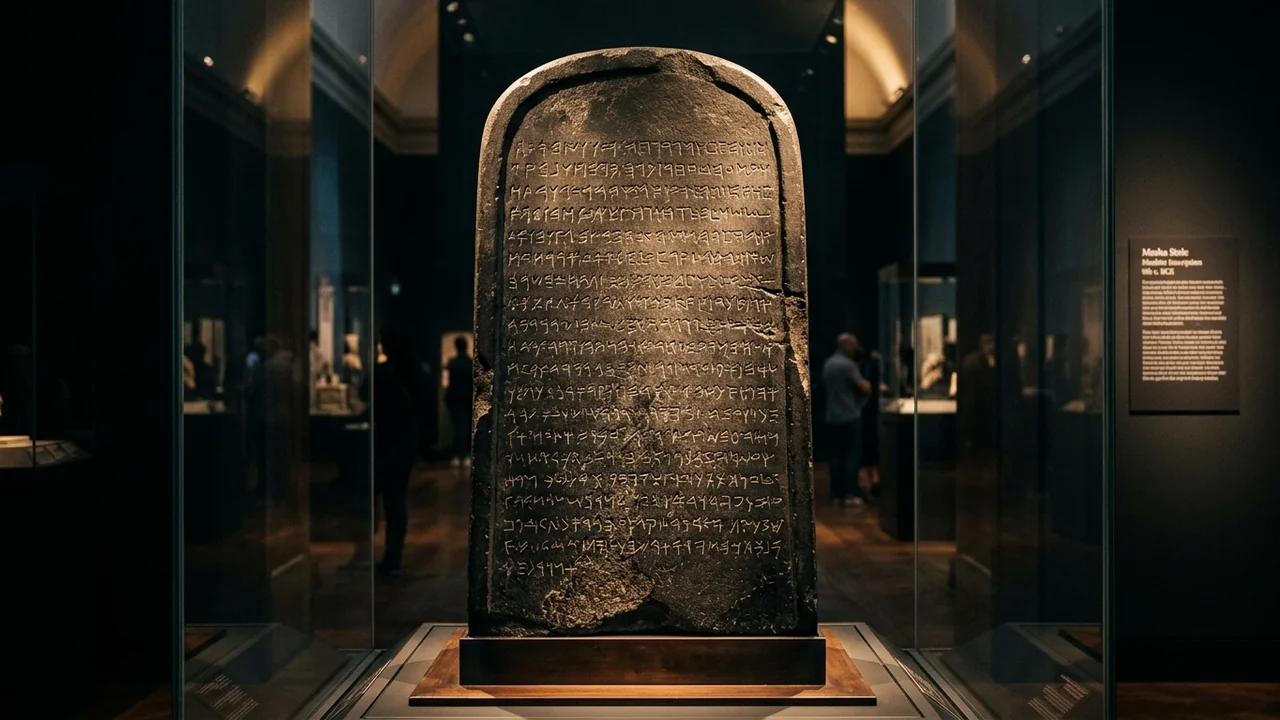
In August 1868, an Alsatian Anglican missionary named Frederick Augustus Klein was traveling through the arid basalt hills east of the Dead Sea in modern-day Jordan. Guided by local Bedouin sheikhs across the ancient ruins of Dhiban (the biblical capital of Dibon, mentioned in Numbers 21:30 and Isaiah 15:2), Klein was led to a remarkable sight lying face-up in the rubble: a colossal slab of polished black basalt stone measuring 1.24 meters (4.1 feet) tall, 71 centimeters wide, and 37 centimeters thick.
The curved, rounded monument was covered in thirty-four lines of crisp, impeccably incised alphabetic text written in the ancient Moabite language—a West Semitic dialect virtually identical in grammar, syntax, and vocabulary to classical Biblical Hebrew.
Klein had discovered what would become the most celebrated extra-biblical monument in Near Eastern archaeology: the Mesha Stele (popularly known as the Moabite Stone).
Commissioned around 840 BC by King Mesha of Moab, the stele provides an astonishing parallel account of the military, political, and religious wars recorded in 2 Kings 1 and 2 Kings 3. It explicitly names the God of Israel (Yahweh), the Northern Kingdom’s royal founder ("Omri, King of Israel"), and, according to recent 21st-century epigraphic technology, the royal southern dynasty of Judah: the "House of David" (Beit Dawid)!
The Tragedy of 1868: Fire, Water, and the Paper Squeeze
The survival of the Mesha Stele is an archaeological miracle born out of an 1868 diplomatic and cultural tragedy.
When news of the discovery reached European consulates in Jerusalem, intense rivalries erupted between Prussian, French, and British officials, each seeking to purchase the stone for their national museums. The young French scholar and diplomat Charles Simon Clermont-Ganneau recognized the immense epigraphic value of the monument and dispatched an Arab assistant, Ya'qub Karavaca, to the site in 1869 with a crucial mission: make a paper squeeze (papier-mâché wet impression) of the inscription.
Karavaca laid sheets of wet paper across the face of the stone, beating them into the incised letters with a horsehair brush to create an exact negative impression:
[Clermont-Ganneau's Assistant Pressing Wet Paper Squeeze]
                           │
                           ▼  Bedouin Tribal Dispute Erupts!
[Squeeze Ripped From Stone in Panic (Preserving 34 Lines of Text)]
                           │
                           ▼
[Beni Sakhr Bedouin Light Blazing Fire Around Basalt Stele]
                           │  Basalt expands rapidly under extreme heat (~800°C)
                           ▼
[Sudden Pouring of Cold Well Water onto Glowing Stone]
                           │  Severe Thermal Shock & Sudden Contraction
                           ▼
[Basalt Shatters into Hundreds of Exploding Fragments!]
                           │
                           ▼
[Clermont-Ganneau Painstakingly Recovers 613 Fragments Over Decades]
                           │
                           ▼
[Reassembled Monument Displayed in Louvre Museum (AO 5066)]
Suspecting that the foreigners wanted the stone because it contained hidden gold, the local Beni Sakhr Bedouin heated the monument in a roaring bonfire until it glowed red-hot, and then poured cold well water over it. The catastrophic thermal shock caused the basalt to violently fracture and explode into hundreds of fragments, which were distributed among tribal families as magical amulets.
Clermont-Ganneau spent decades tracking down and purchasing 613 individual basalt fragments, representing roughly two-thirds of the monument. Because his assistant had miraculously preserved the original damp paper squeeze before the explosion, conservators at the Louvre Museum in Paris were able to reconstruct the missing sections with plaster, preserving the complete 34-line text for world history!
Corroborating 2 Kings 3: Omri, Ahab, and the Sheepmaster King
The biblical Book of Second Kings introduces King Mesha of Moab with sharp economic and political detail:
"And Mesha king of Moab was a sheepmaster, and rendered unto the king of Israel an hundred thousand lambs, and an hundred thousand rams, with the wool. But it came to pass, when Ahab was dead, that the king of Moab rebelled against the king of Israel." (2 Kings 3:4–5)
Now, compare the biblical record with King Mesha's own royal words inscribed on lines 1 to 8 of the black basalt stele:
┌────────────────────────────────────────────────────────────────────────┐
│                   THE MESHA STELE (Lines 4–8 Translation)              │
│                                                                        │
│ "I am Mesha, son of Chemosh-gad, king of Moab, the Dibonite...         │
│  Omri was the king of Israel, and he oppressed Moab for many days,     │
│  for Chemosh was angry with his land. And his son succeeded him;       │
│  and he also said, 'I will oppress Moab!' In my days he spoke thus,   │
│  but I triumphed over him and over his house; and Israel perished      │
│  forever!"                                                             │
└────────────────────────────────────────────────────────────────────────┘
The historical synchronization is breathtaking:
- The Exact Names: Both sources confirm that Mesha was King of Moab.
- The Israelite Oppression: Both sources confirm that the Omride dynasty (King Omri and his son King Ahab) subjugated Moab, imposing crippling economic tribute.
- The Timing of the Rebellion: Both the Bible and the Stele confirm that Moab launched its bloody war of independence precisely upon the death of King Ahab!
Where the accounts diverge is a classic example of ancient royal propaganda:
- 2 Kings emphasizes the devastating counter-invasion led by the allied kings of Israel (Jehoram), Judah (Jehoshaphat), and Edom, who marched through the southern desert, destroyed Moabite cities, and besieged King Mesha in his mountain citadel of Kir-Hareseth.
- The Mesha Stele omits Israel’s initial military successes and celebrates Moab’s ultimate survival, the slaughter of Israelite garrisons at Ataroth and Nebo, and the liberation of Moabite border cities.
The Human Sacrifice of Kir-Hareseth: Chemosh vs. Yahweh
The darkest, most horrific moment of the 9th-century BC Moabite war occurred when the coalition forces of Israel, Judah, and Edom cornered King Mesha inside the mountain fortress of Kir-Hareseth (modern Kerak in Jordan):
"And when the king of Moab saw that the battle was too sore for him, he took with him seven hundred men that drew swords, to break through even unto the king of Edom: but they could not. Then he took his eldest son that should have reigned in his stead, and offered him for a burnt offering upon the wall. And there was great indignation against Israel: and they departed from him, and returned to their own land." (2 Kings 3:26–27)
In ancient Levantine paganism, Chemosh (the national god of Moab) was a fierce, wrathful deity whose favor was courted through total devotion (kherem, devotion to destruction).
When Mesha realized his royal lines were collapsing and his death was imminent:
- He took his firstborn crown prince—the future king of Moab—and slaughtered him publicly on top of the city ramparts in full view of the besieging Israelite and Judean armies.
- To ancient Near Eastern soldiers, this ultimate human sacrifice was viewed as releasing supreme, terrifying supernatural wrath (qetzef).
- Shaken by psychological horror and religious dread, the Israelite coalition broke camp, abandoned the siege, and marched back across the Jordan, leaving King Mesha alive to rule his devastated nation and erect his victory stele at Dibon!
On the stele, Mesha attributes his survival entirely to this terrifying deity: "And Chemosh said to me, 'Go, take Nebo from Israel!' So I went by night and fought against it from the break of dawn until noon; and I took it and killed all: seven thousand men, boys, women, girls and maidens, for I had devoted them to Ashtar-Chemosh" (Lines 14–17).
The Line 31 Breakthrough: RTI Imaging and the "House of David"
For over a century, scholars debated Line 31 of the Mesha Stele. Following the Bedouin explosion of 1869, this specific line on the basalt surface was damaged, containing a crucial missing letter.
In 1994, renowned French epigrapher Prof. André Lemaire examined the stele in the Louvre and proposed that Line 31 read: bt [d]wd (בַּית דָּוִד)—"The House of David"!
                    Paleo-Hebrew / Moabite Script:
                         𐤁𐤕   𐤃𐤅𐤃
                    b  t   d  w  d
                    "Beit Dawid" — House of David
Minimalist critics fiercely contested Lemaire’s reading, claiming the missing letter made the reading speculative. However, between 2018 and 2022, an elite scientific team consisting of epigraphers Dr. Michael Langlois and Dr. Matthieu Richelle deployed revolutionary 21st-century imaging technology:
- Reflectance Transformation Imaging (RTI): High-resolution digital photographic sensors captured the basalt surface under dozens of moving, angled light sources, generating a 3D mathematical model of every microscopic chisel mark and indentation.
- Photogrammetry of the 1869 Paper Squeeze: The team applied 3D optical scanning to the pristine paper impression made by Clermont-Ganneau's assistant before the stone was blown up!
- The Incontrovertible Result: In 2022, Langlois and Richelle published their definitive findings in the Revue Biblique: the letter dalet ($d$) is physically, unmistakably present in the paper squeeze! Line 31 speaks of the King of Moab liberating sheep-grazing pastures in the south that had previously been occupied by the "House of David"—the royal Judean dynasty ruling from Jerusalem!
Coming alongside the famous 1993 discovery of the Tel Dan Stele in northern Israel (which also explicitly mentions the Beit Dawid), the Mesha Stele provides independent, contemporary 9th-century BC proof that King David was not a fictional myth, but the historic founder of a recognized royal dynasty in the ancient Near East!
Comparative Epigraphy: 9th-Century BC Royal Levant Inscriptions
| Monument / Inscription | Discovery Location & Year | Author / Commissioning King | Biblical Figures / Dynasties Named | Historical Significance |
|---|---|---|---|---|
| Mesha Stele (Moabite Stone) | Dhiban, Jordan (1868) | King Mesha of Moab (c. 840 BC) | Omri King of Israel, House of David, Chemosh, Yahweh | Direct contemporary corroboration of 2 Kings 3; oldest extra-biblical mention of Yahweh. |
| Tel Dan Stele | Tel Dan, Northern Israel (1993) | King Hazael of Aram-Damascus (c. 835 BC) | King of Israel (Jehoram), King of the House of David (Ahaziah) | First extra-biblical inscription discovered confirming the historical "House of David". |
| Kurkh Monolith | Kurkh, Turkey (1861) | Emperor Shalmaneser III of Assyria (853 BC) | "Ahab the Israelite" (A-ha-ab-bu mat Sir-'a-la-a-a) | Records Ahab deploying 2,000 chariots and 10,000 infantry at the Battle of Qarqar. |
| Black Obelisk of Shalmaneser III | Nimrud, Iraq (1846) | Emperor Shalmaneser III of Assyria (841 BC) | "Jehu, son of Omri" (Ia-u-a mar Hu-um-ri-i) | Features stone relief showing King Jehu of Israel bowing prostrate at Shalmaneser’s feet. |
| Balaam Inscription (Deir Alla) | Tell Deir Alla, Jordan (1967) | Pagan plaster wall inscription (c. 800 BC) | "Balaam, son of Beor, the seer of the gods" | Proves the historical existence of the enigmatic prophet Balaam from Numbers 22–24. |
The Name of Yahweh on Pagan Stone
Perhaps the most electrifying sentence in the entire 34 lines of the Mesha Stele occurs on Line 18. Describing the sack of the Israelite cultic city of Nebo in northern Moab, King Mesha proclaims:
"And I took from there the [vessels] of Yahweh (𐤉𐤄𐤅𐤄), and I dragged them before Chemosh." (Line 18)
This is the oldest known extra-biblical occurrence of the Sacred Tetragrammaton (YHWH) in human history!
Even in a pagan triumphalist monument celebrating the defeat of Israelite garrisons, the Moabite stone testifies to the real-world existence of the covenant God of Israel. Mesha did not claim to conquer generic "gods of the hills"; he boasted of dragging the sacred vessels of YHWH before the shrine of his god Chemosh.
Centuries later, the proud empire of Moab vanished beneath the sands of time. Its cities became ruined tels, and its god Chemosh became an extinct mythological footnote. Yet the words carved into that black basalt slab survived fire, explosion, and millennia of decay—testifying to modern generations that the historical kings, wars, and prophets of the Hebrew Bible walked the soil of this earth, and that the God of Abraham remains the sovereign ruler of history.
Discover the Full Epigraphic and Archaeological Dossiers
The Mesha Stele is one of dozens of ancient royal monuments where West Semitic epigraphy, high-resolution 3D RTI imaging, and biblical history intersect. To examine complete line-by-line paleo-Hebrew transliterations of the Moabite Stone, high-resolution scans of the 1869 paper squeeze, and comparative military maps of 2 Kings 3:
👉 Discover Volume III: The Final Files – Biblical Disasters & Ancient Wonders ($2.99)
Features complete 34-line English and Hebrew epigraphic glossaries of the Mesha Stele, archaeological blueprints of the Kir-Hareseth fortress, and RTI photographic dossiers.
Frequently Asked Questions
What is the Mesha Stele and why is it so important?
The Mesha Stele (also called the Moabite Stone) is a 3-foot black basalt monument discovered in 1868 at Dhiban, Jordan. Carved around 840 BC by King Mesha of Moab, it contains 34 lines of text that directly corroborate the events of 2 Kings 3, explicitly naming King Omri of Israel, the God Yahweh, and the "House of David".
How was the stone destroyed and rebuilt?
In 1869, local Bedouin heated the basalt stone in a bonfire and doused it with cold well water, shattering it into hundreds of pieces due to thermal shock. Fortunately, French archaeologist Charles Clermont-Ganneau had taken a damp paper impression (paper squeeze) before the explosion. Conservators at the Louvre Museum in Paris used this impression to reassemble over 600 fragments.
Does the Mesha Stele really mention the "House of David"?
Yes. In 1994, epigrapher André Lemaire identified the letters bt [d]wd ("House of David") on Line 31. In 2022, epigraphers Michael Langlois and Matthieu Richelle used high-resolution Reflectance Transformation Imaging (RTI) and 3D photogrammetry of the original 1869 paper squeeze to confirm the reading beyond doubt, providing independent extra-biblical proof of King David’s royal dynasty.
What is the significance of the Tetragrammaton (YHWH) on the stele?
On Line 18, King Mesha boasts that he looted the sacred vessels of YHWH from the Israelite city of Nebo and dragged them before his god Chemosh. This is the oldest known extra-biblical inscription of the personal name of God (Yahweh) ever discovered in archaeology.
Frequently Asked Questions
What is the Mesha Stele and why is it so important?
The Mesha Stele (also called the Moabite Stone) is a 3-foot black basalt monument discovered in 1868 at Dhiban, Jordan. Carved around 840 BC by King Mesha of Moab, it contains 34 lines of text that directly corroborate the events of 2 Kings 3, explicitly naming King Omri of Israel, the God Yahweh, and the "House of David".
How was the stone destroyed and rebuilt?
In 1869, local Bedouin heated the basalt stone in a bonfire and doused it with cold well water, shattering it into hundreds of pieces due to thermal shock. Fortunately, French archaeologist Charles Clermont-Ganneau had taken a damp paper impression (paper squeeze) before the explosion. Conservators at the Louvre Museum in Paris used this impression to reassemble over 600 fragments.
Does the Mesha Stele really mention the "House of David"?
Yes. In 1994, epigrapher André Lemaire identified the letters bt [d]wd ("House of David") on Line 31. In 2022, epigraphers Michael Langlois and Matthieu Richelle used high-resolution Reflectance Transformation Imaging (RTI) and 3D photogrammetry of the original 1869 paper squeeze to confirm the reading beyond doubt, providing independent extra-biblical proof of King David’s royal dynasty.
What is the significance of the Tetragrammaton (YHWH) on the stele?
On Line 18, King Mesha boasts that he looted the sacred vessels of YHWH from the Israelite city of Nebo and dragged them before his god Chemosh. This is the oldest known extra-biblical inscription of the personal name of God (Yahweh) ever discovered in archaeology.
Related Research Dossiers
View all 120 articles →
150 mph Ballistics: Why Goliath’s Bronze Helmet Was Useless Against David’s Sling
185,000 Assyrian Soldiers Wiped Out in One Night: The Pathology of Sennacherib's Siege Failure