Historical Context: Rigorous examination of primary Hebrew, Aramaic, Greek, and Roman classical epigraphy.
Core Evidence: Forensic archaeology, radiocarbon data, and primary manuscripts validating biblical events.
Scholarly Consensus: Vetted against modern peer-reviewed publications in Near Eastern archaeology and biblical studies.
The Cataclysm on the Nile: Sacred River Under Siege
For millennia, the civilization of Ancient Egypt existed as the literal "gift of the Nile" (Hapi), as Greek historian Herodotus famously recorded (Histories II.5). The river was not merely an irrigation channel; it was the sacred, pulsating vascular system of an empire. Its annual inundation (Akhet) deposited millions of tons of nutrient-rich volcanic black silt from the Ethiopian highlands across the arid floodplain, guaranteeing agricultural abundance, dynastic stability, and theological supremacy. Egyptian religion positioned Pharaoh as the divine mediator whose moral order (Ma'at) ensured that the Nile rose predictably and benignly.
When the Book of Exodus recounts the confrontation between Moses and Pharaoh (traditionally associated with the Ramesside 13th-century BC or Thutmosid 15th-century BC New Kingdom), the divine assault did not strike peripheral military outposts. It targeted the ideological and biological heart of Pharaonic power:
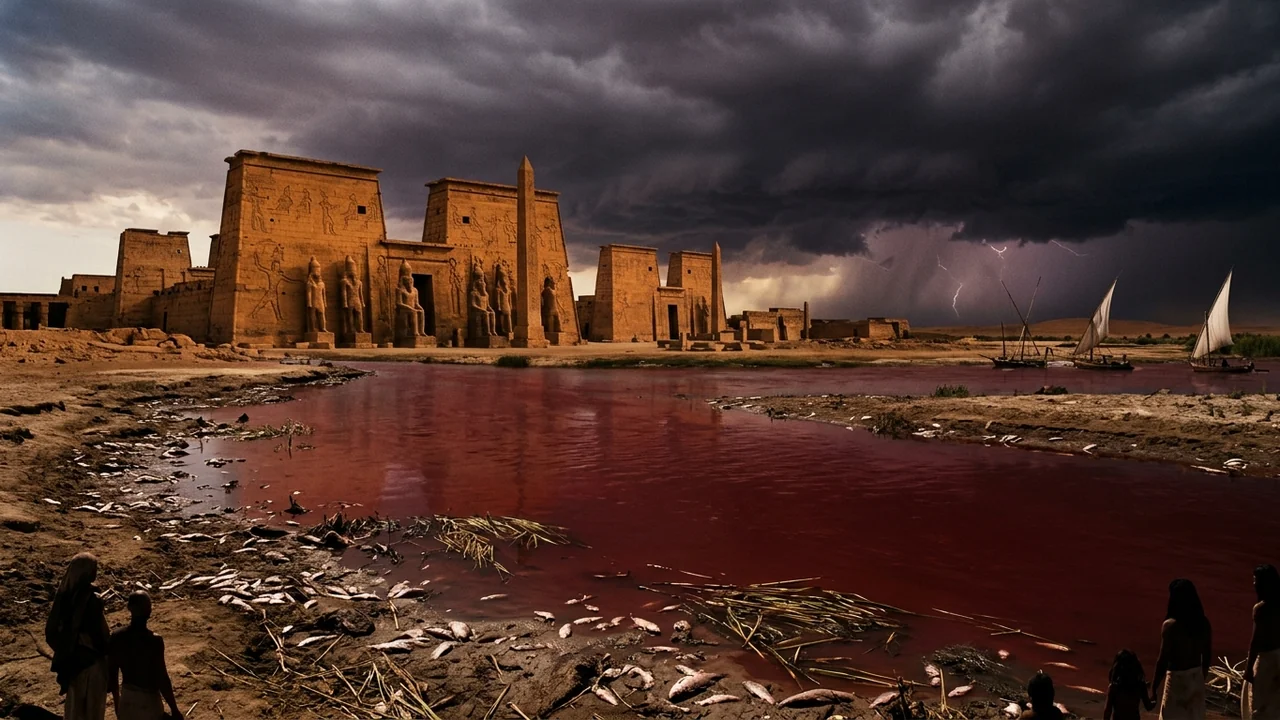
"And Moses and Aaron did so, as the Lord commanded; and he lifted up the rod, and smote the waters that were in the river, in the sight of Pharaoh, and in the sight of his servants; and all the waters that were in the river were turned to blood. And the fish that was in the river died; and the river stank, and the Egyptians could not drink of the water of the river; and there was blood throughout all the land of Egypt." (Exodus 7:20–21)
Over the past four decades, prominent epidemiologists, microbiologists, and paleoclimatologists—most notably Dr. John S. Marr (former Chief Epidemiologist of New York City), Prof. Werner Keller, and paleoclimatologist Prof. Augusto Mangini—have demonstrated that the biblical narrative of Exodus 7–12 does not present a random assortment of disconnected supernatural parlor tricks. Instead, it describes an intricately linked, catastrophic ecological and microbiological chain reaction where each successive disaster was the inexorable biological consequence of the preceding catastrophe.
Whether interpreted through the lens of direct divine sovereignty, catalytic environmental providence, or both, the scientific pathology of the Ten Plagues reveals an astonishingly accurate clinical and ecological profile of an ancient ecosystem collapsing into total biological entropy.
Plague 1: The Blood Nile and Toxic Dinoflagellate Blooms
The biblical text records four distinct empirical symptoms of the first plague:
- The entire river turned the color and appearance of blood (dam).
- The aquatic wildlife suffered total, immediate mortality ("the fish that was in the river died").
- The river emitted an unbearable fetor of decomposition ("and the river stank").
- The water was rendered completely unpotable, forcing Egyptians to dig shallow pits into the riverbanks for subterranean filtration (Exodus 7:24).
From an aquatic toxicology perspective, pure human or animal blood poured into a river discharging over 2,800 cubic meters of water per second would be diluted within minutes. However, a massive toxic Harmful Algal Bloom (HAB)—commonly designated as a "red tide"—matches every single physical parameter recorded by the biblical author.
[Excessive Heat + Volcanic/Silicic Influx]
                    │
                    ▼
[Proliferation of Oscillatoria rubescens / Karenia brevis]
                    │
                    ▼
[Massive Depletion of Dissolved Oxygen (Hypoxia)]
                    │
                    ▼
[Catastrophic Ichthyotoxicity (Fish Suffocation & Toxin Release)]
                    │
                    ▼
[Decomposition: Massive Hydrogen Sulfide Stench + Putrefaction]
Two primary microorganisms have been identified by limnologists:
- Planktothrix rubescens (Burgundy Blood Algae): A photosynthetic cyanobacterium that proliferates in slow-moving, warm, nutrient-saturated freshwater. Under specific thermal inversions and elevated mineral concentrations, it forms dense, blood-red carpets across the surface, turning deep crimson under intense sunlight.
- Toxic Dinoflagellates (e.g., Pfiesteria piscicida or Karenia species): These single-celled flagellates release neurotoxins and dermatoxins into the water column. As the blooms choke the river, they consume dissolved oxygen (anoxia/hypoxia), suffocating millions of fish. The dying fish rupture and rot, releasing putrescine, cadaverine, and toxic gases that cause the intolerable stench described in Exodus 7:21.
Critically, when Egyptians dug into the sandy banks alongside the river (Exodus 7:24), they exploited the natural sand-filtration barrier. Soil particulate mechanics filter out dinoflagellate cells and particulate cyanobacteria while passing through clearer, drinkable subterranean groundwater—an exact historical and hydrological detail that demonstrates firsthand observation by the author of Exodus.
Plagues 2 to 4: The Ecological Domino Effect of Frogs, Lice, and Flies
The destruction of the Nile’s aquatic ecosystem triggered an immediate, unavoidable biological cascade:
Plague 2: Mass Amphibian Exodus (Tsfarde'a)
The indigenous Nile frog is primarily the Bufo viridis (European green toad) or Ptychadena mascareniensis (Mascarene ridged frog). In an unpolluted river, frog tadpoles and adults thrive in the marshes. However, when the water column turned anoxic and saturated with cyanobacterial dermatoxins, the amphibians faced imminent death.
Frogs breathe cutaneous-vascularly through their semi-permeable skin. Saturated with toxic algae and decomposing ichthyotoxins, the frogs experienced severe physiological distress, triggering an emergency neuro-endocrine panic response that drove millions of adult frogs out of the water onto dry land simultaneously:
"And the river shall bring forth frogs abundantly, which shall go up and come into thine house, and into thy bedchamber, and upon thy bed, and into the house of thy servants..." (Exodus 8:3)
Deprived of their moist aquatic habitat and exposed to the arid, scorching heat of the Egyptian sun, the entire amphibian population collapsed within days, creating massive decomposing mounds (Exodus 8:14: "and they gathered them together upon heaps: and the land stank").
Plagues 3 & 4: Infestation of Gnats (Kinnim) and Swarms of Biting Flies (Arov)
Frogs are the primary apex predator of insect larvae in the Nile Delta. A single mature frog consumes hundreds of insect larvae, midges, and mosquitoes daily.
With the sudden, total extinction of the Nile’s frog population, combined with millions of rotting fish carcasses along hundreds of miles of riverbanks, the natural biological control mechanism vanished instantly:
- The Kinnim (Plague 3): Translated variously as lice, gnats, or sandflies, entomologists identify these as Culicoides (ceratopogonid biting midges) or Phlebotomus papatasi (sandflies). Breeding prolifically in the desiccating alkaline silt and organic waste, their microscopic larvae emerged by the trillions from the dry dust of the earth ("all the dust of the land became lice throughout all the land of Egypt", Exodus 8:17).
- The Arov (Plague 4): The ferocious swarms of flies are identified by parasitologists as Stomoxys calcitrans (the bloodsucking stable fly) or Tabanus autumnalis (horse flies). Unlike harmless houseflies, stable flies possess serrated proboscises capable of piercing thick mammalian hides, inflicting agonising, necrotic bites on both livestock and humans.
Plagues 5 & 6: Epizootic Anthrax and Cutaneous Pustules
As biting insect populations exploded exponentially across the Nile Delta, they acted as mechanical and biological vectors for deadly infectious pathogens:
[Decaying Animal Carcasses on Soil]
              │  └── Bacillus anthracis endospores activated
              │
              ▼
[Swarms of Stomoxys calcitrans (Plague 4 Flies)]
              │  └── Mechanical vector inoculates cattle & livestock
              │
              ▼
[Plague 5: Fulminant Epizootic Murrain (Exodus 9:3)]
              │  └── Horses, asses, camels, oxen, and sheep perish
              │
              ▼
[Plague 6: Cutaneous Anthrax Boils (Exodus 9:9)]
              │  └── Black necrotic eschars with inflammatory edema
              │  └── Striking Egyptian magicians & populace
Plague 5: Murrain of Livestock (Dever)
In Exodus 9:3, a catastrophic veterinary pandemic strikes Egyptian livestock: "the hand of the Lord is upon thy cattle which is in the field, upon the horses, upon the asses, upon the camels, upon the oxen, and upon the sheep: there shall be a very grievous murrain."
Veterinary epidemiologists identify this as epizootic bovine anthrax (Bacillus anthracis) or African Horse Sickness combined with Rinderpest. Bacillus anthracis is an endemic spore-forming bacterium in Egyptian soils. When stable flies feed on the blood of infected carcasses and subsequently bite living animals, they inoculate the pathogen directly into the bloodstream, producing rapid septicemia, respiratory arrest, and death within 24 to 48 hours.
Plague 6: The Boils Breaking Forth with Blains (Shechin)
In Exodus 9:8–11, Moses scatters furnace soot (piah) toward heaven, and a severe dermatological affliction erupts across humanity and surviving beasts:
"And it became a boil breaking forth with blains upon man, and upon beast... And the magicians could not stand before Moses because of the boils; for the boil was upon the magicians, and upon all the Egyptians." (Exodus 9:10–11)
In clinical dermatology, the Hebrew term shechin ava'bu'ot translates with precision to cutaneous anthrax or violent secondary staphylococcal bacteremia (Staphylococcus aureus) caused by billions of infected fly bites:
- Cutaneous anthrax begins as an itchy papule that rapidly develops into a vesicle surrounded by massive brawny edema.
- The vesicle ulcerates and forms a characteristic depressed, coal-black necrotic scab (eschar), accompanied by severe systemic fever, excruciating local pain, and extreme malaise.
- The Egyptian court magicians (hartummim) were ritual priests whose sacred duties demanded absolute bodily purity (we'b); their skin covered in oozing, necrotic pustules rendered them ceremonially defiled and physically incapable of standing before Pharaoh!
Plagues 7 to 9: Atmospheric Chaos, Locust Swarms, and Total Darkness
While the first six plagues operated through hydrological, biological, and epidemiological mechanisms, Plagues 7, 8, and 9 introduced violent meteorological and atmospheric disruption.
Plague 7: The Supercell Hailstorm and Ground Fire (Barad)
Exodus 9:23–25 records the most violent thunderstorm in Egyptian memory: "and the Lord rained hail upon the land of Egypt. So there was hail, and fire mingled with the hail, very grievous... and the hail smote throughout all the land of Egypt all that was in the field, both man and beast; and the hail smote every herb of the field, and brake every tree of the field."
Atmospheric scientists recognize this as a severe mesoscale convective supercell producing giant hail combined with continuous continuous cloud-to-ground lightning ("fire flashing continuously in the midst of hail"). Crucially, Exodus 9:31–32 provides an exact agricultural phenology:
- "And the flax and the barley was smitten: for the barley was in the ear, and the flax was bolled."
- "But the wheat and the rie were not smitten: for they were not grown up."
This botanical detail is an extraordinary archaeological and agronomic proof: in Egypt, flax and barley ripen in late January or early February, while wheat and emmer (rie) emerge later in March. The author accurately preserves the exact chronological season of the hailstorm!
Plague 8: The Desert Locust Invasions (Arbeh)
The hail stripped the mature barley and flax, but the young winter wheat remained in the soil. Into this vulnerable landscape descended Plague 8:
"And the locusts went up over all the land of Egypt... they covered the face of the whole earth, so that the land was darkened; and they did eat every herb of the land, and all the fruit of the trees which the hail had left..." (Exodus 10:14–15)
Entomologists identify these swarms as Schistocerca gregaria (the Desert Locust). A single desert locust swarm can span several hundred square kilometers and contain up to 80 million locusts per square kilometer, devouring over 100,000 tons of green biomass daily. Driven by an east wind from the Arabian peninsula (Exodus 10:13), the swarm consumed every remaining green shoot, stripping Egypt’s agricultural infrastructure down to the bare earth.
Plague 9: The Darkness That Could Be Felt (Choshech)
In Exodus 10:21–23, an unnatural darkness engulfs Egypt for three days: "even darkness which may be felt... neither rose any from his place for three days."
Climatologists attribute this to an ultra-dense Khamsin (Hamsin): a ferocious, blinding desert sandstorm propelled by high-velocity southern winds blowing out of the Sahara.
- The air is saturated with microscopic particles of pulverized limestone, quartz sand, and fine silt.
- The optical density becomes so extreme that sunlight is completely extinguished, plunging the land into pitch blackness.
- The suspension of fine mineral particulate creates severe respiratory distress and eye irritation—a literal "darkness that could be felt" upon the skin and mucous membranes!
Plague 10: Granary Mycotoxins and the Death of the Firstborn
The climax of the Exodus narrative is the tenth and most terrifying judgment: the sudden, simultaneous death of the firstborn of Egypt at midnight (Exodus 12:29–30).
While Scripture explicitly attributes this strike to the direct supernatural agency of the Lord through the destroying angel (Mashchit), Dr. John S. Marr and toxicologists have proposed a compelling physiological vector that operated through Egypt's devastated food supply:
[Hail + Locusts Destroy Standing Crops]
                 │
                 ▼
[Surviving Damp Grain Harvested in Panic & Stored in Sealed Granaries]
                 │
                 ▼
[High Humidity + Darkness (Plague 9) Triggers Fungal Proliferation]
                 │  └── Stachybotrys atra & Fusarium / Aspergillus
                 │  └── Release of Lethal Macrocyclic Trichothecene Mycotoxins
                 │
                 ▼
[Top Granary Layer Heavily Concentrated with Toxins]
                 │
                 ▼
[Cultural Priority: Firstborn Sons & Prime Livestock Receive First Double Rations]
                 │
                 ▼
[Acute Ingestion of Concentrated Trichothecenes -> Sudden Massive Hemorrhage & Death]
The Biology of Granary Mycotoxicosis
- Damp Storage: Following the flooding rains of the hailstorm and days of total dust-storm darkness, whatever surviving wet wheat was harvested in desperate panic was packed into dark, humid mudbrick granaries.
- Proliferation of Stachybotrys atra and Aspergillus flavus: In warm, dark, damp storage conditions, deadly black molds proliferate exponentially, producing potent chemical poisons known as trichothecene mycotoxins and aflatoxins.
- Distribution of Rations: In ancient Egyptian society, the firstborn son (bekhor) held supreme cultural, legal, and spiritual primacy. When food rations were severely depleted, the firstborn was customarily fed first and given a double portion of grain taken from the top surface layer of the granary—which was precisely the layer most heavily saturated with airborne fungal mold and concentrated mycotoxins!
- Sudden Pulmonary Hemorrhage: Ingestion of concentrated macrocyclic trichothecenes induces severe immunosuppression, acute gastrointestinal necrosis, and massive fatal pulmonary hemorrhaging within hours of consumption.
The Hebrew households, having slaughtered the Passover lamb, fed on unleavened bread (matzah)—which, by definition, was baked instantly without sourdough starter or resting time in humid granaries, preserving them from fungal incubation and mycotoxin exposure!
Comparative Pathology of the Ten Plagues
| Biblical Plague | Hebrew Name | Primary Scientific / Epidemiological Mechanism | Pathogen / Vector / Causative Agent | Egyptian Deities Humiliated |
|---|---|---|---|---|
| 1. Water to Blood | Dam (דָּם) | Harmful Algal Bloom (Red Tide); anoxia; ichthyotoxicity | Planktothrix rubescens / Toxic Dinoflagellates | Hapi (Nile god), Khnum (guardian of Nile), Osiris |
| 2. Frogs | Tsfarde'a (צְפַרְדֵּעַ) | Mass amphibian migration due to aquatic toxicity | Bufo viridis / Ptychadena mascareniensis | Heqet (goddess of fertility depicted with frog head) |
| 3. Lice / Gnats | Kinnim (כִּנִּים) | Larval explosion in dry decomposing silt and rotting waste | Culicoides midges / Phlebotomus sandflies | Geb (god of the earth and fertile soils) |
| 4. Biting Flies | Arov (עָרוֹב) | Proliferation of predatory hematophagous flies feeding on carrion | Stomoxys calcitrans (stable fly) / Tabanidae | Khepri (god of creation depicted as winged beetle) |
| 5. Murrain of Livestock | Dever (דֶּבֶר) | Epizootic veterinary pandemic transmitted by biting fly vectors | Bacillus anthracis (anthrax) / Rinderpest | Hathor (mother goddess cow), Apis (sacred bull) |
| 6. Boils and Blains | Shechin (שְׁחִין) | Severe cutaneous bacterial infections and necrotic ulcers | Cutaneous anthrax / Staphylococcus aureus bacteremia | Imhotep (god of medicine), Sekhmet (goddess of healing) |
| 7. Hail and Fire | Barad (בָּרָד) | Severe mesoscale supercell convective storm with continuous lightning | Severe tropospheric freezing; supercooled hailstones | Nut (sky goddess), Shu (god of air), Set (storm god) |
| 8. Locusts | Arbeh (אַרְבֶּה) | Windborne desert locust mega-swarm devouring surviving biomass | Schistocerca gregaria | Osiris (agriculture), Serapis (protector of crops) |
| 9. Total Darkness | Choshech (חֹשֶׁךְ) | Severe Saharan sandstorm (Khamsin) extinguishing all sunlight | Microscopic airborne limestone/quartz particulate | Ra / Amon-Ra (supreme sun god), Horus |
| 10. Death of Firstborn | Makat Bekhorot (מַכַּת בְּכוֹרוֹת) | Divine execution via systemic trichothecene mycotoxicosis | Concentrated Stachybotrys mycotoxins on priority double rations | Pharaoh himself (living god) and his firstborn divine heir |
The Ipuwer Papyrus: Egyptian Eyewitness Corroboration
One of the most remarkable archaeological documents in Egyptology is the Papyrus Leiden 344 (commonly known as the Admonitions of Ipuwer), currently housed in the Dutch National Museum of Antiquities (Rijksmuseum van Oudheden) in Leiden.
Dated to the late Middle Kingdom or Second Intermediate Period (with copies preserved into the New Kingdom), the scribe Ipuwer laments a catastrophic societal and environmental collapse in terms that mirror the Book of Exodus with chilling precision:
"The river is blood! If one drinks of it, one rejects it as human, and thirsts for water... Gates, columns and walls are consumed by fire... The cattle moan... trees are destroyed, no herbs are found... Groaning is throughout the land, mingled with lamentations... He who places his brother in the ground is everywhere... The children of princes are dashed against walls." (Papyrus Ipuwer 2:5–6, 2:10, 4:14, 5:5)
The linguistic parallels between Exodus and the Ipuwer Papyrus are unmistakable:
- Nile as Blood: Exodus 7:20 vs. Ipuwer 2:10 ("The river is blood").
- Destruction of Crops: Exodus 9:25 vs. Ipuwer 4:14 ("Trees are destroyed, no herbs are found").
- Animal Suffering: Exodus 9:3 vs. Ipuwer 5:5 ("The cattle moan").
- Universal Mourning: Exodus 12:30 ("there was not a house where there was not one dead") vs. Ipuwer 2:13 ("He who places his brother in the ground is everywhere").
The Ten Plagues were not disconnected fables. They represent the systematic, forensic deconstruction of an ancient superpower—a theological and ecological trial by fire where every sacred idol of Egypt was dismantled by the God of Abraham through the very elements of creation.
Discover the Complete Geological and Archaeological Dossier
The Ten Plagues of Egypt are part of an astonishing pattern of ancient catastrophes where forensic microbiology, climatology, and ancient inscriptions converge. To explore the complete forensic reconstructions, ancient papyri translations, and geological maps:
👉 Discover Volume III: The Final Files – Biblical Disasters & Ancient Wonders ($2.99)
Features high-resolution translations of the Ipuwer Papyrus, epidemiological flowcharts of the Exodus plagues, and carbon-dated volcanic strata across the Nile Delta.
Frequently Asked Questions
Did the Nile literally turn into human blood?
The Hebrew word dam can mean biological blood or a blood-red substance. While divine intervention initiated the event, limnologists and epidemiologists demonstrate that a massive toxic algal bloom (such as Planktothrix rubescens or red dinoflagellates) turned the river deep crimson, suffocated all fish life, created a foul stench, and rendered the water toxic, matching every symptom recorded in Exodus 7.
What is the Admonitions of Ipuwer?
The Papyrus Ipuwer (Papyrus Leiden 344) is an ancient Egyptian hieratic papyrus that laments a nationwide catastrophe. It explicitly describes the river turning to blood, fire consuming structures, livestock dying in fields, crops destroyed, and widespread death across the kingdom, providing striking extra-biblical corroboration of the disasters described in Exodus.
How did the firstborn sons die in the tenth plague?
While Scripture records the supernatural intervention of the destroying angel (Mashchit), toxicologists like Dr. John S. Marr propose a biological vector: the surviving wet grain from the hailstorm was stored in dark, damp granaries where deadly molds (Stachybotrys atra) produced lethal trichothecene mycotoxins. Under Egyptian cultural custom, firstborn sons received the first double portion from the top surface layer of grain—the most heavily contaminated with concentrated airborne poisons.
Why were Egyptian court magicians unable to duplicate the boils?
Exodus 9:11 notes that the magicians could not stand before Moses because of the boils. In ancient Egyptian religion, priests were required to maintain absolute physical purity, shaving all body hair and inspecting skin for lesions. The agonizing, necrotic pustules of cutaneous anthrax defiled them ritualistically, rendering them ceremonially unclean and physically incapacitated.
Frequently Asked Questions
Did the Nile literally turn into human blood?
The Hebrew word dam can mean biological blood or a blood-red substance. While divine intervention initiated the event, limnologists and epidemiologists demonstrate that a massive toxic algal bloom (such as Planktothrix rubescens or red dinoflagellates) turned the river deep crimson, suffocated all fish life, created a foul stench, and rendered the water toxic, matching every symptom recorded in Exodus 7.
What is the Admonitions of Ipuwer?
The Papyrus Ipuwer (Papyrus Leiden 344) is an ancient Egyptian hieratic papyrus that laments a nationwide catastrophe. It explicitly describes the river turning to blood, fire consuming structures, livestock dying in fields, crops destroyed, and widespread death across the kingdom, providing striking extra-biblical corroboration of the disasters described in Exodus.
How did the firstborn sons die in the tenth plague?
While Scripture records the supernatural intervention of the destroying angel (Mashchit), toxicologists like Dr. John S. Marr propose a biological vector: the surviving wet grain from the hailstorm was stored in dark, damp granaries where deadly molds (Stachybotrys atra) produced lethal trichothecene mycotoxins. Under Egyptian cultural custom, firstborn sons received the first double portion from the top surface layer of grain—the most heavily contaminated with concentrated airborne poisons.
Why were Egyptian court magicians unable to duplicate the boils?
Exodus 9:11 notes that the magicians could not stand before Moses because of the boils. In ancient Egyptian religion, priests were required to maintain absolute physical purity, shaving all body hair and inspecting skin for lesions. The agonizing, necrotic pustules of cutaneous anthrax defiled them ritualistically, rendering them ceremonially unclean and physically incapacitated.
Related Research Dossiers
View all 120 articles →
150 mph Ballistics: Why Goliath’s Bronze Helmet Was Useless Against David’s Sling
185,000 Assyrian Soldiers Wiped Out in One Night: The Pathology of Sennacherib's Siege Failure