Historical Context: Rigorous examination of primary Hebrew, Aramaic, Greek, and Roman classical epigraphy.
Core Evidence: Forensic archaeology, radiocarbon data, and primary manuscripts validating biblical events.
Scholarly Consensus: Vetted against modern peer-reviewed publications in Near Eastern archaeology and biblical studies.
The Catastrophe at Aphek: The Capture of the Ark
In approximately 1070 BC, during the waning days of the High Priest Eli, the armies of Israel suffered the most humiliating military and spiritual defeat in their early history. Colliding with the armored iron chariots of the Philistines at the Battle of Aphek (near modern Rosh HaAyin), the Israelite infantry lines shattered, leaving thirty thousand foot soldiers dead on the field.
In a desperate, superstitious attempt to turn the tide of battle, the corrupt priests Hophni and Phinehas had carried the golden Ark of the Covenant from its ancient resting place in the Tabernacle at Shiloh into the front lines. The gambit backfired catastrophically:
"And the Philistines fought, and Israel was smitten... and there was a very great slaughter; for there fell of Israel thirty thousand footmen. And the ark of God was taken; and the two sons of Eli, Hophni and Phinehas, were slain." (1 Samuel 4:10–11)
When a lone runner reached Shiloh with the news, the ninety-eight-year-old Eli fell backward off his seat, broke his neck, and died. Phinehas's pregnant wife gave birth prematurely and died, naming her child Ichabod ("The glory is departed from Israel").
To the Philistines, the capture of the supreme deity-box of the Hebrews was the ultimate imperial triumph. They carried the Ark down to their coastal capital of Ashdod, placing it as a captive trophy inside the temple of their chief god, Dagon.
The Humiliation of Dagon: Broken Hands on the Threshold
The Philistines assumed that Dagon had subdued Yahweh. But when the temple priests of Ashdod opened the heavy sanctuary doors at dawn the following morning, they were met with a shocking sight:
"And when they of Ashdod arose early on the morrow, behold, Dagon was fallen upon his face to the earth before the ark of the Lord. And they took Dagon, and set him in his place again." (1 Samuel 5:3)
Dismissing the incident as a freak structural tremor or accidental displacement, the priests set the heavy carved statue upright upon its pedestal.
The next morning, the supernatural judgment was unmistakable:
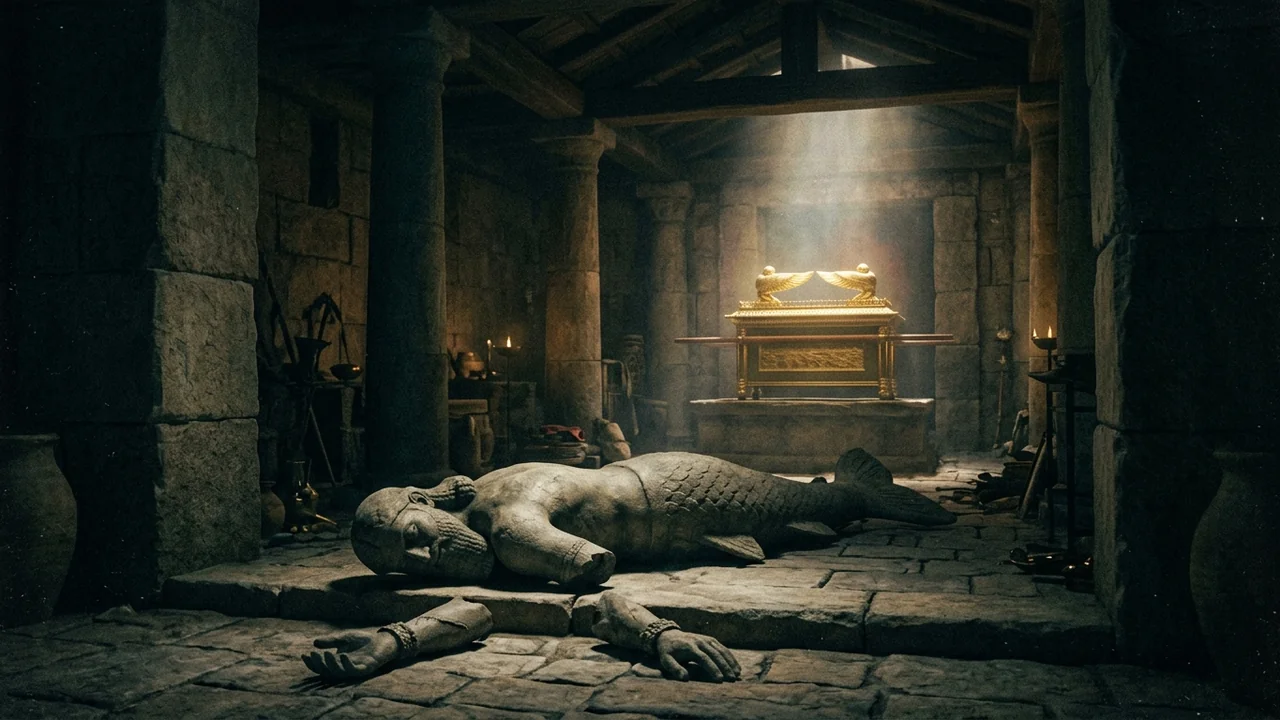
"And when they arose early on the morrow morning, behold, Dagon was fallen upon his face to the ground before the ark of the Lord; and the head of Dagon and both the palms of his hands were cut off upon the threshold; only the stump of Dagon was left to him." (1 Samuel 5:4)
In ancient Near Eastern judicial and military protocol, cutting off the head and the hands of a defeated adversary was the universal sign of absolute conquest and total subjugation. Dagon lay mutilated and headless, bowing in his own sanctuary before the throne of God!
The incident was so deeply traumatic that for centuries, the priests of Dagon refused to tread upon the threshold of their temple in Ashdod (1 Samuel 5:5; Zephaniah 1:9).
The Outbreak in the Pentapolis: Ashdod, Gath, and Ekron
Immediately following the decapitation of Dagon’s idol, a terrifying biological catastrophe erupted among the civilian and military population of Ashdod:
"But the hand of the Lord was heavy upon them of Ashdod, and He destroyed them, and smote them with emerods, even Ashdod and the coasts thereof." (1 Samuel 5:6)
Panicked, the lords of the Philistines moved the Ark eastward to the fortress city of Gath. Instantly, the same horrific affliction struck Gath: "He smote the men of the city, both small and great, and they had emerods in their secret parts" (1 Samuel 5:9).
Desperate to rid themselves of the cursed object, they transferred the Ark north to Ekron. But as the sacred chest approached the city gates, the citizens of Ekron cried out in hysteria: "They have brought about the ark of the God of Israel to us, to slay us and our people!"
The chronicler records: "there was a deadly destruction throughout all the city... and the men that died not were smitten with the emerods: and the cry of the city went up to heaven" (1 Samuel 5:11–12).
[Capture of the Ark (Battle of Aphek)]
                   │
                   ├──► Ashdod: Dagon mutilated; sudden inguinal tumors erupt
                   │
                   ├──► Gath: Epidemic spreads; severe mortality in "secret parts"
                   │
                   ├──► Ekron: Total municipal panic; deadly destruction throughout city
                   │
                   └──► Restitution: 5 Golden Tumors + 5 Golden Mice Sent Away
                             └── Placed on unguided ox cart to Beth-Shemesh
Clinical Epidemiology: Bubonic Plague and Lymph Node Buboes
What was the disease that devastated the Philistines? In the King James Version, the Hebrew word is translated as "emerods" (an archaic term for hemorrhoids). However, modern medical historians, epidemiologists, and infectious disease specialists recognize that translating the Hebrew word opolim (or the Masoretic scribal reading techorim) as simple hemorrhoids is a profound clinical error.
The word ophel literally means a "swelling", "mound", or "bulging tumor."
When cross-referenced with the geographic, temporal, and zoological markers in 1 Samuel 5–6, modern medicine recognizes an indisputable diagnosis: Bubonic Plague (Yersinia pestis)!
- "In Their Secret Parts" (Inguinal Buboes): The primary diagnostic hallmark of bubonic plague is the rapid development of buboes—extremely painful, inflammatory, necrotic swellings of the lymph nodes. Over 70% of bubonic plague buboes occur specifically in the inguinal lymph nodes of the groin and upper inner thigh (precisely the "secret parts" described in 1 Samuel 5:9), with secondary swellings in the axillae (armpits) and neck.
- Acute, Excruciating Agony: Buboes swell to the size of an egg or orange within 2 to 5 days, turning tense, shiny, purplish-black (gangrenous necrosis), accompanied by high fever, delirium, vomiting, and internal hemorrhage.
- High Mortality Rate: Untreated bubonic plague has an unassisted mortality rate of 50% to 70%, perfectly matching the biblical description: "the men that died not were smitten with the emerods: and the cry of the city went up to heaven" (1 Samuel 5:12).
The Rodent Vector: Why the Golden Mice Were Mandatory
The definitive medical proof that links the Philistine plague to bubonic plague is the explicit, unexpected zoological detail introduced in 1 Samuel 6:
When the Philistine lords summoned their diviners and priests to determine how to return the Ark and appease the God of Israel, the pagan priests gave an extraordinary prescription:
"Then said they, 'What shall be the trespass offering which we shall return to Him?' They answered, 'Five golden emerods, and five golden mice, according to the number of the lords of the Philistines: for one plague was on you all, and on your lords. Wherefore ye shall make images of your emerods, and images of your mice that mar the land; and ye shall give glory unto the God of Israel.'" (1 Samuel 6:4–5)
Why did the Philistine priests connect swollen tumors with field mice (akhbarim)?
In modern epidemiology, it is common knowledge that bubonic plague is an enzootic rodent infection:
- The causative bacterium, Yersinia pestis, is carried by wild rodents (mice, rats, gerbils).
- The vector of transmission to humans is the rodent flea (Xenopsylla cheopis).
- During an epizootic rodent outbreak, infected fleas multiply exponentially on wild field mice. When the rodents die in their millions from the infection, the starving fleas abandon the dead rodent corpses and swarm human hosts, biting them and inoculating the lethal bacteria into the human lymphatic system!
The Philistines did not possess electron microscopes, but three thousand years ago they observed the direct, undeniable correlation: wherever the plague of field mice swarmed across their grain fields, the lethal tumors erupted in the groins of the population!
To make ritual restitution, they cast five golden effigies of the swollen lymph buboes and five golden models of the rodent vectors!
The Unguided Cart to Beth-Shemesh: Statistical Confirmation
To verify whether this catastrophic pandemic was indeed divine judgment from the God of Israel or a mere statistical accident, the Philistine diviners devised a brilliant, mathematically foolproof trial:
"Now therefore make a new cart, and take two milch kine, on which there hath come no yoke, and tie the kine to the cart, and bring their calves home from them: and take the ark of the Lord, and lay it upon the cart; and put the jewels of gold, which ye return Him for a trespass offering, in a coffer by the side thereof; and send it away, that it may go. And see, if it goeth up by the way of his own coast to Beth-shemesh, then He hath done us this great evil: but if not, then we shall know that it is not His hand that smote us; it was a chance that happened to us." (1 Samuel 6:7–9)
From an animal behavioral standpoint, the test was impossible for nature to execute:
- The cows had never been yoked or trained to pull a cart.
- They were nursing mothers whose newborn calves had been locked up at home.
- Natural maternal instinct dictates that a nursing bovine will bellow, refuse to move forward, and stubbornly turn back to nurse her distressed calves.
Yet, when the Philistines released them:
"And the kine took the straight way to the way of Beth-shemesh, and went along the highway, lowing as they went, and turned not aside to the right hand or to the left; and the lords of the Philistines went after them unto the border of Beth-shemesh." (1 Samuel 6:12)
Weeping for their calves yet propelled by an invisible divine hand, the two cows pulled the cart straight across the frontier up the Sorek Valley to the Levitical city of Beth-Shemesh!
The wheat harvesters of Beth-Shemesh lifted up their eyes and rejoiced. The Philistine lords watched from the border in stunned silence. The God of Israel had judged Dagon, decimated the Philistine Pentapolis, and returned His own Ark in glory without a single Hebrew soldier lifting a sword.
Discover the Scientific Investigations of Biblical Plagues
The medical mystery of the Philistine plague and the golden mice reveals the remarkable scientific accuracy preserved in the ancient Hebrew historical records. If you want to explore the complete epidemiological case studies, archaeological site maps of Ashdod and Gath, and the lost journeys of the Ark:
👉 Discover Volume III: The Final Files – Biblical Disasters & Ancient Wonders ($2.99)
Features complete medical pathology reports on ancient pandemics, archaeological excavations of Philistine temples, and high-resolution maps of the Ark of the Covenant.
Frequently Asked Questions
What was the disease that struck the Philistines in 1 Samuel 5?
Modern medical historians and epidemiologists identify the disease as bubonic plague (Yersinia pestis). The biblical text describes painful swellings or tumors (opolim) in the groin and "secret parts" (inguinal lymph node buboes), accompanied by high mortality and an explicit association with a sudden swarm of field mice (the primary rodent vector for plague fleas).
Why did the Philistines make golden models of mice and tumors?
According to ancient Near Eastern sympathetic magic and religious restitution customs, when returning the Ark to appease God, the Philistines were instructed by their priests to make a guilt offering representing the instruments of their suffering: five golden tumors (representing the buboes) and five golden mice (representing the rodent vectors), corresponding to the five ruling lords of the Philistine Pentapolis.
Why did the Philistines use nursing cows to pull the cart?
The Philistines used two untrained nursing cows whose calves were kept at home to test whether the plague was truly from God or just random chance. Under natural animal behavior, nursing cows would refuse to pull a cart and return to their calves. The fact that the cows walked straight toward Israel without a driver proved to the Philistine lords that God was supernaturally guiding them.
What happened to the idol of Dagon in Ashdod?
When the Philistines placed the Ark of the Covenant inside the temple of Dagon in Ashdod, the idol of Dagon miraculously fell face-down before the Ark on the first night. On the second night, Dagon fell again, and his head and both hands were severed upon the threshold, leaving only the torso intact—symbolizing complete divine conquest.
Frequently Asked Questions
What was the disease that struck the Philistines in 1 Samuel 5?
Modern medical historians and epidemiologists identify the disease as bubonic plague (Yersinia pestis). The biblical text describes painful swellings or tumors (opolim) in the groin and "secret parts" (inguinal lymph node buboes), accompanied by high mortality and an explicit association with a sudden swarm of field mice (the primary rodent vector for plague fleas).
Why did the Philistines make golden models of mice and tumors?
According to ancient Near Eastern sympathetic magic and religious restitution customs, when returning the Ark to appease God, the Philistines were instructed by their priests to make a guilt offering representing the instruments of their suffering: five golden tumors (representing the buboes) and five golden mice (representing the rodent vectors), corresponding to the five ruling lords of the Philistine Pentapolis.
Why did the Philistines use nursing cows to pull the cart?
The Philistines used two untrained nursing cows whose calves were kept at home to test whether the plague was truly from God or just random chance. Under natural animal behavior, nursing cows would refuse to pull a cart and return to their calves. The fact that the cows walked straight toward Israel without a driver proved to the Philistine lords that God was supernaturally guiding them.
What happened to the idol of Dagon in Ashdod?
When the Philistines placed the Ark of the Covenant inside the temple of Dagon in Ashdod, the idol of Dagon miraculously fell face-down before the Ark on the first night. On the second night, Dagon fell again, and his head and both hands were severed upon the threshold, leaving only the torso intact—symbolizing complete divine conquest.
Related Research Dossiers
View all 120 articles →
The Unholy Fire of Nadab and Abihu: What Chemical Incense Exploded Inside the Tabernacle?
185,000 Assyrian Soldiers Wiped Out in One Night: The Pathology of Sennacherib's Siege Failure