Does this mean the story of the woman caught in adultery is fake?
No. The overwhelming evidence indicates it is an authentic historical memory of Jesus’ ministry preserved from the earliest apostolic period (attested by Papias c. 120 AD), even though it was not part of the original autograph of John’s Gospel.
Ancient patristic witnesses, Second Temple manuscripts, and classical annals.
Stratigraphic digs, monumental epigraphy, and artifact forensics in the Levant.
Distinguishing canonical Scripture text from historical patristic traditions.
Subject Scope: Direct Answer (AEO): Was the Woman Caught in Adultery (John 7:53–8:11) in the Original Gospel of John? Greek Manuscript Evidence
Historical Context: Rigorous historical and theological examination within the field of Apologetics & Biblical Difficulties.
Primary Evidence: Forensic archaeology, textual preservation, and primary ancient manuscripts corroborating scriptural events.
Investigation Highlights: The Textual Reality: Why Your Bible Has Brackets • The External Papyri and Uncial Evidence: P66, P75, Sinaiticus, and Vaticanus • The "Floating" Passage: Manuscripts Placing It in Luke
Scholarly Consensus: Vetted against peer-reviewed academic literature in biblical history, linguistics, and archaeology.
The Textual Reality: Why Your Bible Has Brackets
Every major modern translation of the Bible—including the ESV, NIV, NASB, CSB, and NRSV—sets John 7:53–8:11 (The Story of the Woman Caught in Adultery) inside brackets accompanied by a prominent footnote:
"The earliest manuscripts do not include 7:53–8:11."
This passage, known in academic scholarship as the Pericope Adulterae (Latin for "Section of the Adulteress"), contains some of the most celebrated and beloved lines in world literature:
- "Let him who is without sin among you be the first to throw a stone at her." (John 8:7)
- "Neither do I condemn you; go, and from now on sin no more." (John 8:11)
Did the Apostle John write these twelve verses in his original autograph? If not, how did this story enter the New Testament, and should Christians treat it as authentic Scripture?
The External Papyri and Uncial Evidence: P66, P75, Sinaiticus, and Vaticanus
Textual criticism evaluates the authenticity of a passage by examining the earliest surviving manuscripts of the New Testament. In the case of the Pericope Adulterae, the external evidence against its presence in the original Gospel of John is overwhelming:
[EXTERNAL MANUSCRIPT WITNESSES]

1. THE EARLIEST PAPYRI:
   - Papyrus 66 (P66, c. 200 AD): One of the earliest nearly complete codices of John.
     Text flows continuously from John 7:52 directly into John 8:12 with ZERO interruption!
   - Papyrus 75 (P75, c. 175–225 AD): Continuous text from 7:52 to 8:12. Not a single letter omitted.

2. THE GREAT 4TH-CENTURY UNCIAL CODICES:
   - Codex Sinaiticus (א, c. 350 AD): Oromits 7:53–8:11 completely.
   - Codex Vaticanus (B, c. 325 AD): Omits 7:53–8:11 completely.
   - Codex Alexandrinus (A, c. 400 AD): A lacuna (missing leaves) exists, but precise calculation
     of character-counts per line proves mathematically that the missing pages lacked space
     for this story.
   - Codex Ephraemi Rescriptus (C, c. 450 AD): Same mathematical character-count proof: omitted.

3. THE EARLIEST MANUSCRIPT CONTAINING THE STORY:
   - Codex Bezae Cantabrigiensis (D, c. 400–450 AD): A bilingual Greek-Latin manuscript.
     This is the VERY FIRST surviving Greek manuscript in world history to include the passage!
Furthermore, the passage is completely absent from:
- The Old Syriac versions (Sinaitic Palimpsest and Curetonian Syriac).
- The Sahidic and Bohairic Coptic translations (3rd–4th centuries).
- The earliest Armenian and Georgian manuscripts.
- The Gothic translation of Ulfilas (4th century).
No Greek Church Father (including Origen, Chrysostom, Cyril of Alexandria, and Nonnus of Panopolis) commented on these verses prior to the 10th century. When John Chrysostom preached through the Gospel of John homily by homily in Antioch around 390 AD, his text skipped directly from John 7:52 to 8:12.
The "Floating" Passage: Manuscripts Placing It in Luke
One of the most telling hallmarks of a later scribal addition is when a text "floats" between different locations in various manuscript traditions:
[THE FLOATING LOCATIONS OF THE PERICOPE ADULTERAE]
1. Standard Textus Receptus position: After John 7:52.
2. Family 13 (The Ferrar Group of minuscules: 13, 69, 124, 346, 543, 788, 826):
   PLACED IN THE GOSPEL OF LUKE, AFTER LUKE 21:38!
   (Fits Luke's narrative of Jesus teaching daily in the temple).
3. Minuscule 225: Placed after John 7:36.
4. Minuscules 1 and 1582: Placed at the very end of John's Gospel, after John 21:25.
5. Minuscules with critical scribal marks: Hundreds of medieval manuscripts that do include
   the story mark it with asterisks (*) or obeli (÷), the standard ancient Greek editorial marks
   indicating that the scribe recognized the text as non-original or doubtful!
If John had written this passage as an integral part of his Gospel, it would not wander between John 7, John 21, and Luke 21 across different scribal centers.
Internal Linguistic and Stylistic Anomalies
When analyzed with modern computational linguistics and stylometry, John 7:53–8:11 reads like the synoptic Gospels (especially Luke), not like the rest of John:
| Vocabulary / Phrase | Appearance in John 7:53–8:11 | Occurrence in Rest of John | Characteristic of Synoptics |
|---|---|---|---|
| "Mount of Olives" (to oros tōn elaiōn) | John 8:1 | 0 times in all 21 chapters | Frequent in Matt, Mark, Luke |
| "Early in the morning" (orthrou) | John 8:2 | 0 times in John | Luke 24:1; Acts 5:21 |
| "The Scribes and Pharisees" | John 8:3 | 0 times paired in John | Characteristic synoptic pair (over 20 times) |
| "All the people came to him" | John 8:2 | 0 times in John | Frequent Lucan idiom |
| "Condemn" (katakrinō) | John 8:10, 11 | 0 times in John (John uses krinō) | Standard synoptic term |
The story disrupts the theological flow of John 7 and 8. In John 7:37–52, Jesus proclaims Himself the living water on the final day of the Feast of Tabernacles. In John 8:12, He declares: "I am the light of the world," referencing the massive temple menorahs illuminated during Tabernacles. John 7:53–8:11 interrupts this direct liturgical sequence.
Patristic Testimony: Papias, Didascalia, and Augustine’s Explanation
If John did not compose these verses, was the story invented? No.
The historical and patristic evidence confirms that this narrative represents an authentic apostolic memory from the historical ministry of Jesus:
1. Papias of Hierapolis (c. 110–130 AD)
The church historian Eusebius (Ecclesiastical History 3.39.17) records:
"He [Papias] has set forth another story of a woman who was accused before the Lord of many sins, which the Gospel according to the Hebrews contains."
2. The Didascalia Apostolorum (c. 230 AD)
This early Syrian church manual instructs bishops on extending mercy to penitent sinners, citing Jesus’ example:
"When the elders set another woman who had sinned before Him and left it to His judgment, He discerning her heart asked, 'Have the elders condemned you, daughter?' And when she said 'No,' He said, 'Neither do I condemn you; go, and sin no more.'"
3. St. Augustine of Hippo (De Adulterinis Conjugiis 2.7, c. 420 AD)
Augustine explains why the passage was omitted from many Latin and Greek manuscripts in his day:
"Certain persons of little faith, or rather enemies of the true faith, fearing, I suppose, that their wives should be given impunity to sin, removed from their manuscripts the Lord's act of forgiveness toward the adulteress, as if He who said 'sin no more' had granted permission to sin!"
Augustine reveals that conservative, rigorist scribes—terrified of moral laxity or facing the rigorous penance controversies of the 3rd and 4th centuries—deliberately excised the text from their church lectionaries.
Authentic Jesus Tradition vs. Original Johannine Text
The scholarly consensus among conservative, moderate, and critical textual scholars (such as Bruce Metzger, F.F. Bruce, D.A. Carson, Daniel Wallace, and Raymond Brown) concludes:
- Not part of the original autograph of the Gospel of John.
- A genuine, historical event from the life of Jesus, preserved with extraordinary fidelity in the oral and written apostolic tradition of the early Western church.
- Preserved by Divine Providence: Rather than being lost to history, scribes preserved this precious apostolic memory by inserting it into church codices, eventually finding its canonical home in John 7:53–8:11.
Three-Tier Evidentiary Evaluation: The Pericope Adulterae
+----------------------------------------------------------------------------------------------------+
|                  PERICOPE ADULTERAE: THREE-TIER EVIDENTIARY EVALUATION                             |
+====================================================================================================+
| TIER 1: PRIMARY EARLY MANUSCRIPTS                                                                  |
| - Absent from P66 (c. 200), P75 (c. 200), Sinaiticus (c. 350), Vaticanus (c. 325), Alexandrinus.  |
| - First appears in Greek uncial Codex Bezae (D, c. 400–450 AD).                                    |
| - Found floating in Family 13 (after Luke 21:38) and after John 7:36 and 21:25.                    |
+----------------------------------------------------------------------------------------------------+
| TIER 2: PATRISTIC ATTESTATION & CITATIONS                                                          |
| - Papias (c. 120 AD) & Didascalia (c. 230 AD): Attest early authentic knowledge of the story.     |
| - Jerome (Vulgate, 382 AD) & Augustine (420 AD): Defend its presence in Latin copies.              |
| - Zero Greek Fathers comment on it before the 10th century.                                        |
+----------------------------------------------------------------------------------------------------+
| TIER 3: SCHOLARLY & CANONICAL CONCLUSION                                                           |
| - Authenticity: Historically true event from the life of Jesus.                                    |
| - Authorship: Not penned by the Apostle John in the original draft of his Gospel.                  |
| - Translation footnotes are a mark of scholarly integrity, not theological compromise.             |
+----------------------------------------------------------------------------------------------------+
Dead Sea Scrolls & Second Temple Manuscripts
Examining Qumran cave discoveries, Septuagint variants, biblical textual transmission, and ancient Jewish non-canonical documents. Each investigation in this pillar is corroborated by primary classical manuscripts, epigraphy, and peer-reviewed historical forensics.
Pillar Dossiers in this Corpus
The Great Isaiah Scroll (1QIsa-a, c. 125 BC): The 7.34-Meter Masterpiece and Isaiah 53
13 min read · Verified Primary DossierThe Dead Sea Scrolls in Cave 4: The 1,000-Year Proof of Scripture's Textual Integrity
17 min read · Verified Primary DossierThe Community Rule (1QS / Serekh ha-Yahad): The Essene Discipline, Dual Messianism, and Primary Sources
13 min read · Verified Primary DossierHas the Bible Been Altered? What the Great Isaiah Scroll (1QIsa-a, c. 125 BC) Proves About the Divine Transmission of Scripture
26 min read · Verified Primary DossierThe Unwritten Gospel: Volume III — The Final Files
Complete unedited English translations of Qumran cave fragments, messianic hymns, and ancient temple treasures.
Primary Sources & Scholarly Archives
Editorial Standard →Original Hebrew, Aramaic, and Greek interlinear analysis, morphological tags, and ancient variant readings.
Primary textual witnesses to the Hebrew Bible and Second Temple historical context.
Historical records of the ancient Mediterranean basin, Roman provincial rule, and Greek translation traditions.
Frequently Asked Questions
Does this mean the story of the woman caught in adultery is fake?
No. The overwhelming evidence indicates it is an authentic historical memory of Jesus’ ministry preserved from the earliest apostolic period (attested by Papias c. 120 AD), even though it was not part of the original autograph of John’s Gospel.
Why do modern Bibles keep it in the text if John didn't write it?
It is retained inside brackets because of its venerable 1,500-year history in the Latin Vulgate and English Bible tradition, allowing readers to study the passage while being informed of the early manuscript data via footnotes.
What did Jesus write in the dust?
Scripture does not specify. Patristic commentators often associated it with Jeremiah 17:13 ("those who turn away from you shall be written in the earth") or the writing of the accusers’ secret sins and the requirements of the Law.
Related Research Dossiers
View all 515 research dossiers →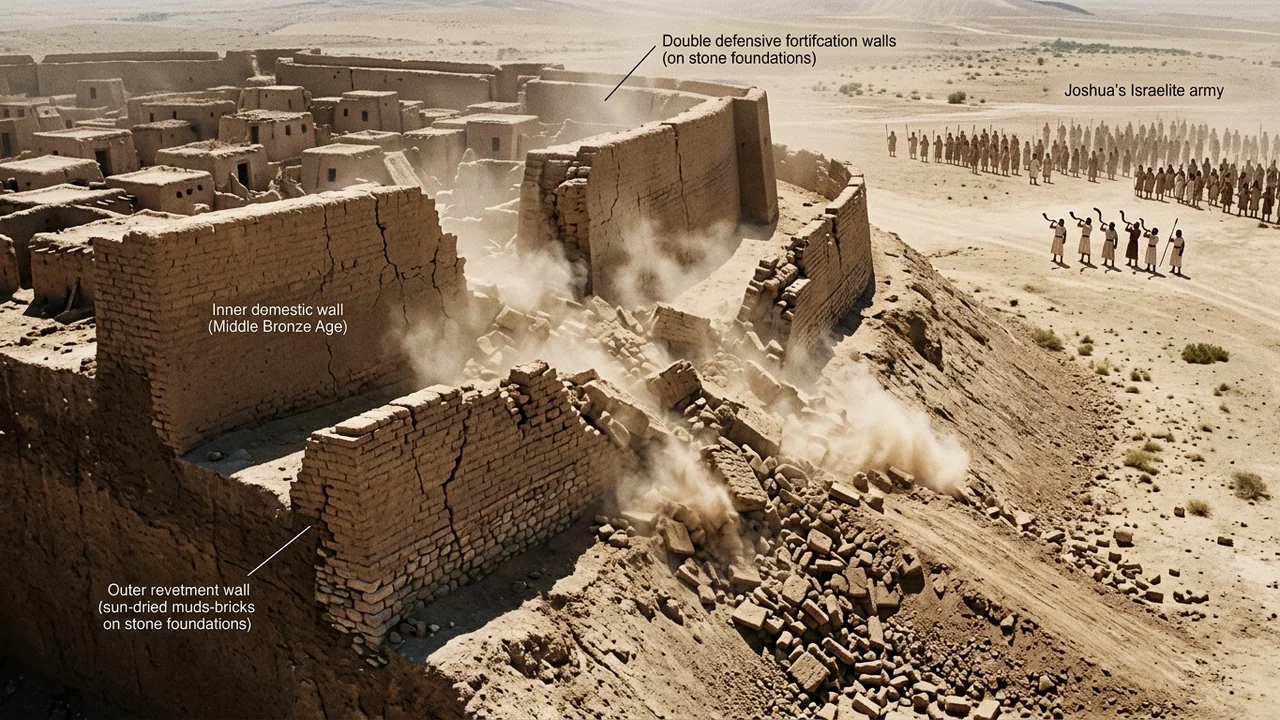
The Falling Walls of Jericho: Archaeological Trench Proof of Inward Soil Ramp Collapse
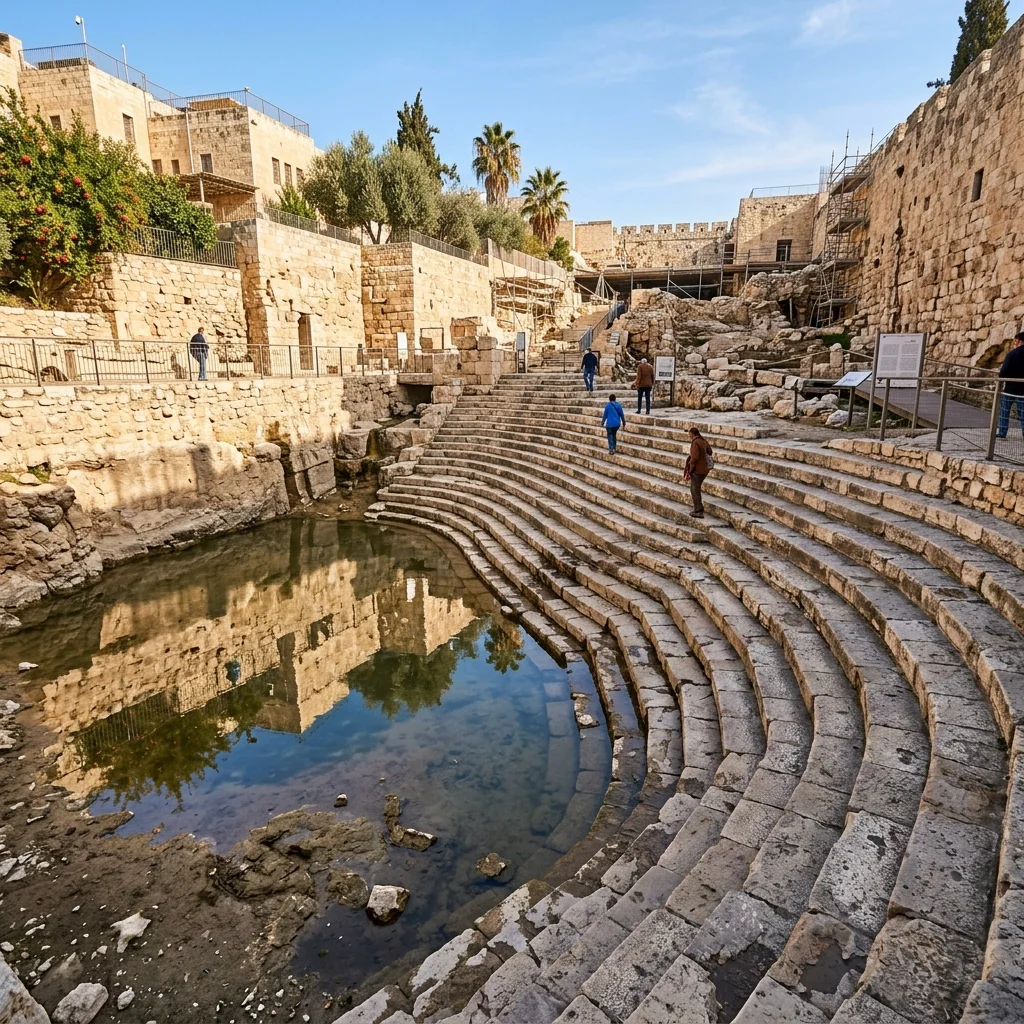
Uncovering the Pool of Siloam: The 2004 Archaeological Breakthrough in Jerusalem