Historical Context: Rigorous examination of primary Hebrew, Aramaic, Greek, and Roman classical epigraphy.
Core Evidence: Forensic archaeology, radiocarbon data, and primary manuscripts validating biblical events.
Scholarly Consensus: Vetted against modern peer-reviewed publications in Near Eastern archaeology and biblical studies.
The Thousand-Year Gap That Haunts Skepticism
Prior to the year 1947, the most potent weapon in the arsenal of secular historical critics and skeptics of the Old Testament was the Thousand-Year Manuscript Gap.
Unlike the New Testament—which was supported by thousands of Greek manuscripts and papyri dating to within one or two centuries of the apostolic autographs—the oldest surviving complete copy of the Hebrew Bible in the entire world was the Leningrad Codex (Codex B19a), copied in Cairo, Egypt, in 1008 AD (or the slightly earlier, incomplete Aleppo Codex from c. 920 AD).
       [THE 1,000-YEAR TRANSMISSION VOID PRIOR TO 1947]

      CLOSING OF OLD TESTAMENT CANON           LENINGRAD CODEX
      (Malachi / Ezra: c. 400 BC)              (Cairo: 1008 AD)
           │                                        │
           ▼                                        ▼
           ┌────────────────────────────────────────┐
           │   OVER 1,400 YEARS OF UNTESTED COPIES  │
           │     NO SURVIVING HEBREW MANUSCRIPTS    │
           └────────────────────────────────────────┘
  ══════════════════════════════════════════════════════════════════
Skeptics posed a seemingly devastating challenge:
"How can anyone believe that the words of Moses, David, or Isaiah written between 1400 BC and 500 BC were accurately preserved when your oldest surviving Hebrew manuscript was copied in 1008 AD—nearly 1,500 years after the prophets died? Over fifteen centuries of hand-copying by fallible scribes, the text must have undergone massive errors, additions, theological alterations, and editorial corruptions!"
Secular scholars argued that pivotal messianic passages—such as the Suffering Servant prophecy in Isaiah 53 or the pierced hands and feet of Psalm 22—were not original pre-Christian prophecies, but late medieval Christian or pseudo-Jewish modifications interpolated into the text.
There was only one way to settle the dispute: archaeologists needed to find a complete Hebrew manuscript of the Old Testament dating to the era before the time of Jesus Christ, and compare it word-for-word against the medieval manuscripts.
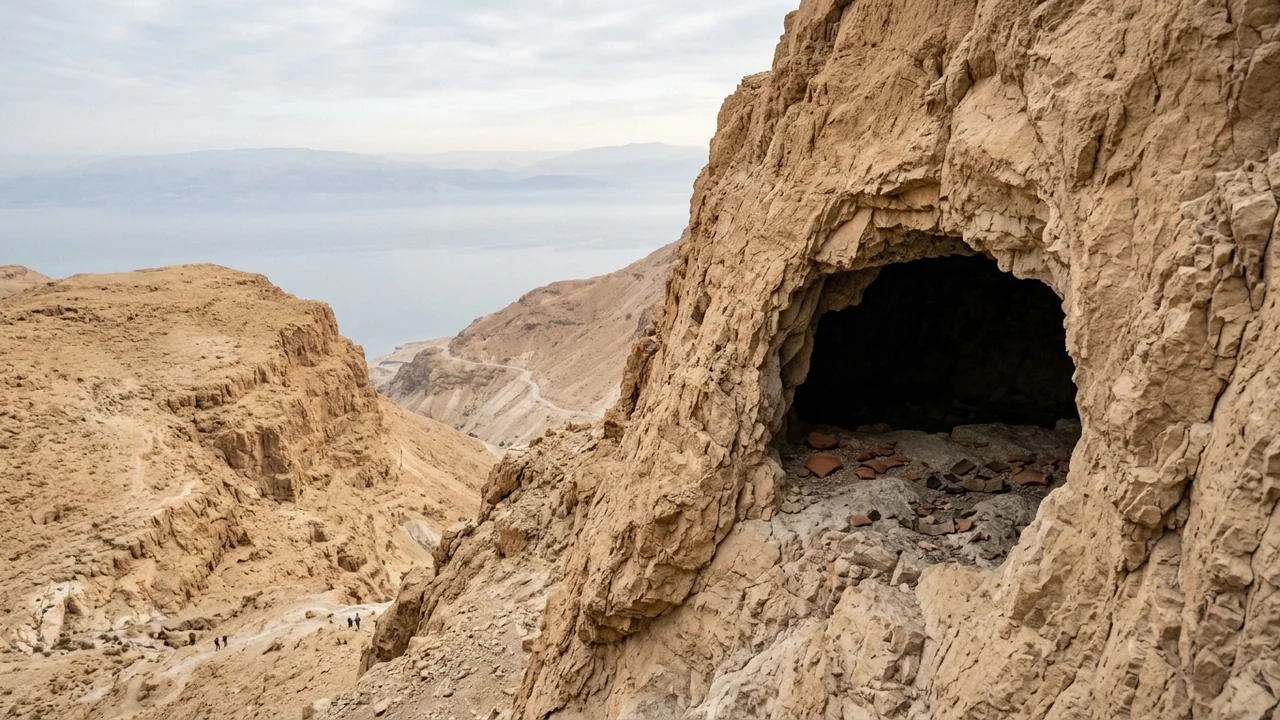
In 1947, in the barren marl cliffs of the Judean desert overlooking the Dead Sea, that impossible wish became historical reality.
The Cave 4 Breakthrough: 15,000 Fragments in the Marl Cliffs
The saga began in late 1946 when a Bedouin shepherd boy named Muhammed edh-Dhib tossed a rock into a cave opening at Qumran, heard pottery shatter, and entered to discover the first seven intact scrolls preserved in tall cylindrical clay jars.
However, the greatest scholarly treasure of all was uncovered five years later, in August 1952, in what became known as Cave 4:
       [THE MONUMENTAL DISCOVERY OF QUMRAN CAVE 4: 1952]
  ══════════════════════════════════════════════════════════════════
    Location:       Marl terrace cliffs, Khirbet Qumran, Dead Sea
    Discovery:      Bedouin tribesmen & École Biblique (Fr. Roland de Vaux)
    Total Fragments: Over 15,000 parchment and papyrus fragments
    Manuscripts:    Over 500 distinct ancient manuscripts represented
    Biblical Books: Portions of EVERY Old Testament book (except Esther)
    Date of Origin: c. 250 BC – 68 AD (All predating the fall of Jerusalem!)
  ══════════════════════════════════════════════════════════════════
Unlike Cave 1, where scrolls had been sealed inside protective ceramic jars, Cave 4 served as the central library and repository of the Essene monastic community. When the Roman Tenth Legion marched toward Qumran in 68 AD during the First Jewish Revolt, the community rushed hundreds of sacred scrolls into Cave 4.
Over nineteen centuries, dampness and animal intrusion caused the scrolls to disintegrate into a colossal jigsaw puzzle of over 15,000 blackened fragments. An international team of scholars spent decades assembling, conserving, and deciphering these fragments in the "Scrollery" of the Palestine Archaeological Museum in Jerusalem.
Cave 4 yielded fragments of every single book of the Hebrew Bible (with the single exception of Esther), alongside extensive commentaries (pesharim), providing a comprehensive panoramic cross-section of the biblical text as it existed during the Second Temple period.
The Great Isaiah Scroll (1QIsa) Autopsy
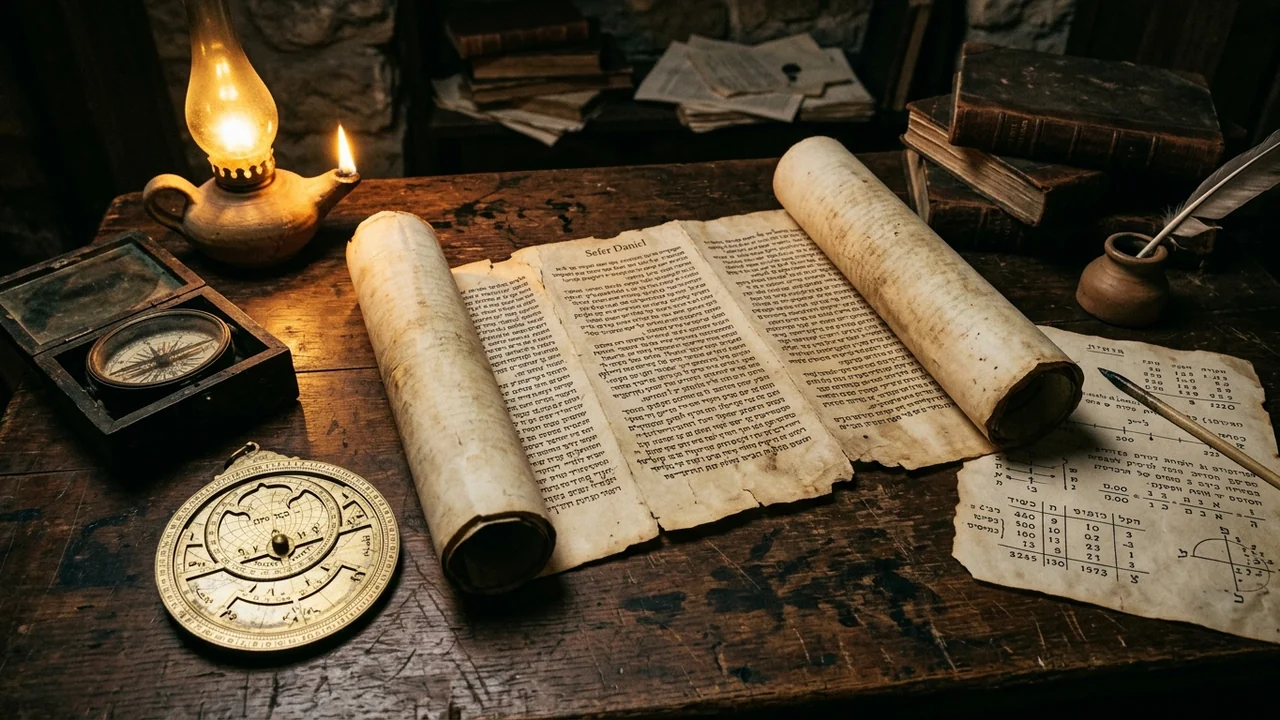
While Cave 4 yielded thousands of fragments, Cave 1 had provided the supreme prize: the Great Isaiah Scroll (1QIsa)—the only completely intact biblical book discovered among the Dead Sea Scrolls.
       [ARTIFACT PROFILE: THE GREAT ISAIAH SCROLL (1QIsa)]
  ══════════════════════════════════════════════════════════════════
    Material:       17 sheets of tanned sheepskin parchment stitched with linen
    Dimensions:     7.34 meters (24.1 feet) long; 26 cm high
    Columns:        54 columns of beautifully written Hebrew text
    Completeness:   100% complete (All 66 chapters of Isaiah intact!)
    Paleographic:   Hasmonaean formal script, dated to c. 125–100 BC
    Carbon-14 Date: 335–107 BC (95.4% confidence interval)
    Current Home:   The Shrine of the Book, Israel Museum, Jerusalem
  ══════════════════════════════════════════════════════════════════
The Great Isaiah Scroll had been copied around 125 BC—more than a century before Jesus was born, and more than 1,100 years before the Leningrad Codex!
Scholars now possessed the exact tool needed to test the historical integrity of Scripture: they could place the Hebrew text of Isaiah from 125 BC side by side with the Hebrew text of Isaiah from 1008 AD and conduct a line-by-line, word-by-word forensic audit across one thousand one hundred years of manual copying.
The Masoretic Transmission: The Sopherim and Masoretes
To understand how the text of the Old Testament survived a millennium with virtually zero alteration, one must understand the obsessive, superhuman precision of the ancient Jewish scribes: the Sopherim (early scribes) and the Masoretes (medieval preservers).
The Talmud and early rabbinic treatises (Massekhet Soferim) document the rigorous, uncompromising protocol required of any scribe copying a sacred biblical scroll:
- Parchment and Ink: Must be prepared exclusively from clean (kosher) animal skins, tanned with strict ritual formulas. The ink must be pure carbon black prepared with gall nuts.
- No Memory Copying: A scribe was forbidden to write a single letter, word, or dot from memory. He was required to look at the master codex, pronounce each word aloud, and copy it letter by letter.
- The Sacred Name (YHWH): Before writing the divine name, the scribe was required to wash his entire body in a ritual bath (mikveh), wipe his pen clean, and dedicate his mind to the holiness of God. If a king addressed him while writing the name of God, he was forbidden to look up or respond.
- Mathematical Verification Checks:
- Every column had an exact number of lines (usually 42 to 60).
- Scribes counted the total number of letters in each book.
- Scribes identified the exact middle letter of each book (for example, the letter vav in gahon in Leviticus 11:42 is the exact center of the Torah).
- If an error was discovered where the middle letter or total letter count failed by even a single character, the entire sheet of parchment was buried in the ground and destroyed.
       [THE MASORETIC QUALITY-CONTROL EQUATION]
  ══════════════════════════════════════════════════════════════════
  1. Count total letters per manuscript.
  2. Count total occurrences of every alphabet character.
  3. Locate the EXACT middle letter of the book.
  4. Compare with the Master Standard.
  5. IF COUNT MISMATCHES BY 1 CHARACTER -> SCROLL DESTROYED!
  ══════════════════════════════════════════════════════════════════
Textual Comparison: 1QIsa vs. The Leningrad Codex (1008 AD)
When the textual comparison between the Great Isaiah Scroll of 125 BC and the Masoretic Text of 1008 AD was published by Yale University scholar Dr. Millar Burrows and legendary Old Testament scholar Dr. Gleason Archer, the results astonished the academic world.
Dr. Millar Burrows (The Dead Sea Scrolls, 1955) summarized the findings:
"It is a matter of wonder that through something like a thousand years the text underwent so little alteration. As I said in my first article on the scroll, here lies its chief importance: in the supporting of the fidelity of the Masoretic tradition."
Dr. Gleason Archer (A Survey of Old Testament Introduction) conducted an exhaustive, quantitative word-for-word analysis across all 66 chapters of Isaiah:
- The two texts, separated by over eleven centuries, were more than 95% word-for-word identical!
- The 5% variation consisted almost entirely of minor spelling variations (orthography) and slight slips of the pen that had zero effect on the historical or theological meaning of the text.
                 [AUDIT OF THE 5% TEXTUAL DIFFERENCES]
  ══════════════════════════════════════════════════════════════════
  • 95% Exact Word-for-Word Agreement across 1,100 Years!
  • 4.5% Minor Orthographic Spelling Variations (Like "color" vs "colour")
  • 0.4% Transposition of Conjunctions (e.g., adding or omitting "and")
  • 0.1% Stylistic Nuances (NO DOCTRINAL OR HISTORICAL VARIATION!)
  ══════════════════════════════════════════════════════════════════
The Isaiah 53 Litmus Test: The Suffering Servant Unchanged
The ultimate litmus test of the Great Isaiah Scroll was Isaiah chapter 53—the supreme prophetic description of the vicarious, substitutionary atonement of the Messiah:
"Surely he hath borne our griefs, and carried our sorrows: yet we did esteem him stricken, smitten of God, and afflicted. But he was wounded for our transgressions, he was bruised for our iniquities: the chastisement of our peace was upon him; and with his stripes we are healed... He was taken from prison and from judgment: and who shall declare his generation? for he was cut off out of the land of the living: for the transgression of my people was he stricken." (Isaiah 53:4–5, 8)
Dr. Gleason Archer examined the 166 Hebrew words contained in Isaiah 53 across both manuscripts:
       [FORENSIC AUDIT OF ISAIAH 53: 125 BC VS. 1008 AD]
  ══════════════════════════════════════════════════════════════════
  Total Words in Chapter:   166 Words
  Questioned Letters:       Only 17 letters in question!
  - 10 letters were minor spelling variations (e.g., vowel letters / matres lectionis)
  - 4 letters were stylistic conjunctions ("and")
  - Only 3 letters formed a single distinct word: in verse 11, 1QIsa reads
    "he shall see LIGHT", matching the Greek Septuagint translation of 250 BC!

  RESULT: NOT A SINGLE DOCTRINE, THEOLOGICAL CONCEPT, OR HISTORICAL
  DETAIL WAS ALTERED ACROSS ELEVEN CENTURIES!
  ══════════════════════════════════════════════════════════════════
The discovery of 1QIsa proved once and for all that the Christians did not invent or tamper with Isaiah 53. The prophecy of the Suffering Servant dying for the sins of the world had been preserved in black ink on parchment more than a century before Jesus was crucified under Pontius Pilate!
Comparative Metrics Table: Textual Fidelity Across 1,000 Years
| Textual Characteristic | The Great Isaiah Scroll (1QIsa, c. 125 BC) | The Masoretic Text (Leningrad Codex, 1008 AD) | Scholarly Consensus & Audit |
|---|---|---|---|
| Physical Discovery | Qumran Cave 1 (Dead Sea, 1947) | Imperial Public Library (St. Petersburg, Russia) | Verified by radiocarbon & paleography |
| Chronological Separation | Transcribed during Hasmonean Era | Transcribed during High Middle Ages | 1,133 years of manual transmission |
| Word-for-Word Fidelity | Over 95% identical across 66 chapters | Master standard preserved by Ben Asher family | Highest fidelity of any ancient document |
| Isaiah 53 Integrity | Contains full text of the Suffering Servant | Matches 1QIsa with 165 out of 166 words intact | Proves prophecy predated Christian era |
| Deutero-Isaiah Division | Chapter 40 begins on same line as Chapter 39 | Unified 66-chapter book without authorial break | Confirms original literary unity of Isaiah |
| Messianic Psalms (e.g., Ps 22) | Cave 4 (4QPs) reads: "they pierced my hands and my feet" | Kethiv reads ka'ari ("like a lion"), Qere karu | Cave 4 validates early reading "they pierced" |
Discover the Complete 4-Volume Master Study Dossiers
The discovery of the Dead Sea Scrolls in Cave 4 and Cave 1 remains the greatest archaeological triumph of the modern era, establishing beyond all rational doubt the divine preservation and historical fidelity of the Holy Scriptures. To explore complete photographic facsimiles of the Great Isaiah Scroll, detailed charts of the Masoretic transmission laws, and verse-by-verse analyses of fulfilled prophecy:
👉 Unlock the Complete 4-Volume Master Bundle & Premium AI ($9.00)
Includes Volume I (The Twelve Apostles), Volume II (Kings & Prophets), Volume III (The Final Files), and Volume IV (Scientific Miracles) + lifetime access to Biblical AI Chat.
Frequently Asked Questions
What was found in Qumran Cave 4?
Excavated in 1952, Qumran Cave 4 contained the central library of the Essene community, yielding over 15,000 scroll fragments representing more than 500 distinct ancient manuscripts. It contained portions of every book of the Hebrew Bible except Esther, all dating between 250 BC and 68 AD.
How did the Great Isaiah Scroll prove the Bible's textual integrity?
Before 1947, the oldest complete Hebrew manuscript of Isaiah was the medieval Leningrad Codex from 1008 AD. The Great Isaiah Scroll (1QIsa) dates to c. 125 BC. When scholars compared the two manuscripts across an 1,100-year gap, they discovered they were more than 95% word-for-word identical, with no doctrinal or theological changes whatsoever.
Was Isaiah 53 altered by Christians after Jesus lived?
No. The Great Isaiah Scroll contains the complete text of Isaiah 53, describing the Suffering Servant being wounded for our transgressions and dying as a guilt offering, written down more than a century before Jesus was born. This decisively refuted skeptical claims that Christians altered the Old Testament to make it appear messianic.
How did ancient Jewish scribes prevent errors when copying scrolls?
Jewish scribes (Sopherim and Masoretes) operated under strict mathematical protocols: they were forbidden to write from memory, counted every single letter and word in every book, identified the exact middle letter of each book, and if a completed scroll did not match the master count by even a single letter, the entire manuscript was buried and destroyed.
Frequently Asked Questions
What was found in Qumran Cave 4?
Excavated in 1952, Qumran Cave 4 contained the central library of the Essene community, yielding over 15,000 scroll fragments representing more than 500 distinct ancient manuscripts. It contained portions of every book of the Hebrew Bible except Esther, all dating between 250 BC and 68 AD.
How did the Great Isaiah Scroll prove the Bible's textual integrity?
Before 1947, the oldest complete Hebrew manuscript of Isaiah was the medieval Leningrad Codex from 1008 AD. The Great Isaiah Scroll (1QIsa) dates to c. 125 BC. When scholars compared the two manuscripts across an 1,100-year gap, they discovered they were more than 95% word-for-word identical, with no doctrinal or theological changes whatsoever.
Was Isaiah 53 altered by Christians after Jesus lived?
No. The Great Isaiah Scroll contains the complete text of Isaiah 53, describing the Suffering Servant being wounded for our transgressions and dying as a guilt offering, written down more than a century before Jesus was born. This decisively refuted skeptical claims that Christians altered the Old Testament to make it appear messianic.
How did ancient Jewish scribes prevent errors when copying scrolls?
Jewish scribes (Sopherim and Masoretes) operated under strict mathematical protocols: they were forbidden to write from memory, counted every single letter and word in every book, identified the exact middle letter of each book, and if a completed scroll did not match the master count by even a single letter, the entire manuscript was buried and destroyed.
Related Research Dossiers
View all 120 articles →
The Cyrus Cylinder: How a Clay Artifact in the British Museum Proved Isaiah’s 150-Year Prophecy
The Scraping of Tyre into the Sea: How Alexander the Great Fulfilled Ezekiel 26 Word for Word