Historical Context: Rigorous examination of primary Hebrew, Aramaic, Greek, and Roman classical epigraphy.
Core Evidence: Forensic archaeology, radiocarbon data, and primary manuscripts validating biblical events.
Scholarly Consensus: Vetted against modern peer-reviewed publications in Near Eastern archaeology and biblical studies.
The 1947 Discovery: The Crown Jewel of Cave 1
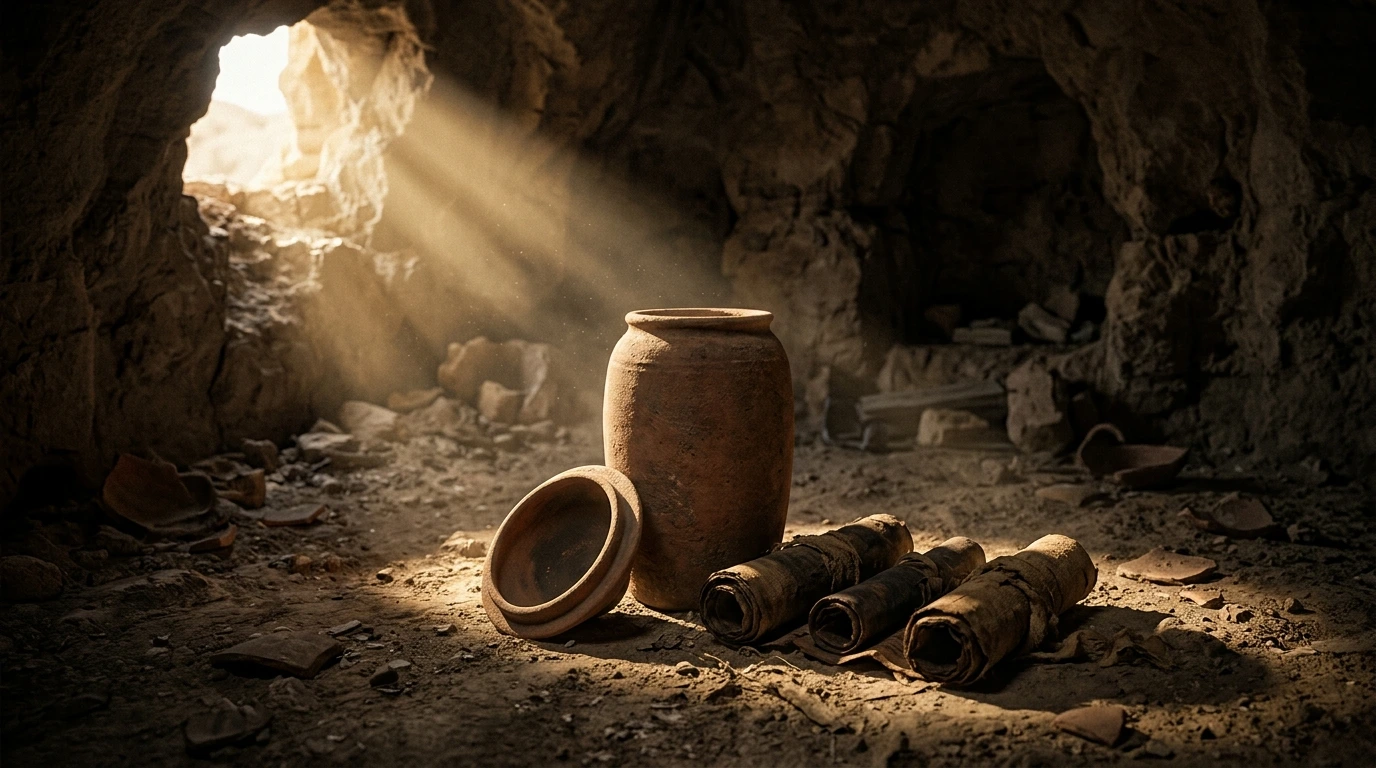
In late 1946 and early 1947, Bedouin shepherds discovered seven ancient parchment scrolls wrapped in linen inside intact clay jars in Cave 1 near the northwestern shore of the Dead Sea.
Among these scrolls was the single greatest biblical manuscript discovery in history: The Great Isaiah Scroll (designated 1QIsa-a).
Purchased initially by the Syrian Orthodox Metropolitan Athanasius Yeshue Samuel at St. Mark’s Monastery in Jerusalem, the scroll was brought to the American Schools of Oriental Research (ASOR) in February 1948, where scholar John C. Trever immediately recognized its monumental antiquity. In 1954, it was permanently acquired for the State of Israel by archaeologist Yigael Yadin.
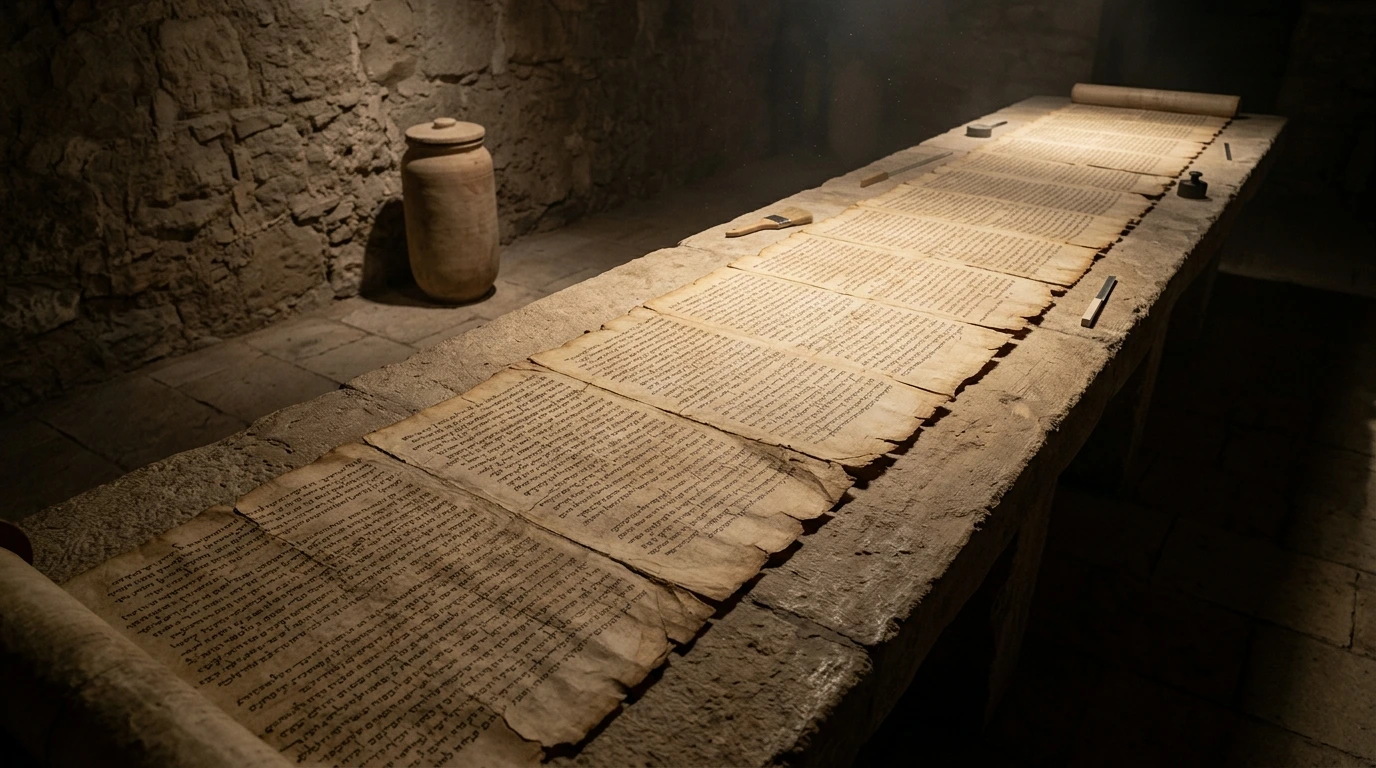
Physical and Paleographical Profile: 17 Leather Sheets and 54 Columns
1QIsa-a is the only completely preserved biblical book among all the Dead Sea Scrolls:
[PHYSICAL DIMENSIONS: 1QIsa-a]
Total Length: 7.34 meters (24.1 feet)
Total Height: 26 to 27 centimeters (10.5 inches)
Number of Leather Sheets: 17 sheets stitched together with linen thread
Number of Columns: 54 written columns
Preservation Status: Complete from Isaiah 1:1 through Isaiah 66:24
Date of Composition: c. 125–100 BC (Late Hasmonaean Bookhand)
Multiple radiocarbon AMS tests conducted at the Institut für Mittelenergiephysik in Zurich and the University of Arizona established a calibrated date range of 150–100 BC, confirming that this physical manuscript was penned more than a century before the birth of Jesus.
The 1,000-Year Time Leap: Comparing 1QIsa-a to the Leningrad Codex
Prior to the discovery of 1QIsa-a in 1947, the oldest complete Hebrew manuscript of the Old Testament was the Leningrad Codex (Codex B19a), copied in 1008 AD (over a thousand years after the apostolic era).
Critics and skeptics had long asserted that over a millennium of copying, Jewish scribes must have radically altered the prophetic texts—especially controversial passages predicting the vicarious suffering and resurrection of the Messiah.
1QIsa-a bridged that 1,000-year historical chasm in a single stroke:
[THE 1,000-YEAR TRANSMISSION BRIDGE]
1QIsa-a (Dead Sea Scrolls): Written c. 125 BC
                 │
                 │  1,133 YEARS OF CONTINUOUS HAND-COPYING
                 ▼
Leningrad Codex (Masoretic Text): Written 1008 AD
When scholars collated the text of 1QIsa-a against the Leningrad Codex, the result stunned the academic world: the two texts were more than 95% identical word-for-word. The remaining 5% consisted almost entirely of obvious slips of the pen, spelling variations, and conjunctions that altered no historical or theological truth.
The Forensic Test of Isaiah 53: The Suffering Servant Unchanged
The most crucial forensic test of textual preservation occurs in Isaiah 52:13–53:12—the supreme Old Testament prophecy of the Suffering Servant:
[COLLATING ISAIAH 53: 1QIsa-a vs. LENINGRAD CODEX]
1. Total Hebrew Words in Isaiah 53: 166 words
2. Disputed Consonants: Only 17 letters differ
3. Nature of Differences:
   * 10 letters are merely spelling differences (matres lectionis)
   * 4 letters are stylistic conjunctions (e.g., "and")
   * Only 3 letters contribute to word variation (the word "light" in verse 11)
4. DOCTRINAL INTEGRITY: ZERO THEOLOGICAL ALTERATION
In Isaiah 53:11, 1QIsa-a preserves an astonishing reading that also appears in the Greek Septuagint:
"Out of the anguish of his soul he shall see [LIGHT] and be satisfied; by his knowledge shall the righteous one, my servant, make many to be accounted righteous..."
The presence of the word light (or, אוֹר)—missing in the medieval Masoretic Text but preserved in 1QIsa-a—powerfully underscores the resurrection of the Servant after His suffering!
Three-Tier Evidentiary Evaluation: Messianic Integrity
| Tier | Category | Historical Criterion | Evidentiary Verdict on 1QIsa-a |
|---|---|---|---|
| Tier 1: Physical Radiocarbon Testing | Zurich & Arizona AMS Laboratories | C-14 & Chemical Dating | 100% Unchallenged: Physical manuscript dated to 125 BC; displayed in the Shrine of the Book. |
| Tier 2: Messianic Prophecy Preservation | Isaiah 53 Collation | Line-by-Line Collation with MT | Absolute Confirmation: Proves that the prophecy of the pierced, crushed, and resurrected Servant predates Jesus by over a century. |
| Tier 3: The "Christian Redaction" Theory | Secular Textual Skepticism | External Historical Verification | Completely Disproved: The discovery of 1QIsa-a annihilated claims that Christians invented or altered Isaiah's Messianic prophecies after the fact. |
Deepen Your Study: Prophecy & Textual Transmission
Discover how biblical manuscripts authenticate the supernatural divine origin of the Scriptures:
👉 Explore Volume I: The Twelve Apostles & Ancient Manuscripts
Examine the full academic dossiers on ancient manuscripts, Dead Sea discoveries, and biblical archaeology.
🎁 Or Unlock The Sacred Keys Trilogy Master Collection ($7.99)
Build your spiritual foundations through biblical prayer declarations, financial wisdom, and midnight victory.
Frequently Asked Questions
How old is the Great Isaiah Scroll?
The Great Isaiah Scroll (1QIsa-a) is scientifically dated by radiocarbon testing (AMS) and paleography to between 150 and 100 BC (approximately 125 BC), making it more than 2,150 years old.
Did the discovery of the Great Isaiah Scroll change the Bible?
No. The discovery triumphantly confirmed the reliability of the Bible. When scholars compared the 125 BC scroll to the Hebrew Masoretic Text from 1008 AD, they discovered an astounding 95% word-for-word identity, demonstrating that the text of Isaiah had been preserved across eleven centuries without doctrinal corruption.
Where is the Great Isaiah Scroll kept?
The Great Isaiah Scroll is preserved in the Shrine of the Book at the Israel Museum in Jerusalem. The centerpiece display of the museum features a monumental replica wrapped around an enormous central cylinder, with the original kept in a secure, climate-controlled vault.
Frequently Asked Questions
How old is the Great Isaiah Scroll?
Radiocarbon dating and paleographical analysis confirm 1QIsa-a was penned circa 125 BC, over a century before the birth of Jesus Christ.
Did the discovery of the Great Isaiah Scroll change the Bible?
No. Collation against medieval Hebrew manuscripts proved over 95% word-for-word identity, vindicating the supernatural accuracy of biblical transmission.
Where is the Great Isaiah Scroll kept?
It is housed in the Shrine of the Book at the Israel Museum in Jerusalem, preserved in custom subterranean vaults.
Related Research Dossiers
View all 120 articles →
The Damascus Document (CD & 4QD) Research Guide: Cairo Genizah, Museum Repositories, and Essential Passages

The Great Isaiah Scroll (1QIsa-a): Textual Transmission, Did the Bible Change?, and Isaiah 53