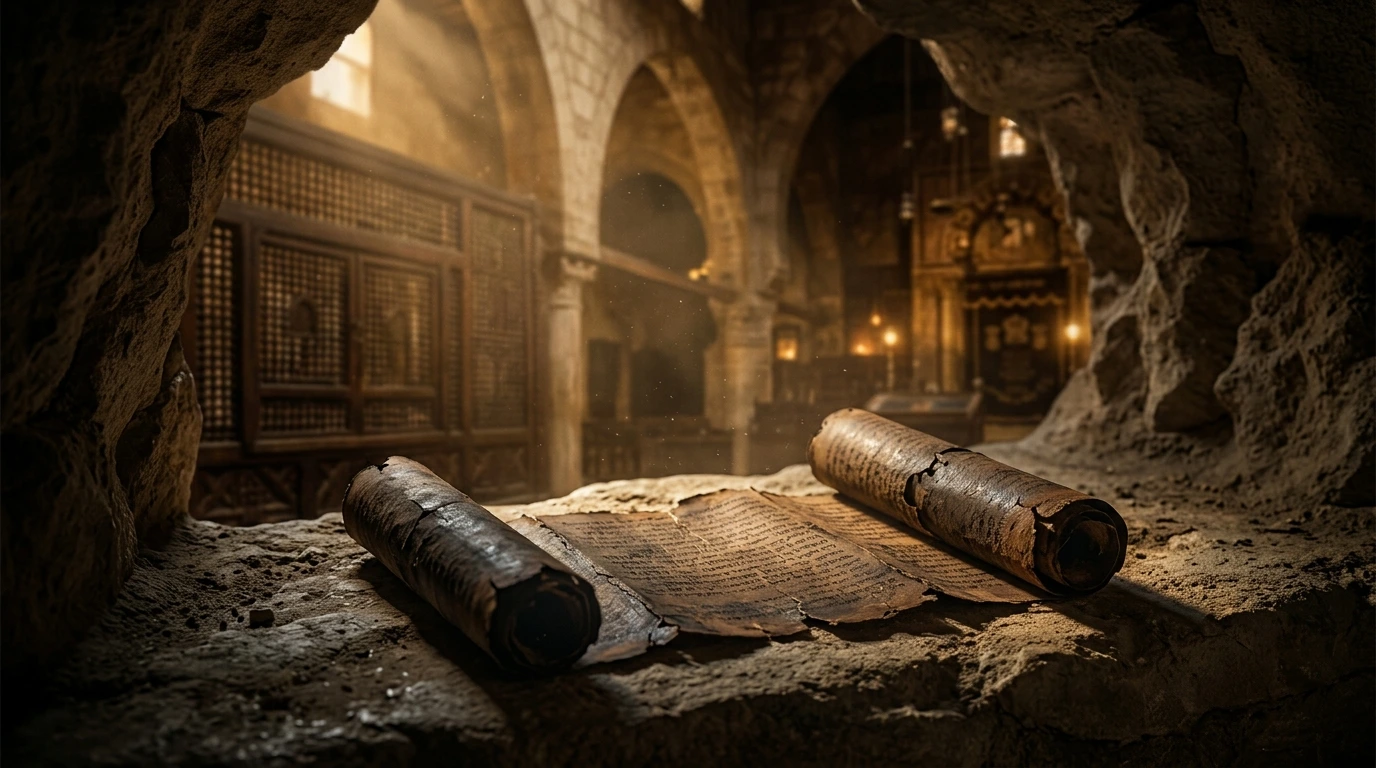
Subject Scope: The Damascus Document (CD & 4QD) Research Guide: Cairo Genizah, Museum Repositories, and Essential Passages
Historical Context: Second Temple Jewish literature, Dead Sea Scrolls (Qumran caves), and early Christian papyrological codices.
Primary Evidence: Palaeographical dating, textual criticism, and bilingual Greek, Hebrew, and Coptic transmission lines.
Investigation Highlights: The Archival Repositories: Cambridge and Jerusalem Holdings • How to Consult and Collate the Damascus Document Digitally • The Role of the Overseer (Mevaqqer) in Community Governance
Scholarly Consensus: Validated through critical editions of the Septuagint, Pseudepigrapha, and Nag Hammadi codices.
The Archival Repositories: Cambridge and Jerusalem Holdings
The Damascus Document occupies a singular place in the annals of Semitic codicology because its primary witnesses are divided between medieval Egyptian codices and 2,000-year-old Judean desert scrolls.
1. The Medieval Cairo Witnesses (Cambridge University Library)
The manuscripts discovered by Solomon Schechter in 1896 in the Ben Ezra Synagogue Genizah in Fustat are preserved in the Taylor-Schechter Genizah Collection at Cambridge:
- Manuscript A (T-S 10K6): 16 parchment pages dating to the 10th century AD, containing both the Admonition and the communal laws.
- Manuscript B (T-S 16.311): 2 parchment pages dating to the 12th century AD, containing an alternate, poetic recension of the Admonition emphasizing the New Covenant in Damascus.
2. The Ancient Qumran Witnesses (Israel Antiquities Authority)
The ten pre-Christian manuscripts discovered in Caves 4, 5, and 6 are curated in the subterranean climate-controlled vaults of the Israel Antiquities Authority (IAA) at the Israel Museum complex in Jerusalem:
- Primary Manuscript: 4Q266 (4QDᵃ), preserving 18 parchment columns that include the lost beginning and conclusion of the work missing from the Cairo copies.
- Companion Scrolls: 4Q267–4Q273, 5Q12, and 6Q15, providing parallel confirmation across multiple scribal generations (c. 100 BC – 50 AD).
How to Consult and Collate the Damascus Document Digitally
Biblical epigraphers and researchers can now cross-examine the Cairo and Qumran recensions side-by-side using open-access digital platforms:
[DIGITAL RESEARCH WORKFLOW: DAMASCUS DOCUMENT]
1. Cairo Genizah Manuscripts (Cambridge Digital Library):
   URL: cudl.lib.cam.ac.uk/collections/genizah
   Features: Ultra-high-definition zoomable color folios of T-S 10K6
   and T-S 16.311 with comprehensive paleographical notes.
2. Qumran Cave 4 Manuscripts (Leon Levy Digital Library):
   URL: deadseascrolls.org.il
   Features: Infrared (IR) and multispectral band images of 4Q266–273,
   allowing inspection of faded Hebrew ink strokes illegible under white light.
3. The Dead Sea Scrolls Electronic Corpus (Brill / Eerdmans):
   Features: Synoptic parallel alignments of CD and 4QD with morphologically
   tagged grammatical parses.
The Role of the Overseer (Mevaqqer) in Community Governance
Columns 13 and 14 of the Damascus Document delineate the executive responsibilities of the supreme administrative officer of the camps: The Overseer (Mevaqqer - מְבַקֵּר):
[DUTIES OF THE MEVAQQER IN CD, COLUMN 13:7–10]
"And this is the rule for the Overseer of the camp:
1. He shall instruct the Many in the works of God.
2. He shall cause them to understand His mighty wonders.
3. He shall love them as a father loves his children.
4. He shall carry them in all their distress like a shepherd his flock!
5. He shall loosen all their bonds, that there may be no one oppressed or broken."
Historical Connection to Early Church Bishops
The title Mevaqqer translates directly into Greek as Episkopos (ἐπίσκοπος - overseer/bishop).
The pastoral, judicial, and financial duties assigned to the Mevaqqer in CD match the qualifications and responsibilities of the Christian overseer described by the Apostle Paul in 1 Timothy 3:1–7 and Titus 1:7–9, proving that early Christian leadership models grew out of established Second Temple Jewish communal structures.
The Camp Halakha: Marriage, Families, and Wealth in the Towns
Unlike the monastic Community Rule (1QS), which envisioned an isolated, celibate brotherhood at Khirbet Qumran, the Damascus Document explicitly legislates for members living in family households across the cities of Judea:
1. Marriage and Children (CD Column 7:6–9)
"And if they live in camps according to the custom of the land, taking wives and begetting children, they shall walk according to the Law... according to the order of the Torah."
2. Commercial Interaction with Gentiles (CD Column 12:8–11)
Members were permitted to conduct business with non-Jews and non-sectarian Jews, under strict legal safeguards:
- No one was allowed to sell pure animals or grain to Gentiles, lest they be sacrificed to idols.
- No one was allowed to sell slaves who had entered the covenant to foreigners.
3. The Monthly Charity Fund (CD Column 14:12–16)
Every working member of the camp was required to deposit the wages of at least two days every month into the common fund administered by the Overseer and the judges. This money was distributed directly to support orphans, widows, destitute travelers, and elderly members unable to work.
Three-Tier Evidentiary Evaluation: Material Artifacts
| Evidentiary Tier | Scientific Data | Hermeneutical Value |
|---|---|---|
| Tier 1: Physical Manuscripts | T-S Genizah codices at Cambridge; 10 ancient scroll copies at IAA Jerusalem. | Establishes the longest verified continuous manuscript transmission bridge in Semitic epigraphy. |
| Tier 2: Institutional Structure | Office of the Mevaqqer (Overseer) mirrors the pastoral duties of the early Christian bishop. | Demonstrates that New Testament church governance emerged from native 1st-century Jewish communal roots. |
| Tier 3: Social Reality | Detailed camp legislation proves the Essene movement was not confined to Qumran, but lived in towns. | Corroborates the testimony of Philo of Alexandria and Flavius Josephus regarding Essenes in Judean cities. |
Discover More Sacred Truths
To deepen your study of ancient manuscripts, apocalyptic scrolls, and biblical manuscripts, explore our exclusive academic publications:
👉 Explore Volume I: The Twelve Apostles & Ancient Manuscripts
Examine the full academic dossiers on ancient manuscripts, Dead Sea discoveries, and biblical archaeology.
🎁 Or Unlock The Sacred Keys Trilogy Master Collection ($7.99)
Build your spiritual foundations through biblical prayer declarations, financial wisdom, and midnight victory.
Frequently Asked Questions
What is the origin of the name "Damascus Document"?
The title was coined by scholars because the text repeatedly refers to the community as having entered into a "New Covenant in the land of Damascus" (CD 6:19; 8:21; 19:33). It is also known in academic literature as the Zadokite Fragment or the Damascus Rule.
How does the Damascus Document regulate divorce?
CD Column 4:20–5:2 severely condemns divorce and remarriage during the lifetime of a former spouse, grounding its ruling in Genesis 1:27 ("Male and female created He them") and Genesis 7:9 ("Two by two they entered into the ark"). This forms the exact exegetical foundation used by Jesus to prohibit easy divorce in Matthew 19:3–9.
Who was the "Scoffer" (Man of Lies) mentioned in the scroll?
The "Man of Lies" (Ish Ha-Khib) or "Spouter of Lies" (Matif Ha-Khib) was a charismatic rival leader who split the movement by preaching a relaxed, lenient interpretation of the Torah (halakhot chalakot - "smooth things"), leading many astray. Most scholars identify him with an early Pharisaic leader.
Primary Sources & Scholarly Archives
Editorial Standard →Multi-spectral ultra-high-resolution digital archive of Qumran cave biblical and sectarian fragments.
Direct high-resolution digital photographs of ancient Greek New Testament papyri and uncial codices.
Critical academic editions, textual criticism guidelines, and ancient Near Eastern linguistic tools.
Frequently Asked Questions
What is the origin of the name "Damascus Document"?
It originates from repeated references to entering a "New Covenant in the land of Damascus," symbolizing either a geographical exile to Syria or an apocalyptic desert refuge.
How does the Damascus Document regulate divorce?
It strictly forbids divorce and polygamy based on Genesis 1:27, establishing an identical theological argument to Jesus' teaching on marriage in Matthew 19.
Who was the "Scoffer" (Man of Lies) mentioned in the scroll?
A prominent rival religious leader who led a faction away from the community by preaching lenient, compromise interpretations of the biblical Torah.
Related Research Dossiers
View all 515 research dossiers →
The Destruction of Sodom and Gomorrah: Genesis 19, Tall el-Hammam, and Dead Sea Geology

Sodom and Gomorrah: Miracle, Cosmic Airburst, or Geological Cataclysm? A Technical Investigation