Historical Context: Rigorous examination of primary Hebrew, Aramaic, Greek, and Roman classical epigraphy.
Core Evidence: Forensic archaeology, radiocarbon data, and primary manuscripts validating biblical events.
Scholarly Consensus: Vetted against modern peer-reviewed publications in Near Eastern archaeology and biblical studies.
The Ultimate Enigma of Biblical Archaeology
Of all the sacred relics, lost treasures, and ancient artifacts mentioned in human history, none commands greater fascination, awe, and archaeological curiosity than the Ark of the Covenant (Aron HaBrit).
Constructed at the foot of Mount Sinai around 1446 BC under the direct architectural instructions of Yahweh to Moses, the Ark was the tangible, physical footstool of the Almighty on earth:
- It led the armies of Israel across the parted Jordan River (Joshua 3).
- It circled the walls of Jericho before they collapsed (Joshua 6).
- It struck the Philistines with plagues and toppled the idol of Dagon in Ashdod (1 Samuel 5).
- It rested inside the pitch-black Holy of Holies (Kodesh HaKodashim) of Solomon’s Temple, where the glowing cloud of the divine Shekinah Glory descended between the golden wings of the cherubim (1 Kings 8:10–11).
Yet, around 586 BC, when the armies of King Nebuchadnezzar II breached the walls of Jerusalem, burned Solomon's Temple, and looted its sacred treasures, the Ark of the Covenant vanished into thin air.
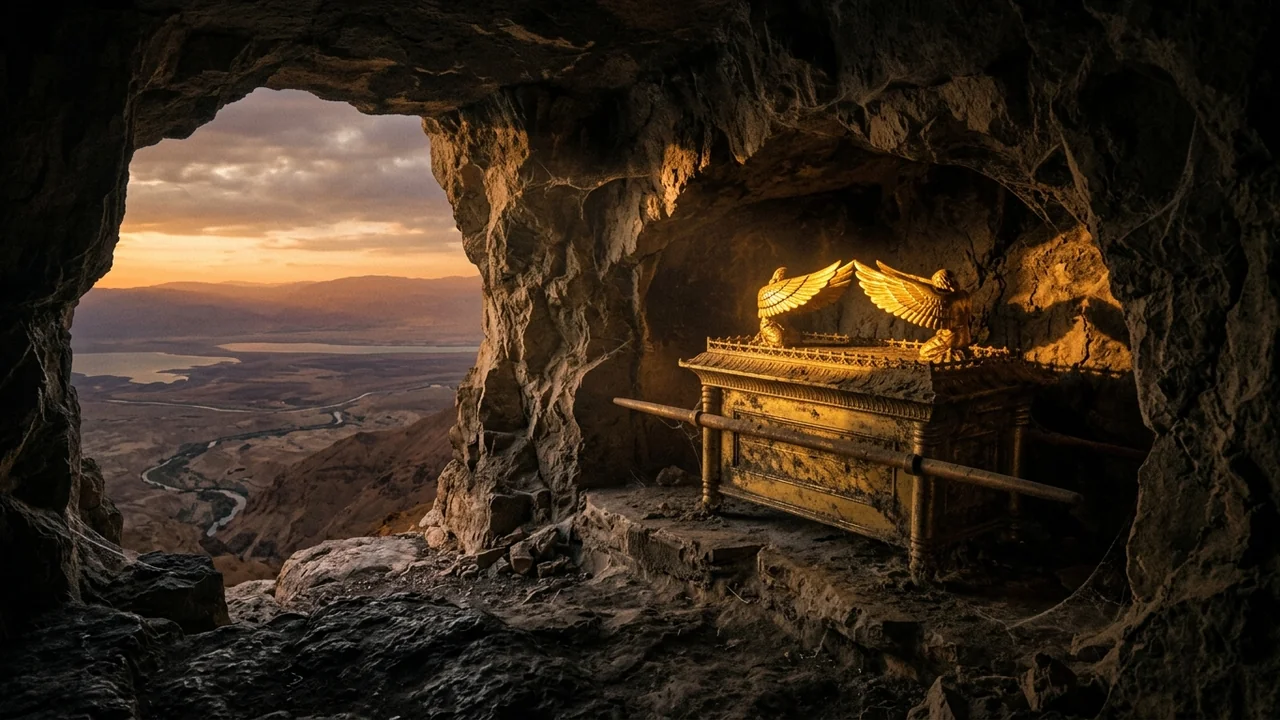
What happened to the golden chest? Was it carried off as imperial loot to Babylon? Was it hidden deep inside subterranean bedrock vaults beneath Mount Moriah? Did the prophet Jeremiah carry it across the Jordan to a forgotten cave on Mount Nebo? Or does it rest today inside a guarded stone chapel in the highlands of Ethiopia?
To separate romantic mythology from cold historical reality, one must examine the ancient textual witnesses, the physical archaeological records of Babylon, and the profound theological purpose of the Ark itself.
The Anatomy of the Sacred Chest: Exodus 25 Specifications
The biblical blueprint of the Ark of the Covenant is recorded in meticulous architectural detail in Exodus 25:10–22:
       [ARCHITECTURAL BLUEPRINT: THE ARK OF THE COVENANT]

                ◄──────────── 2.5 CUBITS (3.75 FT) ────────────►
       ┌─────────────────────────────────────────────────────────────┐ ▲
       │       THE MERCY SEAT (KAPPORETH) - PURE SOLID GOLD          │ │
       │       Beaten Cherubim Wings Overshadowing the Center        │ │
       ├─────────────────────────────────────────────────────────────┤ │ 1.5 CUBITS
       │                                                             │ │ (2.25 FT)
       │       ACACIA WOOD CHEST OVERLAID INSIDE & OUT               │ │
       │       WITH PURE GOLD (24-KARAT BURNISHED GOLD)              │ │
       │                                                             │ │
       │       Contains:                                             │ │
       │       1. The Two Stone Tablets of the Law (Exodus 25:16)    │ │
       │       2. The Golden Pot of Manna (Hebrews 9:4)              │ │
       │       3. Aaron's Rod that Budded (Numbers 17:10)            │ ▼
       └─────────────────────────────────────────────────────────────┘
       [Four Golden Rings]                                [Four Golden Rings]
       [Acacia Poles Overlaid with Gold]                  [Never to be Removed!]
  ═════════════════════════════════════════════════════════════════════════════
The dimensions of the Ark were:
- Length: 2.5 cubits (approximately 112 cm / 3.75 feet).
- Width: 1.5 cubits (approximately 67 cm / 2.25 feet).
- Height: 1.5 cubits (approximately 67 cm / 2.25 feet).
- Materials: Rot-resistant acacia wood (shittim), overlaid inside and outside with hammered sheets of pure gold, bordered by a cast gold crown (zer).
- The Mercy Seat (Kapporeth): The lid was not wood overlaid with gold; it was a single, solid slab of pure 24-karat gold, from which two angelic cherubim were beaten out of the same piece of metal, facing each other with wings stretched upward, shadowing the blood-sprinkled mercy seat.
The Mystery of 586 BC: The Babylonian Inventory Silence
The primary mystery surrounding the disappearance of the Ark lies in an astonishing textual omission in the official inventories of the Babylonian conquest.
When Nebuchadnezzar destroyed Jerusalem in 586 BC, the authors of 2 Kings 25:13–17 and Jeremiah 52:17–23 provided an extraordinarily exhaustive, itemized inventory of every single bronze, silver, and gold object looted by the Babylonian army:
- They listed the two colossal bronze pillars (Jachin and Boaz).
- The bronze sea (laver) and the twelve oxen beneath it.
- The bronze bases, cauldrons, shovels, snuffers, spoons, and firepans.
- They explicitly inventoried items down to small brass cups and ash basins!
       [THE BABYLONIAN INVENTORY PARADOX]
  ══════════════════════════════════════════════════════════════════
  • Massive Bronze Pillars:            RECORDED (2 Kings 25:13)
  • Bronze Sea and Oxen:               RECORDED (2 Kings 25:13)
  • Small Pots, Shovels, Snuffers:     RECORDED (2 Kings 25:14)
  • Minor Gold and Silver Spoons:      RECORDED (2 Kings 25:15)

  • THE GOLDEN ARK OF THE COVENANT:    COMPLETELY ABSENT!
    (The most valuable, holy, and famous gold artifact in the nation
     is not mentioned once in the loot list or the return list in Ezra!)
  ══════════════════════════════════════════════════════════════════
Furthermore, in Ezra 1:7–11, when Cyrus the Great returned the 5,400 looted Temple vessels to the Jewish exiles returning to Jerusalem, the Ark of the Covenant was not among them.
When the Second Temple was rebuilt by Zerubbabel and later remodeled by Herod the Great, the Holy of Holies was completely empty!
- The Talmud (Yoma 21b) explicitly states that the Second Temple lacked five sacred realities that were present in the First Temple, foremost among them: the Ark of the Covenant, the Mercy Seat, and the Shekinah Glory!
- Flavius Josephus (Jewish War V.5.5) notes that when the Roman general Pompey boldly walked into the Holy of Holies in 63 BC, he was astonished to find: "nothing at all was there, but an empty room."
The Ark had vanished before Nebuchadnezzar breached the Temple doors.
The Mount Nebo Tradition: Jeremiah in 2 Maccabees 2
The earliest written historical account describing the fate of the Ark is found in the ancient Jewish historical book of 2 Maccabees, composed around 124 BC:
       [THE RECORD OF JEREMIAH IN 2 MACCABEES 2:4–8]
  ══════════════════════════════════════════════════════════════════
  "It was also contained in the same writing, that the prophet
   [Jeremiah], being warned of God, commanded the tabernacle and
   the ark to go with him, as he went forth into that mountain
   where Moses climbed up and saw the heritage of God [MOUNT NEBO].

   And when Jeremiah came thither, he found an hollow cave, wherein
   he laid the tabernacle, and the ark, and the altar of incense,
   and so stopped the door.

   And some of those that followed him came to mark the way, but they
   could not find it. Which when Jeremiah perceived, he blamed them,
   saying, As for that place, IT SHALL BE UNKNOWN UNTIL THE TIME
   THAT GOD GATHER HIS PEOPLE AGAIN TOGETHER, AND RECEIVE THEM UNTO MERCY."
  ══════════════════════════════════════════════════════════════════
According to this ancient tradition, before the Babylonian armies sealed the siege lines around Jerusalem, Jeremiah and a group of faithful priests carried the Ark eastward across the Jordan Valley into modern-day Jordan, scaling the cliffs of Mount Nebo (where Moses died in Deuteronomy 34).
Jeremiah placed the Ark, the Tabernacle tent, and the Altar of Incense inside a natural rock cavern, sealed the entrance with stones, and declared under divine inspiration that the hiding place would remain concealed until the final messianic restoration of Israel.
The Ethiopian Claim: Axum and the Kebra Nagast
The most famous modern international claim regarding the Ark belongs to the Ethiopian Orthodox Tewahedo Church.
According to the fourteenth-century Ethiopian national epic, the Kebra Nagast (The Glory of Kings):
- When the Queen of Sheba visited King Solomon in Jerusalem (1 Kings 10), she conceived a son named Menelik I, who founded the royal Solomonic dynasty of Ethiopia.
- Upon reaching manhood, Menelik visited his father Solomon in Jerusalem. When Menelik returned to Ethiopia, the young nobles accompanying him secretly stole the true Ark of the Covenant, replacing it in the Temple with a duplicate wooden replica.
- Menelik brought the Ark to his ancient capital of Axum in northern Ethiopia.
       [THE ETHIOPIAN CHURCH OF OUR LADY MARY OF ZION]
  ══════════════════════════════════════════════════════════════════
    Location:       Chapel of the Tablet, Axum, Tigray, Ethiopia
    Guardian:       A single consecrated celibate monk (Guardian of the Ark)
    Access Policy:  NO ONE IS PERMITTED TO ENTER EXCEPT THE GUARDIAN!
                    Not even the Patriarch of Ethiopia or the Emperor!
    Artifact:       Believed by 50 million Ethiopian Christians to be
                    the original Ark of the Covenant.
  ══════════════════════════════════════════════════════════════════
The Critical Historical Assessment
While the Ethiopian tradition is deeply venerated by millions of devout believers, professional historians, archaeologists, and biblical scholars identify fatal chronological flaws in the narrative:
- The Biblical Witness: Centuries after Solomon and Menelik lived, King Josiah of Judah (640–609 BC)—more than three hundred years after Solomon—commanded the Levites in 2 Chronicles 35:3: "Put the holy ark in the house which Solomon the son of David king of Israel did build; it shall not be a burden upon your shoulders." The Ark was demonstrably still resting in the Temple in Jerusalem three centuries after the Queen of Sheba died!
- Medieval Provenance of the Text: The Kebra Nagast was composed in the fourteenth century AD as a political document designed to legitimize the restoration of the Solomonic dynasty under Emperor Yekuno Amlak.
- The Tabot Tradition: What the Ethiopian Church venerates in each of its thousands of parishes is a tabot—a consecrated wooden or stone altar slab representing the Ten Commandments, not the golden chest of Exodus 25.
The Temple Mount Subterranean Chambers: Rabbinic Traditions
A third major school of thought, preserved in the Talmud and classical rabbinic literature, places the Ark directly beneath the Temple Mount itself.
In the Talmudic tractates Shekalim (VI.1–2) and Yoma (53b–54a), the rabbis debate the fate of the Ark:
- Rabbi Eliezer and Rabbi Joshua held that the Ark was carried to Babylon.
- However, the dominant rabbinic tradition—held by Rabbi Judah ben Ilai and Maimonides (Mishneh Torah, Hilkhot Beit HaBechirah 4:1)—states:
"When Solomon built the Temple, knowing that it was destined to be destroyed, he constructed a secret subterranean labyrinth of deep, winding underground vaults beneath the Temple Mount. When King Josiah saw the impending Babylonian catastrophe, he hid the Ark, the anointing oil, and Aaron's rod in these hidden subterranean chambers, where it remains hidden directly beneath the Holy of Holies to this day."
Archaeologists confirm that the limestone bedrock beneath the Temple Mount is honeycombed with at least forty-five massive subterranean cisterns, caverns, and rock-cut tunnels (cataloged by British explorer Sir Charles Warren in 1867).
However, because the Temple Mount is administered by the Islamic Waqf and is home to the Dome of the Rock and Al-Aqsa Mosque, no archaeological excavations are permitted, leaving the subterranean vaults of Mount Moriah a sealed mystery.
The True Destination: The Mercy Seat Fulfilled in Christ
While the physical resting place of the golden chest remains shrouded in historical mist, the theological mystery of the Ark is resolved completely in the New Testament.
In the Old Covenant, the Ark was the place of blood atonement. Once a year, on Yom Kippur (the Day of Atonement), the High Priest entered the pitch-black Holy of Holies carrying the blood of a sacrificed bull and goat, sprinkling it upon the Mercy Seat (Kapporeth):
- Beneath the Mercy Seat lay the Ten Commandments—the Law of God that condemned all humanity as guilty transgressors worthy of death.
- Above the Mercy Seat hovered the consuming fire of the Shekinah Glory of a holy, righteous God.
- When the innocent blood was sprinkled upon the gold between the cherubim, God looked down and saw atoning blood covering the broken Law, allowing His mercy to triumph over judgment!
       [THE SPIRITUAL ANATOMY OF THE MERCY SEAT]

      THE HOLY SHEKINAH GLORY (Righteous Divine Wrath)
                        │
                        ▼
      ═════════════════════════════════════════════════════════════
      THE SPRINKLED BLOOD OF THE SACRIFICE (Atoning Cover)
      ═════════════════════════════════════════════════════════════
      THE MERCY SEAT (KAPPORETH / HILASTERION)
      ─────────────────────────────────────────────────────────────
      THE BROKEN LAW (The Tablets of the Ten Commandments Condemning Man)
  ══════════════════════════════════════════════════════════════════
In the Greek New Testament, the Apostle Paul reveals the staggering fulfillment in Romans 3:25:
"Whom God hath set forth to be a PROPITIATION through faith in his blood, to declare his righteousness for the remission of sins..."
In the original Greek, the word translated "propitiation" is hilastērion (ἱλαστήριον)—which is the exact technical Greek term used in the Septuagint for the MERCY SEAT OF THE ARK!
Paul is declaring: JESUS CHRIST IS THE TRUE MERCY SEAT!
On the Cross of Calvary, Christ did not offer the blood of bulls and goats; He offered His own sinless blood, standing between the holy wrath of God and the broken Law of humanity, abolishing the need for an earthly golden chest forever!
When Jesus breathed His last, the sixty-foot-high veil separating the Holy of Holies was torn in two from top to bottom (Matthew 27:51). The earthly Ark was no longer needed, because the way into the very presence of God had been opened for all eternity.
And in the final book of the Bible, the Apostle John peers into heaven itself and catches the ultimate glimpse of the sacred vessel:
"And the temple of God was opened in heaven, and there was seen in his temple THE ARK OF HIS TESTAMENT: and there were lightnings, and voices, and thunderings, and an earthquake, and great hail." (Revelation 11:19)
Comparative Matrix of Ark Hypotheses
| Historical / Archaeological Theory | Primary Historical Source | Archaeological & Textual Evaluation | Theological Assessment |
|---|---|---|---|
| Hidden on Mount Nebo | 2 Maccabees 2:4–8 (Written c. 124 BC) | Earliest written record; matches Jeremiah's historical timeline | Sealed until the final messianic restoration |
| Subterranean Vaults of Temple Mount | Talmud (Shekalim VI; Yoma 53b); Maimonides | Bedrock beneath Moriah is riddled with sealed cisterns | Physically inaccessible due to political Waqf control |
| Looted to Babylon | Skeptical secular hypothesis | Refuted by complete omission in 2 Kings 25 and Ezra 1 loot lists | Highly improbable given detailed inventory records |
| Ethiopian Axum Chapel | Kebra Nagast (14th Century AD epic) | Contradicted by 2 Chronicles 35:3; late medieval political origin | Revered tabot tradition, but historically unverified |
| Fulfilled in Jesus Christ | Romans 3:25; Hebrews 9:11–14; Rev 11:19 | Validated by the tearing of the Temple veil in 33 AD | Ultimate Biblical Reality: Christ is our eternal Mercy Seat |
Discover the Complete 4-Volume Master Study Dossiers
You have completed the historical exploration of all 100 biblical investigations! To own the complete library of primary source translations, forensic medical autopsies, classical epigraphic surveys, and archaeological blueprints across all four volumes:
👉 Unlock the Complete 4-Volume Master Bundle & Premium AI ($9.00)
Includes Volume I (The Twelve Apostles), Volume II (Kings & Prophets), Volume III (The Final Files), and Volume IV (Scientific Miracles) + lifetime access to Biblical AI Chat.
Frequently Asked Questions
What was the Ark of the Covenant?
The Ark of the Covenant was a gold-overlaid acacia wood chest built at Mount Sinai around 1446 BC, measuring 3.75 feet long by 2.25 feet wide and high, topped by a solid gold Mercy Seat with two angelic cherubim. It housed the two stone tablets of the Ten Commandments, the pot of manna, and Aaron's rod that budded, serving as the physical footstool and throne of God's presence in the Holy of Holies.
When did the Ark disappear from history?
The Ark vanished from historical records around 586 BC when Nebuchadnezzar destroyed Jerusalem and Solomon's Temple. Astonishingly, while the Babylonians itemized every small bronze spoon and cup looted from the Temple in 2 Kings 25, the Ark of the Covenant is never mentioned, proving it had already been hidden before the city fell.
Does the Ark of the Covenant reside in Ethiopia?
The Ethiopian Orthodox Church claims the Ark rests in the Chapel of the Tablet at the Church of Our Lady Mary of Zion in Axum. However, biblical records disprove this narrative: 2 Chronicles 35:3 proves the Ark was still in Jerusalem during King Josiah's reign, more than 300 years after Menelik I and the Queen of Sheba lived.
What is the theological significance of the Mercy Seat?
In Exodus 25, the gold lid of the Ark was the Mercy Seat (kapporeth), where sacrificial blood was sprinkled once a year on Yom Kippur to cover the broken Law beneath it. In Romans 3:25, the Apostle Paul explicitly identifies Jesus Christ as our hilastērion (the Mercy Seat), whose blood permanently satisfied divine justice and opened direct access to God.
Frequently Asked Questions
What was the Ark of the Covenant?
The Ark of the Covenant was a gold-overlaid acacia wood chest built at Mount Sinai around 1446 BC, measuring 3.75 feet long by 2.25 feet wide and high, topped by a solid gold Mercy Seat with two angelic cherubim. It housed the two stone tablets of the Ten Commandments, the pot of manna, and Aaron's rod that budded, serving as the physical footstool and throne of God's presence in the Holy of Holies.
When did the Ark disappear from history?
The Ark vanished from historical records around 586 BC when Nebuchadnezzar destroyed Jerusalem and Solomon's Temple. Astonishingly, while the Babylonians itemized every small bronze spoon and cup looted from the Temple in 2 Kings 25, the Ark of the Covenant is never mentioned, proving it had already been hidden before the city fell.
Does the Ark of the Covenant reside in Ethiopia?
The Ethiopian Orthodox Church claims the Ark rests in the Chapel of the Tablet at the Church of Our Lady Mary of Zion in Axum. However, biblical records disprove this narrative: 2 Chronicles 35:3 proves the Ark was still in Jerusalem during King Josiah's reign, more than 300 years after Menelik I and the Queen of Sheba lived.
What is the theological significance of the Mercy Seat?
In Exodus 25, the gold lid of the Ark was the Mercy Seat (kapporeth), where sacrificial blood was sprinkled once a year on Yom Kippur to cover the broken Law beneath it. In Romans 3:25, the Apostle Paul explicitly identifies Jesus Christ as our hilastērion (the Mercy Seat), whose blood permanently satisfied divine justice and opened direct access to God.
Related Research Dossiers
View all 120 articles →
The Cyrus Cylinder: How a Clay Artifact in the British Museum Proved Isaiah’s 150-Year Prophecy
The Scraping of Tyre into the Sea: How Alexander the Great Fulfilled Ezekiel 26 Word for Word