Historical Context: Rigorous examination of primary Hebrew, Aramaic, Greek, and Roman classical epigraphy.
Core Evidence: Forensic archaeology, radiocarbon data, and primary manuscripts validating biblical events.
Scholarly Consensus: Vetted against modern peer-reviewed publications in Near Eastern archaeology and biblical studies.
The Great Fire of 64 AD and the Scapegoating of Christians
In the oppressive summer heat of July, 64 AD, a catastrophic inferno ignited in the dense wooden merchant shops bordering the Circus Maximus. Over six days and seven nights, fire swept relentlessly across ten of Rome's fourteen imperial Augustan regions. Palaces of antiquity, ancestral shrines, and irreplaceable Greek masterpieces crumbled into ash. When the smoke finally cleared over the devastated ruins, rumors spread like wildfire across the Tiber: Emperor Nero himself had orchestrated the blaze to clear land for his colossal 300-acre palace complex, the Domus Aurea (Golden House).
Facing public mutiny and existential political ruin, Nero required an immediate, visible scapegoat. He directed the wrath of the imperial praetorian guard toward a rapidly growing Eastern religious sect whose adherents refused emperor worship, rejected the pagan pantheon, and spoke secretly of a coming King.
The Roman senator and historian Tacitus, writing in his authoritative Annales (Book XV, Chapter 44), immortalized this calculated campaign of terror:
"To get rid of the report, Nero fastened the guilt and inflicted the most exquisite tortures on a class hated for their abominations, called Christians by the populace. Christus, from whom the name had its origin, suffered the extreme penalty during the reign of Tiberius at the hands of one of our procurators, Pontius Pilatus... Accordingly, an arrest was first made of all who pleaded guilty; then, upon their information, an immense multitude was convicted, not so much of the crime of firing the city, as of hatred against mankind."
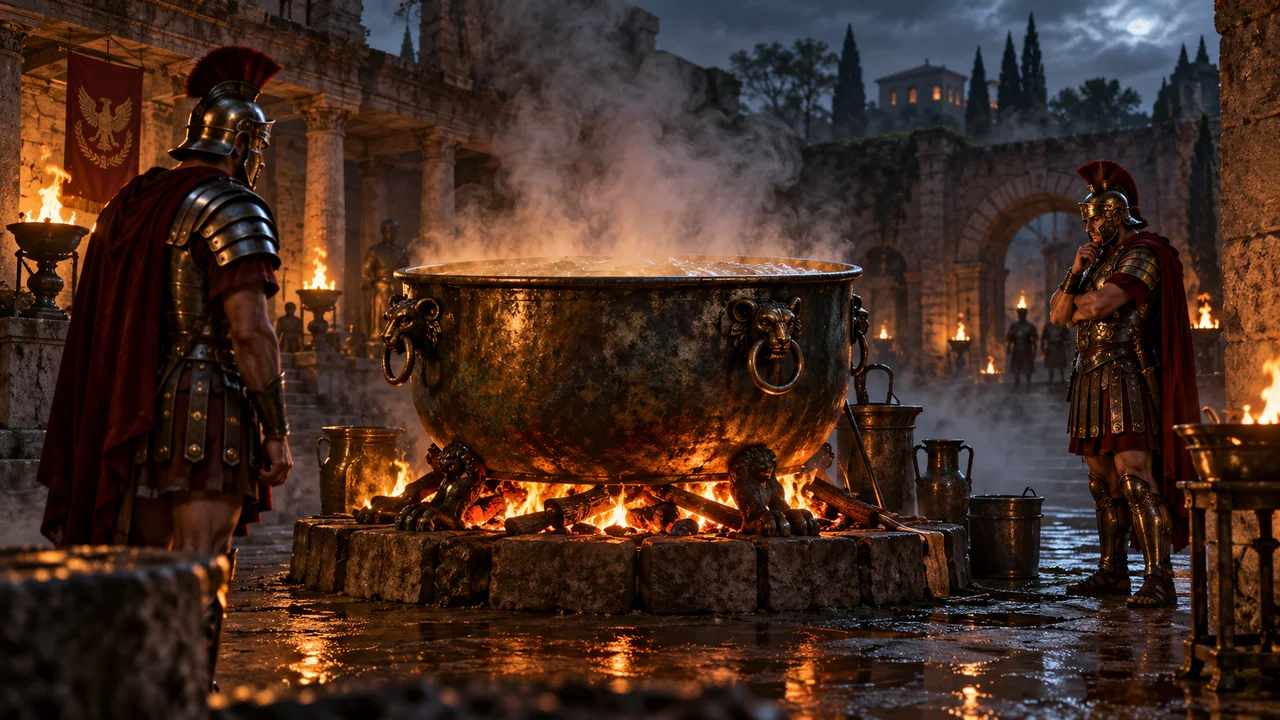
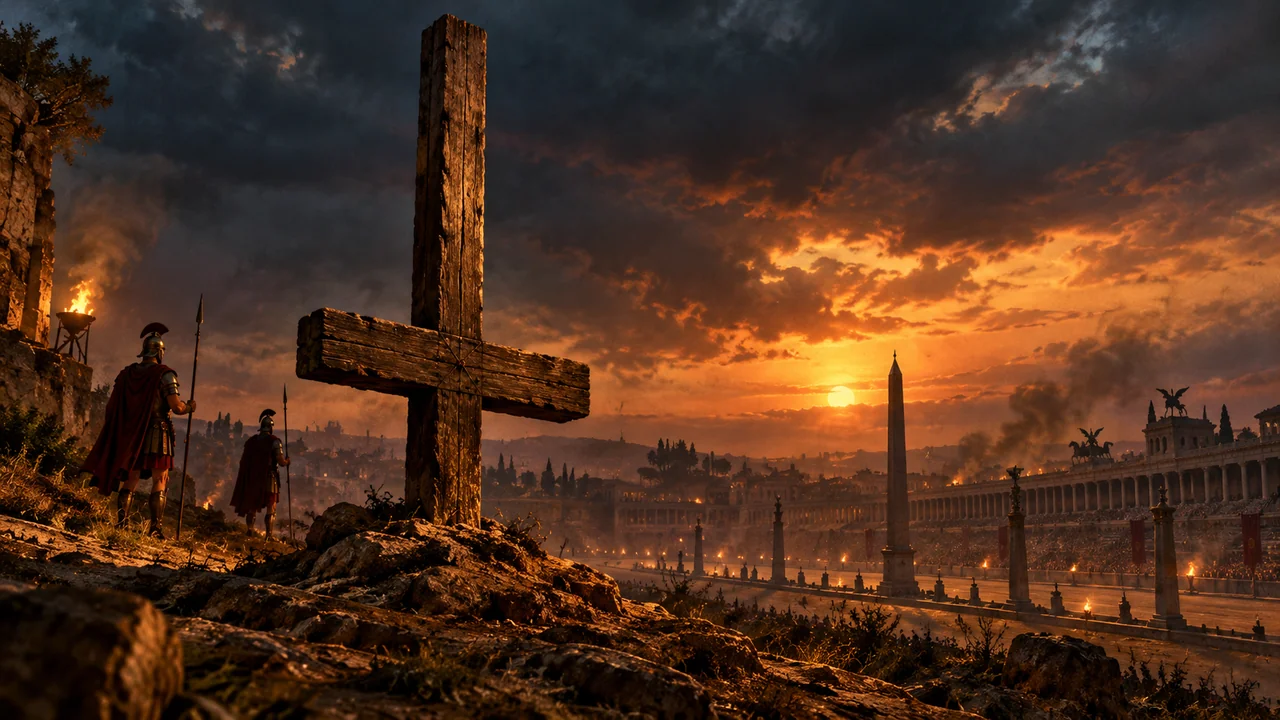
Nero turned executions into macabre public theatrical spectacles inside his private gardens on the Vatican Hill (Mons Vaticanus), adjacent to the imperial Circus. Tacitus records that believers were covered in wild beast skins to be torn by rabid dogs, while others were nailed to wooden crosses or covered in pitch and ignited at twilight to serve as living human torches along the imperial chariot tracks. It was within this vortex of imperial sadism that Simon Peter, the Galilean fisherman whom Jesus of Nazareth had named the "Rock," was led to his final trial.
Primary Historical Attestations: Eusebius, Origen, and the Apocrypha
While the canonical New Testament records Jesus cryptically prophesying Peter's martyrdom in John 21:18–19—stating that when Peter became old, he would "stretch out your hands, and another will dress you and carry you where you do not want to go"—it stops short of narrating the physical execution itself. To reconstruct the historical reality of Peter’s death, historians rely on a robust corpus of early patristic manuscripts and sub-apostolic records.
The earliest preserved textual reference describing Peter’s specific posture on the cross appears in the Acts of Peter (commonly preserved in the Latin Vercelli Acts, dating to the late 2nd century). The manuscript details Peter’s confrontation with Roman authorities and his deliberate plea to the imperial executioners:
"I beseech you, executioners, crucify me thus, with the head downward and not otherwise: and the reason wherefore, I will tell unto them that hear."
This tradition was universally accepted by the early intellectual leaders of the Christian church. Origen of Alexandria (c. 185–253 AD), one of antiquity’s most prolific biblical scholars, confirmed the event in the third volume of his Commentaries on Genesis, an excerpt preserved verbatim by church historian Eusebius of Caesarea in his foundational Historia Ecclesiastica (Book III, Chapter 1):
"Peter appears to have preached through Pontus, Galatia, Bithynia, Cappadocia, and Asia to the Jews that were in the dispersion; and at last, having come to Rome, he was crucified head-downwards; for he had requested that he might suffer in this way."
Further independent confirmation comes from Tertullian of Carthage (c. 155–220 AD), who writes in Scorpiace (Chapter 15) that "Peter is tied to the cross, like his Lord, but head down," and Saint Jerome in De Viris Illustribus (Chapter 1), who notes that Peter "was crowned with martyrdom under Nero, being crucified with his head towards the ground and his feet raised on high, asserting that he was unworthy to be crucified in the same manner as his Lord."
The historical convergence across North Africa, Rome, Palestine, and Asia Minor demonstrates that the memory of Peter’s inverted crucifixion was not a late medieval legend, but a deeply rooted historical conviction across the 2nd and 3rd centuries.
Forensic Pathology of Inverted Crucifixion (Crux Inversa)
Crucifixion was perfected by Roman military engineers as the most excruciating form of slow public execution (summum supplicium). In traditional, upright crucifixion (crux immissa), death is predominantly caused by progressive positional asphyxiation combined with hypovolemic shock, cardiac rupture, and severe dehydration. When the victim hangs by their wrists, the pectoral and intercostal muscles are held in a state of maximum inhalation. To exhale, the condemned must painfully push upward against the spikes driven through their calcaneus (heel bones), creating agony that could last for days.
However, inverting the victim (crux inversa) completely reverses and accelerates the physiological cascade. Modern forensic pathologists and trauma specialists have analyzed the physical mechanics of head-down suspension:
[Inversion on the Cross]
       │
       ├──► 1. Massive Hydrostatic Blood Pressure Shift (Head & Brain)
       │         └── Acute cerebral venous congestion & intracranial hemorrhage
       │
       ├──► 2. Visceral Gravitational Oppression on the Diaphragm
       │         └── Abdominal organs crush lungs, triggering acute respiratory failure
       │
       └──► 3. Asphyxiation and Fatal Cardiovascular Decompensation
                 └── Left ventricular failure, cerebral edema, or cardiogenic shock
- Massive Hydrostatic Shifting to the Cranium: In an inverted posture, gravity forces approximately 70% of the body’s circulating venous volume toward the thorax, neck, and brain. The internal jugular veins and dural venous sinuses become severely engorged. The resulting intracranial pressure rapidly skyrockets, leading to massive cerebral edema, ocular hemorrhage (rupture of retinal vessels), and profound neurological disorientation.
- Diaphragmatic Gravitational Oppression: In upright suspension, the abdominal organs sag downward, pulling away from the diaphragm. In an inverted cross, the heavy abdominal viscera—including the liver, stomach, spleen, and intestines—descend directly onto the diaphragm. This mechanically forces the diaphragm upward into the thoracic cavity, severely compressing both lung bases. The vital lung capacity is reduced by over 60%, precipitating rapid hypercapnia (carbon dioxide retention) and metabolic acidosis.
- Cardiovascular Overload and Terminal Shock: As venous return to the heart surges from the lower extremities, the right atrium experiences acute volume overload. Simultaneously, the vascular resistance in the cephalic bed increases dramatically. The heart struggles against impossible hydrostatic gradients, eventually precipitating acute left ventricular failure, lethal ventricular arrhythmias, or fatal pulmonary edema.
Forensic analysis indicates that while an upright victim could linger for up to 72 hours, an inverted victim suspended without foot support would experience loss of consciousness within hours, with fatal cardiopulmonary failure following soon after. Peter’s suffering was devastatingly intense, compressed into hours of suffocating neurological and vascular pressure.
Comparative Analysis: Standard vs. Inverted Suspension
| Forensic Variable | Standard Upright Crucifixion (Crux Immissa) | Inverted Crucifixion (Crux Inversa) |
|---|---|---|
| Primary Cause of Death | Positional asphyxiation from muscular exhaustion; dehydration | Acute cerebral edema, respiratory collapse from visceral pressure, heart failure |
| Duration of Agony | 24 to 72 hours (depending on crurifragium or sedile) | 2 to 8 hours before fatal loss of consciousness |
| Breathing Mechanism | Active pushing on pinned feet required to exhale air | Active abdominal muscular contraction required to draw breath against gravity |
| Cerebral Hemodynamics | Progressive cerebral ischemia and hypovolemia | Extreme intracranial hypertension and venous rupture |
| Historical Precedent | Documented by Seneca, Josephus (Jewish War V.11) | Documented in Seneca’s Consolatio ad Marciam (XX.3) |
Seneca the Younger, Nero's own imperial tutor, confirmed that Roman soldiers routinely altered crucifixion postures for cruel amusement, writing in Consolatio ad Marciam: "I see crosses there, not just of one kind, but made in different ways: some have their victims with heads down to the ground; some impale their privates; others stretch out their arms on yokes."
Archaeological Excavations: The Red Wall and the "Petros Eni" Inscription
For nearly two millennia, Roman Catholic tradition held that St. Peter’s Basilica was built directly atop the tomb of the apostle. However, critical secular historians often dismissed this as pious fabrication until a remarkable twentieth-century archaeological excavation proved otherwise.
Between 1939 and 1949, under the authorization of Pope Pius XII, a team of archaeologists conducted clandestine excavations beneath the Confessio of St. Peter's Basilica. What they uncovered stunned the scientific world: a remarkably preserved 1st- and 2nd-century Roman necropolis (Scavi Vaticani) buried under the foundation fills of Emperor Constantine’s original 4th-century basilica.
[Ground Level: High Altar of St. Peter's]
       │
       ▼ (8 meters subterranean depth)
[Constantine's 4th-Century Marble Shrine]
       │
       ▼
[The "Aedicula" (c. 160 AD Tropaeum of Gaius)]
       │
       ├──► "The Red Wall" (Plastered brick barrier)
       │         └── Graffiti Wall G: Ancient pilgrims' scratches
       │              └── Inscription: "ΠΕΤΡ[ΟΣ] ΕΝΙ" ("Peter is here")
       │
       └──► Marble Loculus: Skeletal remains of a 60-70 year old male
                 └── Traces of royal murex purple cloth interwoven with gold
In 1968, classical epigrapher Margherita Guarducci deciphered the crucial Greek graffiti etched into the plaster of "Wall G":
$$\text{PETROS ENI} \quad (\Pi E T P O \Sigma ; E N I) \implies \text{"Peter is within" or "Peter is here"}$$
Adjacent to this inscription was a hidden marble-lined recess (loculus). Inside, physical anthropologists analyzed skeletal remains belonging to an individual:
- Biological sex: Male
- Estimated age at death: Between 60 and 70 years old
- Bone condition: Robust physical frame consistent with lifelong manual labor (such as handling fishing nets)
- Burial textile: Wrapped in a luxurious purple cloth dyed with true Murex snails and interwoven with pure gold threads—an extraordinary honor reserved for monarchs and revered martyrs.
- Significant absence: The feet bones displayed trauma consistent with severed ankles, matching Roman protocols where executioners chopped the feet off inverted victims to quickly remove the corpse from the wooden stipes.
This archaeological chain of custody physically links the 1st-century fisherman of Galilee to the exact geographical epicenter of the Circus of Nero on Vatican Hill.
Cosmic and Theological Symbolism: Unworthiness Before Christ
Why did Peter demand this excruciating inverted posture? In popular memory, Peter's decision is understood solely as an act of radical humility: feeling morally unworthy to die in the identical posture as the Son of God, whom he had famously denied three times in the courtyard of Caiaphas (Matthew 26:69–75).
However, early patristic theology recognized an even deeper, cosmic dimension to the inverted cross. In the Acts of Peter, the apostle addresses the weeping spectators from the inverted timber:
"Learn the mystery of all nature, and the beginning of all things, what it was. For the first man, whose likeness I have in my falling, fell head downward, and showed forth a manner of birth which was not so formerly... For the whole world is turned upside down. But thou, Christ, hast made straight all things."
In Peter's eyes, fallen human civilization was living upside down—worshiping tyrannical emperors, practicing institutional bloodsport, and celebrating pagan hedonism while crushing the poor. By hanging inverted, Peter declared that the cross of Jesus Christ had righted an inverted world. What imperial Rome viewed as the ultimate degradation was, in spiritual truth, the coronation of an unshakable kingdom.
Deepen Your Investigation with the Historical Dossier
The story of Peter's inverted crucifixion is only the first chapter in a documented historical trail of blood, courage, and eyewitness conviction. If you want to explore the complete primary source manuscripts, forensic medical reconstructions, and archaeological discoveries of all twelve disciples:
👉 Download Volume I: The Twelve Apostles – Historical Dossier ($2.99)
Includes unabridged Roman trial records, early church father citations, forensic cause-of-death breakdowns, and high-resolution archaeological maps.
Frequently Asked Questions
Did Peter really demand to be crucified upside down?
Yes. The tradition of Peter requesting an inverted crucifixion is attested by the earliest church historians and theologians, including Origen (preserved by Eusebius in Historia Ecclesiastica III.1), Tertullian, and Saint Jerome. Peter asserted that he was morally unworthy to die in the exact physical manner of Jesus Christ.
What is the medical cause of death in an inverted crucifixion?
Forensic pathology reveals that inverted crucifixion (crux inversa) causes death primarily through acute cerebral venous congestion, intracranial hemorrhage, and rapid respiratory failure caused by abdominal organs crushing the lungs against the diaphragm, leading to asphyxiation and cardiogenic shock within a few hours.
Where was Peter crucified in Rome?
Peter was executed in Nero's Circus (Circus Neronis), located on the Vatican Hill (Mons Vaticanus) outside the classical city walls of Rome, precisely where St. Peter’s Basilica and the Vatican Obelisk stand today.
What archaeological proof exists of Peter’s burial?
In the 1940s and 1950s, excavations beneath St. Peter's Basilica uncovered a 1st-century Roman necropolis containing a 2nd-century shrine (Aedicula) and a graffiti wall bearing the Greek inscription PETROS ENI ("Peter is here"). Forensic examination identified the bones of a 60-to-70-year-old muscular male wrapped in royal purple cloth dyed with murex and woven with gold.
Frequently Asked Questions
Did Peter really demand to be crucified upside down?
Yes. The tradition of Peter requesting an inverted crucifixion is attested by the earliest church historians and theologians, including Origen (preserved by Eusebius in Historia Ecclesiastica III.1), Tertullian, and Saint Jerome. Peter asserted that he was morally unworthy to die in the exact physical manner of Jesus Christ.
What is the medical cause of death in an inverted crucifixion?
Forensic pathology reveals that inverted crucifixion (crux inversa) causes death primarily through acute cerebral venous congestion, intracranial hemorrhage, and rapid respiratory failure caused by abdominal organs crushing the lungs against the diaphragm, leading to asphyxiation and cardiogenic shock within a few hours.
Where was Peter crucified in Rome?
Peter was executed in Nero's Circus (Circus Neronis), located on the Vatican Hill (Mons Vaticanus) outside the classical city walls of Rome, precisely where St. Peter’s Basilica and the Vatican Obelisk stand today.
What archaeological proof exists of Peter’s burial?
In the 1940s and 1950s, excavations beneath St. Peter's Basilica uncovered a 1st-century Roman necropolis containing a 2nd-century shrine (Aedicula) and a graffiti wall bearing the Greek inscription PETROS ENI ("Peter is here"). Forensic examination identified the bones of a 60-to-70-year-old muscular male wrapped in royal purple cloth dyed with murex and woven with gold.
Related Research Dossiers
View all 120 articles →
The Spear at Mylapore: Did the Apostle Thomas Really Build Churches in Ancient India?
Bound for Two Days: The Unspoken Agony of St. Andrew on the Crux Decussata in Greece