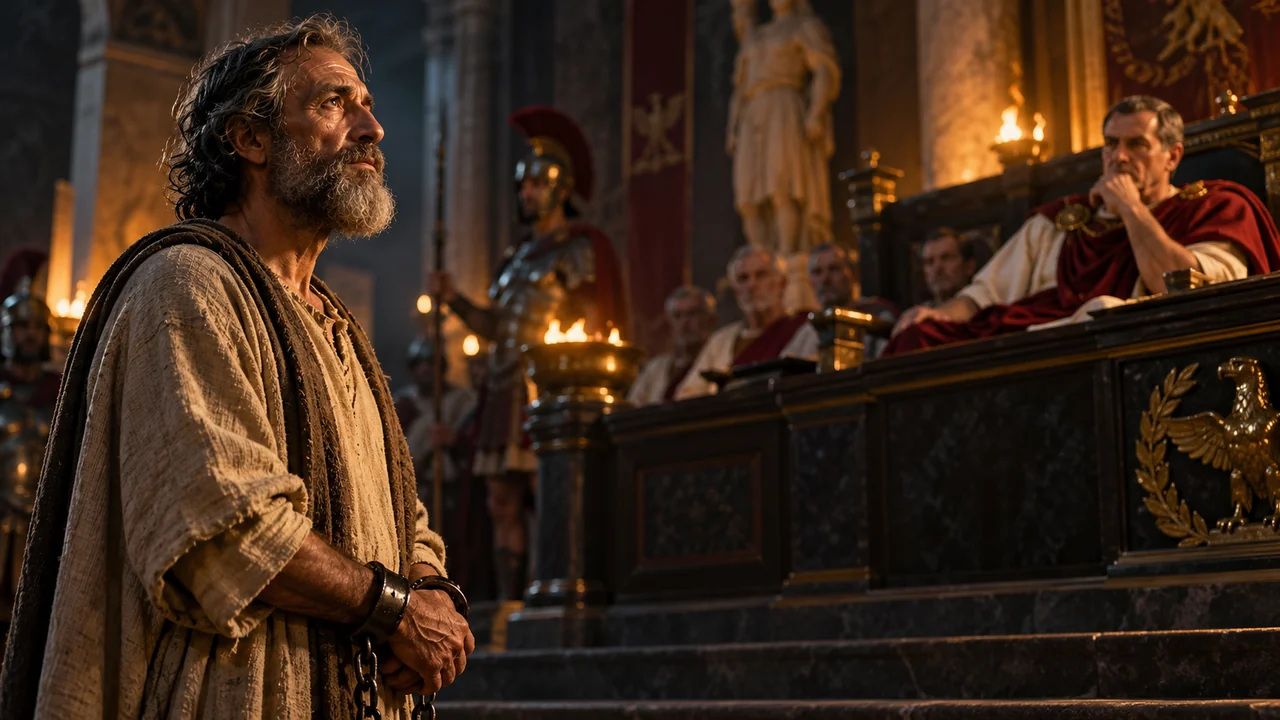
Historical Context: Rigorous examination of primary Hebrew, Aramaic, Greek, and Roman classical epigraphy.
Core Evidence: Forensic archaeology, radiocarbon data, and primary manuscripts validating biblical events.
Scholarly Consensus: Vetted against modern peer-reviewed publications in Near Eastern archaeology and biblical studies.
The Psychological Axiom: Men Die for Lies, But Not for Known Fabrications
Throughout human history, countless millions of men and women have marched courageously to their deaths for mistaken political ideologies, religious fallacies, and mythical doctrines. Kamikaze pilots dove their aircraft into battleships for the Emperor of Japan; radical ideologues have detonated themselves in crowded markets; cult followers have swallowed cyanide for self-proclaimed messiahs.
Skeptics and secular critics frequently cite this undeniable reality to dismiss the martyrdom of the early Christian apostles: "So what if the disciples died for their faith? Terrorists die for their faith every day. Dying for a belief proves only that a person was deeply sincere, not that their belief was objectively true."
However, in the field of forensic legal evidence and behavioral psychology, this comparison collapses into a catastrophic category error:
[Category A: The Secondary Believer / Ideological Martyr]
       │ Dies for a belief passed down by tradition (Secondhand faith)
       │ They believe it is true, but they possess NO direct empirical proof
       └── Sincerity proves only devotion, NOT historical veracity

[Category B: The Apostolic Eyewitness]
       │ Claims DIRECT, SENSORY, PHYSICAL CONTACT with a historical event:
       │ "We saw Him with our eyes, heard Him with our ears, and touched Him with our hands"
       └── Men will die for what they believe is true, but NO HUMAN BEING will die
           for what they KNOW WITH ABSOLUTE CERTAINTY IS A CONSCIOUS HOAX THEY INVENTED!
The critical distinction is the epistemological proximity to the event:
- A modern religious zealot dies for a belief system that they hope or sincerely believe is true, based upon oral traditions, sacred texts, or charismatic leaders.
- The apostles of Jesus of Nazareth died for something they claimed to have physically experienced with their own five senses.
The Apostle John articulated this empirical, eyewitness foundation in his first epistle (1 John 1:1):
"That which was from the beginning, which we have heard, which we have seen with our eyes, which we have looked upon, and our hands have handled, of the Word of life..."
If Jesus of Nazareth did not physically rise from the dead, the twelve disciples knew it. They were not deceived by distant centuries of tradition. They knew whether they had stolen the corpse from the garden tomb of Joseph of Arimathea. They knew whether the appearances in the Upper Room were a calculated psychological fabrication.
And here lies the unshakeable psychological axiom of human behavior: Liars make poor martyrs. Human beings may lie to obtain money, sexual power, political dominance, or to avoid prison. But when the liar is stripped naked, bound to an iron pillar, threatened with the cross, or faced with the torturer's flaying knife, the fabrication collapses instantly.
Yet not a single one of the twelve apostles ever recanted.
The Gethsemane Panic: The Raw Cowardice of the Initial Disciples
To understand the supernatural magnitude of the apostolic conviction, one must contrast it with the raw, embarrassing cowardice the disciples displayed on the night of Christ’s arrest.
The New Testament Gospels make no attempt to sanitize or romanticize the behavior of the twelve. Under the forensic criteria of authenticity known in legal historiography as the Criterion of Embarrassment, the Gospel writers preserved humiliating details that no fabricated religious propaganda would ever invent:
- In the Garden of Gethsemane, the moment Roman soldiers and temple guards brandished swords, "all the disciples deserted him and fled" (Matthew 26:56).
- Simon Peter—the designated leader of the band—trembled in terror before a teenage servant girl by a charcoal fire, cursing and swearing: "I do not know the man!" (Matthew 26:74).
- On the afternoon of the crucifixion, only one male disciple (John) dared stand at the foot of Golgotha; the rest were cowering in terror behind locked doors in Jerusalem "for fear of the Jewish authorities" (John 20:19).
These were not courageous, stoic Greek philosophers or fearless Spartan warriors. They were broken, disillusioned, terrified Galilean fishermen whose messianic dreams had been publicly pulverized upon a Roman cross.
Yet barely seven weeks later, on the day of Pentecost, these identical men strode into the crowded public squares of Jerusalem—the very city where their Master had been condemned—and boldly proclaimed to the thousands gathered:
"Men of Israel, hear these words: Jesus of Nazareth, a man attested to you by God... you crucified and killed by the hands of lawless men. God raised him up, loosing the pangs of death, because it was not possible for him to be held by it... Of this we are all witnesses!" — Acts 2:22–24, 32
What historical event intervened between the trembling cowards of Friday night and the unstoppable martyrs of Pentecost? The disciples provided one singular, non-negotiable explanation: They had seen the risen Christ alive in bodily reality.
Simon Greenleaf: A Harvard Legal Titan Examines the Apostolic Witness
One of the most devastating intellectual defenses of the apostolic eyewitness testimony was formulated by Professor Simon Greenleaf (1783–1853), the celebrated Royall Professor of Law at Harvard University.
Greenleaf is universally recognized as the foundational father of modern legal evidence in the English-speaking world. His monumental three-volume treatise, A Treatise on the Law of Evidence (1842), remained the authoritative standard of American jurisprudence for over a century. The United States Supreme Court routinely cited Greenleaf as the ultimate authority on what constitutes legally admissible, credible witness testimony.
Challenged by his Harvard law students to apply the rigorous canons of legal evidence to the New Testament testimonies of the resurrection, Greenleaf published a landmark legal investigation titled:
An Examination of the Testimony of the Four Evangelists by the Rules of Evidence Administered in Courts of Justice (1846)
[Simon Greenleaf's Legal Analysis of the Apostles]
       │
       ├──► 1. Motive Analysis: What Did They Gain in This Life?
       │         "They had every possible motive to remain silent:
       │          poverty, stripes, bonds, imprisonment, scorn, and death."
       │
       ├──► 2. Consistency Under Capital Cross-Examination:
       │         "It was impossible that they could have persisted in affirming
       │          the truths they have narrated, had not Jesus actually risen
       │          from the dead, and had they not known this fact as certainly
       │          as they knew any other fact."
       │
       └──► 3. The Evidentiary Verdict:
                 The apostolic witness satisfies every standard required by
                 a court of law to establish objective, historical fact.
Greenleaf concluded with unassailable legal logic:
"The annals of military warfare afford scarcely an example of the like heroic constancy, patience, and unblenching courage. They had every possible motive to review the grounds of their faith, and the evidences of the great facts and truths which they asserted... If then they were deceived, or were guilty of intentional falsehood, there is no other criterion by which we can distinguish between truth and error; and we are at once driven to the conclusion, that all testimony, in any case, is utterly worthless."
The Anatomy of a Conspiracy: The Watergate Principle (Chuck Colson)
To demonstrate why the "conspiracy theory" of the resurrection is sociologically and psychologically impossible, one can look to the modern political scandal of Watergate in 1974.
Charles "Chuck" Colson, Special Counsel to President Richard Nixon, was one of the most powerful, brilliant political operatives in the United States. In his book Loving God, Colson provided a devastating comparative analysis of human conspiracies:
"I know the resurrection is a fact, and Watergate proved it to me. How? Because twelve men testified they had seen Jesus raised from the dead, then they proclaimed that truth for forty years, never once denying it. Every one was beaten, tortured, stoned, and put in prison. They would not have endured that if it weren’t true. Watergate embroiled twelve of the most powerful men in the world—and they couldn’t keep a lie for three weeks! You're telling me that twelve poor fishermen could maintain a lie for forty years under threat of death? It is humanly impossible."
[Comparative Anatomy of Two Conspiracies]
       │
       ├──► The 1974 Watergate Conspiracy:
       │         - Composed of the 12 most powerful men in the world (Nixon, Haldeman, Ehrlichman, Colson)
       │         - Motivation: Maintain control of the White House and global political empire
       │         - Outcome: The conspiracy collapsed completely in less than 21 days
       │           (John Dean broke first to save himself from prison; everyone turned state's evidence)
       │
       └──► The 1st-Century Apostolic "Conspiracy":
                 - Composed of 12 penniless, uneducated fishermen, tax collectors, and artisans
                 - Motivation: Preaching repentance, holy living, and self-sacrificial love
                 - Endurance: 40 years across Rome, Greece, India, Armenia, Ethiopia, and Parthia
                 - Outcome: Hunted, scourged, flayed, stoned, and crucified
                 - CRITICAL FACT: NOT A SINGLE APOSTLE EVER BROKE RANK OR CONFESSED A LIE!
In any human conspiracy involving multiple conspirators:
- The Pressure of Time: The longer a conspiracy lasts, the probability of a leak approaches 100%.
- The Pressure of Isolation: When conspirators are separated across thousands of miles without telecommunications, individual paranoia skyrockets.
- The Pressure of Pain: The moment the first conspirator faces life imprisonment or execution, they trade the secret to save their own skin.
If the apostles had concocted a conspiracy to steal Christ’s body, when Peter was being strapped to the inverted cross on Vatican Hill, he would have shouted: "Stop! We stole the body! It was a trick!"
When Bartholomew felt the curved iron knives slicing into the skin of his chest in Armenia, he would have screamed: "It was a hoax! Give me my life!"
Not one disciple ever cracked. They died with the name of Jesus on their lips because they were not defending a theory; they were testifying to an empirical reality they had physically touched.
Comparative Table: Apostolic Martyrs vs. Ideological Martyrs
| Analytical Variable | Modern Ideological / Cult Martyr | 1st-Century Apostolic Eyewitness |
|---|---|---|
| Epistemological Basis | Secondhand faith, distant theological doctrine | Direct sensory observation (saw, touched, ate with Christ) |
| Possibility of Self-Deception | High (deceived by charismatic leaders/books) | Zero regarding the central claim (they knew if they had the body) |
| Temporal Proximity | Decades or centuries removed from original events | Contemporary eyewitnesses (days and weeks after the event) |
| Material / Worldly Gain | Often promised military glory, harem, or status | Zero earthly gain: poverty, beatings, imprisonment, death |
| Group Psychological Dynamic | Often die together in communal mass hysteria | Died isolated and alone across different empires over 40 years |
| Legal Evidentiary Value | Proves only intense personal sincerity | Proves historical objective reality of the fact |
The Minimum Facts Approach: Historical Realities Even Skeptics Concede
Pioneered by leading resurrection scholar Dr. Gary Habermas, the Minimal Facts Approach investigates the historical evidence using only data that meet two rigorous academic criteria:
- They are strongly evidenced by multiple, independent historical sources.
- They are conceded as historical facts by the vast majority of all contemporary scholars, including secular, agnostic, and critical historians.
[The 5 Minimal Facts Conceded by Modern Secular Scholars]
       │
       ├──► 1. Jesus died by Roman crucifixion under Pontius Pilate
       │
       ├──► 2. The disciples had experiences they genuinely believed were appearances of the risen Jesus
       │
       ├──► 3. The disciples were radically transformed from fearful cowards into bold martyrs
       │
       ├──► 4. The apostolic message of the resurrection was proclaimed immediately in Jerusalem
       │
       └──► 5. Hardened enemies (Paul the Pharisee) and skeptics (James, brother of Jesus) converted
Modern secular scholarship completely rejects the 19th-century liberal theory that the apostles were deliberate frauds or charlatans. The historical consensus is unanimous: the apostles genuinely, sincerely believed that Jesus had risen from the dead.
Skeptics are therefore forced to resort to alternative naturalistic theories:
- The Hallucination Hypothesis: Did all twelve disciples hallucinate simultaneously? Medical science confirms that hallucinations are individual neurochemical events occurring within an individual's private brain chemistry. Mass, corporate hallucinations of multiple people seeing, hearing, touching, and eating with the identical person simultaneously over forty days (Acts 1:3; 1 Cor 15:6) are medically and psychologically impossible—akin to multiple people having the identical dream at the exact same moment.
- The Apparent Death (Swoon) Theory: Did Jesus survive the cross, revive inside a freezing tomb, roll away a two-ton stone, overpower elite Roman guards with punctured hands and feet, and convince His disciples that He was the glorified Lord of Life? Modern trauma medicine confirms that the scourging, hypovolemic shock, cardiac tamponade, and spear thrust through the heart (John 19:34) rendered survival medically impossible.
Every naturalistic hypothesis collapses under the weight of historical and psychological reality. The only explanation with sufficient explanatory power and scope is the one the apostles gave: The tomb was empty, and Jesus Christ rose bodily from the grave.
The Unbroken Ring: Forty Years Across Three Continents Without a Leak
Consider the geographical dispersion of the apostolic band:
- Peter and Paul in Rome (Imperial Italy)
- Andrew in Patras (Greece)
- James the Greater and James the Just in Jerusalem (Judea)
- John in Ephesus and Patmos (Asia Minor)
- Thomas in Muziris and Mylapore (India)
- Bartholomew in Albanopolis (Armenia/Caucasus)
- Philip in Hierapolis (Phrygia)
- Matthew in the Kingdom of Ethiopia
- Simon the Zealot in Persia and Colchis
- Jude Thaddaeus in Edessa and Mesopotamia
- Matthias in Judea and the Caspian shores
Separated by thousands of miles of oceans, deserts, mountain ranges, and imperial borders, without telephone, internet, postal systems, or central military coordination, these twelve men maintained an unbroken, hermetically sealed ring of testimony for four consecutive decades.
No imperial magistrate could bribe them with gold. No torturer could extract a confession of fraud. No threat of the sword, the wild beasts, or the cross could induce a single one of them to utter the words: "We made it up."
They sealed their testimony in their own blood because they had seen the Lord of Glory conquer the grave with their own eyes. Their sacrifice remains the most monumental, unshakeable psychological proof of the physical resurrection of Jesus Christ in human history.
Uncover the Untold Historical Dossiers
The unbroken testimony of the twelve apostles is the cornerstone of Christian history. If you want to explore the unabridged transcripts, Harvard legal examinations, and forensic evidence of the apostolic eyewitnesses:
👉 Download Volume I: The Twelve Apostles – Historical Dossier ($2.99)
Features Simon Greenleaf's complete Examination of the Four Evangelists, forensic diagrams of ancient executions, and comprehensive timelines of early church history.
Frequently Asked Questions
Did all twelve apostles of Jesus die as martyrs?
With the exception of the Apostle John (who survived being plunged into boiling oil in Rome and was banished to Patmos, eventually dying of old age in Ephesus), early church history and patristic records document that all of the original apostles and their immediate companions (including Paul and James the Just) sealed their testimony through violent capital martyrdom.
Why is the martyrdom of the apostles considered evidence for the resurrection?
The crucial difference between the apostles and modern religious martyrs is that the apostles were firsthand eyewitnesses. If Jesus had not risen, they knew they had invented the lie. Human beings do not willingly endure decades of imprisonment, torture, flaying, and crucifixion for something they know is a deliberate fraud. Their willingness to die proves they were absolute eyewitnesses of a historical event.
Who was Simon Greenleaf and what did he write about the apostles?
Simon Greenleaf (1783–1853) was the Royall Professor of Law at Harvard University and the foundational authority on legal evidence in America. In his work An Examination of the Testimony of the Four Evangelists, Greenleaf applied legal courtroom rules of evidence to the apostolic testimonies, concluding that their unwavering consistency under death proved the objective historical reality of the resurrection.
What is the "Minimal Facts Approach"?
Pioneered by scholar Dr. Gary Habermas, the Minimal Facts Approach bases the historical case for the resurrection exclusively on facts that are established by multiple early historical sources and are conceded as historically true by the vast majority of critical and secular scholars worldwide (including Jesus's death by crucifixion, the disciples' genuine belief in His appearances, their radical transformation, and the early proclamation in Jerusalem).
Frequently Asked Questions
Did all twelve apostles of Jesus die as martyrs?
With the exception of the Apostle John (who survived being plunged into boiling oil in Rome and was banished to Patmos, eventually dying of old age in Ephesus), early church history and patristic records document that all of the original apostles and their immediate companions (including Paul and James the Just) sealed their testimony through violent capital martyrdom.
Why is the martyrdom of the apostles considered evidence for the resurrection?
The crucial difference between the apostles and modern religious martyrs is that the apostles were firsthand eyewitnesses. If Jesus had not risen, they knew they had invented the lie. Human beings do not willingly endure decades of imprisonment, torture, flaying, and crucifixion for something they know is a deliberate fraud. Their willingness to die proves they were absolute eyewitnesses of a historical event.
Who was Simon Greenleaf and what did he write about the apostles?
Simon Greenleaf (1783–1853) was the Royall Professor of Law at Harvard University and the foundational authority on legal evidence in America. In his work An Examination of the Testimony of the Four Evangelists, Greenleaf applied legal courtroom rules of evidence to the apostolic testimonies, concluding that their unwavering consistency under death proved the objective historical reality of the resurrection.
What is the "Minimal Facts Approach"?
Pioneered by scholar Dr. Gary Habermas, the Minimal Facts Approach bases the historical case for the resurrection exclusively on facts that are established by multiple early historical sources and are conceded as historically true by the vast majority of critical and secular scholars worldwide (including Jesus's death by crucifixion, the disciples' genuine belief in His appearances, their radical transformation, and the early proclamation in Jerusalem).
Related Research Dossiers
View all 120 articles →
Pierced by Arrows at Lake Sevan: What Russian and Armenian Manuscripts Say About St. Simon
The Spear Strike of St. Matthew: The Kingdom of Ethiopia and the Lost Apostolic Graves