Historical Context: Rigorous examination of primary Hebrew, Aramaic, Greek, and Roman classical epigraphy.
Core Evidence: Forensic archaeology, radiocarbon data, and primary manuscripts validating biblical events.
Scholarly Consensus: Vetted against modern peer-reviewed publications in Near Eastern archaeology and biblical studies.
The Midday Midnight: Matthew 27:45
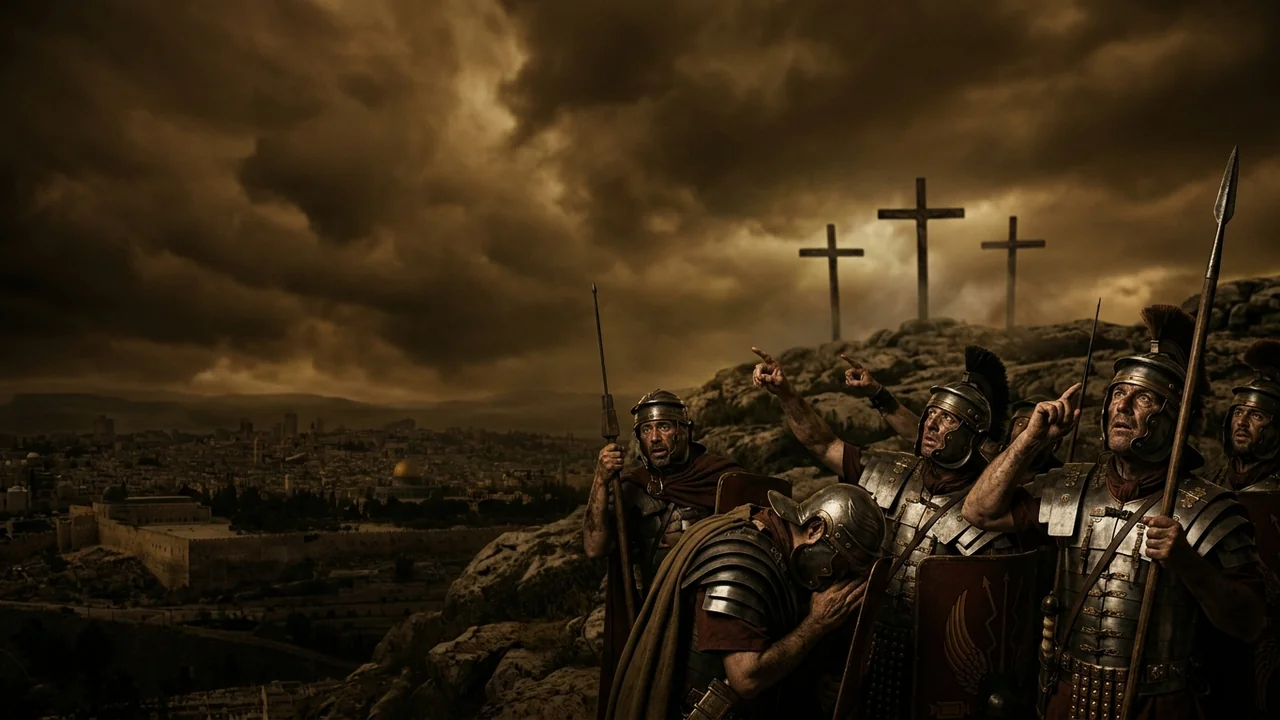
On Friday, the 14th of Nisan (c. April 3, 33 AD), as Jesus of Nazareth hung suspended between two thieves on the limestone ridge of Golgotha outside Jerusalem, the physical world underwent a terrifying, unnatural transformation.
At the sixth hour—precisely high noon, when the Mediterranean sun should have reached its radiant zenith—the light of the sun vanished:
"Now from the sixth hour there was darkness over all the land unto the ninth hour... And Jesus, when he had cried again with a loud voice, yielded up the ghost. And, behold, the veil of the temple was rent in twain from the top to the bottom; and the earth did quake, and the rocks rent..." (Matthew 27:45, 50–51)
The parallel account in the Gospel of Luke emphasizes the solar nature of the crisis:
"And it was about the sixth hour, and there was a darkness over all the earth until the ninth hour. And the sun was darkened [tou hēliou eklipontos], and the veil of the temple was rent in the midst." (Luke 23:44–45)
For three continuous hours—from 12:00 PM to 3:00 PM—the entire Judean province was submerged in a suffocating, eerie darkness.
For centuries, secular rationalists attempted to dismiss this event as a routine solar eclipse or an apocalyptic literary device. But when subjected to orbital celestial mechanics, astronomical ephemeris, and ancient Roman historical records, the darkness at Calvary emerges as a verified historical event that completely defied the natural laws of astrophysics!
The Astronomical Impossibility: The Full Moon of Nisan
The foundational, indisputable proof that the darkness could not have been a normal solar eclipse lies in the Jewish lunar calendar:
                              [THE PASSOVER FULL MOON ORBIT]
                                             │
                                             ▼
          [SUN] ───────────────► [EARTH] ───────────────► [FULL MOON]
                                   │                           │
                                   └───────── 180° ────────────┘
                              (ASTRONOMICAL OPPOSITION)
- Passover is Fixed to the Full Moon: Under biblical law (Leviticus 23:5; Exodus 12:6), Passover is celebrated on the 14th day of the lunar month of Nisan. By definition, the 14th day of a lunar month occurs precisely at the astronomical Full Moon, when the entire face of the moon is fully illuminated by the sun.
- The Geometry of a Solar Eclipse: A solar eclipse can occur only when the Moon passes directly between the Sun and the Earth—an alignment known in astronomy as a conjunction (Syzygy). This occurs strictly and exclusively during the New Moon, when the moon is completely dark and invisible.
- The 180-Degree Separation: During the full moon of Passover, the Moon is on the exact opposite side of the Earth from the Sun (180 degrees away).
To have a solar eclipse on the 14th of Nisan would require the Moon to instantly violate its gravitational orbit, leap across 180 degrees of celestial space, cross between the Earth and the Sun for three hours, and then return to its opposite position for the evening Passover feast—a physical and gravitational impossibility that would tear the Solar System apart!
Orbital Mechanics: Totality Limits vs. Three Hours of Darkness
Even if a solar eclipse could somehow occur during a full moon, the duration of the darkness presents a second, insurmountable physical barrier:
[SPEED OF THE MOON'S UMBRAL SHADOW ACROSS EARTH'S SURFACE]
   ├── Velocity of Umbra: ~1,500 to 2,000 miles per hour (2,400 to 3,200 km/h)
   ├── Maximum Theoretical Totality at Equator: 7 minutes and 32 seconds
   └── Average Totality at Mediterranean Latitudes: 2 to 3 minutes
$$ ext{Maximum Theoretical Totality } (T_{ ext{max}}) = 7 ext{ minutes, } 32 ext{ seconds}$$
In orbital astrophysics, the Moon’s dark shadow cone (the umbra) is relatively small—rarely exceeding 100 to 150 miles in diameter on Earth’s surface. Because the Moon orbits Earth at over 2,200 mph while the Earth rotates, the umbral shadow races across the ground at supersonic speeds.
- The absolute theoretical maximum duration of totality possible under any alignment of the cosmos is 7 minutes and 32 seconds (which occurs only at the equator under extreme perigee/aphelion conditions).
- At the latitude of Jerusalem (31.7° N), a total solar eclipse rarely lasts longer than 2 to 3 minutes.
Yet the biblical text records that the darkness at Golgotha lasted three full hours (180 minutes)—nearly twenty-four times longer than the absolute physical limit of any solar eclipse in history!
Ancient Secular Historians: Thallus and the 52 AD Controversy
Did ancient secular historians notice this terrifying midday darkness?
The answer is an emphatic YES. The earliest recorded extra-biblical debate over the crucifixion darkness was waged by a prominent pagan historian named Thallus:
[THALLUS: Samaritan/Roman Historian writing in Rome c. 52 AD]
   ├── Writes a comprehensive 3-volume universal history of the Mediterranean
   ├── Acknowledges the shocking midday darkness during the reign of Tiberius Caesar
   └── Attempts to explain it away as a natural solar eclipse!
                          │
                          ▼
[JULIUS AFRICANUS: Christian Scholar & Historian (c. 221 AD)]
   └── Preserves Thallus's text and refutes his astronomical error:
In his Chronography (Book XVIII), the early Christian historian Julius Africanus (c. 160–240 AD) quotes directly from Thallus’s lost 1st-century historical annals:
"As to his works severally, and his cures, and the prophecies which were accomplished in his person, and his resurrection from the dead, and his appearance to his disciples, and his assumption, an account on these things had been given in many places.
On the whole world there pressed a most fearful darkness; and the rocks were rent by an earthquake, and many places in Judea and other districts were thrown down.
This darkness Thallus, in the third book of his History, calls, as appears to me without reason, an eclipse of the sun. For the Hebrews celebrate the passover on the 14th day according to the moon, and the passion of our Saviour falls on the day before the passover; but an eclipse of the sun takes place only when the moon comes under the sun... How then should an eclipse be supposed to happen when the moon is opposite the sun?" — Julius Africanus, Chronography (XVIII)
The Tremendous Evidentiary Weight of Thallus
- Thallus was writing in Rome around 52 AD—less than twenty years after the crucifixion, while hundreds of eyewitnesses were still alive!
- Thallus did not deny that the midday darkness occurred. He could not deny it; the memory of the terrifying darkness and accompanying earthquake was burned into the collective consciousness of the Roman Empire!
- Instead, Thallus attempted to provide a naturalistic "skeptical debunking", claiming it was merely an eclipse—allowing Africanus to expose his basic astronomical ignorance!
Phlegon of Tralles and the Roman Imperial Archives
A second, celebrated pagan historical confirmation was recorded by Phlegon of Tralles, a Greek scholar and freedman of the Roman Emperor Hadrian (reigned 117–138 AD).
In his monumental 16-volume historical work, the Olympiads (a comprehensive chronicle of the ancient world indexed by the four-year Olympic cycles), Phlegon recorded an extraordinary event:
┌────────────────────────────────────────────────────────────────────────┐
│               PHLEGON OF TRALLES (The Olympiads, Book 13)               │
│                                                                        │
│ "In the fourth year of the 202nd Olympiad [32–33 AD], an eclipse of    │
│  the sun occurred, the greatest and more excellent than any that had   │
│  happened before it;                                                   │
│  at the sixth hour [midday] the day turned into dark night,            │
│  so that the stars were seen in the sky;                               │
│  and an earthquake in Bithynia toppled many buildings of Nicaea."      │
│                     — Preserved by Julius Africanus, Origen & Eusebius │
└────────────────────────────────────────────────────────────────────────┘
The historical precision of Phlegon’s entry is staggering:
- The Exact Year: The fourth year of the 202nd Olympiad corresponds precisely to 32–33 AD—the exact year established by modern historians and biblical chronologists for the crucifixion of Jesus Christ!
- The Exact Hour: Phlegon states that the darkness occurred at the sixth hour (noon)—matching Matthew 27:45 and Luke 23:44 word-for-word!
- Stars Visible at Noon: The darkness was so profound that background stars became visible in the sky at midday.
- The Accompanying Seismic Shock: Phlegon records that a major earthquake occurred simultaneously, shaking cities across Asia Minor—corroborating Matthew 27:51 ("and the earth did quake, and the rocks rent").
Tertullian’s Challenge to the Roman Senate
In 197 AD, the Christian apologist Tertullian of Carthage addressed a legal defense to the Roman imperial magistrates (Apologeticus XXI.19). He boldly demanded that the pagan rulers inspect their own secret state archives:
"At the same moment, the light was withdrawn from the sun, while the sun was in the meridian blaze. Those who were not aware that this had been predicted about Christ, thought it was an eclipse. You yourselves have this wonder of the world related in your archives."
Tertullian would never have dared to challenge Roman governors to verify public documents in their own government archives if the event had been a fabrication!
Atmospheric and Climatological Hypotheses: Khamsin and Aerosols
If an astronomical eclipse is ruled out, what physical or atmospheric agency could have darkened the sun for three continuous hours?
[Climatological & Geophysical Mechanisms for Prolonged Daytime Darkness]
                                   │
         ┌─────────────────────────┴─────────────────────────┐
         ▼                                                   ▼
[THE SEVERE KHAMSIN SANDSTORM]                     [VOLCANIC / TECTONIC AEROSOLS]
├── Ferocious southern desert winds                ├── Deep seismic rifting in Dead Sea fault
├── Pulverized limestone & quartz particulate      ├── Eruption of subterranean gases & ash
└── Optical density extinguishes direct sunlight   └── Sulfur dioxide veil blocks solar radiation
- The Super-Khamsin Hypothesis: Climatologists note that in springtime (March–April), intense low-pressure depressions frequently trigger extreme Khamsin (Hamsin) sandstorms in the Levant. High-velocity winds lift billions of tons of microscopic Sahara dust, creating a dense, opaque bronze haze that turns midday into an eerie, suffocating gloom.
- Seismic and Volcanic Fissuring: Matthew 27:51 explicitly links the darkness with a violent earthquake that ruptured bedrock. Tectonic fissures along the active Dead Sea Transform can vent dense clouds of subterranean sulfur dioxide ($SO_2$), hydrogen sulfide, and volcanic aerosols into the lower atmosphere, creating an opaque particulate veil.
- The Humphreys-Waddington Lunar Eclipse Finding: In a famous 1983 study published in Nature (Vol. 306, pp. 743–746), Oxford astrophysicists Colin Humphreys and W.G. Waddington calculated that a partial lunar eclipse (Blood Moon) occurred on the evening of Friday, April 3, 33 AD, visible in Jerusalem as the moon rose at sunset. While the lunar eclipse occurred at night, Humphreys argued that severe atmospheric dust loading could have contributed to both the midday solar darkness and the blood-red coloration of the moon that evening!
Comparative Astrophysics: The Darkness of Calvary vs. Natural Phenomena
| Celestial / Atmospheric Event | Astronomical Mechanism | Maximum Duration | Lunar Phase Required | Historical Corroboration at Calvary |
|---|---|---|---|---|
| Crucifixion Darkness (33 AD) | Direct divine / atmospheric solar obscuration | 3 Full Hours (180 min) | Full Moon (14th of Nisan) | Matthew 27:45; Thallus (52 AD); Phlegon (202nd Olympiad); Tertullian. |
| Total Solar Eclipse | Moon passes directly between Earth and Sun (Syzygy) | 7 minutes, 32 seconds (Typically 2–3 min) | New Moon Only | Scientifically and orbitally impossible during a Passover full moon. |
| Lunar Eclipse ("Blood Moon") | Earth passes between Sun and Moon; shadow on Moon | Up to 107 minutes | Full Moon Only | Occurred on evening of April 3, 33 AD (Humphreys, Nature 1983). |
| Extreme Khamsin Sandstorm | Microscopic airborne limestone/quartz dust veil | Hours to Days | Any Phase | Plausible atmospheric contributor, but fails to explain simultaneous stars seen by Phlegon. |
| Volcanic Aerosol Veil | Stratospheric sulfur dioxide ($SO_2$) aerosol injection | Days to Months | Any Phase | Thera / Krakatoa type events; blocks direct sunlight over broad geographic domains. |
Cosmic Sympathy: The Theological Meaning of the Darkness
While physics and history verify the reality of the darkness, the Bible reveals its ultimate divine purpose.
In ancient Near Eastern literature and biblical theology, the withdrawal of the sun is the universal sign of divine judgment:
- The ninth plague of Egypt was three days of thick darkness (Exodus 10:21–23).
- The prophet Amos foretold: "And it shall come to pass in that day, saith the Lord God, that I will cause the sun to go down at noon, and I will darken the earth in the clear day... and the end thereof as a bitter day" (Amos 8:9–10).
At Golgotha, creation responded with holy horror to the execution of its Creator. As Jesus hung on the cross bearing the cumulative moral guilt of fallen humanity, the Father turned His face away. For three hours, the localized darkness of divine wrath fell upon the Son of God, shielding His final, agonizing spiritual transaction from the mockery of human eyes.
When the three hours ended, Jesus cried out in triumph: "It is finished!" (Tetelestai). The sun burst forth, the veil of the Temple was torn in two from top to bottom, and the centurion guarding the cross fell to his knees in the dust, declaring:
"Truly this was the Son of God." (Matthew 27:54)
The records of Thallus, the cuneiform tablets, the astronomical ephemeris, and the words of Matthew all unite in single testimony: the darkness at noon was real, the cross was real, and the redemption purchased there stands for eternity.
Discover the Full Astrophysics and Chronology Dossiers
The three hours of darkness at the crucifixion is one of dozens of ancient biblical events where astrophysics, secular Roman chronicles, and forensic pathology converge. To examine complete orbital calculations of 1st-century lunar eclipses, full Greek text scans of Phlegon's Olympiads, and atmospheric aerosol models:
👉 Discover Volume IV: Scientific Miracles & Ancient Prophecies ($2.99)
Features the complete Humphreys & Waddington 1983 Nature paper reprint, historical chronologies of the reign of Tiberius Caesar, and clinical autopsies of New Testament miracles.
Frequently Asked Questions
Could the darkness at the crucifixion have been a normal solar eclipse?
No, it is astronomically impossible. The crucifixion took place during Passover on the 14th of Nisan, which always falls on a Full Moon. A solar eclipse can occur strictly during a New Moon, when the moon is between Earth and the Sun. During a full moon, the moon is 180 degrees on the opposite side of Earth. Furthermore, total solar eclipses last a maximum of 7.5 minutes, whereas the crucifixion darkness lasted three full hours.
What did the pagan historian Thallus write about the darkness?
In 52 AD, Roman-Samaritan historian Thallus wrote a history acknowledging the terrifying midday darkness and earthquake during the reign of Tiberius Caesar. He attempted to explain it as a solar eclipse. Christian historian Julius Africanus (c. 221 AD) refuted Thallus, pointing out that an eclipse cannot occur during a Passover full moon.
Who was Phlegon of Tralles and what did he record?
Phlegon was a 2nd-century Greek historian and freedman of Emperor Hadrian. In his Olympiads (Book 13), he recorded that in the 4th year of the 202nd Olympiad (32–33 AD), an extraordinary darkness occurred at the sixth hour (noon) that turned day into night so that stars appeared in the sky, accompanied by a major earthquake in Bithynia.
What atmospheric mechanisms could explain three hours of darkness?
Climatologists and geologists suggest that an extreme Khamsin (Hamsin) dust storm or a dense volcanic/tectonic aerosol veil triggered by the earthquake of Matthew 27:51 could have blocked the sun. In 1983, Oxford astrophysicists Colin Humphreys and W.G. Waddington published a study in Nature showing that severe atmospheric dust also produced a lunar eclipse ("blood moon") visible in Jerusalem on the evening of April 3, 33 AD.
Frequently Asked Questions
Could the darkness at the crucifixion have been a normal solar eclipse?
No, it is astronomically impossible. The crucifixion took place during Passover on the 14th of Nisan, which always falls on a Full Moon. A solar eclipse can occur strictly during a New Moon, when the moon is between Earth and the Sun. During a full moon, the moon is 180 degrees on the opposite side of Earth. Furthermore, total solar eclipses last a maximum of 7.5 minutes, whereas the crucifixion darkness lasted three full hours.
What did the pagan historian Thallus write about the darkness?
In 52 AD, Roman-Samaritan historian Thallus wrote a history acknowledging the terrifying midday darkness and earthquake during the reign of Tiberius Caesar. He attempted to explain it as a solar eclipse. Christian historian Julius Africanus (c. 221 AD) refuted Thallus, pointing out that an eclipse cannot occur during a Passover full moon.
Who was Phlegon of Tralles and what did he record?
Phlegon was a 2nd-century Greek historian and freedman of Emperor Hadrian. In his Olympiads (Book 13), he recorded that in the 4th year of the 202nd Olympiad (32–33 AD), an extraordinary darkness occurred at the sixth hour (noon) that turned day into night so that stars appeared in the sky, accompanied by a major earthquake in Bithynia.
What atmospheric mechanisms could explain three hours of darkness?
Climatologists and geologists suggest that an extreme Khamsin (Hamsin) dust storm or a dense volcanic/tectonic aerosol veil triggered by the earthquake of Matthew 27:51 could have blocked the sun. In 1983, Oxford astrophysicists Colin Humphreys and W.G. Waddington published a study in Nature showing that severe atmospheric dust also produced a lunar eclipse ("blood moon") visible in Jerusalem on the evening of April 3, 33 AD.
Related Research Dossiers
View all 120 articles →
Hematidrosis in Gethsemane: What Causes Human Sweat Glands to Bleed Under Severe Anguish?
The Effusion of Blood and Water: Forensic Confirmation of Acute Cardiac Rupture on the Cross