Historical Context: Rigorous examination of primary Hebrew, Aramaic, Greek, and Roman classical epigraphy.
Core Evidence: Forensic archaeology, radiocarbon data, and primary manuscripts validating biblical events.
Scholarly Consensus: Vetted against modern peer-reviewed publications in Near Eastern archaeology and biblical studies.
The Explosive Apologia: Stephen Before the Great Sanhedrin
Around 34–35 AD, barely two years after the crucifixion and resurrection of Jesus of Nazareth, Jerusalem was electric with spiritual ferment. The nascent Christian community had expanded from a fragile band of 120 disciples into a movement of thousands. Among its most articulate leaders was Stephen, a Hellenistic Jewish believer ordained as one of the seven deacons charged with overseeing welfare distribution to widows (Acts 6:1–6).
Endowed with formidable rhetorical power and performing notable miracles, Stephen engaged in public disputations with members of the Synagogue of the Libertines (freed Roman Jewish captives), Cyrenians, and Alexandrians. Unable to withstand his wisdom, his opponents arrested him and dragged him before the supreme judicial body of the Jewish nation: the Great Sanhedrin, presided over by High Priest Caiaphas in the Chamber of Hewn Stone (Lishkat ha-Gazit).
Falsely accused of speaking blasphemous words against the Holy Temple and the Law of Moses, Stephen delivered a tour de force historical defense recorded in Acts 7. Re-reading the entire Hebrew narrative from Abraham through Solomon, Stephen argued that God had never been confined to man-made stone shrines, and that the religious establishment had consistently resisted the Holy Spirit by persecuting the prophets.
The climax arrived with incandescent spiritual intensity:
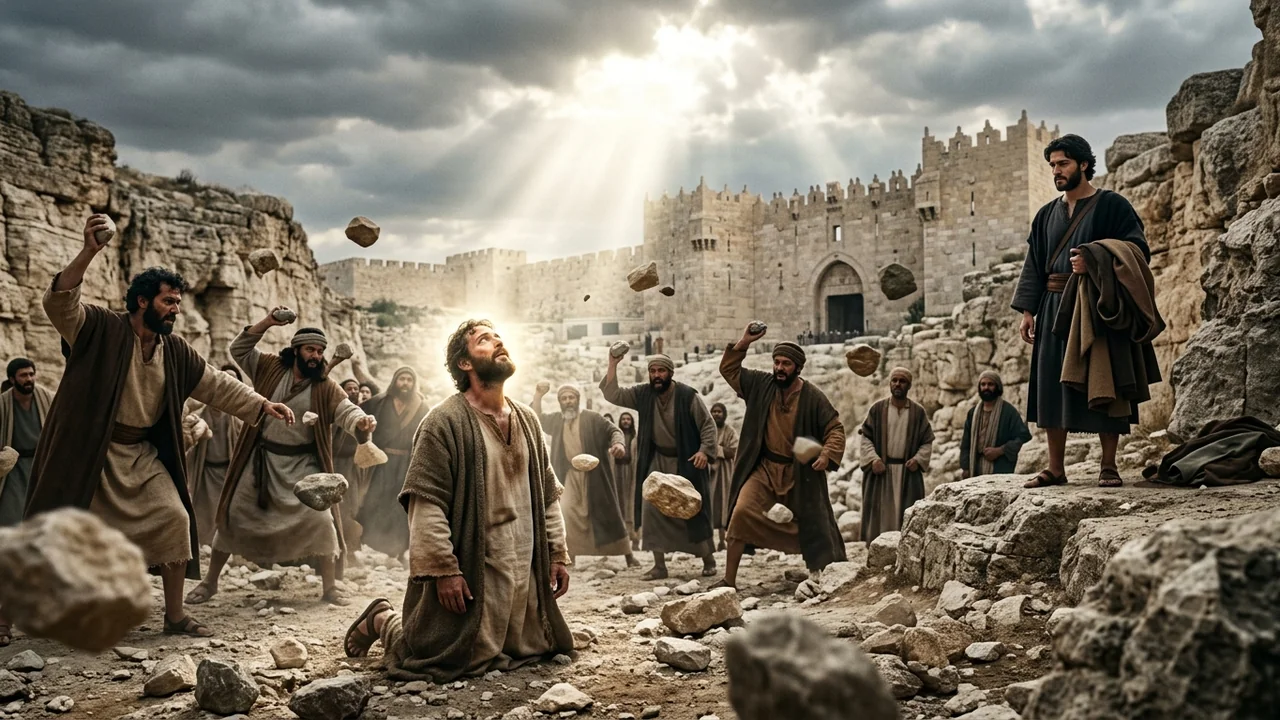
"When they heard these things, they were cut to the heart, and they gnashed on him with their teeth. But he, being full of the Holy Ghost, looked up steadfastly into heaven, and saw the glory of God, and Jesus standing on the right hand of God, and said, 'Behold, I see the heavens opened, and the Son of man standing on the right hand of God.' Then they cried out with a loud voice, and stopped their ears, and ran upon him with one accord, and cast him out of the city, and stoned him." (Acts 7:54–58)
Within moments, legal decorum disintegrated into uncontrolled ideological fury. The judges of Israel mobbed the young Hellenist and dragged him through the city gates to be executed.
The Legal Paradox: Rome’s Monopoly on Capital Punishment (Ius Gladii)
The execution of Stephen presents one of the most intriguing legal paradoxes in ancient jurisprudence: Was Stephen's stoning a legal judicial sentence, or an illegal mob lynching under Roman imperial law?
Following the deposition of Herod Archelaus in 6 AD, Judea was reduced to a direct Roman equestrian province governed by Roman prefects. Under standard provincial administration, Rome stripped native civic councils of the sovereign right to execute capital punishment—a legal prerogative known as the Ius Gladii (the "Law of the Sword"):
"Then said Pilate unto them, 'Take ye him, and judge him according to your law.' The Jews therefore said unto him, 'It is not lawful for us to put any man to death.'" (John 18:31)
Why then was Stephen executed by the Sanhedrin without any recorded trial before the Roman governor, Pontius Pilate?
Legal historians have identified three key factors:
- Mob Violence Disguised as Judicial Action: The text in Acts 7 indicates that the Sanhedrin never issued a formal, recorded judicial verdict. There was no formal voting process (pesak din). Instead, the assembly erupted into spontaneous collective fury, dragging Stephen out of the city in a quasi-judicial riot.
- The Blasphemy Capital Exemption: The Sanhedrin operated under the belief that in cases of direct, flagrant verbal blasphemy uttered in the presence of the court, the crowd was religiously obligated to execute immediate judgment under Leviticus 24:16.
- The Precedent of Provincial Tolerance: Roman prefects like Pilate were stationed primarily at the coastal capital of Caesarea Maritima, coming to Jerusalem only during major pilgrimage festivals. Local provincial magistrates frequently looked the other way regarding internal religious disputes, provided they did not threaten tax collection or spark armed rebellion against Caesar.
Talmudic Stoning Protocol: Mishnah Sanhedrin 6 Decoded
Popular culture imagines stoning as a chaotic scene where an unruly crowd surrounds a standing victim and hurls small pebbles until death occurs. However, Jewish legal jurisprudence codified in the Mishnah (Tractate Sanhedrin 6:1–4) paints a vastly different, highly structured execution protocol:
[Mishnah Sanhedrin 6: Ancient Jewish Stoning Protocol]
                          │
                          ├──► 1. Location: Minimum 2,000 Cubits Outside City Walls
                          │
                          ├──► 2. The Precipice Drop: Victim Pushed from a 10-Foot Platform
                          │         └── Impact on stone floor to break spine or crush skull
                          │
                          ├──► 3. The Primary Boulder: Dropped by First Witness onto Chest
                          │         └── Directed at cardiac cavity; if fatal, execution ends
                          │
                          └──► 4. General Stoning: Carried out by All Israel only if needed
- Outside the Municipal Walls: The execution place (Beit ha-Sekilah) was mandated to be located well outside the city perimeter (at least 2,000 cubits or nearly a mile) to prevent the defilement of the sacred city.
- The Fall from the Scaffold (Beit ha-Sekilah): The execution site featured an elevated platform or natural rock-cut cliff face at least twice the height of a man (roughly 10 to 12 feet). The condemned man was brought to the precipice:
"The place of stoning was twice the height of a man. One of the witnesses pushed him from behind, so that he fell forward upon his chest. If he turned over on his back, the witness turned him over on his chest." (Mishnah Sanhedrin 6:4)
- The First Witness Drop: If the 12-foot fall did not immediately kill the victim, the primary legal witness was required to lift a massive building stone—so heavy that it required two men to carry it to the edge—and drop it directly onto the victim's chest, targeting the heart.
- General Participation: Only if the victim survived the blunt trauma of both the vertical fall and the heavy chest boulder did the remaining spectators pelt the victim with smaller stones until death was verified.
The Forensic Trauma of Stoning: Impact Mechanics
Forensic pathology analysis of ancient stoning trauma reveals the horrific physical mechanics of Stephen’s martyrdom:
- Initial High-Impact Vertical Deceleration: Falling 10 to 12 feet onto the jagged limestone quarry bedrock outside Jerusalem's walls would cause multiple compound fractures of the tibia and fibula, severe pelvic disruption, and closed basilar skull fractures.
- Crush Trauma to Thorax: The deliberate dropping of a 40-to-60-pound limestone boulder onto the anterior chest wall produces immediate bilateral flail chest, multiple comminuted rib fractures, pulmonary contusion, and traumatic cardiac arrest through myocardial rupture or severe hemopericardium.
- Multiple High-Velocity Projectile Impacts: As the secondary crowd hurled stones weighing between 1 and 5 kilograms (2 to 11 pounds) at terminal throwing velocities of 15 to 20 meters per second, the impacts produced extensive depressed skull fractures, cerebral lacerations, and fatal intracranial hemorrhage.
Yet, amid this storm of shattering limestone, Luke records that Stephen knelt in the dust, gazed upward, and uttered two final petitions that mirrored Jesus on the cross: "Lord Jesus, receive my spirit" and "Lord, lay not this sin to their charge." Having spoken these words, the text notes with tender majesty: "he fell asleep."
Saul of Tarsus: The Official Witness and Guardian of Garments
Standing at the periphery of this violent vortex was a brilliant young Pharisee from Cilicia who would become the most consequential missionary in human history: Saul of Tarsus.
Luke records Saul’s specific legal role in Acts 7:58 and Acts 8:1:
"And the witnesses laid down their clothes at a young man's feet, whose name was Saul... And Saul was consenting unto his death."
This detail is not incidental; it carries profound legal significance under Torah law:
- The Witness Requirement (Deuteronomy 17:7): The law mandated that "The hands of the witnesses shall be first upon him to put him to death, and afterward the hands of all the people." Because lifting and throwing massive stones required maximum physical exertion, the primary witnesses stripped off their heavy outer woolen mantles (himation).
- Saul as the Official Overseer: By placing their garments in Saul's custody, the executioners designated Saul as the recognized legal guardian, official supervisor, and administrative representative of the Sanhedrin. Saul was not a casual bystander; he was an active legal agent authenticating the execution on behalf of the High Priest’s court!
The memory of Stephen’s transfigured, angelic face and his dying prayer for his executioners’ forgiveness burned into Saul’s conscience, acting as the divine "pricks" (kentron) against which he struggled until his explosive encounter with the risen Christ on the Damascus Road (Acts 9).
Why Did Pontius Pilate Not Intervene?
Historical and archaeological evidence indicates that Stephen’s stoning occurred around 34–36 AD, a period of severe political vulnerability for Roman Governor Pontius Pilate.
In 36 AD, Pilate was officially suspended and recalled to Rome by Lucius Vitellius, the Roman Legate of Syria, following Pilate’s brutal massacre of Samaritan pilgrims on Mount Gerizim. During these final turbulent years of his prefectship, Pilate was under intense scrutiny from imperial authorities in Antioch and Rome.
Fearing further complaints from the Jewish aristocracy to Emperor Tiberius, Pilate actively avoided intervening in internal Jewish theological disputes that did not involve open armed rebellion. The Sanhedrin exploited this political vacuum to eliminate Stephen with complete impunity.
Uncover the Untold Martyrologies of the Early Church
The stoning of Stephen ignited the first great wave of Roman and Jewish persecution, driving the apostles into all the earth. If you want to explore the unabridged legal trials, Roman court records, and forensic case studies of the early church martyrs:
👉 Discover Volume II: Kings & Prophets – Tragic Ends & Medical Mysteries ($2.99)
Features the complete legal analyses of Roman capital trials, Talmudic execution codes, and the forensic reconstructions of biblical martyrs.
Frequently Asked Questions
Was Stephen's stoning legal under Roman law?
Technically, no. Under Roman law (Ius Gladii), only the Roman governor had the authority to impose and execute capital punishment in a provincial territory. However, the execution was carried out as a sudden religious mob action triggered by Stephen's perceived blasphemy, and Roman Governor Pontius Pilate turned a blind eye to avoid civil unrest.
How was stoning actually carried out according to ancient Jewish law?
According to the Mishnah (Sanhedrin 6:1–4), execution by stoning was not done by a standing mob throwing small pebbles. The victim was pushed from a 10-to-12-foot scaffold or rock ledge to fall chest-first onto bedrock. The primary witness then dropped a heavy boulder directly onto the victim's chest over the heart. Only if the victim survived did the crowd throw stones.
Where was Stephen stoned in Jerusalem?
According to ancient Jerusalem tradition, Stephen was stoned outside the city walls near the Damascus Gate (north) or outside the Lions' Gate (east, traditionally called St. Stephen's Gate) overlooking the Kidron Valley, where extensive limestone quarries and deep vertical rock drops existed in the 1st century.
What was the apostle Paul's role in Stephen's death?
Paul (then known by his Hebrew name, Saul of Tarsus) was present as an official agent of the Sanhedrin. The primary witnesses who threw the stones laid their outer garments at Saul's feet for safekeeping, indicating that Saul officially supervised, endorsed, and legally validated the execution of Stephen.
Frequently Asked Questions
Was Stephen's stoning legal under Roman law?
Technically, no. Under Roman law (Ius Gladii), only the Roman governor had the authority to impose and execute capital punishment in a provincial territory. However, the execution was carried out as a sudden religious mob action triggered by Stephen's perceived blasphemy, and Roman Governor Pontius Pilate turned a blind eye to avoid civil unrest.
How was stoning actually carried out according to ancient Jewish law?
According to the Mishnah (Sanhedrin 6:1–4), execution by stoning was not done by a standing mob throwing small pebbles. The victim was pushed from a 10-to-12-foot scaffold or rock ledge to fall chest-first onto bedrock. The primary witness then dropped a heavy boulder directly onto the victim's chest over the heart. Only if the victim survived did the crowd throw stones.
Where was Stephen stoned in Jerusalem?
According to ancient Jerusalem tradition, Stephen was stoned outside the city walls near the Damascus Gate (north) or outside the Lions' Gate (east, traditionally called St. Stephen's Gate) overlooking the Kidron Valley, where extensive limestone quarries and deep vertical rock drops existed in the 1st century.
What was the apostle Paul's role in Stephen's death?
Paul (then known by his Hebrew name, Saul of Tarsus) was present as an official agent of the Sanhedrin. The primary witnesses who threw the stones laid their outer garments at Saul's feet for safekeeping, indicating that Saul officially supervised, endorsed, and legally validated the execution of Stephen.
Related Research Dossiers
View all 120 articles →
The Banqueting Hall Oath: What Really Happened to the Head of John the Baptist at Machaerus?
The Twin Pillars of Gaza: The Structural Physics Behind Samson's Catastrophic Final Vengeance