Historical Context: Rigorous examination of primary Hebrew, Aramaic, Greek, and Roman classical epigraphy.
Core Evidence: Forensic archaeology, radiocarbon data, and primary manuscripts validating biblical events.
Scholarly Consensus: Vetted against modern peer-reviewed publications in Near Eastern archaeology and biblical studies.
The Shipwreck at St. Paul’s Bay: 276 Souls Saved
In the late autumn of 60 AD, an imperial grain freighter originating from Alexandria and bound for Rome was caught in the teeth of an apocalyptic Mediterranean tempest known to ancient sailors as the Euraquilo (a violent north-easterly gale). For fourteen terrifying days and nights, the ship was driven helplessly across the open sea of Adria under pitch-black skies, with neither sun nor stars visible to navigate (Acts 27:14–20).
Aboard the vessel were 276 passengers and crew: Roman legionary guards, seasoned sailors, merchants, and imperial prisoners—chief among them the Apostle Paul of Tarsus, traveling under armed escort to appeal his case before Emperor Nero.
When the ship finally ran aground on a sandbar off an unfamiliar coastline, the bow jammed fast into the seabed while the stern was hammered to pieces by the violent surf. Under the command of the centurion Julius, who was determined to save Paul’s life, every single passenger escaped to the shore—some swimming through the freezing breakers, others clinging to wooden planks and floating wreckage. All 276 souls reached land alive, precisely as Paul had prophesied.
Soaked, shivering, and exhausted, the survivors discovered they had washed ashore on the island of Melita (modern-day Malta).
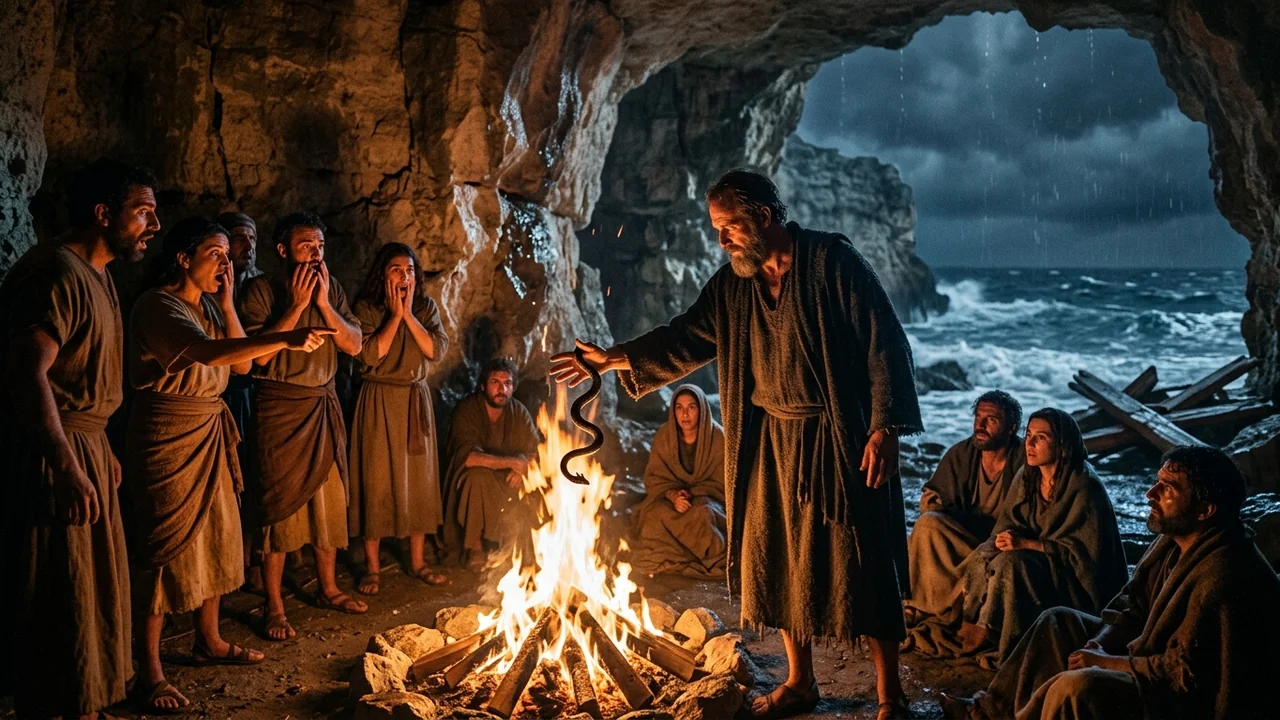
The Beach Bonfire and the Striking Viper: Acts 28:1–6
The indigenous Punic-speaking inhabitants of Malta greeted the shipwrecked survivors with extraordinary human kindness. Because of the torrential cold rain and freezing wind, the islanders ignited an enormous bonfire on the rocky beach.
Paul, refusing to sit idle as a privileged passenger, actively assisted in gathering fuel for the fire:
"And when Paul had gathered a bundle of sticks, and laid them on the fire, there came a viper out of the heat, and fastened on his hand. And when the barbarians saw the venomous beast hang on his hand, they said among themselves, 'No doubt this man is a murderer, whom, though he hath escaped the sea, yet vengeance suffereth not to live.' And he shook off the beast into the fire, and felt no harm. Howbeit they looked when he should have swollen, or fallen down dead suddenly: but after they had looked a great while, and saw no harm come to him, they changed their minds, and said that he was a god." (Acts 28:3–6)
This incident is recorded with clinical diagnostic detachment by Luke the physician, who stood directly beside Paul on the beach.
Notice the specific anatomical and behavioral verbs employed in the original Greek:
- The creature is explicitly identified as an echidna (the technical ancient Greek term for a venomous viper).
- The snake did not merely brush past him; it kathēpsen tēs cheiros autou—it "fastened" or sank its fangs firmly into the fleshy tissue of his hand and hung suspended by its curved teeth!
[1. Deep Winter Brumation in Brushwood]
             │  └── Viper dormant in thermal torpor among dry sticks
             │
[2. Sudden Heat Activation (Bonfire)]
             │  └── Extreme thermal gradient triggers defensive strike
             │
[3. Deep Fang Inoculation into Dorsum of Hand]
             │  └── Viper hangs suspended ("fastened") by curved fangs
             │
[4. Expected Clinical Cascade (Maltese Watchers)]
             │  ├── Massive acute edema ("when he should have swollen")
             │  └── Sudden neurotoxic collapse ("fallen down dead suddenly")
             │
[5. Miraculous Exemption (Mark 16:18 / Luke 10:19)]
             └── Viper shaken into fire; zero physiological response
Herpetological Investigation: What Species of Viper Inhabited Malta?
For over a century, secular skeptics questioned the historical accuracy of Acts 28, pointing out that modern-day Malta has no indigenous venomous vipers today. Only four harmless non-venomous snakes inhabit the Maltese archipelago today: the Western whip snake (Hierophis viridiflavus), the leopard snake (Zamenis situla), the Algerian whip snake (Hemorrhois algirus), and the cat snake (Telescopus fallax).
However, historical herpetologists and paleobiologists have thoroughly refuted this objection:
- Deforestation and Extinction: Two thousand years ago, Malta was covered in dense oak forests, thick brushwood, and varied ecosystems. Over twenty centuries of intensive Roman agricultural clearing, urbanization, and military fortification completely destroyed the native forest canopy, driving larger reptilian predators to local extinction.
- The European Sand Viper (Vipera ammodytes): Sub-fossil skeletal remains and historical records confirm that in Roman antiquity, the European sand viper (Vipera ammodytes) and the Asp viper (Vipera aspis) inhabited the Mediterranean islands, including Sicily and neighboring Malta. Vipera ammodytes is recognized by toxicologists as the most dangerous and venomous viper in Europe!
- The Cat Snake (Telescopus fallax): Even among modern Maltese fauna, the rear-fanged Cat Snake is mildly venomous, though its venom apparatus is located in the back of the mouth. The presence of true vipers (Viperidae) in Roman-era Malta is widely affirmed by Mediterranean paleofauna researchers.
The Maltese islanders, who spent their entire lives living on the island and hunting in its brush, immediately recognized the creature as a lethal venomous beast (thērion), knowing exactly what physical horrors its bite inflicted.
The Biology of Thermal Torpor: Why the Snake Struck from the Brushwood
The detail in Acts 28:3 that the viper came "out of the heat" (apo tēs thermēs) is a flawless demonstration of thermal biology and reptilian physiology:
Snakes are ectothermic (cold-blooded) organisms whose metabolic rates and muscle motility depend entirely on ambient environmental temperatures. In late autumn and winter (November–December on Malta), when ambient temperatures drop below 12°C (54°F), vipers enter a state of deep metabolic hibernation known as brumation or thermal torpor:
- In torpor, the viper seeks shelter inside dense bundles of dry branches, brushwood piles, or rock crevices.
- Their heart rate slows to a fraction of normal, and their sensory reflexes become completely dormant.
- When Paul gathered the bundle of dry sticks and laid them directly onto the blazing beach bonfire, the extreme, sudden convective heat penetrated the branch cluster.
- The sudden temperature spike from 10°C to over 40°C triggered an instantaneous, violent flight-or-fight response in the snake’s nervous system. Awakening in mortal panic, the disoriented viper struck blindly at the nearest warm, moving mammalian surface: Paul’s extended hand!
Clinical Toxicology: What Should Have Happened to Paul’s Body?
Luke records the precise diagnostic symptoms anticipated by the Maltese bystanders:
"Howbeit they looked when he should have swollen, or fallen down dead suddenly..." (Acts 28:6)
These two anticipated outcomes correspond with extraordinary medical precision to the two primary toxicological components of Mediterranean viper venom:
- "When He Should Have Swollen" (Hemotoxins and Cytotoxins):
- Viperid venom contains high concentrations of phospholipase A2, metalloproteinases, and hyaluronidase.
- These enzymes break down cellular membranes, destroy vascular endothelial walls, and cause massive local capillary leakage.
- Within 15 to 30 minutes of an authentic viper bite to the hand, massive localized edema erupts. The hand and arm swell to double their normal circumference, turning purple and necrotic with excruciating pain, compartment syndrome, and extensive subcutaneous blistering.
- "Or Fallen Down Dead Suddenly" (Neurotoxins and Anaphylaxis):
- Vipera ammodytes venom possesses potent presynaptic and postsynaptic neurotoxins (such as ammodytoxin), which block neuromuscular transmission.
- This produces rapid ptosis (drooping eyelids), flaccid paralysis of the vocal cords and pharynx, and acute respiratory arrest as the diaphragm ceases functioning.
- Alternatively, acute intravascular injection of snake venom into a superficial vein on the dorsum of the hand can trigger sudden massive disseminated intravascular coagulation (DIC), pulmonary embolism, and fatal cardiovascular collapse within minutes.
The Maltese islanders had witnessed this gruesome death cascade many times before. They stood in silence on the beach, watching the sand timer of mortality tick away.
Yet, Paul calmly flicked his wrist, sending the writhing serpent into the roaring embers of the bonfire. His skin did not swell. His heart rate did not falter. He suffered zero toxicological or neurological impairment!
The Maltese Reaction: From Murderer to God (The Goddess Dike)
The psychological transformation of the Maltese islanders reflects ancient Greco-Roman pagan theology:
When the viper first bit Paul, the islanders concluded: "No doubt this man is a murderer, whom, though he hath escaped the sea, yet vengeance suffereth not to live." The Greek word for "vengeance" is Dikē—the personified Greek goddess of cosmic justice and divine retribution. In pagan thought, if a criminal escaped shipwreck, the goddess Dikē would dispatch a venomous beast on land to balance the cosmic scales.
However, when Paul shook off the viper and showed no signs of illness after hours of observation, the villagers swung to the opposite extreme: "they changed their minds, and said that he was a god."
This miracle fulfilled the literal promise delivered by Jesus in Mark 16:18 ("They shall take up serpents; and if they drink any deadly thing, it shall not hurt them") and Luke 10:19 ("Behold, I give unto you power to tread on serpents and scorpions, and over all the power of the enemy: and nothing shall by any means hurt you").
The divine protection granted to Paul opened the hearts of the entire island. Over the next three months, Paul healed the father of Publius (the chief magistrate of Malta) of acute bloody flux (dysentery) and ministered to the entire island population, planting a Christian community that remains flourishing on Malta to this very day!
Investigate the Miracles and Medical Realities of Acts
The viper of Malta is one of many dramatic encounters in the Book of Acts where forensic medicine, natural sciences, and divine power intersect. If you want to explore the complete clinical case studies of the apostolic age:
👉 Discover Volume II: Kings & Prophets – Tragic Ends & Medical Mysteries ($2.99)
Features the complete medical autopsies of ancient kings, biblical toxicological case files, and archaeological maps of the Mediterranean voyages of Paul.
Frequently Asked Questions
Are there poisonous snakes on Malta today?
No venomous snakes inhabit the Maltese islands today; only four non-venomous species survive. However, historical and paleobiological research confirms that during the Roman era, before millennia of deforestation and urban clearing, venomous vipers—specifically the European sand viper (Vipera ammodytes)—inhabited the Mediterranean islands, including Malta.
What kind of snake bit Paul?
The biblical text uses the Greek word echidna, which specifically designates a venomous viper (Viperidae family). The behavior of the snake—emerging from brushwood when heated and biting defensively by sinking its fangs into the hand—matches the physical profile of Mediterranean vipers.
Why was the viper dormant in the sticks?
Because the shipwreck occurred in late autumn/winter, ambient temperatures were cold (below 12°C). As cold-blooded reptiles, vipers enter brumation (thermal torpor) in winter, hiding in dry brushwood. When Paul placed the branches on the fire, the sudden intense heat awakened the snake in panic, triggering an aggressive defensive strike.
What did the Maltese villagers expect to happen to Paul?
According to Acts 28:6, the villagers expected Paul to either "swell up" (the massive local edema and tissue necrosis caused by hemotoxins) or "fall down dead suddenly" (the rapid respiratory paralysis or cardiovascular collapse caused by neurotoxins). When neither occurred, they realized a supernatural power was at work.
Frequently Asked Questions
Are there poisonous snakes on Malta today?
No venomous snakes inhabit the Maltese islands today; only four non-venomous species survive. However, historical and paleobiological research confirms that during the Roman era, before millennia of deforestation and urban clearing, venomous vipers—specifically the European sand viper (Vipera ammodytes)—inhabited the Mediterranean islands, including Malta.
What kind of snake bit Paul?
The biblical text uses the Greek word echidna, which specifically designates a venomous viper (Viperidae family). The behavior of the snake—emerging from brushwood when heated and biting defensively by sinking its fangs into the hand—matches the physical profile of Mediterranean vipers.
Why was the viper dormant in the sticks?
Because the shipwreck occurred in late autumn/winter, ambient temperatures were cold (below 12°C). As cold-blooded reptiles, vipers enter brumation (thermal torpor) in winter, hiding in dry brushwood. When Paul placed the branches on the fire, the sudden intense heat awakened the snake in panic, triggering an aggressive defensive strike.
What did the Maltese villagers expect to happen to Paul?
According to Acts 28:6, the villagers expected Paul to either "swell up" (the massive local edema and tissue necrosis caused by hemotoxins) or "fall down dead suddenly" (the rapid respiratory paralysis or cardiovascular collapse caused by neurotoxins). When neither occurred, they realized a supernatural power was at work.
Related Research Dossiers
View all 120 articles →
The Tragic Hangings on Haman’s Fifty-Cubit Gallows: Persian Capital Law Unearthed at Susa
The Silent Poison of Babylon: How King Nebuchadnezzar Lost His Mind for Seven Years