Historical Context: Rigorous examination of primary Hebrew, Aramaic, Greek, and Roman classical epigraphy.
Core Evidence: Forensic archaeology, radiocarbon data, and primary manuscripts validating biblical events.
Scholarly Consensus: Vetted against modern peer-reviewed publications in Near Eastern archaeology and biblical studies.
The Tullianum: The Subterranean Cold of Paul's Final Prison
In the dreary winter of approximately 67 AD, during the paranoid twilight of Emperor Nero’s bloody reign, an aging, scarred Jewish scholar sat shivering in absolute darkness beneath the bedrock of the Roman Forum.
This was not the relatively comfortable house arrest described at the conclusion of the Book of Acts (Acts 28:30), where Paul lived in his own rented quarters under light military guard. This was the Carcer Tullianum—historically known as the Mamertine Prison.
Built by early Roman kings as a subterranean stone quarry and converted into an underground cistern, the lower dungeon (Tullianum) was accessible only through a small circular hole in the stone ceiling. Condemned state traitors were lowered by ropes into a damp, windowless vault filled with raw sewage and pestilence.
From this stygian tomb, Paul penned his final, poignant correspondence to his spiritual son Timothy:
"For I am already being poured out like a drink offering, and the time of my departure has come. I have fought the good fight, I have finished the race, I have kept the faith... Do your best to come before winter. Only Luke is with me." — 2 Timothy 4:6–7, 11, 21
[Winter 67 AD: The Tullianum Dungeon]
       │
       ▼ (Imperial Trial before Nero's Praetor)
[Verdict: Guilty of Capital Sedition against Imperial Majesty (Crimen Laesae Maiestatis)]
       │
       ├──► Legal Right: "Civis Romanus Sum" (Roman Citizen by Birth)
       │         └── Exempt from crucifixion, scourging, and damnatio ad bestias
       │
       └──► Sentence: "Decollatio per Gladium" (Beheading by the Sword)
                 └── Marched 3 miles outside Rome along the Via Ostiensis
Why did the master of the Roman Empire consider this frail, aging tentmaker from Tarsus so extraordinarily dangerous?
Paul had established a sprawling network of clandestine counter-cultural communities stretching from Antioch to Ephesus, Corinth, Philippi, and into the very imperial household of Caesar himself (Philippians 4:22). He proclaimed that an executed Galilean rabbi—not Nero Claudius Caesar Augustus Germanicus—was the supreme Kyrios (Lord) of the cosmos. In the totalitarian ideology of the Roman principate, to declare another King was an act of high treason (crimen laesae maiestatis).
Civis Romanus Sum: The Legal Exemption from the Cross
When the imperial praetor pronounced the final capital verdict against Paul, Roman jurisprudence dictated his physical fate.
Under the ancient republican statutes of the Lex Porcia and the Lex Julia de vi publica, a Roman citizen possessed extraordinary legal protections that separated him from non-citizen provincials (peregrini) and slaves (servi):
- Immunity from Cruel and Degrading Penalties: Roman citizens could not be subjected to crucifixion (arbor infelix), cast to wild beasts in the Colosseum (damnatio ad bestias), or burned alive as human torches.
- Right to Decapitation (Decollatio): For high political crimes, the only honorable and legally permissible capital sentence for a Roman citizen was swift decapitation by the sword (animadversio gladio).
While Simon Peter—a provincial Galilean without Roman citizenship—was dragged to Nero's private circus on the Vatican Hill and nailed upside down to a shameful wooden cross, Paul was afforded the dignity of an imperial citizen’s death.
The Execution March Along the Via Ostiensis to Aquae Salviae
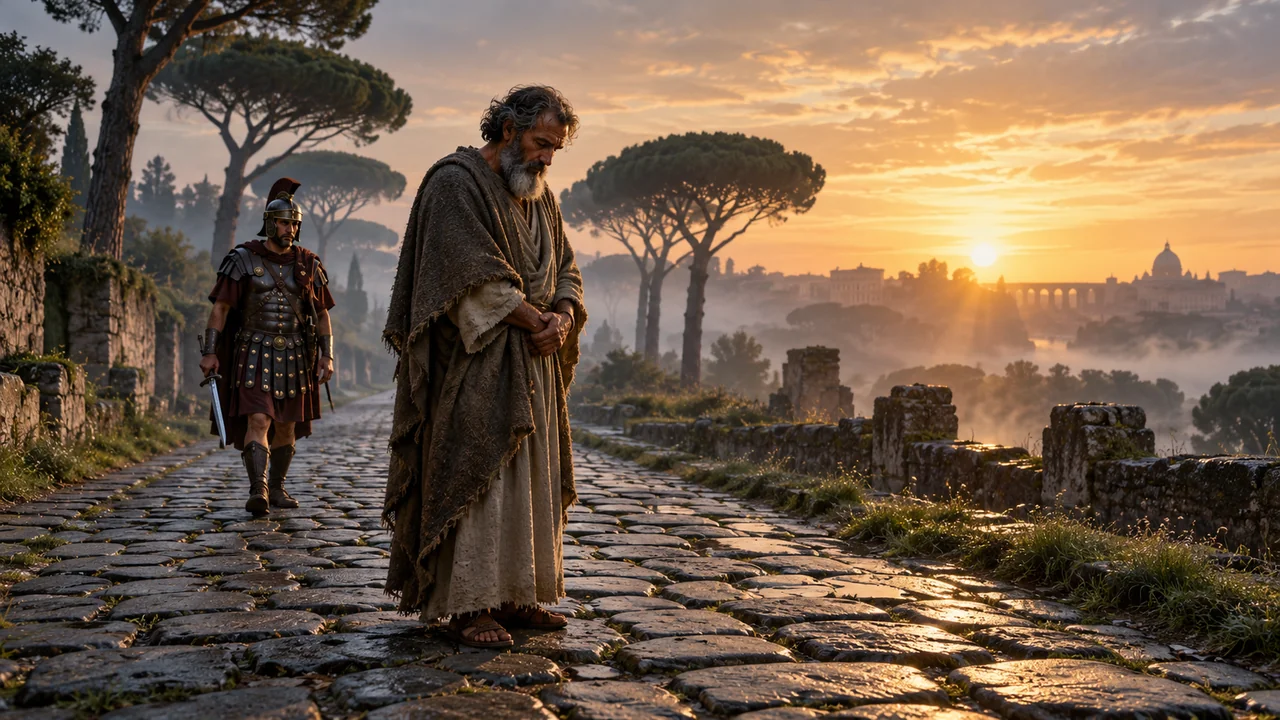
On a crisp morning in 67 AD, a heavy detachment of imperial praetorian guards escorted Paul out of the Mamertine Prison.
Roman penal law strictly prohibited carrying out capital executions within the sacred religious boundary of the city (pomerium). Therefore, the condemned apostle was led through the Porta Ostiensis (known today as the Porta San Paolo), exiting the city along the bustling commercial road linking Rome to its primary seaport of Ostia.
The guards escorted Paul approximately three miles southwest of the city walls to a secluded, tree-shaded hollow known as Aquae Salviae (Salvian Springs). The site offered imperial authorities a secluded location away from the bustling commercial traffic of the main highway, minimizing the risk of sympathetic public demonstrations from the city's rapidly growing Christian underclass.
The earliest sub-apostolic witness to Paul’s Roman martyrdom appears in the First Epistle of Clement (1 Clement 5:5–7), written from Rome by Clement, bishop of Rome, around 95 AD:
"Through jealousy and strife Paul displayed the prize of endurance. Seven times he was in chains, he was driven into exile, he was stoned, he reached the furthest limits of the West, and he bore his testimony before rulers; thus was he released from the world and went to the holy place, having become the greatest pattern of patient endurance."
Further explicit confirmation comes from Tertullian (De Praescriptione Haereticorum 36), who writes that "Paul was crowned in Rome with a death like that of John the Baptist" (decapitation), and church historian Eusebius (Hist. Eccl. II.25), who cites the 2nd-century Roman presbyter Gaius:
"I can point out the trophies of the apostles. For if you will go to the Vatican Hill or to the Ostian Way, you will find the trophies of those who laid the foundations of this church."
Forensic Pathology of Swift Decapitation (Decollatio)
At the grove of Aquae Salviae, Paul was blindfolded and forced to kneel beside a low stone block.
A Roman executioner—typically a specialized centurion known as a speculator—stepped forward wielding a heavy military sword: either the standard thrusting-and-slashing gladius hispaniensis or the longer imperial cavalry sword known as the spatha.
[Execution Strike with the Roman Sword]
       │
       ├──► Complete Transfixion of the Cervical Spine (C3-C4 Level)
       │         └── Carotid arteries, jugular veins & brainstem severed
       │
       ├──► Immediate Hydrostatic Arterial Collapse
       │         └── Brain arterial pressure drops instantly to zero
       │
       └──► Irreversible Brain Death within 2.5 to 3 Seconds
                 └── Instantaneous, painless transition to eternal life
Forensic trauma analysis and neurological pathology reveal the clinical mechanics of this execution:
- Clean Cervical Separation: A forceful, practiced horizontal strike targets the space between the third and fourth cervical vertebrae (C3–C4). The heavy steel blade instantly severs:
- Bilateral common carotid arteries and internal jugular veins.
- Bilateral vertebral arteries ascending through the cervical foramina.
- The cervical spinal cord and bilateral phrenic and vagus nerves.
- Immediate Perfusion Failure: Blood flows to the human brain under high hydrostatic pressure (mean arterial pressure ~90 mmHg). Severing the carotid and vertebral systems causes instantaneous, catastrophic depressurization in the cerebral capillary beds.
- Loss of Consciousness: The reticular activating system, which governs human consciousness, requires an uninterrupted supply of oxygenated glucose. With the total cessation of blood flow and the physical severing of the brainstem, neural synapses cease electrical transmission within 2.5 to 3 seconds, producing instantaneous, irreversible unconsciousness.
Ancient Christian tradition—first recorded in the apocryphal Acts of Paul (late 2nd century)—asserts that when the apostle's head struck the sloping earth, it bounced three times, and at each spot where it touched the soil, a miraculous freshwater spring bubbled up from the ground. Today, on that exact spot, stands the historic Abbey of the Three Fountains (Abbazia delle Tre Fontane), where three distinct natural water springs remain preserved inside the marble shrines of the basilica.
Comparative Table: Peter vs. Paul's Roman Trials and Martyrdoms
| Historical Category | Simon Peter (The Apostle to the Circumcised) | Paul of Tarsus (The Apostle to the Gentiles) |
|---|---|---|
| Legal Status | Non-citizen provincial (Peregrinus) from Galilee | Full Roman Citizen by Birth (Civis Romanus) |
| Execution Method | Inverted Crucifixion (Crux Inversa) | Decapitation by Sword (Decollatio) |
| Execution Location | Vatican Hill (Mons Vaticanus), Nero’s Circus | Ostian Way (Via Ostiensis), at Aquae Salviae |
| Burial Site | Roman Necropolis beneath St. Peter's High Altar | Roman Necropolis beneath Basilica of Saint Paul Outside the Walls |
| Archaeological Proof | "Red Wall" with Petros Eni graffiti, 60-70yo male bones | White marble sarcophagus inscribed PAULO APOSTOLO MART |
| Ecclesiastical Commemoration | Feast of Saints Peter and Paul (June 29) | Feast of Saints Peter and Paul (June 29) |
Archaeological Triumph at San Paolo Fuori le Mura: The 2006–2009 Sarcophagus Discovery
Following Paul’s execution, early Roman Christian women—led by a devout matron named Lucina—recovered his severed body and buried it in a private family tomb within a pagan necropolis adjacent to the Via Ostiensis, approximately one mile from the execution site.
In the 4th century, Emperor Constantine built a basilica over the tomb, which was expanded by Emperors Valentinian II, Theodosius I, and Arcadius into the colossal Basilica of Saint Paul Outside the Walls (San Paolo fuori le Mura).
For centuries, the physical sarcophagus remained completely inaccessible, buried beneath towering marble altars, papal confessionals, and concrete fills. Many secular historians doubted whether anything authentic remained beneath the massive church.
Between 2002 and 2006, Vatican chief archaeologist Giorgio Filippi undertook meticulous excavations directly under the Papal High Altar. What they discovered stunned the academic world:
[Papal High Altar of San Paolo fuori le Mura]
       │
       ▼ (Subterranean excavation depth)
[The 4th-Century Theodosian Sarcophagus]
       │
       ├──► White Carrara Marble Sarcophagus (2.55m long, 1.25m wide)
       │         └── Massive stone lid with three ancient drainage apertures
       │
       └──► Monumental Epigraphic Inscription (4th Century Latin):
                 "PAULO APOSTOLO MART" (To Paul, Apostle and Martyr)
The sarcophagus had never been opened or moved since the 4th century.
In June 2009, Pope Benedict XVI announced the sensational results of a scientific probe inserted into the interior of the sarcophagus through a micro-aperture:
- Carbon-14 Radiocarbon Analysis: Micro-samples of bone fragments were submitted to an independent laboratory for blind radiocarbon dating. The scientific verdict: the bones belonged to an individual who lived between the 1st and 2nd centuries AD.
- Textile Forensics: Alongside the bone fragments, the probe recovered microscopic threads of a luxurious purple linen fabric dyed with authentic murex snails and laminated with pure gold leaf, alongside grains of red incense—extraordinary forensic proof that ancient Christians had entombed this individual with the highest honors reserved for revered martyrs.
The physical chain of archaeological evidence corroborated eighteen centuries of Christian tradition: the apostle who shaped the Western theological world was indeed resting beneath the Ostian basilica.
The Triumphant Epitaph: "I Have Finished the Race"
When the executioner’s blade severed Paul’s earthly life at Aquae Salviae, imperial Rome believed it had decisively eliminated an annoying agitator.
Yet history records the ultimate irony.
The Roman Empire that hunted, chained, and decapitated Paul crumbled into historical memory fifteen centuries ago. Nero died a terrified, disgraced suicide in a miserable suburban villa less than a year after executing the apostles.
Meanwhile, the letters Paul composed in chains from filthy Roman dungeons—Romans, Galatians, Ephesians, Philippians, Corinthians—became the foundational intellectual, moral, and spiritual architecture of human civilization. They introduced the revolutionary concepts of universal human dignity, salvation by sovereign grace through faith, and a love that transcends tribes, tongues, and imperial boundaries.
Paul went to the execution block not as a defeated victim, but as a triumphant conqueror who knew that death was nothing more than an open doorway:
"For to me, to live is Christ, and to die is gain... Henceforth there is laid up for me the crown of righteousness, which the Lord, the righteous judge, will award to me on that day." — Philippians 1:21; 2 Timothy 4:8
Uncover the Complete Apostolic Dossier
Paul's martyrdom on the Via Ostiensis was the climax of an extraordinary global mission. To explore the unabridged patristic texts, forensic archaeological reports, and high-resolution diagrams of the 2006 Vatican sarcophagus discovery:
👉 Download Volume I: The Twelve Apostles – Historical Dossier ($2.99)
Includes high-resolution photographic plates of the "PAULO APOSTOLO MART" inscription, forensic reconstructions of Roman execution weapons, and comprehensive timelines of the Neronian purge.
Frequently Asked Questions
Why was Saint Paul beheaded instead of crucified?
Paul was a full Roman citizen by birth (Civis Romanus), as recorded in Acts 22:25–29. Under Roman law (Lex Julia de vi publica), Roman citizens were legally protected from the humiliating and agonizing punishment of crucifixion, which was reserved for slaves and non-citizens. The only legal capital execution permitted for a citizen was swift decapitation by the sword (decollatio).
Where was Saint Paul executed in Rome?
Paul was executed at a location called Aquae Salviae (Salvian Springs), located approximately three miles outside Rome’s ancient city walls along the Via Ostiensis. Today, this historic site is home to the Abbey of the Three Fountains (Abbazia delle Tre Fontane).
Has Saint Paul's tomb been verified by archaeology?
Yes. Between 2002 and 2006, Vatican archaeologists excavated beneath the high altar of the Basilica of Saint Paul Outside the Walls (San Paolo fuori le Mura), uncovering a 4th-century marble sarcophagus inscribed PAULO APOSTOLO MART ("To Paul, Apostle and Martyr"). Scientific carbon-14 testing in 2009 confirmed that the bone fragments inside dated to the 1st/2nd century AD.
Did Peter and Paul die at the same time in Rome?
Early church fathers such as Dionysius of Corinth (quoted by Eusebius) and Saint Jerome state that Peter and Paul were martyred in Rome during Nero's persecution around the same period (c. 64–67 AD). The Roman church has historically celebrated their unified martyrdom on the same liturgical day, June 29.
Frequently Asked Questions
Why was Saint Paul beheaded instead of crucified?
Paul was a full Roman citizen by birth (Civis Romanus), as recorded in Acts 22:25–29. Under Roman law (Lex Julia de vi publica), Roman citizens were legally protected from the humiliating and agonizing punishment of crucifixion, which was reserved for slaves and non-citizens. The only legal capital execution permitted for a citizen was swift decapitation by the sword (decollatio).
Where was Saint Paul executed in Rome?
Paul was executed at a location called Aquae Salviae (Salvian Springs), located approximately three miles outside Rome’s ancient city walls along the Via Ostiensis. Today, this historic site is home to the Abbey of the Three Fountains (Abbazia delle Tre Fontane).
Has Saint Paul's tomb been verified by archaeology?
Yes. Between 2002 and 2006, Vatican archaeologists excavated beneath the high altar of the Basilica of Saint Paul Outside the Walls (San Paolo fuori le Mura), uncovering a 4th-century marble sarcophagus inscribed PAULO APOSTOLO MART ("To Paul, Apostle and Martyr"). Scientific carbon-14 testing in 2009 confirmed that the bone fragments inside dated to the 1st/2nd century AD.
Did Peter and Paul die at the same time in Rome?
Early church fathers such as Dionysius of Corinth (quoted by Eusebius) and Saint Jerome state that Peter and Paul were martyred in Rome during Nero's persecution around the same period (c. 64–67 AD). The Roman church has historically celebrated their unified martyrdom on the same liturgical day, June 29.
Related Research Dossiers
View all 120 articles →
The Cauldron of Boiling Oil in Rome: Why the Apostle John Could Not Be Executed
Flayed Alive in Armenia: The Royal Execution That Silenced St. Bartholomew