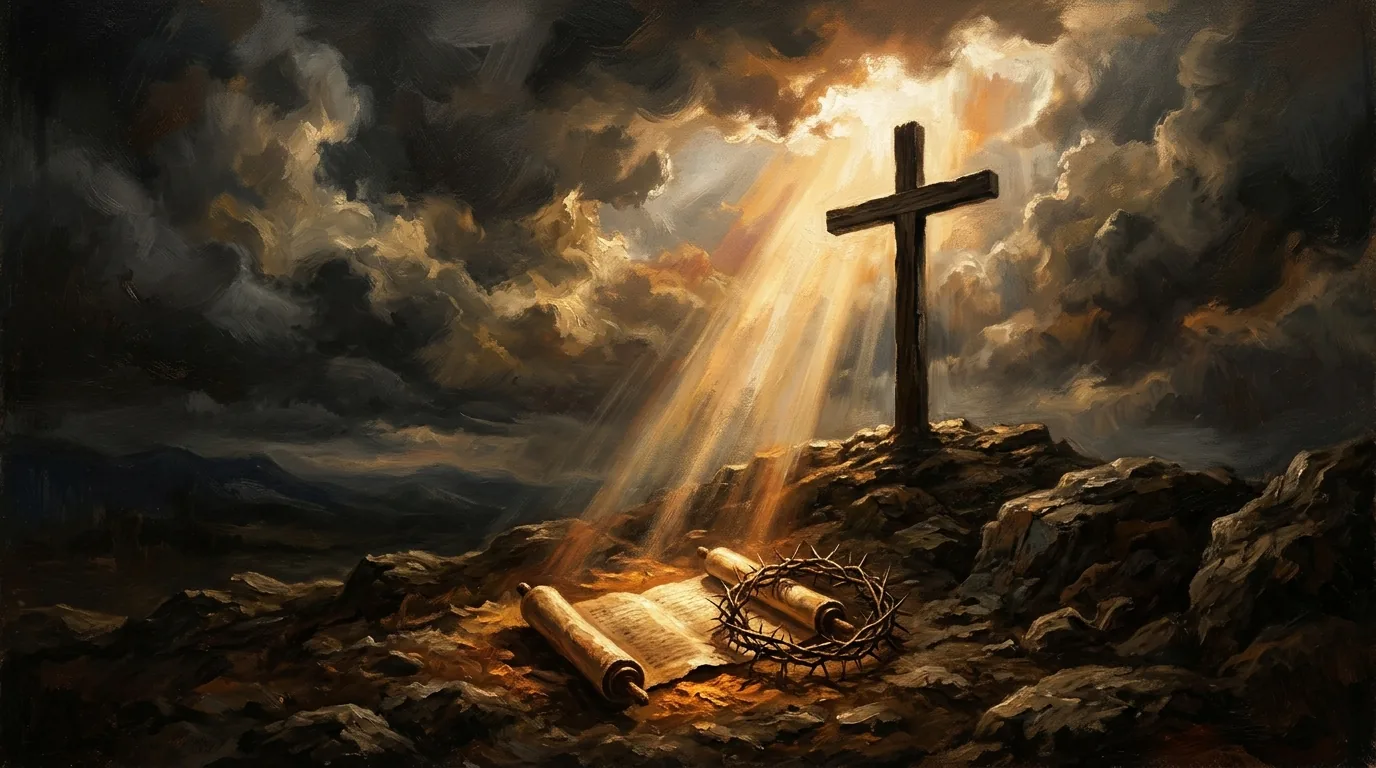
What was the cause of Jesus' immediate death on the cross?
While victims of crucifixion typically died of slow suffocation over two to three days, Jesus died after roughly six hours. Forensic pathologists conclude the primary cause of death was acute cardiac arrest or catastrophic cardiac rupture precipitated by severe hypovolemic shock, blunt trauma from the scourging, and progressive traumatic asphyxia.
Ancient patristic witnesses, Second Temple manuscripts, and classical annals.
Stratigraphic digs, monumental epigraphy, and artifact forensics in the Levant.
Distinguishing canonical Scripture text from historical patristic traditions.
Subject Scope: The Medical Reality of the Crucifixion: What John 19:34 ('Blood and Water') Proves
Historical Context: Primary Roman legal transcripts, imperial annals (Tacitus, Suetonius), and early patristic martyrologies.
Primary Evidence: Forensic trauma biomechanics, historical Roman execution praxis, and classical epigraphic inscriptions.
Investigation Highlights: The Anatomy of Roman Scourging and Crucifixion • The Forensic Significance of John 19:34 • Medical Explanations: Pericardial and Pleural Effusion
Scholarly Consensus: Cross-referenced against Roman imperial records and Mediterranean early Christian archaeological sites.
The Anatomy of Roman Scourging and Crucifixion
Roman crucifixion was not engineered merely to execute a condemned prisoner; it was calculated by military engineers over three centuries to produce maximum physical agony, prolonged public degradation, and slow asphyxiation. The Latin noun cruciatus (the linguistic root of our English word excruciating) literally means 'out of the cross.'
Before a condemned man ever reached the crossbeams of Golgotha, he was subjected to the Roman verberatio (scourging). Roman lictors utilized the flagrum—a heavy whip consisting of multiple braided leather thongs studded at irregular intervals with jagged sheep bone fragments and lead balls called plumbatae.
As the whip repeatedly struck the prisoner’s bare back, shoulders, and chest, the lead weights caused deep subcutaneous contusions, while the sharp bone fragments tore into the subcutaneous tissue and underlying skeletal muscles (including the latissimus dorsi, trapezius, and erector spinae). This trauma resulted in massive hypovolemia—rapid, systemic loss of circulating blood and plasma.
By the time Jesus was forced to carry the horizontal crossbar (patibulum) toward the northern quarry outside Jerusalem's Damascus Gate, His cardiovascular system was already entering decompensated hypovolemic shock:
- Severe Tachycardia: A racing heart attempting to compensate for depleted vascular volume.
- Profound Dehydration: Acute thirst resulting from cellular fluid loss (explaining Christ’s cry, 'I thirst' in John 19:28).
- Respiratory Compromise: Inability to oxygenate peripheral tissues due to blood loss and sheer physical exhaustion.
Direct Historical Answer Box:
In John 19:34, the Apostle John records: 'One of the soldiers pierced His side with a spear, and immediately blood and water came out.' In ancient Hellenistic or Jewish literature, this biological phenomenon had no symbolic medical precedent. Modern forensic medicine demonstrates that severe blunt trauma, prolonged shock, and asphyxiation cause pericardial effusion (fluid accumulation around the heart) and pleural effusion (serous fluid pooling in the chest cavity). The spear pierced the right ventricle through the pericardium, releasing separated erythrocytes (red blood) and transparent serous fluid ('water'), providing definitive anatomical proof of prior clinical death.
The Forensic Significance of John 19:34
The Greek text of John 19:34–35 contains a striking authorial interruption:
- 'kai exēlthen eythys haima kai hydōr' ('and immediately came out blood and water').
- 'kai ho heōrakōs memartyreken' ('And he who has seen has testified, and his testimony is true; and he knows that he is telling the truth, so that you also may believe').
Why did John pause His gospel narrative to emphatically swear an eyewitness oath over this specific anatomical occurrence?
In the first century AD, circulation of the blood was completely unknown; William Harvey did not discover systemic blood circulation until 1628. Neither Jewish rabbis nor Greco-Roman physicians understood that trauma could cause fluid accumulation around the thoracic cavity. If John were fabricating an idealized mythology of a dying god, he would never have invented a bizarre, seemingly unscriptural detail like fluid separation. He recorded it solely because he stood within eye-range of the cross and observed clear serous fluid draining alongside dark coagulated blood.
Medical Explanations: Pericardial and Pleural Effusion
In a landmark clinical study published in The Journal of the American Medical Association (JAMA, Vol. 255, No. 11), a team of pathologists and cardiologists led by Dr. William D. Edwards evaluated the physiological trauma of the crucifixion. Modern cardiology points to two interrelated clinical realities:
1. Cardiac Rupture and Hemopericardium
Under extreme catecholamine surges, emotional agony, and massive blood pressure fluctuations caused by asphyxial struggling, the myocardium (heart muscle) can undergo acute rupture. When the ventricular wall fissures, blood escapes into the pericardial sac. Within minutes, the blood begins to separate: the heavier cellular components (erythrocytes) settle at the bottom, while the clear, watery serum collects on top.
2. Hypovolemic Pleural Effusion
More commonly in cases of prolonged traumatic asphyxia and systemic blunt force shock, the pleura (the membranes encasing the lungs) begin weeping excess serous fluid into the pleural space. As Jesus hung suspended by forged iron nails driven through His wrists (contacting the median nerves) and feet, breathing required Him to lift His body weight against the nails to exhale. When exhaustion prevented Him from pushing upward, carbon dioxide built up in His lungs, producing severe acidosis, cardiac arrhythmia, and massive pleural effusion.
When the Roman soldier thrust his heavy iron spear (lancea) into the right thorax—a standard Roman military stroke designed to ensure a fallen enemy was dead—the blade punctured the pleural cavity and the right atrium. The lower red cellular sediment rushed out accompanied by the clear watery fluid.
Why This Detail Demolishes the Swoon Theory
During the European Enlightenment, rationalist critics such as Karl Friedrich Bahrdt and Heinrich Paulus proposed the 'Swoon Theory' (the idea that Jesus did not actually die on Golgotha, but merely fainted from exhaustion, revived in the cool dampness of the limestone tomb, rolled away the stone, and convinced His followers He had risen).
The forensic evidence of John 19:34 renders the Swoon Theory medically and historically impossible:
- The Roman Death Inspection: Roman execution squads were subject to capital punishment if a condemned prisoner survived. They inspected the legs of the crucified; while they broke the femurs of the two thieves (crurifragium) to accelerate suffocation, they bypassed Jesus because He was already visibly deceased (John 19:33).
- The Penetrating Wound: A Roman lancea measured several inches across at the spearhead. A penetrating wound through the fifth intercostal space into the pericardium and right atrium is universally fatal on its own within seconds.
- The Impossibility of Revivification: Even if a human being could survive severe scourging, massive blood loss, and a punctured heart, he could not have pushed aside a two-ton rolling disc stone from inside a tomb, overpowered trained Roman guards, and inspired the Apostles to preach the glorious triumph of life over death.
Jesus did not swoon; He poured out His life as the definitive, historical, physical sacrifice for human redemption.
The 3-Step Protocol for Meditating on the Passion
When studying the forensic and medical realities of Christ's sacrifice, implement this three-step spiritual protocol:
- Step 1: Replace Sentimentalism With Historical Weight: Move beyond generic religious abstractions. Recognize that your forgiveness was paid for in real human hemoglobin, iron nails, bruised muscle tissue, and torn skin on a specific Friday afternoon in April 30 AD.
- Step 2: Cast Down the Lie of Cheap Grace: When tempted to treat sin casually or view obedience as trivial, return to the Roman whipping post. The cost of your rescue required the complete physical crushing of the Son of God (Isaiah 53:5).
- Step 3: Stand Firm Against Skepticism: Use forensic medical evidence to fortify your own faith and answer seeking skeptics. The eyewitness integrity of the Gospel accounts is validated by the very details an ancient mythologist could never have anticipated.
Spoken Prayer of Gratitude for the Finished Work
Speak this prayer aloud in quiet thanksgiving:
"Lord Jesus Christ, Lamb of God who takes away the sin of the world, my heart is silenced before the weight of Your sacrifice. You bore the scourging whip that I might receive healing; You endured the iron nails that my debt might be cancelled; You poured out Your blood and water that I might be cleansed from every stain of sin and shame.
I declare that You truly died, You were buried in the rock, and by the power of the Holy Spirit, You rose physically from the grave on the third day. Let the historical reality of Your love drive out all fear, lukewarmness, and doubt from my life today. I belong to You, body and soul. In Your holy name, Amen."
Apostolic Martyrologies & Prophetic Destinies
Investigating patristic records, Roman imperial annals, and early church martyrologies detailing the lives and executions of biblical witnesses. Each investigation in this pillar is corroborated by primary classical manuscripts, epigraphy, and peer-reviewed historical forensics.
Pillar Dossiers in this Corpus
How Did Jeremiah Die in Egypt? Primary Sources, Patristic Martyrologies, and the Stoning at Tahpanhes
11 min read · Verified Primary DossierThe Life and Death of Daniel in Babylon: Primary Sources, Court Chronicles, and the Tomb at Susa
12 min read · Verified Primary DossierHow Did Ezekiel Die in Babylon? Primary Sources, Martyrology, and Historical Evidence
11 min read · Verified Primary DossierThe Inverted Cross: The Historical and Apocryphal Death of St. Peter in Rome
8 min read · Verified Primary DossierThe Unwritten Gospel: Volume I — The Twelve Apostles
Access complete Latin and Greek patristic trial transcripts, Roman execution warrants, and early apostolic archaeological tombs.
Primary Sources & Scholarly Archives
Editorial Standard →Primary source corpus including Tacitus (Annales), Suetonius, and early Roman provincial administrative records.
Complete verified English translations of Eusebius Pamphili, Clement of Rome, Polycarp, and Tertullian.
Subterranean Roman necropolis documentation, epigraphic graffiti, and early Christian funerary stelae.
Frequently Asked Questions
What was the cause of Jesus' immediate death on the cross?
While victims of crucifixion typically died of slow suffocation over two to three days, Jesus died after roughly six hours. Forensic pathologists conclude the primary cause of death was acute cardiac arrest or catastrophic cardiac rupture precipitated by severe hypovolemic shock, blunt trauma from the scourging, and progressive traumatic asphyxia.
Could an uneducated fisherman have known about pleural fluid?
No. The physiology of thoracic fluid accumulation and the separation of blood serum were unknown to ancient science. The Apostle John recorded the observation of 'blood and water' solely because he was an eyewitness standing at the foot of the cross, providing profound internal evidence for the historical authenticity of John's gospel.
Where was the spear thrust into Jesus' body?
Forensic reconstructions indicate the Roman infantry spear was thrust into the right side of the chest (the right fifth or sixth intercostal space). Roman soldiers were trained to strike the right side because an opponent’s shield protected the left, and a strike from the right upward pierced through the liver, lung, and directly into the right chambers of the heart.
Biblical Archaeology & Master Study Resources {#archaeology-study-resources}
Deepen your exploration of the forensic and historical evidence for the Bible:- Discover the complete historical dossier in The Unwritten Gospel: 4-Volume Master Bundle ($9.00).
- Uncover 40 examined biblical and historical questions in Is That Really in the Bible? ($9.00).
- For a comprehensive spiritual study framework, explore The Sacred Keys Trilogy Master Bundle ($7.99).
Related Research Dossiers
View all 572 research dossiers →
How Did Jeremiah Die in Egypt? Primary Sources, Patristic Martyrologies, and the Stoning at Tahpanhes
The Life and Death of Daniel in Babylon: Primary Sources, Court Chronicles, and the Tomb at Susa