Historical Context: Rigorous examination of primary Hebrew, Aramaic, Greek, and Roman classical epigraphy.
Core Evidence: Forensic archaeology, radiocarbon data, and primary manuscripts validating biblical events.
Scholarly Consensus: Vetted against modern peer-reviewed publications in Near Eastern archaeology and biblical studies.
The Crisis in the Upper Room: Restoring the Sacred Twelve
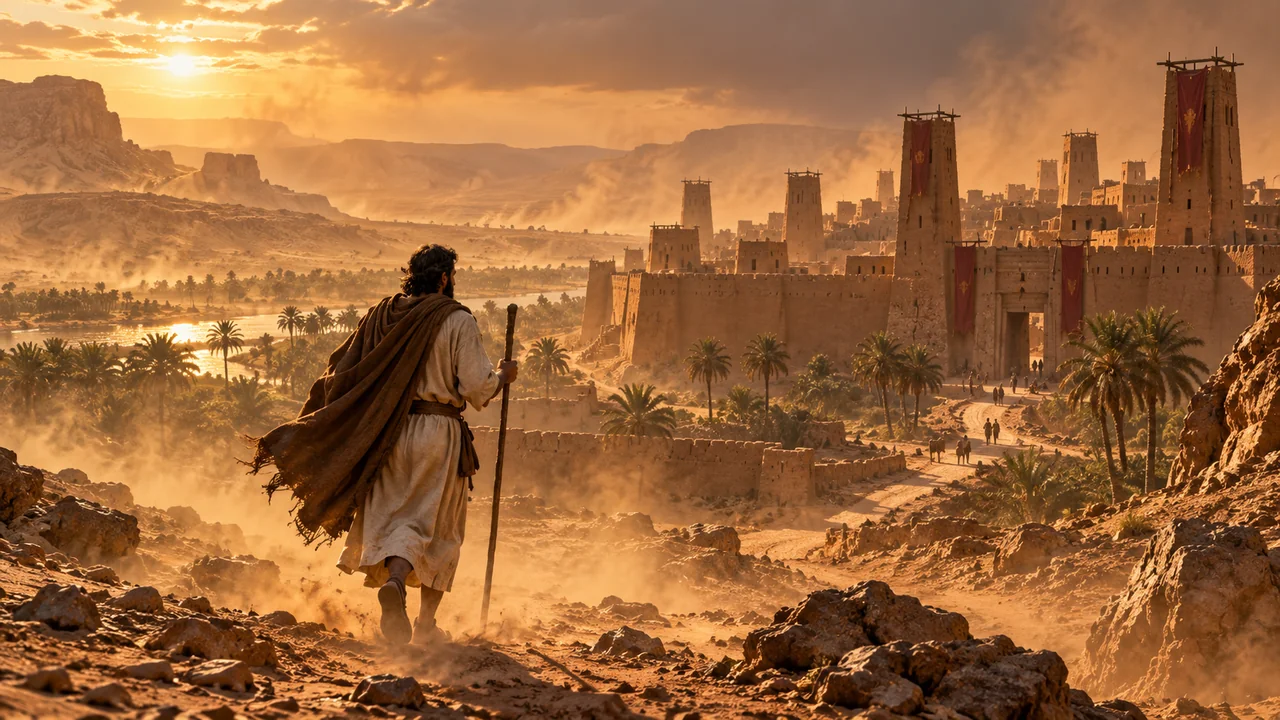
In the ten days between the Ascension of Jesus of Nazareth and the fiery outpouring of the Holy Spirit on Pentecost, a somber assembly of approximately one hundred and twenty disciples gathered in the Upper Room (Cenacle) in Jerusalem (Acts 1:13–15).
Beneath the palpable anticipation of divine power lay a deep, festering communal wound: the betrayal and gruesome suicide of Judas Iscariot.
For Jesus, the number twelve was not an arbitrary administrative choice; it possessed immense prophetic, covenantal, and eschatological significance. Just as the ancient nation of Israel had been founded upon the twelve patriarchs and the twelve tribes, the New Covenant Kingdom of God was architecturally grounded upon twelve apostolic eyewitnesses who would "sit on twelve thrones, judging the twelve tribes of Israel" (Matthew 19:28; Revelation 21:14).
A vacancy in the sacred twelve was an intolerable breach in the covenantal foundation:
[Upper Room, Jerusalem (120 Disciples Assembled)]
       │
       ▼ (Peter Rises to Address the Assembly)
[The Apostolic Mandate of Psalm 109:8]
       │ "Let his days be few; let another take his office (episkope)"
       ▼
[Strict Criteria for Apostolic Office (Acts 1:21-22)]
       ├── Must have accompanied Jesus throughout His entire earthly ministry
       │    (From the baptism of John to the Ascension at Mount Olivet)
       └── Must be a qualified Eyewitness of the Resurrected Christ
Simon Peter stood before the assembly, quoting the imprecatory prophetic scriptures of David: "Let his habitation become desolate, and let no one dwell in it; and his office let another take" (Psalm 69:25; Psalm 109:8).
Peter established rigorous, uncompromising criteria for any candidate:
- They must have physically accompanied the apostolic company throughout the entire three-and-a-half-year ministry of Jesus, beginning from the day John the Baptist plunged the Lord into the Jordan River.
- They must have personally walked with Christ through the crucifixion, witnessed the empty tomb, and conversed with the risen Savior prior to His Ascension.
From among the broader circle of the seventy disciples (Luke 10:1), two men met this extraordinary standard: Joseph called Barsabbas (surnamed Justus, "the Righteous") and Matthias (from the Hebrew Mattityahu, meaning "Gift of Yahweh").
The Sacred Lots: From the Urim and Thummim to Acts 1:26
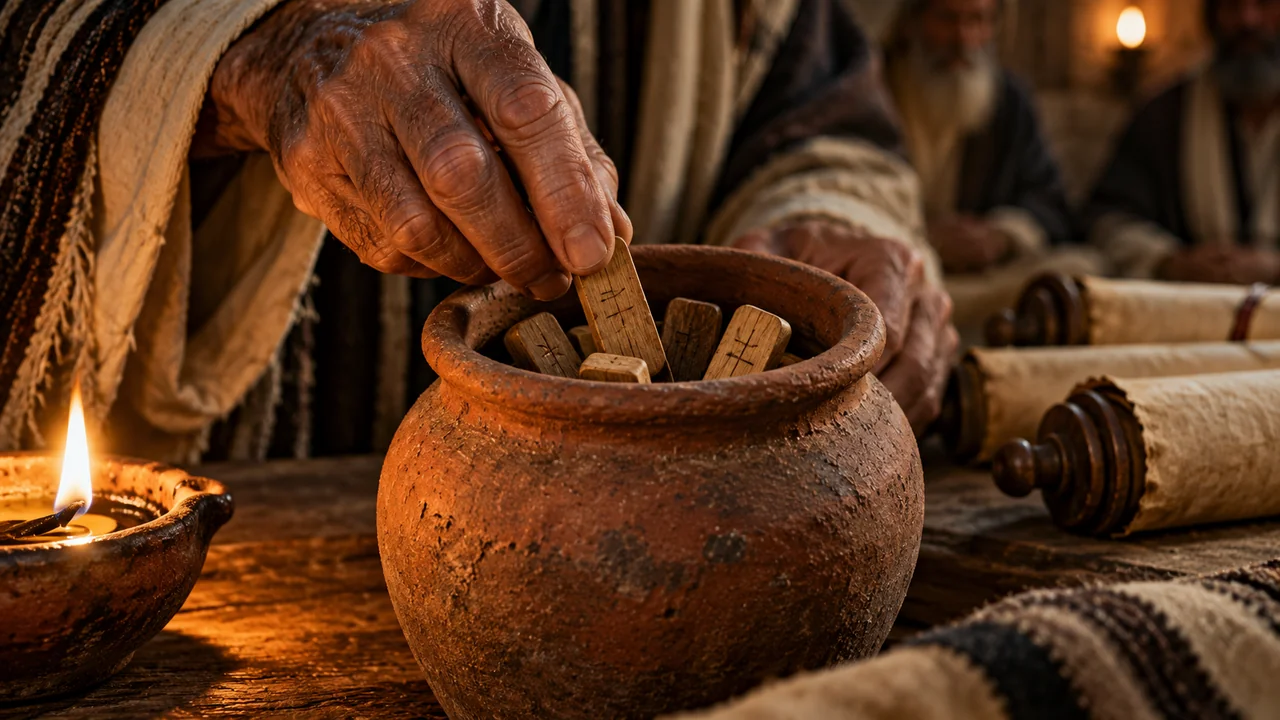
To resolve this critical choice, the early church did not conduct a political campaign, take a majority vote, or rely on human consensus. Instead, they appealed directly to the ancient biblical practice of casting sacred lots (kleroi).
In ancient Israel, when a crucial decision required pure divine revelation uncontaminated by human partiality, high priests utilized the Urim and Thummim (Exodus 28:30; Numbers 27:21). The Book of Proverbs formalized this theological reality:
"The lot is cast into the lap, but its every decision is from the Lord." — Proverbs 16:33
[The Sacred Lot Process (Acts 1:23-26)]
       │
       ├──► 1. Formal Prayer for Sovereign Revelation:
       │         "You, Lord, who know the hearts of all, show which one of these two you have chosen..."
       │
       ├──► 2. Two Marked Lots (Wooden or Terracotta Tablets) Placed in Urn:
       │         One inscribed "Matthias" / One inscribed "Joseph Barsabbas"
       │
       └──► 3. The Urn is Shaken Until a Single Lot Falls to the Floor:
                 └── The lot falls upon Matthias, numbering him with the Eleven
The assembly prayed a solemn, heart-searching invocation: "You, Lord, who know the hearts of all, show which one of these two you have chosen to take the place in this ministry and apostleship from which Judas turned aside to go to his own place" (Acts 1:24–25).
They cast their lots, and the sacred tablet bearing the name of Matthias fell from the vessel. From that sacred moment onward, Matthias was officially recognized, commissioned, and numbered alongside the original Eleven, receiving the identical baptism of Holy Spirit fire and tongues on Pentecost morning.
The Lost "Traditions of Matthias": The Gospel of Sacred Wonder
Following Acts 1, Matthias disappears entirely from the canonical New Testament narrative. However, early 2nd-century Christian literature preserved a vibrant portrait of his intellectual and spiritual stature.
The celebrated Christian philosopher Clement of Alexandria (c. 150–215 AD), writing in his monumental Stromata (Miscellanies, Books II, III, and VII), frequently quotes from a revered sub-apostolic document titled the Traditions of Matthias (Paradosis Matthiae):
"They say that in his Traditions, Matthias the Apostle gave this advice: 'Wonder at what is before you!' For this, he said, is the first step toward true knowledge of God."
Clement explains that Matthias was renowned for his strict ethical purity and self-discipline:
"Matthias taught that we must fight against the flesh and treat it with strictness, yielding nothing to it for licentious pleasure, in order that the soul may grow through faith and divine knowledge."
Eusebius of Caesarea (Historia Ecclesiastica III.25) also references a document known as the Gospel of Matthias, which was cherished in Egypt. While the formal gnosticized "Gospel" was rejected from the canon, the authentic oral traditions of Matthias's rigorous holiness and theological depth continued to echo across North Africa and the Levant.
The Dual Torment: Stoning and Decapitation with the Battle-Axe
The historical trails of Matthias's missionary labors diverge into two primary geographic corridors:
- The Judean Corridor: Recorded in ancient Jewish-Christian martyrologies and Latin liturgical calendars, stating that Matthias labored primarily among the mountainous villages of Judea, Galilee, and Samaria.
- The Colchian Corridor: Recorded in Greek Byzantine chronicles (including Nicephorus Callistus, Hist. Eccl. II.40), asserting that Matthias traveled with Andrew into Caucasian Colchis (modern Georgia), preaching at the mouth of the Apsaros River (Gonio fortress) before suffering martyrdom in the East.
In the Western Latin tradition—preserved in ancient Roman breviaries and the Passio Sancti Matthiae—Matthias was arrested in Judea around 64 to 68 AD by order of the Sadducean Sanhedrin on charges of public blasphemy for proclaiming Jesus of Nazareth as the resurrected Messiah.
[Sanhedrin Indictment for Capital Blasphemy (Judea c. 64-68 AD)]
       │
       ▼ (Mosaic Capital Sentence: Deuteronomy 13:6-10; Leviticus 24:16)
[Stage 1: Public Lapidatio (Stoning with Heavy Limestone Rocks)]
       │ Condemned hurled into stone pit; witnesses drop heavy boundary stones
       ▼
[Stage 2: Secondary Decapitation with an Axe (Securis / Tabarzin)]
       │ Executioner terminates life with a heavy executioner's axe
Under Mosaic criminal jurisprudence (Leviticus 24:16; Mishnah Sanhedrin VI.1–4), blasphemy was punished by stoning (lapidatio):
- The Stoning Platform: The condemned prisoner was brought outside the city walls to a designated stoning pit. The second witness pushed the victim off an elevated platform twelve feet high onto bedrock below, breaking the victim's ribs and pelvis.
- Battering with Heavy Stones: If the fall did not produce instant death, the primary legal witnesses lifted heavy limestone boulders and dropped them directly upon the victim's chest and head.
- The Axe Decapitation: Roman authorities or temple executioners, seeking to confirm the death and humiliate the victim under imperial martial law, utilized an iron executioner's axe (securis) to sever the head of the battered apostle.
Because of this dual torment, Saint Matthias is universally depicted in Christian art, woodcuts, and heraldry holding an axe or halberd, alongside a stone or an open book of the Scriptures.
Comparative Table: The Twelfth Apostle Debate — Matthias vs. Paul
| Theological Dimension | Matthias (The Chosen Substitute) | Paul of Tarsus (The Apostle to the Gentiles) |
|---|---|---|
| Historical Timing | Chosen between Ascension and Pentecost (Acts 1) | Called post-Pentecost on the Damascus Road (c. 34 AD) |
| Selection Method | Casting of Sacred Lots (Kleroi) + Corporate Prayer | Direct Supernatural Theophany of the Risen Christ |
| Fulfillment of Prophecy | Completed the historic Twelve (Psalm 109:8; Rev 21:14) | Extraterritorial Apostle to the Uncircumcised (Gal 2:7) |
| Eyewitness Requirement | Accompanied Jesus from John's baptism to Ascension | Saw the resurrected Christ in celestial glory (1 Cor 15:8) |
| Canonical Writings | Oral traditions quoted by Clement of Alexandria | 13 Epistles comprising the core of the New Testament |
| Ecclesiastical Role | Sealed the original apostolic foundation | Extended the apostolic gospel to the Greco-Roman Empire |
Archaeological Custody: The Only Apostolic Tomb North of the Alps (Trier, Germany)
While the vast majority of apostolic burial shrines are located in the Mediterranean basin (Rome, Greece, Turkey, and Spain), Saint Matthias holds an extraordinary, singular distinction in Christian geography:
He is the only apostle of Jesus Christ whose body is buried north of the Alps.
The apostolic relics rest inside the monumental Benedictine Abbey of Saint Matthias in the ancient imperial Roman city of Trier (Augusta Treverorum), Germany.
[4th Century AD: Empress Saint Helena (Mother of Constantine)]
       │ Excavations in Jerusalem recover apostolic relics and the True Cross
       ▼
[Empress Helena Donates Relics of Saint Matthias to Trier, Germany]
       │ Augusta Treverorum was the western capital of the Roman Empire
       ▼
[1127 AD: Rediscovery of the Marble Sarcophagus During Cathedral Reconstruction]
       │ Miraculous preservation during Viking and barbarian invasions
       ▼
[Benedictine Abbey of St. Matthias: Radiant Northern European Pilgrimage Center]
The historical provenance of the Trier relics is documented by an unbroken chain of imperial and ecclesiastical records:
- The Donation of Saint Helena (c. 326 AD): Empress Helena, mother of Constantine the Great and an imperial native of Trier, undertook historic excavations in Jerusalem, recovering the relics of Matthias alongside the True Cross. She dispatched the apostle's body to Agricius, the Bishop of Trier.
- The 1127 AD Rediscovery: During major architectural expansions of the Romanesque abbey church in 1127, monastic workmen broke through an ancient subterranean wall and discovered the lost Roman marble sarcophagus containing the relics of Saint Matthias.
- Scientific and Anatomical Recognitions: Repeated episcopal recognitions (in 1512, 1927, and late 20th century) confirmed that the sarcophagus contains ancient human skeletal elements accompanied by late antique funerary textiles.
To this day, the Abbey of St. Matthias in Trier remains a thriving pilgrimage basilica where tens of thousands of pilgrims walk hundreds of miles along the Matthiasweg to pray before the ancient stone sarcophagus of the substitute apostle.
The Theology of the Quiet Servant: Faithfulness Without Fame
The legacy of Saint Matthias speaks directly to one of the deepest truths of the Christian life: God values quiet, uncelebrated faithfulness just as profoundly as public prominence.
Matthias had followed Jesus through all three and a half years of earthly ministry. He was present when the crowds cheered on Palm Sunday, and he was present when the crowds shouted "Crucify him!" He did not follow Christ for a throne, a book title, or historical fame; he followed Christ out of pure, unadulterated love for the Master.
When the sacred lot fell upon him, he did not boast. When his life concluded under the crushing stones of Judea or the cold mountain winds of Colchis, he died with the same steady, unshakeable obedience that had marked his entire life.
In the New Jerusalem described by the Apostle John, the city wall possesses twelve foundations, and upon them are inscribed the names of the twelve apostles of the Lamb (Revelation 21:14). There, etched into eternal sapphire and emerald, stands the triumphant name of Matthias—the humble servant who stepped into the breach and proved that in the Kingdom of God, no faithful act is ever forgotten.
Uncover the Complete Apostolic Dossier
The journey of Saint Matthias from the Upper Room to the imperial shrines of Germany is an astonishing story of apostolic survival. To explore the unabridged patristic chronicles, theological analyses of the casting of lots, and high-resolution photographs of the Trier sarcophagus:
👉 Download Volume I: The Twelve Apostles – Historical Dossier ($2.99)
Features the complete texts of Clement of Alexandria's Stromata, archaeological blueprints of the Abbey of St. Matthias in Germany, and comprehensive timelines of early church global missions.
Frequently Asked Questions
How did Matthias become an apostle?
Matthias was chosen to replace Judas Iscariot in Acts 1:21–26. Peter established that the candidate must have accompanied Jesus throughout His entire ministry from John's baptism to the Ascension. After corporate prayer, the assembly cast lots between Joseph Barsabbas and Matthias, and the lot fell upon Matthias, numbering him with the Eleven.
What is the meaning of casting lots in Acts 1?
Casting lots (kleroi) was an ancient biblical practice (rooted in the high priestly Urim and Thummim and Proverbs 16:33) used to discern divine sovereign will without human bias. It ensured that the twelfth apostle was selected not by political campaigning or human popularity, but by God's direct appointment.
How did Saint Matthias die?
According to ancient Western and Jewish-Christian martyrologies, Matthias was martyred in Judea in the late 60s AD. He was condemned by hostile religious authorities, stoned by a mob (lapidatio), and subsequently beheaded with an axe. Eastern traditions record that he died in Caucasian Colchis (modern Georgia).
Where is the tomb of Saint Matthias located?
The tomb and primary skeletal relics of Saint Matthias are preserved beneath the high altar of the Benedictine Abbey of Saint Matthias in Trier, Germany. He is the only apostle of Jesus Christ whose body is buried north of the Alps, brought to Trier by Empress Saint Helena in the 4th century.
Frequently Asked Questions
How did Matthias become an apostle?
Matthias was chosen to replace Judas Iscariot in Acts 1:21–26. Peter established that the candidate must have accompanied Jesus throughout His entire ministry from John's baptism to the Ascension. After corporate prayer, the assembly cast lots between Joseph Barsabbas and Matthias, and the lot fell upon Matthias, numbering him with the Eleven.
What is the meaning of casting lots in Acts 1?
Casting lots (kleroi) was an ancient biblical practice (rooted in the high priestly Urim and Thummim and Proverbs 16:33) used to discern divine sovereign will without human bias. It ensured that the twelfth apostle was selected not by political campaigning or human popularity, but by God's direct appointment.
How did Saint Matthias die?
According to ancient Western and Jewish-Christian martyrologies, Matthias was martyred in Judea in the late 60s AD. He was condemned by hostile religious authorities, stoned by a mob (lapidatio), and subsequently beheaded with an axe. Eastern traditions record that he died in Caucasian Colchis (modern Georgia).
Where is the tomb of Saint Matthias located?
The tomb and primary skeletal relics of Saint Matthias are preserved beneath the high altar of the Benedictine Abbey of Saint Matthias in Trier, Germany. He is the only apostle of Jesus Christ whose body is buried north of the Alps, brought to Trier by Empress Saint Helena in the 4th century.
Related Research Dossiers
View all 120 articles →
Bound for Two Days: The Unspoken Agony of St. Andrew on the Crux Decussata in Greece
Stoned and Broken by a Fuller’s Club: The Secret Execution of James the Just in Jerusalem