Historical Context: Rigorous examination of primary Hebrew, Aramaic, Greek, and Roman classical epigraphy.
Core Evidence: Forensic archaeology, radiocarbon data, and primary manuscripts validating biblical events.
Scholarly Consensus: Vetted against modern peer-reviewed publications in Near Eastern archaeology and biblical studies.
The Reign of Terror Under King Manasseh of Judah
In the long chronicle of the Kingdom of Judah, no monarch cast a darker shadow over Jerusalem than King Manasseh, the son of the righteous King Hezekiah. Ascending the throne in 687 BC at the tender age of twelve, Manasseh reigned for fifty-five turbulent years as an Assyrian vassal. In direct defiance of his father’s sweeping monotheistic reforms, Manasseh reinstituted the most degenerate pagan cults of the ancient Levant. He rebuilt the high places, erected altars to Baal, placed an Asherah pole within the sacred precincts of Solomon’s Temple, worshiped the starry host of heaven, practiced witchcraft and divination, and infamously burned his own sons alive in the Valley of Hinnom (Tophet) in homage to Molech (2 Kings 21:1–7).
Beyond religious apostasy, Manasseh unleashed an unprecedented campaign of judicial violence against the prophetic voices of Judah. The author of 2 Kings captures the sheer scale of the carnage in a chilling summary:
"Moreover, Manasseh shed very much innocent blood, till he had filled Jerusalem from one end to another; beside his sin wherewith he made Judah to sin, in doing that which was evil in the sight of the Lord." (2 Kings 21:16)
According to ancient Jewish rabbinic tradition, the crown jewel among those martyrs was none other than the aged prince of prophets: Isaiah son of Amoz. Isaiah, who had counseled Hezekiah through the terrifying Assyrian siege of Sennacherib in 701 BC, was now an old man in his eighties. Uncompromising and fiery, he refused to stay silent while the Holy City was converted into a slaughterhouse of innocent children and demonic idols.
The Talmudic Record: Yebamoth 49b and the Accusation of Blasphemy
While the canonical Old Testament closes the book on Isaiah without describing his physical death, ancient Jewish jurisprudence preserved the explicit trial and execution record in the Babylonian Talmud (Tractate Yebamoth 49b).
The Talmudic sages record that Manasseh sought a veneer of legal justification before executing the venerable prophet. Rather than simply murdering him in secret, the apostate king brought Isaiah before a corrupted tribunal on charges of high treason and theological contradiction of the Torah of Moses:
"Manasseh judged Isaiah and executed him. He said to him: 'Moses your teacher said: For no man shall see Me and live (Exodus 33:20), and yet you said: I saw the Lord sitting upon a throne, high and lifted up (Isaiah 6:1)! Moses your teacher said: What great nation is there that has God so near to them (Deuteronomy 4:7), and yet you said: Seek the Lord while He may be found (Isaiah 55:6)! Moses your teacher said: The number of your days I will fulfill (Exodus 23:26), and you told Hezekiah: I will add unto your days fifteen years (Isaiah 38:5)!'"
Recognizing that Manasseh’s tribunal was a kangaroo court designed to condemn him regardless of any rational defense, Isaiah chose not to engage in futile debate. The Talmud explains:
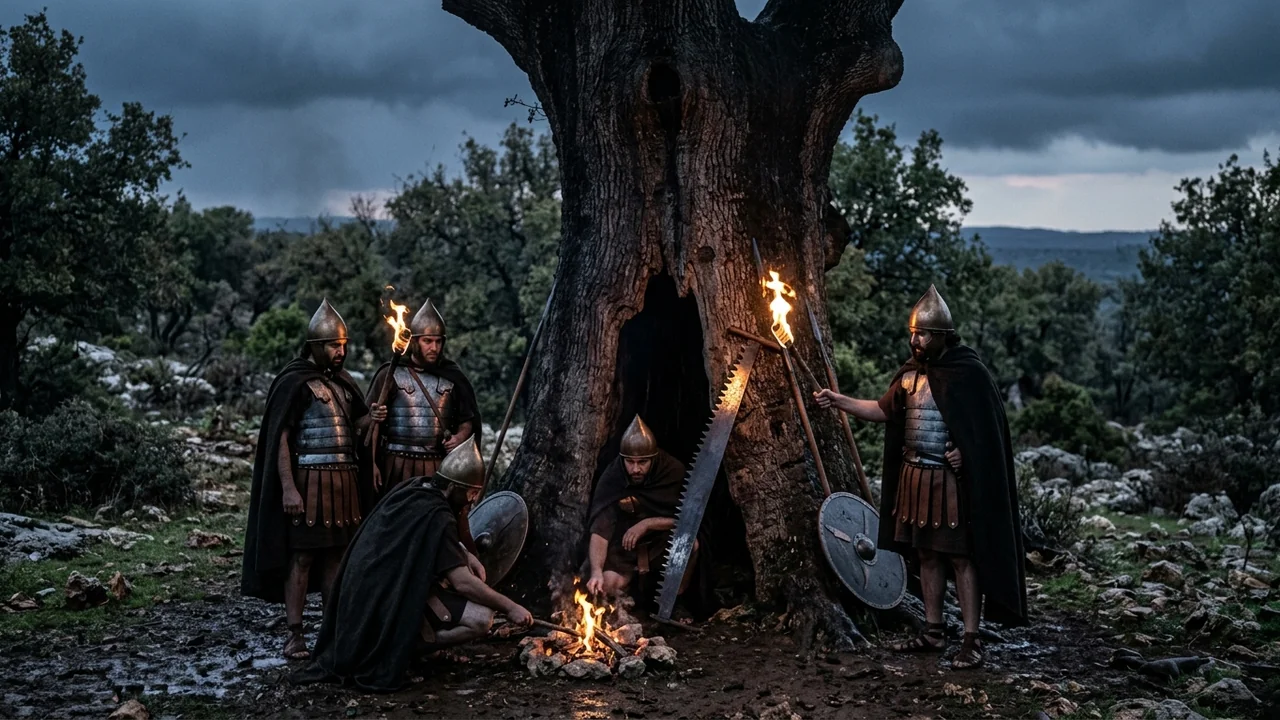
"Isaiah said: I know that he will not accept my words; why should I cause him to become intentionally guilty of murdering me? He uttered a Divine Name and swallowed himself into a cedar tree."
According to the rabbinic narrative, Manasseh's soldiers pursued Isaiah into the woods surrounding Jerusalem. Spotting where the ancient tree had enclosed the fugitive prophet, Manasseh ordered his woodsmen to bring a saw and cut down the tree, slicing through timber and flesh together. The Talmud notes with somber poetic tragedy: "When the saw reached his mouth, he died; and this was his punishment for saying: And I dwell in the midst of a people of unclean lips (Isaiah 6:5)."
The Martyrdom and Ascension of Isaiah: The Hollow Tree Tradition
The tradition of Isaiah’s execution inside a hollow tree was not restricted to rabbinic circles; it was widespread throughout Jewish and early Christian communities in the Greco-Roman world.
The primary literary witness is the Martyrdom and Ascension of Isaiah, a composite Jewish-Christian pseudepigraphal work whose core (The Martyrdom, chapters 1–5) dates to the late 1st century BC or early 1st century AD. In this harrowing text, a false Samaritan prophet named Belkira accuses Isaiah of prophesying the destruction of Jerusalem and blasphemously claiming to see God.
Manasseh, under the demonic influence of Sammael (Satan), captures Isaiah and his companions in the wilderness of Bethlehem:
"And they seized Isaiah the son of Amoz and sawed him in half with a wooden saw. And Manasseh and Belkira and the false prophets and the princes and the people stood by looking on. And to the prophets who were with him he said before he was sawn: 'Go ye to the region of Tyre and Sidon; for for me only hath God mingled the cup.' And whilst he was being sawn in half, he cried not out, nor wept, but his mouth spoke with the Holy Spirit until he was sawn in twain." (Martyrdom of Isaiah 5:1–14)
Early Christian apologists and church fathers universally cited this historical reality. Justin Martyr, writing in his Dialogue with Trypho (c. 160 AD, Chapter 120), rebuked the Jewish elders of his day: "You cut him asunder with a wooden saw!" Tertullian of Carthage (De Patientia, Chapter 15) praised the endurance of Isaiah: "Isaiah is cut asunder, and ceases not to speak of the Lord." Origen of Alexandria (Epistola ad Africanum, Chapter 9) confirmed that Jewish traditions confirmed the murder of Isaiah by sawing under Manasseh.
Most conclusively, the author of the Epistle to the Hebrews unmistakably immortalized Isaiah’s fate in the famous "Hall of Faith":
"They were stoned, they were sawn asunder, were tempted, were slain with the sword: they wandered about in sheepskins and goatskins; being destitute, afflicted, tormented; of whom the world was not worthy." (Hebrews 11:37–38)
In biblical history, only one prophet in Jewish collective memory was ever executed by being "sawn asunder" (epristhēsan): Isaiah son of Amoz.
[Babylonian Talmud: Yebamoth 49b]      [Martyrdom of Isaiah: 1st Cent. AD]
                 │                                        │
                 ├──► Persecutor: King Manasseh          ◄┤
                 ├──► Hiding Place: Enclosed in a Tree    ◄┤
                 ├──► Method: Sawn in Two by Executioners ◄┤
                 └──► Endured: Silent Spiritual Triumph   ◄┤
                                 │
                     [Hebrews 11:37 (Scripture)]
                      "They were sawn asunder..."
The Forensic Realities of Ancient Saws (Hebrews 11:37)
The historical detail in the Martyrdom of Isaiah that the execution was carried out with a "wooden saw" (prioni xilino) has sparked intense debate among historians and forensic experts.
- A Literal Wooden Saw: In ancient timber-poor regions or ritualized executions, serrated hardwood blades made of dense acacia, ebony, or flint-toothed frames were sometimes employed. A wooden friction saw would not cleanly cut through bone; instead, it would cause agonizing, prolonged mechanical tearing, burning flesh through brutal friction and extending the execution over several hours.
- A Saw for Cutting Wood: Alternatively, the phrase in ancient Semitic idiom means a large, two-man iron lumber saw used by carpenters and forestry laborers to fell cedar trunks. In the 7th century BC, Iron Age metallurgy had developed heavy iron crosscut saws with offset teeth.
From a forensic standpoint, being sawn asunder represents an unspeakable form of anatomical trauma:
- Massive Hemorrhagic Shock: As the serrated teeth bite through the thoracic or abdominal wall, major vascular structures—including the abdominal aorta and inferior vena cava—are lacerated, resulting in catastrophic internal and external exsanguination.
- Progressive Visceral Transection: Unlike decapitation, which causes instantaneous cerebral ischemia and loss of consciousness within 3 to 5 seconds, sawing from the midsection or lower torso allows the victim to remain conscious through the initial stages of the trauma until blood pressure plummets below critical cerebral perfusion thresholds.
- Terminal Neurogenic Shock: The continuous severing of spinal nerve roots produces unbearable, intractable agony until traumatic cardiac arrest or cerebral anoxia terminates life.
Comparative Analysis: Textual Sources of Isaiah’s Fate
| Source Document | Date of Origin | Setting & Accusation | Execution Method | Theological Significance |
|---|---|---|---|---|
| 2 Kings 21 / 2 Chronicles 33 | 6th–5th Century BC | Jerusalem; Manasseh fills city with innocent blood | General royal slaughter (specific fate of Isaiah unstated) | Historical backdrop of apostasy and divine judgment on Judah. |
| Talmud Bavli (Yebamoth 49b) | Amoraic Period (c. 3rd–5th Cent. AD) | Accused of contradicting Moses on seeing God's face | Enclosed in cedar tree; sawn until saw touches his lips | Sages preserve oral tradition explaining Isaiah's trial and legal accusations. |
| Martyrdom of Isaiah (ch. 5) | 1st Century BC – 1st Century AD | Bethlehem wilderness; accused by Belkira of treason | Sawn in half with a wooden saw; speaks with Holy Spirit | Earliest written description of the physical mechanics of the execution. |
| Epistle to the Hebrews 11:37 | c. 65–68 AD | Canonical New Testament witness of faithful prophets | Specifically cites: "They were sawn asunder" (epristhēsan) | Apostolic endorsement of the historical veracity of Isaiah’s martyrdom. |
| Justin Martyr (Dialogue with Trypho 120) | c. 160 AD | Patristic polemic against corrupt royal courts | Sawn asunder with a wooden saw | Confirms 2nd-century universal church memory of the event. |
Archaeological Context: Iron Age Tools and Royal Seals
Recent archaeological discoveries in Jerusalem have provided vivid tangible context to the era of Manasseh and Isaiah:
- The Bulla of Prophet Isaiah: In 2018, the late Israeli archaeologist Dr. Eilat Mazar announced the discovery of a 2,700-year-old clay seal impression (bulla) in the Ophel excavations just south of the Temple Mount. The seal bears the paleo-Hebrew inscription: "Yesha’yah[u] Nvy[?]"—belonging to Isaiah the Prophet—found a mere ten feet from the royal seal of King Hezekiah!
- Manasseh's Inscription in Assyrian Records: On the Esarhaddon Prism in the British Museum, King Manasseh is explicitly listed as "Menasê, King of Judah" (Me-na-si-i šar māt Ia-ú-di), paying heavy tribute of stone, cedar, and timber to his Assyrian overlord. This confirms the exact geopolitical setting described in Scripture.
- Iron Age Carpentry Tools: Excavations across Iron Age II strata in the Levant have unearthed heavy iron saw fragments, adzes, and wood-cutting axes, confirming that heavy two-man crosscut saws were standard industrial technology in 7th-century BC Judah.
Isaiah’s blood stained the soil of Jerusalem, but his prophecies survived intact across millennia—from the 24-foot Great Isaiah Scroll found in the Qumran caves to the modern canonical Bible—testifying that while tyrants perish, the Word of God endures forever.
Uncover the Untold Martyrologies of the Prophets
The brutal fate of Isaiah under King Manasseh is one of many dramatic confrontations between prophetic truth and royal tyranny. To read the complete clinical reconstructions, Talmudic records, and lost historical accounts of Jeremiah, Zechariah, Ezekiel, and John the Baptist:
👉 Get Volume II: Kings & Prophets – Tragic Ends & Medical Mysteries ($2.99)
Includes exhaustive historical dossiers, patristic citations, forensic autopsies, and high-resolution archaeological photography.
Frequently Asked Questions
Does the Bible say that Isaiah was sawn in half?
In the Old Testament, 2 Kings 21:16 records that King Manasseh "shed very much innocent blood" in Jerusalem, but does not name Isaiah's specific death. However, Hebrews 11:37 in the New Testament directly refers to the ancient prophets stating, "they were sawn asunder." Early church fathers and Jewish scholars universally agreed that this was an explicit reference to Isaiah.
What is the earliest historical source that mentions Isaiah being sawn in half?
The earliest written account is the Martyrdom and Ascension of Isaiah, an ancient Jewish-Christian text dating from the 1st century BC to 1st century AD. It is also documented in the Babylonian Talmud (Tractate Yebamoth 49b), the Jerusalem Talmud (Sanhedrin 10:2), and early Christian writings by Justin Martyr, Tertullian, and Origen.
Why did King Manasseh want to kill Isaiah?
According to the Talmud, Manasseh charged Isaiah with blasphemy and treason, claiming that Isaiah's prophetic vision ("I saw the Lord sitting on a throne" - Isaiah 6:1) contradicted Moses' law ("No man shall see Me and live" - Exodus 33:20). In reality, Manasseh sought to silence Isaiah because the prophet denounced his pagan idols, human sacrifice to Molech, and tyrannical reign.
What kind of saw was used to execute Isaiah?
Ancient texts describe the instrument as a "wooden saw" (prioni xilino), which scholars interpret either as a wooden-framed friction saw with flint or hardwood teeth, designed to prolong the victim's agony, or as a heavy two-man Iron Age crosscut saw used for felling cedar and timber.
Frequently Asked Questions
Does the Bible say that Isaiah was sawn in half?
In the Old Testament, 2 Kings 21:16 records that King Manasseh shed very much innocent blood in Jerusalem, but does not name Isaiah's specific death. However, Hebrews 11:37 in the New Testament directly refers to the ancient prophets stating, "they were sawn asunder." Early church fathers and Jewish scholars universally agreed that this was an explicit reference to Isaiah.
What is the earliest historical source that mentions Isaiah being sawn in half?
The earliest written account is the Martyrdom and Ascension of Isaiah, an ancient Jewish-Christian text dating from the 1st century BC to 1st century AD. It is also documented in the Babylonian Talmud (Tractate Yebamoth 49b), the Jerusalem Talmud (Sanhedrin 10:2), and early Christian writings by Justin Martyr, Tertullian, and Origen.
Why did King Manasseh want to kill Isaiah?
According to the Talmud, Manasseh charged Isaiah with blasphemy and treason, claiming that Isaiah's prophetic vision ("I saw the Lord sitting on a throne" - Isaiah 6:1) contradicted Moses' law ("No man shall see Me and live" - Exodus 33:20). In reality, Manasseh sought to silence Isaiah because the prophet denounced his pagan idols, human sacrifice to Molech, and tyrannical reign.
What kind of saw was used to execute Isaiah?
Ancient texts describe the instrument as a "wooden saw" (prioni xilino), which scholars interpret either as a wooden-framed friction saw with flint or hardwood teeth, designed to prolong the victim's agony, or as a heavy two-man Iron Age crosscut saw used for felling cedar and timber.
Related Research Dossiers
View all 120 articles →
The Death of Judas Iscariot: Reconciling the Hanging in Matthew with the Catastrophe in Acts
The Catacombs of Domitilla: How 150,000 Early Christians Hid and Buried Their Dead