Historical Context: Rigorous examination of primary Hebrew, Aramaic, Greek, and Roman classical epigraphy.
Core Evidence: Forensic archaeology, radiocarbon data, and primary manuscripts validating biblical events.
Scholarly Consensus: Vetted against modern peer-reviewed publications in Near Eastern archaeology and biblical studies.
The Royal Partnership of Hezekiah and Isaiah
In the geopolitical storm of the late eighth century BC, the small Kingdom of Judah faced imminent extinction. The ferocious Neo-Assyrian war machine, led by Emperor Sennacherib, had pulverized the Northern Kingdom of Israel, razed forty-six walled cities of Judah, and encircled Jerusalem with 185,000 veteran shock troops (701 BC).
Inside the besieged capital, two men stood shoulder to shoulder at the helm of state: King Hezekiah of the House of David, and the royal court prophet Isaiah son of Amoz.
Throughout the historical books of 2 Kings, 2 Chronicles, and the Book of Isaiah, the names of Hezekiah and Isaiah appear interlinked in fourteen distinct chapters. When Sennacherib sent his blasphemous field commander, the Rabshakeh, to demand the unconditional surrender of Jerusalem, King Hezekiah tore his royal robes, put on sackcloth, and sent his chief ministers to the prophet:
"And they said unto him, Thus saith Hezekiah, This day is a day of trouble, and of rebuke, and of blasphemy... wherefore lift up thy prayer for the remnant that is left. So the servants of king Hezekiah came to Isaiah. And Isaiah said unto them, Thus shall ye say to your master, Thus saith the LORD, Be not afraid of the words which thou hast heard, with which the servants of the king of Assyria have blasphemed me." (2 Kings 19:3–6)
God promised divine deliverance, and that very night, the angel of the Lord struck the Assyrian camp, breaking the siege and saving Jerusalem (2 Kings 19:35).
For centuries, secular historians treated this legendary partnership as theological folklore. Critics questioned whether Isaiah was a real historical statesman walking the corridors of royal power, or merely a legendary figure around whom later Jewish scribes gathered poetic oracles.
However, between 2009 and 2018, deep in the royal administrative quarter of Jerusalem known as the Ophel, legendary Israeli archaeologist Dr. Eilat Mazar unearthed two tiny stamped clay seal impressions that proved the biblical partnership was literal history: the seal of King Hezekiah, and resting only ten feet away, the personal seal of the Prophet Isaiah.
The Ophel Excavations: Dr. Eilat Mazar’s Groundbreaking Work
The Ophel is the ancient architectural saddle situated directly south of the Temple Mount, connecting Mount Moriah to the lower City of David. In the First Temple period, this steep ridge served as the administrative acropolis of the Judean monarchy, housing the royal bakeries, armory (House of the Forest of Lebanon), and treasury archives.
Beginning in 2009, third-generation archaeologist Dr. Eilat Mazar of the Hebrew University of Jerusalem conducted systematic excavations in an eighth-century BC royal complex at the foot of the Southern Wall:
       [THE OPHEL EXCAVATIONS PROFILE: JERUSALEM]
  ══════════════════════════════════════════════════════════════════
    Location:       The Ophel Ridge, directly South of Temple Mount
    Director:       Dr. Eilat Mazar (Hebrew University of Jerusalem)
    Stratum:        Iron Age IIB (Late 8th Century BC - Hezekiah's Reign)
    Key Structure:  Royal Administrative Complex & Baking Facility
    Technique:      Systematic wet-sieving of all excavated soil!
    Artifacts:      Scores of stamped clay bullae, pithoi, Judean coins
  ══════════════════════════════════════════════════════════════════
To ensure that no microscopic artifact was lost, Dr. Mazar utilized the groundbreaking wet-sieving technique pioneered by the Temple Mount Sifting Project. Tons of excavated earth were washed over fine mesh screens with pressurized water sprays, exposing tiny seeds, bone fragments, beads, and fragile stamped clay seal impressions known as bullae.
The Discovery of King Hezekiah’s Royal Bulla (2015)
In December 2015, Dr. Mazar made world headlines when she published a breathtaking discovery recovered from an Iron Age refuse dump outside the royal bakery: the personal royal seal impression of King Hezekiah:
                 [THE ROYAL BULLA OF KING HEZEKIAH]

          ┌──────────────────────────────────────────────┐
          │  ╔════════════════════════════════════════╗  │
          │  ║           לחזקיהו [בן] אחז             ║  │
          │  ║           מלך יהודה                    ║  │
          │  ║                                        ║  │
          │  ║  (Winged Solar Disk & Ankh Symbols)    ║  │
          │  ╚════════════════════════════════════════╝  │
          └──────────────────────────────────────────────┘
  ══════════════════════════════════════════════════════════════════
  PALEO-HEBREW INSCRIPTION:
  "Belonging to Hezekiah, [son of] Ahaz, King of Judah"
  ══════════════════════════════════════════════════════════════════
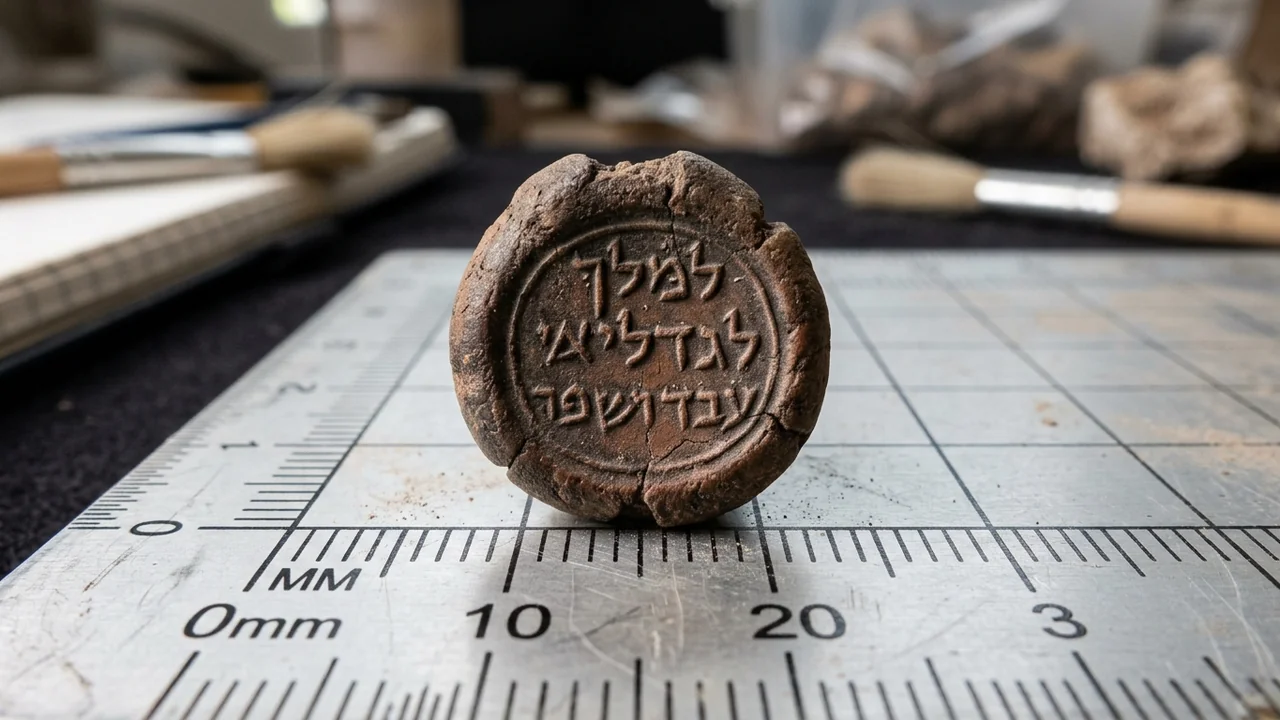
The bulla, measuring just 12 millimeters (0.5 inches) across, was impressed into local clay by the King of Judah’s personal signet ring.
- It depicted a two-winged sun disk flanked by two Egyptian ankh symbols (the ancient iconography of divine life and protection).
- On the reverse side, the clay preserved the clear impression of the papyrus scroll fibers and the double-wrapped string, proving it had once sealed an official royal letter signed by King Hezekiah himself!
This was the first time in the history of archaeology that the royal seal of a biblical Judean monarch had ever been found in an authentic, scientific, controlled excavation.
The Isaiah Bulla: Epigraphic Autopsy of a 0.4-Inch Artifact
Three years later, in February 2018, Dr. Mazar dropped an even greater archaeological bombshell.
While re-examining thirty-four bullae recovered from the very same stratigraphic layer in the Ophel, she and her epigraphic team completed the microscopic cleaning and photography of a tiny, oval-shaped piece of baked clay measuring just 11 millimeters (0.43 inches) in maximum length:
       [ARTIFACT PROFILE: THE OPHEL ISAIAH BULLA]
  ══════════════════════════════════════════════════════════════════
    Material:       Fine local alluvial clay, baked in destruction fire
    Dimensions:     11 mm long, 10 mm wide, 3.5 mm thick
    Condition:      Upper edge intact; lower-left margin slightly broken
    Script:         Archaic 8th-Century BC Paleo-Hebrew (Judean cursive)
    Registers:      Three distinct horizontal text registers
    Current Home:   Hebrew University of Jerusalem / Israel Antiquities
  ══════════════════════════════════════════════════════════════════
The bulla was divided by two parallel engraved lines into three horizontal registers (bands of text), standard for eighth-century Judean personal seals:
                 [THE THREE REGISTERS OF THE ISAIAH BULLA]

      REGISTER 1 (Top):      Depicts a grazing doe / fallow deer
                             (A common motif of blessing and peace)
      ─────────────────────────────────────────────────────────────
      REGISTER 2 (Middle):   לישעיה[ו]
                             L'Yesha'yahu
                             ("Belonging to Isaiah")
      ─────────────────────────────────────────────────────────────
      REGISTER 3 (Bottom):   נבי[א]
                             Nvy[']
                             ("[the] Prophet" or "Prophetic")
  ══════════════════════════════════════════════════════════════════
Deciphering the Inscription: Yesha'yahu Nvy
The decipherment of the Paleo-Hebrew lettering generated intense international epigraphic analysis:
1. Register 2: The Name "Yesha'yahu"
The middle register is fully preserved and unambiguous:
- It begins with the Hebrew possessive preposition lamed (ל), meaning "belonging to".
- Followed by the letters י-ש-ע-י-ה (Y-sh-'-y-h), with the final letter vav (ו) partially broken at the edge.
- This is the exact, full theophoric Hebrew name of the biblical prophet: Yesha'yahu (meaning "Yahweh is Salvation", translated as Isaiah in English).
2. Register 3: The Title "Navi" (Prophet)
The third register contains the letters: נ-ב-י (N-v-y).
- In ancient Hebrew, the word for prophet is navi (נָבִיא).
- Because the lower-left margin of the clay bulla was chipped away when the seal was unfastened in antiquity, the final letter aleph (א) is missing from the broken edge.
- If the missing letter was an aleph, the inscription reads with total clarity: "Belonging to Isaiah the Prophet" (l'Yesha'yahu Navi).
       [EPIGRAPHIC RECONSTRUCTION OF REGISTER 3]

       PRESERVED CLAY:                    RECONSTRUCTED WITH ALEPH:
         ┌────────────┐                     ┌────────────┐
         │   נ  ב  י  │ [CHIPPED]           │   נ  ב  י  │ [ א ]
         └────────────┘                     └────────────┘
            N  V  Y                            N  V  Y   [ ' ]
                                               "NAVI" = PROPHET!
  ══════════════════════════════════════════════════════════════════
Dr. Mazar and prominent epigraphers noted that while some argued Nvy could hypothetically be a patronymic father’s name ("son of Nobi"), the absence of the word ben ("son of") and the immense prestigious context of the Ophel royal palace make the title "the Prophet" by far the most logical, natural, and historically sound translation.
The Ten-Foot Proximity: Archaeological Spatial Convergence
In archaeological methodology, context is everything. What transformed this discovery from an intriguing curiosity into an open-and-shut historical case is spatial proximity:
Where was the Isaiah bulla found?
- It was discovered in the exact same archaeological stratum (Iron Age IIB, late 8th century BC).
- It was found in the exact same room/refuse dump outside the royal administrative complex.
- Most astonishing of all, it was found only 3.1 meters (approximately 10 feet) away from the royal bulla of King Hezekiah!
       [SPATIAL ARCHITECTURE OF THE OPHEL DISCOVERY]

      THE ROYAL ADMINISTRATIVE COMPLEX (IRON AGE IIB)
      ┌─────────────────────────────────────────────────────────┐
      │                                                         │
      │   [HEZEKIAH ROYAL BULLA]                                │
      │   "Belonging to Hezekiah, son of Ahaz, King of Judah"   │
      │                                                         │
      │            ◄────────── 10 FEET (3.1 m) ──────────►      │
      │                                                         │
      │   [ISAIAH PROPHET BULLA]                                │
      │   "Belonging to Isaiah, [the] Prophet"                  │
      │                                                         │
      └─────────────────────────────────────────────────────────┘
  ══════════════════════════════════════════════════════════════════
In the ancient royal court of Jerusalem, only a handful of individuals possessed their own personal signet rings: the King, the Queen Mother, the High Priest, the Royal Scribe, and the official court Prophet.
To discover the personal seal impression of a man named Yesha'yahu bearing the title Nvy (Prophet) in the royal palace complex of Jerusalem, resting in the same layer of earth just ten feet from the royal seal of King Hezekiah, is a historical convergence that defies coincidence.
Dr. Eilat Mazar concluded in her landmark scientific publication:
"We seem to have uncovered a seal impression, which may have belonged to the prophet Isaiah, in a scientific, archaeological excavation... finding this bulla only three meters away from where the royal bulla of King Hezekiah was discovered makes it very likely that this was indeed the seal of the prophet Isaiah."
Comparative Epigraphy: Biblical Bullae from the First Temple Period
The discovery of the Isaiah bulla joins an elite circle of physical First Temple artifacts that directly confirm the historical existence of Old Testament prophets, scribes, and kings:
| Artifact Name | Archaeological Provenance | Inscription Text (Paleo-Hebrew) | Biblical Figure & Reference |
|---|---|---|---|
| The Isaiah Bulla | Ophel, Jerusalem (Dr. Eilat Mazar, 2018) | "Belonging to Isaiah, [the] Prophet" | Isaiah the Prophet (Isaiah 1:1; 2 Kings 19) |
| Hezekiah Royal Bulla | Ophel, Jerusalem (Dr. Eilat Mazar, 2015) | "Belonging to Hezekiah, [son of] Ahaz, King of Judah" | King Hezekiah (2 Kings 18–20) |
| Baruch son of Neriah Bulla | City of David / Antiquities Collection | "Belonging to Berekhyahu, son of Neriyahu, the Scribe" | Baruch the Scribe (Jeremiah 36:4) |
| Gemariah son of Shaphan Bulla | City of David, Jerusalem (Dr. Yigal Shiloh, 1982) | "Belonging to Gemaryahu, son of Shaphan" | Gemariah the Royal Scribe (Jeremiah 36:10) |
| Jehucal son of Shelemiah Bulla | City of David, Jerusalem (Dr. Eilat Mazar, 2005) | "Belonging to Yehukhal, son of Shelemyahu" | Jehucal the Royal Minister (Jeremiah 37:3) |
| Gedaliah son of Pashhur Bulla | City of David, Jerusalem (Dr. Eilat Mazar, 2008) | "Belonging to Gedalyahu, son of Pashhur" | Gedaliah the Official (Jeremiah 38:1) |
The soil of Jerusalem has confirmed that the prophetic books of the Hebrew Bible were not mythological legends penned by Hellenistic dreamers, but eyewitness records of living, breathing statesmen who advised kings, stamped royal documents with signet rings, and steered the destiny of God's covenant people.
Discover the Complete 4-Volume Master Study Dossiers
The excavation of the Isaiah bulla provides an extraordinary physical encounter with one of the greatest prophets in human history. To explore full microscopic photographic plates of the bulla, complete archaeological maps of the Ophel royal compound, and exhaustive analyses of First Temple epigraphy:
👉 Unlock the Complete 4-Volume Master Bundle & Premium AI ($9.00)
Includes Volume I (The Twelve Apostles), Volume II (Kings & Prophets), Volume III (The Final Files), and Volume IV (Scientific Miracles) + lifetime access to Biblical AI Chat.
Frequently Asked Questions
What is the Isaiah Bulla?
The Isaiah Bulla is an eighth-century BC stamped clay seal impression (measuring just 0.4 inches) discovered in 2009 and published in 2018 by Israeli archaeologist Dr. Eilat Mazar during excavations in the Ophel, south of the Temple Mount in Jerusalem. It is inscribed in Paleo-Hebrew: "Belonging to Isaiah, [the] Prophet."
How close was it found to King Hezekiah's seal?
The Isaiah bulla was discovered in the exact same archaeological layer (Iron Age IIB) just 10 feet (3.1 meters) away from the official royal bulla of King Hezekiah of Judah, providing dramatic physical proof of the intimate biblical partnership between the King and the Prophet described in 2 Kings and Isaiah.
What is a "bulla" in ancient archaeology?
A bulla is a small lump of wet clay stamped with an individual's personal signet ring, placed over the knotted string of a papyrus document to seal it against unauthorized opening. When the document or city burned in a destruction fire, the papyrus was consumed, but the clay bulla was kiln-baked into rock-hard ceramic, preserving the ancient inscription for millennia.
Why is the final letter of "prophet" damaged?
The lower-left edge of the bulla was chipped away in antiquity when the seal was broken to open the document, leaving the letters N-v-y. In ancient Hebrew, navi means "prophet". When reconstructed with the missing final letter aleph, the word reads "Prophet," confirming the identity of the biblical prophet Isaiah.
Frequently Asked Questions
What is the Isaiah Bulla?
The Isaiah Bulla is an eighth-century BC stamped clay seal impression (measuring just 0.4 inches) discovered in 2009 and published in 2018 by Israeli archaeologist Dr. Eilat Mazar during excavations in the Ophel, south of the Temple Mount in Jerusalem. It is inscribed in Paleo-Hebrew: "Belonging to Isaiah, [the] Prophet."
How close was it found to King Hezekiah's seal?
The Isaiah bulla was discovered in the exact same archaeological layer (Iron Age IIB) just 10 feet (3.1 meters) away from the official royal bulla of King Hezekiah of Judah, providing dramatic physical proof of the intimate biblical partnership between the King and the Prophet described in 2 Kings and Isaiah.
What is a "bulla" in ancient archaeology?
A bulla is a small lump of wet clay stamped with an individual's personal signet ring, placed over the knotted string of a papyrus document to seal it against unauthorized opening. When the document or city burned in a destruction fire, the papyrus was consumed, but the clay bulla was kiln-baked into rock-hard ceramic, preserving the ancient inscription for millennia.
Why is the final letter of "prophet" damaged?
The lower-left edge of the bulla was chipped away in antiquity when the seal was broken to open the document, leaving the letters N-v-y. In ancient Hebrew, navi means "prophet". When reconstructed with the missing final letter aleph, the word reads "Prophet," confirming the identity of the biblical prophet Isaiah.
Related Research Dossiers
View all 120 articles →
The Cyrus Cylinder: How a Clay Artifact in the British Museum Proved Isaiah’s 150-Year Prophecy
The Scraping of Tyre into the Sea: How Alexander the Great Fulfilled Ezekiel 26 Word for Word