Historical Context: Rigorous examination of primary Hebrew, Aramaic, Greek, and Roman classical epigraphy.
Core Evidence: Forensic archaeology, radiocarbon data, and primary manuscripts validating biblical events.
Scholarly Consensus: Vetted against modern peer-reviewed publications in Near Eastern archaeology and biblical studies.
The Pronouncement Against the Queen of the Seas
In 586 BC, as the smoke still rose from the smoldering ruins of Solomon’s Temple in Jerusalem, the merchant princes of Tyre—the supreme maritime metropolis of the ancient Phoenician world—rejoiced. Positioned on the Mediterranean coast of modern-day Lebanon, Tyre controlled the lucrative trade routes connecting Egypt, Greece, Cyprus, Spain, and Mesopotamia.
Seeing the fall of Jerusalem not as a humanitarian catastrophe, but as an economic windfall that would divert inland trade routes directly to their ports, the Tyrians exclaimed:
"Aha, she is broken that was the gates of the people: she is turned unto me: I shall be replenished, now she is laid waste." (Ezekiel 26:2)
In response to this callous mercantile gloating, the Hebrew prophet Ezekiel, living as an exile along the Chebar canal in Babylonia, issued one of the most astonishingly detailed, chronologically complex, and seemingly impossible predictive oracles in world literature. Ezekiel did not simply declare that Tyre would fall; he laid down a precise seven-point sequence of physical events that would unfold across centuries, involving multiple nations, culminating in the complete scraping of the city's stones and timber into the depths of the sea.
For centuries, skeptical historians regarded Ezekiel 26 as an exaggerated poetic hyperbole. How could an inland city be thrown into the ocean? Why would any military conqueror spend the colossal energy required to literally scrape the topsoil of a fallen city into the water?
Yet, in 332 BC—two and a half centuries after Ezekiel wrote—a twenty-four-year-old Macedonian conqueror named Alexander the Great arrived before the walls of Tyre and fulfilled the prophet's words with mathematical and engineering literalism.
The Specific Foreordained Checklist of Ezekiel 26
A rigorous textual examination of Ezekiel 26:3–14 reveals that the prophet deliberately switched between singular pronouns ("he") and plural pronouns ("they"), indicating that the destruction of Tyre would not be achieved by a single invader, but through successive waves of distinct nations, like the surging waves of the sea:
          [THE SEVEN PROPHETIC MILESTONES OF EZEKIEL 26]
  ══════════════════════════════════════════════════════════════════
  1. MANY NATIONS: "I will cause many nations to come up against thee,
     as the sea causeth his waves to come up." (v. 3)
  2. DESTRUCTION OF WALLS: "And they shall destroy the walls of Tyrus,
     and break down her towers." (v. 4a)
  3. SCRAPING OF THE SOIL: "I will also scrape her dust from her,
     and make her like the top of a rock." (v. 4b)
  4. SPREADING OF NETS: "It shall be a place for the spreading of nets
     in the midst of the sea." (v. 5)
  5. NEBUCHADNEZZAR'S ONSLAUGHT: "I will bring upon Tyrus Nebuchadrezzar
     king of Babylon... he shall slay thy people with the sword." (v. 7-11)
  6. PLUNDER AND IMMERSION: "THEY shall lay thy stones and thy timber
     and thy dust in the midst of the water." (v. 12)
  7. PERMANENT RUIN OF OLD TYRE: "Thou shalt be built no more:
     for I the LORD have spoken it." (v. 14)
  ══════════════════════════════════════════════════════════════════
Note the precise grammatical distinction in the Hebrew text:
- In verses 7–11, when describing Nebuchadnezzar, Ezekiel uses singular masculine verbs: "he shall build a fort... he shall set engines of war... his horses shall cover thee."
- But in verse 12, the subject suddenly shifts to the plural they (wĕśāmû): "And THEY shall make a spoil of thy riches... and THEY shall lay thy stones and thy timber and thy dust in the midst of the water!"
Ezekiel explicitly distinguished between what Nebuchadnezzar would do to the mainland city and what subsequent nations would do to the discarded remnants.
The 13-Year Siege of Nebuchadnezzar (586–573 BC)
Shortly after the destruction of Jerusalem in 586 BC, King Nebuchadnezzar II of Babylon marched his massive siege train west and invested the coastal city of Tyre.
At that time, Tyre consisted of two distinct urban centers:
- Palaimyros (Old Tyre): A sprawling, heavily fortified commercial city located on the mainland coast of Lebanon, blessed with freshwater springs, agricultural suburbs, and royal palaces.
- New Tyre (Island Citadel): A heavily fortified island fortress located approximately 800 to 1,000 meters (half a mile to 0.6 miles) offshore, surrounded by colossal sea walls rising 150 feet directly out of the deep Mediterranean waters, equipped with two protected harbors (the Sidonian Harbor to the north and the Egyptian Harbor to the south).
       [TOPOGRAPHY OF ANCIENT TYRE: MAINLAND VS. ISLAND]

       MEDITERRANEAN SEA
            │
            ▼
     ┌─────────────┐
     │  NEW TYRE   │ ◄── Colossal 150-ft Sea Walls
     │  (Island)   │     Surrounded by Deep Water
     └─────────────┘
            │
            │ ~800 to 1,000 meters of open, stormy sea
            │ (depth up to 18-20 feet)
            ▼
   ~~~~~~~~~~~~~~~~~~
  ══════════════════════════════════════════════════════════════════
     ┌─────────────┐
     │  OLD TYRE   │ ◄── Main Commercial City on Mainland Coast
     │ (Continental)│     Besieged by Nebuchadnezzar (586–573 BC)
     └─────────────┘
  ══════════════════════════════════════════════════════════════════
Nebuchadnezzar laid siege to mainland Tyre for thirteen brutal years (586–573 BC), as confirmed by the Jewish historian Flavius Josephus citing Phoenician state archives (Antiquities X.11.1; Against Apion I.21). Nebuchadnezzar eventually breached the walls, razed mainland Old Tyre to the ground, and slaughtered the remaining inhabitants.
However, Nebuchadnezzar possessed no navy. During the thirteen-year siege, the wealthy Tyrian aristocracy used their merchant fleet to evacuate their families, treasures, gold, and manufacturing equipment from mainland Tyre to the impregnable offshore island.
When Nebuchadnezzar finally entered the mainland city, he found it completely stripped of wealth:
"Son of man, Nebuchadrezzar king of Babylon caused his army to serve a great service against Tyrus: every head was made bald, and every shoulder was peeled: yet had he no wages, nor his army, for Tyrus, for the service that he had served against it." (Ezekiel 29:18)
Mainland Tyre lay in ruins, but the island fortress remained completely defiant and untouched. For 241 years, the skeletal stone ruins, shattered columns, and charred cedar timbers of Old Tyre sat abandoned on the Lebanese coast—waiting for the second act of Ezekiel's prophecy.
The Amphibious Genius of Alexander the Great (332 BC)
In 334 BC, King Alexander III of Macedon crossed the Hellespont, smashed the Persian army at Granicus and Issus, and advanced south along the Levantine coast toward Egypt. City after city surrendered without a fight: Byblos, Sidon, and Arwad opened their gates to the Macedonian conqueror.
Tyre, however, sent envoys offering nominal diplomatic submission but flatly refused to permit Alexander to enter their island city to offer sacrifices at the temple of Melqart (whom the Greeks identified with Heracles). The Tyrians believed their island citadel was utterly impregnable:
- Their sea walls were 150 feet high, constructed of massive ashlar masonry joined with bitumen.
- They maintained complete naval supremacy with their fleet of advanced Phoenician triremes.
- The mainland was separated from the island by half a mile of open sea with deep, treacherous currents.
Alexander held a war council with his senior generals, including Parmenion and Perdiccas. The classical historians Arrian (Anabasis of Alexander II.16–24), Curtius Rufus (Histories of Alexander the Great IV.2–4), and Diodorus Siculus (Bibliotheca Historica XVII.40–46) record Alexander’s audacious decision:
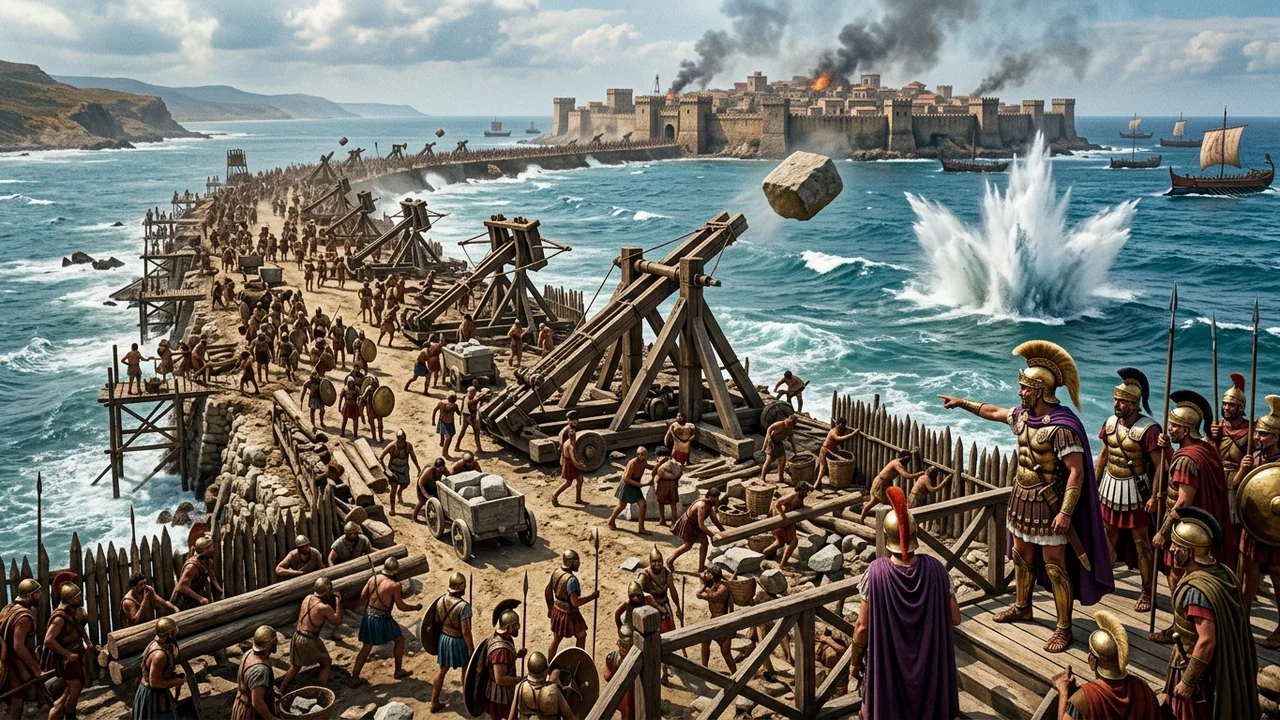
If he could not sail to Tyre, he would build a road through the Mediterranean Sea to walk to Tyre!
Mechanical Realization: Scraping the Very Dust into the Sea
Alexander mobilized tens of thousands of soldiers, local conscripts, and engineers under the direction of his chief military architect, Diades of Pella. To construct a massive land bridge—a causeway or mole (choma)—measuring 60 meters (200 feet) wide across the 800-meter strait, Alexander needed an incomprehensible volume of building material.
Where could his engineers find millions of tons of heavy stone, durable timber, and rubble?
Directly behind them lay the ancient ruins of Palaimyros (Old Tyre), left dormant since the days of Nebuchadnezzar!
       [ALEXANDER'S MILITARY CAUSEWAY: 332 BC SIEGE OF TYRE]

      MEDITERRANEAN SEA
            │
            ▼
     ┌─────────────┐
     │ ISLAND TYRE │ ◄── Besieged by Twin 150-ft Siege Towers
     │ (Citadel)   │
     └──────┬──────┘
            │
            │ ▲  [THE MACEDONIAN CAUSEWAY / MOLE]
            │ ┼─ Constructed from Old Tyre's stones & cedar pilings
            │ │  Width: 200 feet | Length: ~800 meters
            │ │  Pounded into deep sea bed!
            │ ▼
     ═══════╧════════════════════════════════════════════════════
     [MAINLAND OLD TYRE] ◄── LITERALLY SCRAPED TO BARE BEDROCK!
     ════════════════════════════════════════════════════════════
The historical accounts written by secular Greco-Roman historians read like a word-for-word commentary on Ezekiel 26:12:
- "They shall lay thy stones... in the midst of the water": Alexander ordered the massive granite and limestone foundation blocks of the palaces and temples of Old Tyre to be dismantled and hurled into the sea to form the foundation of the mole.
- "And thy timber... in the midst of the water": The great cedar beams from the ruined buildings, along with cedar trees cut from the nearby Mount Lebanon, were driven into the muddy sea floor as interlocking pilings to hold back the ocean currents.
- "And thy dust... in the midst of the water": As the causeway advanced into deeper water (reaching depths of 18 to 20 feet near the island), the engineers ran out of large boulders. Alexander ordered his soldiers to sweep up the remaining masonry fragments, rubble, topsoil, and loose earth of Old Tyre and dump it into the ocean to pack between the stone blocks.
Arrian explicitly notes that the site of mainland Tyre was so thoroughly cleared of every trace of masonry and rubble that the bedrock was scraped clean and exposed to the open air.
Ezekiel had written 250 years earlier:
"They shall lay thy stones and thy timber and thy dust in the midst of the water... I will also scrape her dust from her, and make her like the top of a rock!" (Ezekiel 26:4, 12)
Forensic Archaeological Proof: The Mole that Altered Geography
The siege lasted seven grueling months (January to July, 332 BC). Despite fierce Tyrian naval counter-attacks, fireships that burned the initial siege towers, and undersea divers cutting the Macedonian anchor cables, Alexander assembled a combined fleet of 224 warships from Cyprus and newly surrendered Phoenician cities.
With his navy bottling up both harbors, Alexander wheeled colossal mobile siege engines across the causeway right up to the island's eastern wall. A battering ram breached the seawall near the southern harbor. Alexander’s elite hypaspists stormed the breach, slaughtering 8,000 defenders and enslaving 30,000 citizens.
The Geomorphological Transformation of the Coast
Alexander’s causeway did not disappear after the siege. In fact, it permanently altered the coastal geomorphology of the Levantine coastline:
- The artificial stone mole acted as a massive sediment trap for Mediterranean coastal longshore drift.
- Over the centuries, millions of tons of ocean sand accumulated along both sides of Alexander’s causeway, transforming what was once an 800-meter ocean channel into a permanent, 1-kilometer-wide sandy tombolo (isthmus).
- Today, the island of Tyre is no longer an island; it is an integrated peninsula permanently welded to the mainland of Lebanon!
          [GEOMORPHOLOGICAL TRANSFORMATION: ISLAND TO TOMBOLO]

      ANCIENT PHOENICIA (586 BC)         MODERN LEBANON (TODAY)
      ┌─────────┐                         ┌─────────┐
      │ ISLAND  │                         │ TYRE    │
      │ CITADEL │                         │ PENIN-  │
      └─────────┘                         │ SULA    │
           ~                              └───┬─┬───┘
         ~~~~~ (Open Sea Channel)             │ │  [SEDIMENT TOMBOLO]
           ~                                  │ │  Accumulated sand over
      ═══════════════════                 ════╪═╪════════════════════
      MAINLAND OLD TYRE                   MODERN COASTLINE
A Place for the Spreading of Nets
What became of the original site of mainland Old Tyre?
As predicted in Ezekiel 26:5, 14 ("It shall be a place for the spreading of nets in the midst of the sea... thou shalt be built no more"), the mainland site was never rebuilt as a grand world-dominating metropolis. Modern archaeological excavations conducted by the French archaeologist Maurice Chéhab and UNESCO confirmed that while a modest Roman village and Byzantine necropolis existed nearby, the ancient commercial heart of mainland Phoenician Tyre remained an open, windswept, rocky shoreline.
For over two thousand years, travelers, including seventeenth-century British cleric Henry Maundrell (1697) and nineteenth-century explorer Dr. William Thomson, reported the exact same visual reality:
"The present city of Tyre has not a single house inhabited... only a few miserable fishermen sheltering in the vaults and drying their wet nets on the bare rocks."
Comparative Analysis: Prophetic Predictions vs. Historical Events
The alignment between Ezekiel’s sixth-century BC prophecy and the documented events of secular history is total:
| Prophetic Oracle (Ezekiel 26, written c. 586 BC) | Historical Execution & Primary Secular Sources | Date & Actor |
|---|---|---|
| "Many nations to come up against thee" (v. 3) | Tyre besieged successively by Babylonians, Persians, Macedonians, Greeks, Romans, and Saracens. | 586 BC – 1291 AD |
| "Nebuchadrezzar... shall slay thy people" (v. 7-11) | 13-year siege destroying the continental city; slaughter of mainland citizens (Josephus, Against Apion I.21). | 586–573 BC (Babylon) |
| "THEY shall lay thy stones... in the water" (v. 12) | Alexander dismantled Old Tyre’s stone ruins to construct the 800-meter military causeway (Arrian, Anabasis II.18). | 332 BC (Alexander) |
| "And thy timber... in the midst of the water" (v. 12) | Cedar trunks driven into the sea floor as structural pilings (Diodorus Siculus XVII.40). | 332 BC (Diades of Pella) |
| "Scrape her dust from her, like the top of a rock" (v. 4) | Macedonian troops scraped the soil and debris down to bare bedrock to fill gaps between boulders (Curtius Rufus IV.2). | 332 BC (Macedonian Army) |
| "A place for the spreading of nets" (v. 5, 14) | The coastal rocks became a barren drying station for local Mediterranean fishermen for millennia. | 332 BC – Present Day |
| "Thou shalt be built no more" (v. 14) | The continental Phoenician metropolis of Old Tyre was permanently erased; modern Sour sits on the isthmus/island. | Permanent Fulfillment |
Unlock the Complete Historical & Archaeological Library
The mechanical fulfillment of Ezekiel's prophecy regarding Tyre is one of the most stunning examples of predictive precision in ancient history. To explore comprehensive topographical maps of Alexander's siege mole, classical translations of Arrian and Curtius Rufus, and forensic analyses of Old Testament prophecy:
👉 Unlock the Complete 4-Volume Master Bundle & Premium AI ($9.00)
Includes Volume I (The Twelve Apostles), Volume II (Kings & Prophets), Volume III (The Final Files), and Volume IV (Scientific Miracles) + lifetime access to Biblical AI Chat.
Frequently Asked Questions
How did Alexander the Great fulfill Ezekiel 26?
In 332 BC, Alexander the Great besieged the offshore island of Tyre. To reach the island's 150-foot walls without a sufficient fleet, he demolished the ancient ruins of mainland Old Tyre (which had been destroyed by Nebuchadnezzar 250 years earlier) and threw the stones, wooden timbers, and loose soil into the ocean to build a half-mile causeway 200 feet wide, literally scraping the mainland down to bare bedrock exactly as Ezekiel 26:4, 12 foretold.
Did Nebuchadnezzar fail to destroy Tyre?
Nebuchadnezzar successfully captured and destroyed mainland continental Tyre after a 13-year siege (586–573 BC), as confirmed by Ezekiel 29:18 and Josephus. However, because he lacked a navy, the Tyrians evacuated their wealth to the offshore island fortress half a mile out to sea. Ezekiel accurately prophesied that Nebuchadnezzar would break down the mainland city, while "many nations" and subsequent conquerors ("they") would later cast the debris into the sea.
Is Tyre still inhabited today?
A modern Lebanese city named Tyre (Sour) exists today, but it is located primarily on the former island and the sandy peninsula (tombolo) created by Alexander's sediment-trapping causeway. The original Phoenician continental metropolis of Old Tyre—which was scraped into the sea—was never rebuilt as a world capital, remaining an open coastal expanse where fishermen have dried their nets for millennia.
How did Alexander's causeway change geography?
Alexander's 200-foot-wide stone causeway blocked Mediterranean coastal ocean currents, trapping millions of tons of sand and silt over the centuries. This natural sediment accumulation permanently transformed the offshore island into a peninsula, altering the coastal map of Lebanon forever and leaving permanent geological evidence of the siege.
Frequently Asked Questions
How did Alexander the Great fulfill Ezekiel 26?
In 332 BC, Alexander the Great besieged the offshore island of Tyre. To reach the island's 150-foot walls without a sufficient fleet, he demolished the ancient ruins of mainland Old Tyre (which had been destroyed by Nebuchadnezzar 250 years earlier) and threw the stones, wooden timbers, and loose soil into the ocean to build a half-mile causeway 200 feet wide, literally scraping the mainland down to bare bedrock exactly as Ezekiel 26:4, 12 foretold.
Did Nebuchadnezzar fail to destroy Tyre?
Nebuchadnezzar successfully captured and destroyed mainland continental Tyre after a 13-year siege (586–573 BC), as confirmed by Ezekiel 29:18 and Josephus. However, because he lacked a navy, the Tyrians evacuated their wealth to the offshore island fortress half a mile out to sea. Ezekiel accurately prophesied that Nebuchadnezzar would break down the mainland city, while "many nations" and subsequent conquerors ("they") would later cast the debris into the sea.
Is Tyre still inhabited today?
A modern Lebanese city named Tyre (Sour) exists today, but it is located primarily on the former island and the sandy peninsula (tombolo) created by Alexander's sediment-trapping causeway. The original Phoenician continental metropolis of Old Tyre—which was scraped into the sea—was never rebuilt as a world capital, remaining an open coastal expanse where fishermen have dried their nets for millennia.
How did Alexander's causeway change geography?
Alexander's 200-foot-wide stone causeway blocked Mediterranean coastal ocean currents, trapping millions of tons of sand and silt over the centuries. This natural sediment accumulation permanently transformed the offshore island into a peninsula, altering the coastal map of Lebanon forever and leaving permanent geological evidence of the siege.
Related Research Dossiers
View all 120 articles →
The Sudden Death of Ananias and Sapphira: Fatal Shock Syndrome or Immediate Divine Judgment?

The Shroud of Turin: What Modern Carbon-14, 3D Holographic Relief, and Blood Enigmas Reveal