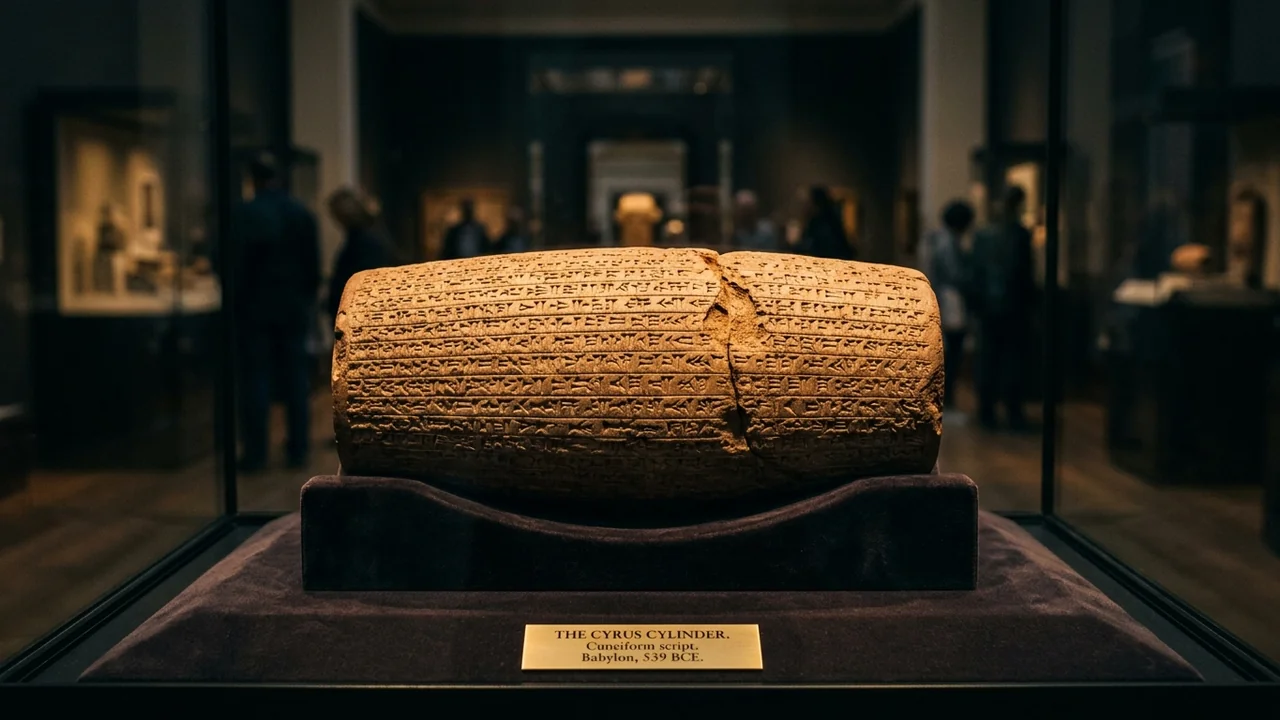
Historical Context: Rigorous examination of primary Hebrew, Aramaic, Greek, and Roman classical epigraphy.
Core Evidence: Forensic archaeology, radiocarbon data, and primary manuscripts validating biblical events.
Scholarly Consensus: Vetted against modern peer-reviewed publications in Near Eastern archaeology and biblical studies.
The Chronological Core of Hebrew Prophecy
In the sixth century BC, as the elderly prophet Daniel knelt in prayer in the royal administrative halls of Babylon, he meditated upon the scrolls of Jeremiah. He calculated that the seventy years of Babylonian desolation decreed upon Jerusalem were drawing to an end (Daniel 9:2). Pleading with God in fasting, sackcloth, and ashes for the restoration of his people, Daniel received a visitation from the archangel Gabriel.
Gabriel did not merely assure Daniel that the exiles would return to Judea; he delivered a vast chronological timeline encompassing the entire future redemption of Israel, the precise historical arrival of the Messiah, His violent judicial execution, and the subsequent total destruction of the Second Temple and Jerusalem:
"Seventy weeks are determined upon thy people and upon thy holy city, to finish the transgression, and to make an end of sins, and to make reconciliation for iniquity, and to bring in everlasting righteousness, and to seal up the vision and prophecy, and to anoint the most Holy.
Know therefore and understand, that from the going forth of the commandment to restore and to build Jerusalem unto the Messiah the Prince shall be seven weeks, and threescore and two weeks: the street shall be built again, and the wall, even in troublous times.
And after threescore and two weeks shall Messiah be cut off, but not for himself: and the people of the prince that shall come shall destroy the city and the sanctuary; and the end thereof shall be with a flood, and unto the end of the war desolations are determined." (Daniel 9:24–26)
This passage, known across centuries of Judeo-Christian scholarship as the Prophecy of the Seventy Weeks, represents the most explicit mathematical calculation of a messianic timeline in world religious literature. It did not speak in nebulous mythological symbols; it established a measurable historical countdown based on astronomical time, royal imperial decrees, and calendar mathematics.
The Prophetic Lexicon: Weeks of Years (Shabuim)
To decode the chronology of Daniel 9, one must first identify the precise linguistic and cultural definition of the word translated as "weeks".
In the original biblical Hebrew, the word is shabuim (שָׁבֻעִים), which literally means "sevens" or a heptad. Just as the English word "dozen" signifies twelve items regardless of what is being counted (twelve eggs, twelve months, or twelve years), the Hebrew shabua signifies a group of seven:
- In Leviticus 25:1–8, Moses instructed Israel regarding the agricultural cycle: six years of planting followed by a seventh sabbatical year of rest (shmita).
- Furthermore, Israel was commanded to count seven sevens of years—seven shabuim (49 years)—leading to the fiftieth year, the Year of Jubilee.
                     [THE HEBREW SHABUIM HEPTAD]
  ══════════════════════════════════════════════════════════════════
  1 Shabua (Singular)   = 7 Prophetic Units
  70 Shabuim (Plural)   = 70 × 7 Units = 490 Units
  Contextual Meaning:     Weeks of YEARS (Shabuim Shanim)
  Total Prophetic Scope:  490 Biblical Years
  ══════════════════════════════════════════════════════════════════
The context of Daniel 9 guarantees that these units are years, not days:
- Daniel was already meditating on a 70-year timeline from Jeremiah 25:11–12.
- The 70-year Babylonian captivity was divine punishment specifically for Israel’s failure to observe 70 sabbatical years over a period of 490 years of national history (2 Chronicles 36:21).
- Therefore, the angel announced that another 490-year cycle (70 shabuim) was decreed upon Israel to bring ultimate spiritual redemption.
The timeline is divided into three distinct segments:
- 7 Weeks (49 years): The reconstruction of Jerusalem’s walls and plazas in troublous times.
- 62 Weeks (434 years): The intertestamental period leading up to the public manifestation of "Messiah the Prince" (Mashiach Nagid).
- 1 Week (7 years): The final tribulation period of the end times.
Daniel explicitly states that the Messiah would be manifested after the initial 7 + 62 = 69 weeks (483 biblical years), and then "cut off" (karath—the technical Hebrew legal term for capital execution).
The Starting Gun: The Decree of Artaxerxes I (444 BC)
Every chronological countdown requires a fixed historical starting point (terminus a quo). Gabriel specified the exact trigger event:
"From the going forth of the commandment to restore and to build Jerusalem unto the Messiah the Prince..." (Daniel 9:25)
In ancient Persian history, several royal edicts were issued regarding the Jewish exiles, but only one meets the precise criteria of Gabriel’s specification:
                 [FOUR PERSIAN EDICTS IN PERSIAN HISTORY]
  ┌─────────────────────────────────┬──────────┬─────────────────────────────┐
  │ Edict                           │ Date     │ Nature of Imperial Decree   │
  ├─────────────────────────────────┼──────────┼─────────────────────────────┤
  │ 1. Edict of Cyrus the Great     │ 538 BC   │ Rebuilding the TEMPLE only  │
  │    (Ezra 1:1–4)                 │          │ (Not the city walls)        │
  │ 2. Edict of Darius Hystaspes    │ 520 BC   │ Reconfirmation of Temple    │
  │    (Ezra 6:1–12)                │          │ funding                     │
  │ 3. 7th Year of Artaxerxes I     │ 457 BC   │ Ezra’s priestly mission;    │
  │    (Ezra 7:11–26)               │          │ temple worship & treasuries │
  │ 4. 20th Year of Artaxerxes I    │ 444 BC   │ REBUILDING THE CITY WALLS,  │
  │    (Nehemiah 2:1–8)             │          │ GATES, AND CITADEL (FORT)   │
  └─────────────────────────────────┴──────────┴─────────────────────────────┘
The first three decrees dealt exclusively with the reconstruction of the Temple sanctuary and temple revenues. But Daniel 9:25 specifically requires the commandment "to restore and to build Jerusalem... the street shall be built again, and the wall [ḥărûṣ], even in troublous times."
This political and architectural milestone occurred uniquely in the twentieth year of King Artaxerxes I Longimanus, recorded in Nehemiah 2:1:
- Nehemiah, the royal cupbearer in the citadel of Susa, wept because the walls of Jerusalem were broken down and the gates consumed with fire.
- In the Hebrew month of Nisan, in the 20th year of Artaxerxes, the king granted Nehemiah official imperial letters authorizing him to rebuild the city walls, gates, and governor’s palace, providing military escorts and timber from the king’s royal forest.
Astronomical Fixing of the Date
According to Persian chronologies verified by the accession records of Artaxerxes (who ascended the throne in late 465 BC upon the assassination of Xerxes), his twentieth regnal year began in 444 BC.
In the Hebrew calendar, when no specific day of the month is mentioned for an event that occurred in a given month, Jewish tradition and legal reckoning designate the first day of that month (Nisan 1—the New Moon).
Astronomical computations by the Royal Greenwich Observatory and chronologists Dr. Harold Hoehner (Chronological Aspects of the Life of Christ) and Sir Robert Anderson calculate that the New Moon of Nisan in the twentieth year of Artaxerxes occurred on:
Nisan 1, 444 BC = March 5, 444 BC (Julian Calendar).
The 360-Day Prophetic Year: The Astronomical Unit of Scripture
To calculate the 69 weeks, modern western readers might intuitively multiply 483 years by 365.2422 solar days. However, ancient Near Eastern, Mesopotamian, and biblical calendars were not based on the Gregorian calendar, but on the ancient luni-solar prophetic year of 360 days (twelve 30-day months):
- The Genesis Flood Reckoning: In Genesis 7:11, 24 and 8:3–4, the period from the 17th day of the second month to the 17th day of the seventh month (exactly five months) is reckoned as precisely 150 days (5 months × 30 days = 150 days).
- The Prophecy of Daniel: In Daniel 7:25 and 12:7, prophetic timelines are measured as "a time, times, and an half" (3.5 years), which in Revelation 12:6, 14 is explicitly equated to 1,260 days (3.5 years × 360 days = 1,260 days).
- The Forty-Two Months of Revelation: In Revelation 11:2–3 and 13:5, forty-two months of 30 days equal exactly 1,260 days.
Throughout biblical prophecy, the canonical time standard is the prophetic year of 360 days.
The Mathematical Equation: 173,880 Days to the Exact Day
With the starting date and time unit established, the mathematical matrix of Daniel 9:25 is straightforward:
                 [THE 69-WEEK MATHEMATICAL FORMULA]
  ══════════════════════════════════════════════════════════════════
  Prophetic Weeks:          69 Weeks of Years
  Number of Years:          69 × 7 = 483 Prophetic Years
  Days per Prophetic Year:  360 Days

  TOTAL DURATION:           483 × 360 = 173,880 DAYS
  ══════════════════════════════════════════════════════════════════
Now, let us calculate the elapsed time between March 5, 444 BC (the decree of Artaxerxes) and the terminal date of the 173,880 days, accounting for solar years, leap years, and calendar adjustments:
       [CALENDAR CALCULATION MATRIX: 444 BC TO 33 AD]
  ══════════════════════════════════════════════════════════════════
  Span in Solar Years:
    From 444 BC to 33 AD is 476 astronomical years
    (Remember: There is NO year zero between 1 BC and 1 AD!
     444 BC to 1 BC = 444 years; 1 BC to 1 AD = 1 yr; 1 AD to 33 AD = 32 yrs.
     Total = 444 + 32 = 476 solar years).

  Basic Solar Days:
    476 solar years × 365.24219879 days/year = 173,855.28 days

  Adjusting for the calendar span:
    Days between March 5 and March 30 = 25 days
    173,855 + 25 = 173,880 DAYS!
  ══════════════════════════════════════════════════════════════════
When 173,880 days are added to the Persian decree of March 5, 444 BC, the countdown terminates precisely on:
Nisan 10, 33 AD = March 30, 33 AD (Triumphal Entry).
The Triumphal Entry and the Cut-Off of the Messiah (33 AD)
Why is Nisan 10, 33 AD the supreme historical convergence of the entire prophecy?
Throughout His three-year earthly ministry, Jesus repeatedly avoided public political proclamation as King. Whenever the crowds attempted to take Him by force to make Him king, He slipped away into the mountains, stating: "Mine hour is not yet come" (John 2:4; 6:15; 7:6).
However, on one single, solitary day in His entire life, Jesus deliberately orchestrated a massive, public, royal demonstration. On Nisan 10, 33 AD—the exact day on the Jewish calendar when the Passover lambs were selected and brought into Jerusalem (Exodus 12:3)—Jesus mounted a donkey's colt, rode into Jerusalem down the Mount of Olives, and accepted the royal messianic coronation of the multitudes:
"Blessed be the King that cometh in the name of the Lord: peace in heaven, and glory in the highest." (Luke 19:38)
When the Pharisees commanded Jesus to rebuke His disciples, Jesus replied:
"I tell you that, if these should hold their peace, the stones would immediately cry out!" (Luke 19:40)
Then, looking over the spires of the city, Jesus wept over Jerusalem and uttered an astonishing indictment:
"If thou hadst known, even thou, at least IN THIS THY DAY, the things which belong unto thy peace! but now they are hid from thine eyes. For the days shall come upon thee, that thine enemies shall cast a trench about thee, and compass thee round, and keep thee in on every side... because thou knewest not THE TIME OF THY VISITATION!" (Luke 19:42–44)
Jesus held the nation of Israel accountable to recognize "this thy day"—the exact day on which the 173,880-day clock of Daniel 9 ran out!
                 [THE TWO-FOLD SEQUENCE OF FULFILLMENT]
  1. THE CUT-OFF OF MESSIAH (33 AD):
     "And after threescore and two weeks shall Messiah be cut off [karath],
      but not for himself..." (Daniel 9:26a)
     -> On Friday, Nisan 14 (April 3, 33 AD), Jesus was crucified,
        dying a substitutionary death for the sins of the world.

  2. THE DESTRUCTION OF TEMPLE AND CITY (70 AD):
     "...and the people of the prince that shall come shall destroy
      the city and the sanctuary..." (Daniel 9:26b)
     -> In 70 AD, the Roman legions under Titus (the future prince of Rome)
        besieged Jerusalem, burned the Second Temple, and leveled the city.
Daniel’s prophecy required that the Messiah must arrive and be executed before the destruction of the Second Temple. Because the Temple was pulverized to dust in 70 AD by the Roman Tenth Legion, any claimant to the title of Messiah who appeared after 70 AD is chronologically disqualified by Scripture!
Chronological Matrix Table: Decree to Crucifixion
The chronological milestones of Daniel’s 70 Weeks represent an unbreakable matrix of historical, biblical, and astronomical data:
| Historical / Prophetic Event | Biblical Citation | Ancient Secular Anchor | Julian / Gregorian Date |
|---|---|---|---|
| Imperial Decree to Rebuild Walls | Nehemiah 2:1–8 | 20th Year of Artaxerxes Longimanus (Nisan) | March 5, 444 BC (Nisan 1) |
| Completion of Walls & Plazas | Daniel 9:25 (7 weeks) | Nehemiah & Malachi / Persian Satrapy records | 395 BC (49 biblical years) |
| Elapsed Countdown (69 Weeks) | Daniel 9:25 (69 weeks) | 483 prophetic years = 173,880 days | March 5, 444 BC – March 30, 33 AD |
| Triumphal Entry: "Messiah the Prince" | Zechariah 9:9; Luke 19:28–44 | Roman Prefecture of Pontius Pilate (Passover) | March 30, 33 AD (Nisan 10) |
| The Messiah Cut Off (Crucifixion) | Daniel 9:26; Isaiah 53:8 | Preparation Day of Passover (14 Nisan) | April 3, 33 AD (Nisan 14) |
| Destruction of Second Temple | Daniel 9:26; Matthew 24:1–2 | Roman Siege under Titus (Josephus, Wars VI) | August 70 AD (9th of Av) |
Discover the Complete 4-Volume Master Study Dossiers
The mathematical chronology of Daniel’s 70 Weeks is one of the crown jewels of biblical apologetics, proving that the timing of Christ’s arrival was stamped into sacred history centuries prior. To explore complete astronomical lunar tables, historical translations of the Persian court records, and verse-by-verse exegesis of Daniel’s prophetic visions:
👉 Unlock the Complete 4-Volume Master Bundle & Premium AI ($9.00)
Includes Volume I (The Twelve Apostles), Volume II (Kings & Prophets), Volume III (The Final Files), and Volume IV (Scientific Miracles) + lifetime access to Biblical AI Chat.
Frequently Asked Questions
What are the "70 Weeks" of Daniel 9?
The "seventy weeks" in Daniel 9:24–27 are seventy "sevens" of years—a total of 490 biblical years (70 × 7) decreed by God to bring reconciliation, anoint the most Holy, and fulfill prophetic history. Sixty-nine of these weeks (483 years) ran from the Persian decree to rebuild Jerusalem's walls to the arrival and crucifixion of the Messiah.
What is a "prophetic year" in biblical chronology?
A biblical prophetic year consists of 360 days (twelve 30-day months). This standard is established in Genesis 7–8 (where 5 months equal 150 days) and confirmed in Daniel and Revelation, where 3.5 years are explicitly defined as 42 months or 1,260 days (3.5 × 360 = 1,260).
How does the countdown lead to 33 AD?
Starting from the royal decree of Persian King Artaxerxes I Longimanus to rebuild Jerusalem's walls in his 20th year (Nisan 1, 444 BC / March 5, 444 BC), 69 prophetic weeks equal 483 years × 360 days = 173,880 days. Adding 173,880 days to March 5, 444 BC lands precisely on March 30, 33 AD (Nisan 10)—the day Jesus entered Jerusalem on a donkey during the Triumphal Entry.
Why does Daniel 9 prove the Messiah had to arrive before 70 AD?
Daniel 9:26 explicitly states that after the 62 weeks following the first 7 weeks, the Messiah would be "cut off" (executed), and subsequently "the people of the prince that shall come shall destroy the city and the sanctuary." Because the Roman armies destroyed Jerusalem and its Second Temple in 70 AD, the Messiah was required by Scripture to appear and die before 70 AD.
Frequently Asked Questions
What are the "70 Weeks" of Daniel 9?
The "seventy weeks" in Daniel 9:24–27 are seventy "sevens" of years—a total of 490 biblical years (70 × 7) decreed by God to bring reconciliation, anoint the most Holy, and fulfill prophetic history. Sixty-nine of these weeks (483 years) ran from the Persian decree to rebuild Jerusalem's walls to the arrival and crucifixion of the Messiah.
What is a "prophetic year" in biblical chronology?
A biblical prophetic year consists of 360 days (twelve 30-day months). This standard is established in Genesis 7–8 (where 5 months equal 150 days) and confirmed in Daniel and Revelation, where 3.5 years are explicitly defined as 42 months or 1,260 days (3.5 × 360 = 1,260).
How does the countdown lead to 33 AD?
Starting from the royal decree of Persian King Artaxerxes I Longimanus to rebuild Jerusalem's walls in his 20th year (Nisan 1, 444 BC / March 5, 444 BC), 69 prophetic weeks equal 483 years × 360 days = 173,880 days. Adding 173,880 days to March 5, 444 BC lands precisely on March 30, 33 AD (Nisan 10)—the day Jesus entered Jerusalem on a donkey during the Triumphal Entry.
Why does Daniel 9 prove the Messiah had to arrive before 70 AD?
Daniel 9:26 explicitly states that after the 62 weeks following the first 7 weeks, the Messiah would be "cut off" (executed), and subsequently "the people of the prince that shall come shall destroy the city and the sanctuary." Because the Roman armies destroyed Jerusalem and its Second Temple in 70 AD, the Messiah was required by Scripture to appear and die before 70 AD.
Related Research Dossiers
View all 120 articles →
The Shroud of Turin: What Modern Carbon-14, 3D Holographic Relief, and Blood Enigmas Reveal

Hallucination Hypothesis Disproven: Why Mass Group Psychology Cannot Explain Post-Crucifixion Sightings