Historical Context: Rigorous examination of primary Hebrew, Aramaic, Greek, and Roman classical epigraphy.
Core Evidence: Forensic archaeology, radiocarbon data, and primary manuscripts validating biblical events.
Scholarly Consensus: Vetted against modern peer-reviewed publications in Near Eastern archaeology and biblical studies.
The Confrontation in Capernaum: Matthew 17:24–27
In the lakeside fishing village of Capernaum on the northern shore of the Sea of Galilee, Jesus and his disciples were approached by officials collecting the annual Jewish religious levy:
"And when they were come to Capernaum, they that received tribute money came to Peter, and said, 'Doth not your master pay tribute?' He saith, 'Yes.' And when he was come into the house, Jesus prevented him, saying, 'What thinkest thou, Simon? of whom do the kings of the earth take custom or tribute? of their own children, or of strangers?' Peter saith unto him, 'Of strangers.' Jesus saith unto him, 'Then are the children free. Notwithstanding, lest we should offend them, go thou to the sea, and cast an hook, and take up the fish that first cometh up; and when thou hast opened his mouth, thou shalt find a piece of money: that take, and give unto them for me and thee.'" (Matthew 17:24–27)
To modern readers, this incident often sounds like a whimsical folklore tale or a humorous parlor trick. Why would Jesus orchestrate the payment of an administrative tax through the mouth of a random freshwater fish?
Through the combined disciplines of ancient Levantine numismatics, Temple legal jurisprudence, and the ichthyology of Lake Kinneret cichlids, this narrative reveals an astonishing intersection of natural fish biology, currency metallurgy, and absolute divine omniscience.
Numismatic Forensics: The Tyrian Shekel and the Temple Tax
The tax being collected in Matthew 17 was not a Roman civil tribute (such as the census tax paid to Caesar in Matthew 22:17). It was the sacred Half-Shekel Temple Tax (didrachmon):
[EXODUS 30:11–16: THE MOSAIC TEMPLE TAX]
   ├── Mandatory annual atonement offering for every Jewish male aged 20 and older
   ├── Denomination: Exactly ONE HALF-SHEKEL (Bekah / Two Drachmas)
   └── Exclusively dedicated to the daily sacrifices and upkeep of the Jerusalem Temple.
The Exact Mathematical Currency Match
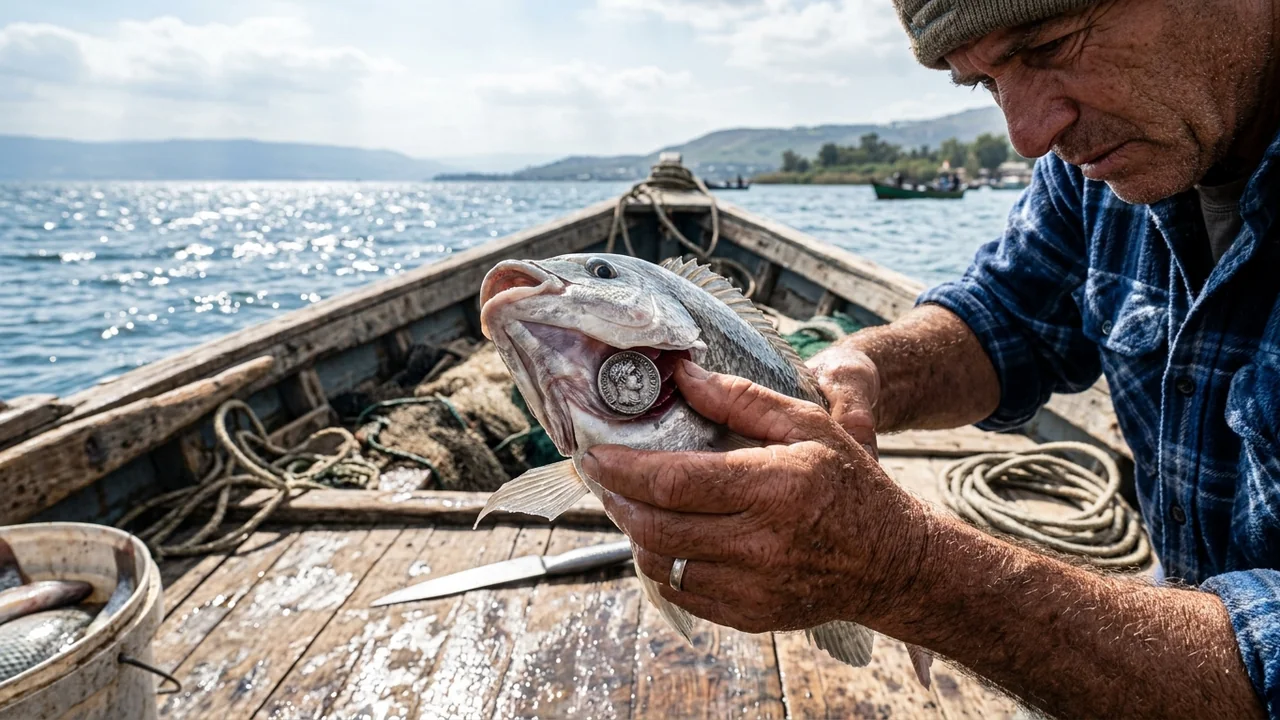
In the Greek text of Matthew 17:27, Jesus instructs Peter: "when thou hast opened his mouth, thou shalt find a stater [statēra]: that take, and give unto them for me and thee."
In 1st-century Greco-Roman and Jewish numismatics:
- The tax collector demanded a didrachmon (a two-drachma coin, representing one half-shekel) per person.
- A stater was a high-denomination silver coin equivalent to four drachmas (a full tetradrachm or full Judean shekel).
- Therefore, one single stater coin paid the exact required tax for precisely two adult men (Jesus and Peter)!
$$ ext{1 Stater} = 4 ext{ Drachmas} = 2 ext{ Didrachmas} = 2 ext{ Temple Tax Payments}$$
Why Only the Tyrian Shekel Was Accepted
Under strict Temple regulations enforced by the Sanhedrin, Roman denarii bearing the image of the emperor (Tiberius Caesar) were disqualified because they were inscribed with pagan idolatrous titles (Divi Filius, "Son of God"). The only coin legally accepted by the Temple moneychangers was the Tyrian Shekel (Stater), minted in Phoenician Tyre, because of its unrivaled metallurgical purity (94% pure silver).
The coin inside the fish's mouth was not a generic copper token; it was a heavy, gleaming silver Tyrian Stater!
Ichthyology of Lake Kinneret: The Biology of St. Peter’s Fish
What species of fish was swimming in the Sea of Galilee that day?
Marine biologists and fisheries scientists studying Lake Kinneret have identified the exact native species: Sarotherodon galilaeus (or Tilapia galilaea), universally known today throughout Israel as "St. Peter’s Fish":
   Kingdom: Animalia
     └── Phylum: Chordata
           └── Class: Actinopterygii
                 └── Order: Cichliformes
                       └── Family: Cichlidae
                             └── Genus: Sarotherodon / Tilapia
                                   └── Species: Sarotherodon galilaeus (Galilee Cichlid)
The cichlids of the Sea of Galilee are famous for two unique, interrelated biological behaviors: mouthbrooding and the ingestion of benthic foreign objects.
Mouthbrooding Behavior: Why Tilapia Collect Shiny Objects
In Sarotherodon galilaeus, parental care is carried out through biparental mouthbrooding:
[Tilapia Mating & Egg Fertilization on Lake Floor]
                          │
                          ▼
[Parent Scoops Fertilized Eggs into its Buccal (Mouth) Cavity]
   ├── Carries hundreds of eggs/fry inside mouth for 2 to 3 weeks
   ├── Ceases normal planktonic feeding to protect offspring
   └── Expands buccal pouch into a natural aquatic incubator!
                          │
                          ▼  POST-BROODING BEHAVIORAL PECULIARITY:
[Tilapia Scoops Up Heavy, Shiny Benthic Objects from Lakebed]
   ├── Small flat stones, shells, and discarded human artifacts (coins!)
   ├── Functions to hold the mouth slightly agape or weigh down the fish
   └── Attracted to gleaming metallic reflections in shallow sandy waters!
The Biology of the "Object-Scooper"
Freshwater biologists and commercial fishermen on Lake Kinneret have long observed that St. Peter's Fish frequently pick up unusual, hard objects from the lake floor:
- Buccal Weighting: After releasing its mature fry, a tilapia often retains the habit of scooping up small, smooth, flat stones or discarded objects into its mouth.
- Attraction to Gleaming Metal: Tilapia are highly visually responsive to metallic shimmer. When bathers, Roman soldiers, merchants, or fishermen accidentally dropped heavy silver coins overboard from boats near the harbor of Capernaum, the coins settled onto the sandy lakebed.
- The Coin in the Buccal Pouch: A hungry or nest-cleaning tilapia grazing along the benthic silt would readily engulf a shiny 14-gram silver Tyrian stater, holding it securely inside its wide, cavernous mouth!
The Hook vs. The Net: An Anomalous Angling Method
One of the most remarkable, subtle details in Matthew 17:27 is Jesus's specific fishing instruction:
"Go thou to the sea, and cast an hook [ankistron], and take up the fish that first cometh up..."
To a professional commercial fisherman like Peter, this command sounded completely counter-intuitive:
[Standard Commercial Fishing on Lake Galilee]
   ├── Done exclusively with NETS (Cast-nets / Amphiblēstron or Drag-nets / Sagēnē)
   ├── Tilapia feed on microscopic phytoplankton and algae
   └── Tilapia RARELY bite baited fishing hooks!
                          │
                          ▼  JESUS'S UNCONVENTIONAL COMMAND:
["Cast an Hook (Ankistron)" into the Waters of Capernaum]
- Tilapia Are Not Predatory Angling Fish: Unlike predatory perch or catfish, Sarotherodon galilaeus feeds by filtering microscopic algae, plankton, and detritus through gill rakers. They do not naturally strike at baited hooks.
- Why a Hook Was Necessary: A commercial net sweeps up hundreds of fish at once, requiring sorting on the beach. But Jesus did not need a boatload of fish. He needed one specific fish carrying one specific coin!
- Peter obediently tied a line to a single bronze hook, walked down to the shore of Capernaum, and cast it into the ripples. The very first fish that took the hook was the specific individual cichlid carrying the silver stater in its buccal pouch!
Comparative Numismatics of 1st-Century Roman Palestine
| Coin Name | Metal Composition | Mint Location | Equivalent Value in Drachmas | Theological / Legal Status in Temple |
|---|---|---|---|---|
| Tyrian Stater (Shekel) | Silver (94% Purity) | Tyre (Phoenicia) | 4 Drachmas (1 Full Shekel) | Exclusively accepted for Temple Tax (Matthew 17:27). Paid for 2 men. |
| Tyrian Didrachm (Half-Shekel) | Silver (94% Purity) | Tyre | 2 Drachmas (0.5 Shekel) | Legal annual tax required for one individual Jewish male. |
| Roman Denarius | Silver (~85% Purity) | Rome / Antioch | 1 Drachma | Bearing image of Tiberius; rejected by Temple; used for imperial tax (Matt 22). |
| Greek Drachma | Silver | Various Greek city-mints | 1 Drachma | Standard daily wage for agricultural or military laborer. |
| Prutah / Lepton | Bronze / Copper | Hasmonean / Herodian mints | 1/64 to 1/128 of a Denarius | "Widow’s Mite" (Mark 12:42); smallest circulating bronze coin. |
The Sovereign Convergence: Omniscience in Action
The miracle of the coin in the fish’s mouth represents a breathtaking convergence of micro-scale cosmic providence:
[Someone Drops a Silver Tyrian Stater Overboard at Capernaum]
                            │
                            ▼
[A Native Tilapia Cichlid Engulfs the Shiny Coin into its Mouth]
                            │
                            ▼
[Tax Collectors Challenge Peter Regarding the Half-Shekel Levy]
                            │
                            ▼
[Jesus Dispatches Peter with a Single Bronze Hook]
                            │
                            ▼
[The Exact Fish Bites the Exact Hook at the Exact Second!]
Consider the thousands of independent variables operating simultaneously:
- A human traveler had to drop a silver coin into the lake days or weeks earlier.
- The coin had to be a Tyrian stater—not a Roman denarius, not a bronze lepton, but the exact four-drachma coin required to pay for two men.
- A cichlid had to engulf the coin and retain it in its buccal cavity without swallowing or expelling it.
- That specific fish had to swim to the exact patch of shoreline where Peter stood.
- In a lake containing millions of fish, that fish had to bite Peter’s solitary hook as the very first catch!
Jesus did not create a new coin out of nothing; He demonstrated that every sparrow in the sky, every atom in the ocean, and every fish swimming in the dark depths of the Sea of Galilee is under His absolute, real-time sovereign surveillance.
The God who owns the cattle on a thousand hills owns the fish in the depths of the sea. When human obligations demand payment, the King of Creation provides with effortless, breathtaking precision.
Discover the Full Ichthyological and Numismatic Dossiers
The miracle of the coin in the fish’s mouth is one of dozens of ancient biblical wonders where freshwater biology, ancient numismatics, and Lake Galilee archaeology intersect. To examine high-resolution photographic plates of authentic 1st-century Tyrian staters, biological dissection diagrams of Sarotherodon galilaeus, and ancient fishing hook artifacts from Capernaum:
👉 Discover Volume IV: Scientific Miracles & Ancient Prophecies ($2.99)
Features detailed numismatic catalogs of Second Temple coinage, ichthyological reports on Galilean mouthbrooders, and complete clinical autopsies of New Testament miracles.
Frequently Asked Questions
What was the coin found in the fish's mouth?
The coin was a stater (Greek statēra), specifically a silver Tyrian Stater (tetradrachm) equivalent to four drachmas or one full Judean shekel. Because the Temple tax was a half-shekel (two drachmas) per adult male, a single stater paid the exact tax for precisely two people: Jesus and Peter.
Why do tilapia collect coins and shiny objects in their mouths?
The native Galilee cichlid (Sarotherodon galilaeus / St. Peter’s Fish) is a mouthbrooder that carries eggs and fry in its oral cavity. They are naturally attracted to shiny, reflective objects on the sandy lakebed, frequently scooping up small stones, shells, and dropped metallic coins to weigh themselves down or clear nesting areas.
Why was catching this fish with a hook unusual?
Commercial fishing on the Sea of Galilee was done with large nets (amphiblēstron and sagēnē). Furthermore, tilapia feed on microscopic plankton and algae, so they rarely strike baited hooks. Jesus specifically commanded Peter to cast a single hook (ankistron), demonstrating divine control over the exact individual fish that bit the line.
Why did Jesus agree to pay the Temple tax if He claimed He was exempt?
Jesus explained to Peter that as the Son of God (the King), He and His followers were royal children and therefore technically exempt from the Temple tax. However, He chose to pay it "lest we should offend them" (Matthew 17:27), modeling humble civic responsibility while demonstrating His divine power by providing the exact funds required.
Frequently Asked Questions
What was the coin found in the fish's mouth?
The coin was a stater (Greek statēra), specifically a silver Tyrian Stater (tetradrachm) equivalent to four drachmas or one full Judean shekel. Because the Temple tax was a half-shekel (two drachmas) per adult male, a single stater paid the exact tax for precisely two people: Jesus and Peter.
Why do tilapia collect coins and shiny objects in their mouths?
The native Galilee cichlid (Sarotherodon galilaeus / St. Peter’s Fish) is a mouthbrooder that carries eggs and fry in its oral cavity. They are naturally attracted to shiny, reflective objects on the sandy lakebed, frequently scooping up small stones, shells, and dropped metallic coins to weigh themselves down or clear nesting areas.
Why was catching this fish with a hook unusual?
Commercial fishing on the Sea of Galilee was done with large nets (amphiblēstron and sagēnē). Furthermore, tilapia feed on microscopic plankton and algae, so they rarely strike baited hooks. Jesus specifically commanded Peter to cast a single hook (ankistron), demonstrating divine control over the exact individual fish that bit the line.
Why did Jesus agree to pay the Temple tax if He claimed He was exempt?
Jesus explained to Peter that as the Son of God (the King), He and His followers were royal children and therefore technically exempt from the Temple tax. However, He chose to pay it "lest we should offend them" (Matthew 17:27), modeling humble civic responsibility while demonstrating His divine power by providing the exact funds required.
Related Research Dossiers
View all 120 articles →
Hematidrosis in Gethsemane: What Causes Human Sweat Glands to Bleed Under Severe Anguish?

The Effusion of Blood and Water: Forensic Confirmation of Acute Cardiac Rupture on the Cross