Historical Context: Rigorous examination of primary Hebrew, Aramaic, Greek, and Roman classical epigraphy.
Core Evidence: Forensic archaeology, radiocarbon data, and primary manuscripts validating biblical events.
Scholarly Consensus: Vetted against modern peer-reviewed publications in Near Eastern archaeology and biblical studies.
The Flavian Imperial Scandal: A Christian in Caesar's Palace
In the late autumn of 95 AD, imperial Rome was rocked by an unprecedented domestic scandal that reached into the bedchambers of the imperial dynasty itself.
Emperor Domitian—paranoid, tyrannical, and obsessed with eliminating potential political rivals—ordered the sudden arrest and immediate execution of his own first cousin, Titus Flavius Clemens, who had just completed his term as Roman Consul (the highest elected magistracy in the empire). Simultaneously, Domitian banished Clemens's wife—his own imperial niece, Flavia Domitilla—to the barren penal island of Pandateria (modern Ventotene) in the Tyrrhenian Sea.
What capital crime had the second most powerful family in the Roman Empire committed?
The Roman pagan historian Cassius Dio, writing in his Roman History (Book LXVII, Chapter 14), preserves the official imperial indictment:
"Domitian slew, along with many others, Flavius Clemens the consul, although he was his cousin and had to wife Flavia Domitilla, who was also a relative of the emperor. The charge brought against them both was that of atheism (atheotes), a charge on which many others who drifted into Jewish ways were condemned. Some of these were put to death, and the rest were at least deprived of their properties; but Domitilla was merely banished."
[Autumn 95 AD: The Imperial Palace on the Palatine Hill]
       │
       ▼
[Emperor Domitian Indicts His Own Royal Family]
       │
       ├──► Charge: "Atheotes" (Atheism / Refusal to Worship Imperial Roman Gods)
       │         └── Historical reality: Conversion to the Christian Faith
       │
       ├──► Consul Flavius Clemens Executed by the Sword
       │
       └──► Flavia Domitilla Banished to Island of Pandateria
                 └── Donates Her Vast Suburban Estate on the Via Ardeatina to the Church
In the ancient Roman legal vocabulary, the bizarre charge of "atheism" (atheotes) did not mean philosophical agnosticism; it was the standard Roman imperial designation for Christianity. Because Christians possessed no visible temple, offered no animal sacrifices on civic altars, and refused to burn incense to the genius of the emperor, pagan magistrates condemned them as dangerous "atheists" who undermined the divine protection (pax deorum) of the empire.
Before her banishment, Flavia Domitilla performed an act of radical subversion: she legally deeded a vast suburban agricultural estate located two miles south of Rome between the Via Ardeatina and the Via Appia to the persecuted Christian community of Rome.
Beneath the olive groves and vineyards of Caesar's royal niece, the early church carved the largest, oldest, and most awe-inspiring underground cemetery in human history: The Catacombs of Saint Domitilla (Catacombe di Domitilla).
The Architecture of the Underworld: 17 Kilometers of Volcanic Tufa
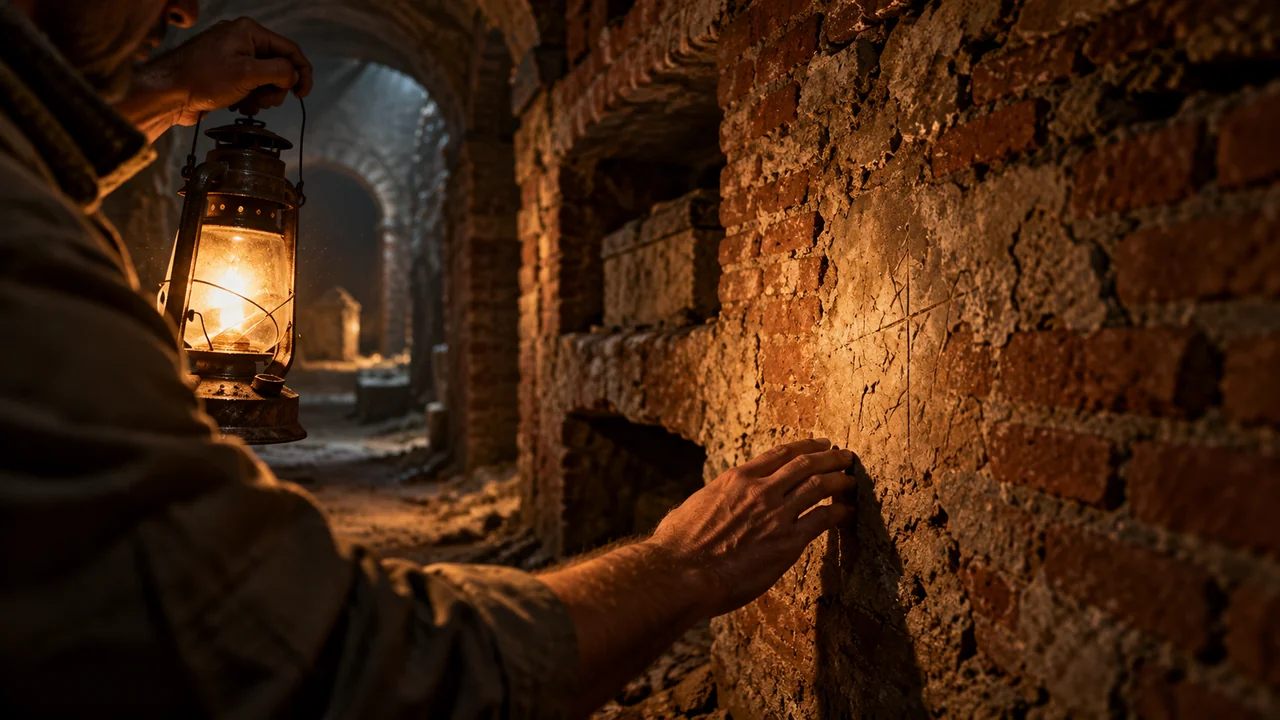
To step into the Catacombs of Domitilla is to descend into a subterranean labyrinth that defies human imagination.
Carved across four overlapping vertical subterranean tiers reaching depths of over eighty feet (25 meters) beneath the surface, the Domitilla network spans:
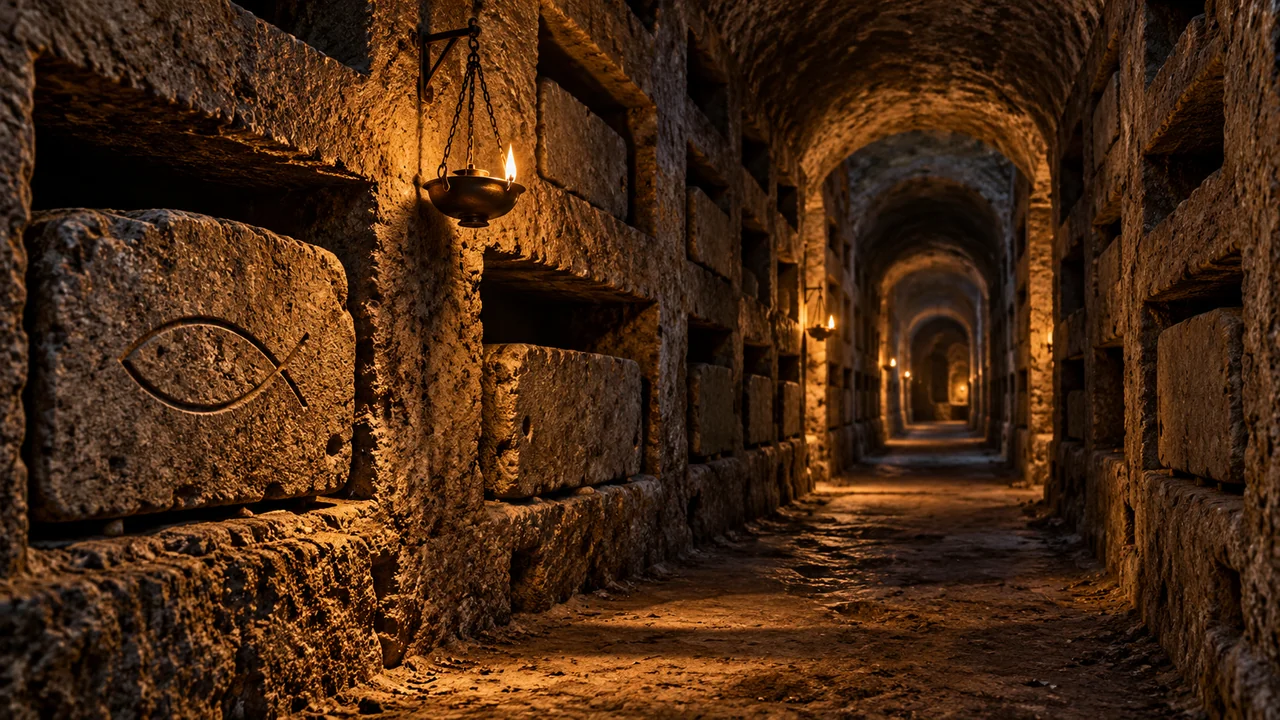
- 17 kilometers (over 10.5 miles) of interconnected subterranean galleries and corridors.
- More than 150,000 individual burial chambers, dug continuously between the late 1st century and the 5th century AD.
[Subterranean Engineering: The 4-Tier Catacomb Architecture]
┌────────────────────────────────────────────────────────┐
│ Surface Ground Level: Ancient Olive Groves & Vineyards │
├────────────────────────────────────────────────────────┤
│ Level 1 (-5 to -8 m): 1st-Century Hypogea of the Flavians│
│   (Earliest pagan-Christian transition burial galleries)│
├────────────────────────────────────────────────────────┤
│ Level 2 (-10 to -15 m): 2nd-to-3rd Century Corridors   │
│   (Thousands of loculi; Christian fish & anchor symbols)│
├────────────────────────────────────────────────────────┤
│ Level 3 (-18 to -22 m): Monumental 4th-Century Frescoes│
│   (The Baker's Cubiculum, Christ & the Apostles)       │
├────────────────────────────────────────────────────────┤
│ Level 4 (-25 m): Deepest Volcanic Bedrock Aquifer      │
└────────────────────────────────────────────────────────┘
The geological foundation made this monumental engineering possible: Rome sits atop deep strata of volcanic pozzolana and tufa (tufa lithoide and tufa granulare) deposited by the extinct Alban Hills volcanoes.
A specialized guild of early Christian subterranean miners, known in Latin as fossores (literally, "the diggers"), carved the narrow galleries (typically barely three feet wide and seven feet high) using simple iron picks and oil lamps.
The fossores carved three primary categories of tombs:
- Loculi: Simple rectangular burial niches hollowed into the vertical rock walls of the corridors. The body of the deceased was wrapped in a simple white linen shroud, placed into the rock cavity, and hermetically sealed with terracotta tiles or marble slabs inscribed with lime mortar.
- Arcosolia: Semicircular arched burial niches carved into the walls, typically reserved for wealthier families or celebrated martyrs.
- Cubicula: Underground square chambers serving as family crypts, frequently decorated with exquisite frescoes depicting biblical themes.
The Secret Visual Lexicon: Anchors, Ichthys, and the Good Shepherd
Walking through the subterranean tunnels of Domitilla in the soft flicker of an olive oil lamp, one is struck by the absence of the macabre.
While Roman pagan tombstones were marked with despairing fatalism—such as the common Roman epitaph: Non fui, fui, non sum, non curo ("I was not; I was; I am not; I do not care")—the Christian catacomb inscriptions overflow with radiant, eternal hope:
[The Sacred Cryptographic Lexicon of the Catacombs]
       │
       ├──► 1. The Anchor (Crux Dissimulata):
       │         └── Hebrews 6:19 ("Hope as an anchor for the soul"); secret cross
       │
       ├──► 2. The Fish (ΙΧΘΥΣ - Ichthys):
       │         └── Iēsoûs Christós, Theoû Hyiós, Sōtḗr (Jesus Christ, Son of God, Savior)
       │
       ├──► 3. The Good Shepherd (Pastor Bonus):
       │         └── Young, beardless shepherd carrying lost sheep across his shoulders
       │
       └──► 4. The Chi-Rho (☧):
                 └── Superimposed Greek letters Chi (X) and Rho (P) for Christ
- The Anchor (Spes): The earliest Christian symbol carved into the tufa mortar in Domitilla was the nautical anchor. Rooted in Hebrews 6:19 ("We have this hope as an anchor for the soul, firm and secure"), the anchor served as a disguised cross (crux dissimulata) during eras of violent imperial persecution, allowing Christians to secretly mark their graves with the shape of the cross before pagan cemetery inspectors.
- The Fish (Ichthys): The Greek word for fish, ΙΧΘΥΣ, was an ingenious cryptographic acronym formulated by 1st-century believers: $$\mathbf{I} \text{ (Iēsoûs / Jesus)} \quad \mathbf{X} \text{ (Christós / Christ)} \quad \mathbf{\Theta} \text{ (Theoû / of God)} \quad \mathbf{Y} \text{ (Hyiós / Son)} \quad \mathbf{\Sigma} \text{ (Sōtḗr / Savior)}$$ To etch a fish upon a loculus slab was to declare an uncompromising confession of faith in the divine identity and resurrection of Jesus Christ.
- The Good Shepherd (Pastor Bonus): In dozens of frescoes throughout Domitilla, Christ is never depicted as an imperial Caesar crowned in gold; He is portrayed as a youthful, compassionate Galilean shepherd dressed in a short tunic, carrying a rescued, injured sheep across his shoulders (Luke 15:4–6; John 10:11).
- The Dove with the Olive Branch: Symbolizing the human soul arriving safely in the harbor of eternal peace (In Pace), released from the stormy waters of worldly tribulation.
Comparative Table: The Major Subterranean Catacombs of Imperial Rome
| Catacomb Complex | Geographical Location | Historical Patron / Foundation | Estimated Burials | Notable Archaeological Treasures |
|---|---|---|---|---|
| Catacombs of Domitilla | Via Ardeatina | Flavia Domitilla (Niece of Domitian, 95 AD) | 150,000+ | 17 km network; Basilica of Nereus & Achilleus; Baker's Fresco |
| Catacombs of Priscilla | Via Salaria | Acilius Glabrio & Priscilla family (2nd Cent.) | ~40,000 | Oldest known fresco of Virgin & Child; Greek Chapel |
| Catacombs of Saint Callixtus | Via Appia Antica | Pope Zephyrinus & Deacon Callixtus (c. 199 AD) | ~500,000 | "Crypt of the Popes" (9 popes buried); Crypt of St. Cecilia |
| Catacombs of Saint Sebastian | Via Appia Antica | Ancient Ad Catacumbas tufa quarry | ~100,000 | Temporary hiding place of Peter & Paul's relics (Platonia) |
The 2017 3D Laser Discovery: The Frescoes of the Imperial Grain Bakers
For centuries, many of the deepest, most elaborate burial chambers in the Catacombs of Domitilla were completely obscured beneath centuries of thick black soot, mineral salts, and organic grime deposited by ancient oil lamps, moisture, and early torches.
In June 2017, a monumental scientific breakthrough occurred.
The Pontifical Commission for Sacred Archaeology, in collaboration with laser physics specialists from the Austrian Academy of Sciences, deployed advanced high-precision 3D terrestrial laser-scanning and white laser-cleaning technology (laser ablation) to the subterranean chambers of Domitilla.
By carefully tuning the laser wavelength, conservators stripped away centuries of black grime without harming a single microscopic particle of ancient Roman paint underneath:
[2017 Laser Ablation Restoration: The Baker's Cubiculum]
       │
       ▼ (Centuries of black soot removed to reveal 4th-Century Frescoes)
[The Full Commercial Cycle of Imperial Grain (Annona)]
       │
       ├──► 1. Massive Alexandrian merchant ship arriving at Portus (Ostia)
       │
       ├──► 2. Wheat bags unloaded onto Tiber river barges
       │
       ├──► 3. Millstones and baking ovens supervised by imperial grain master
       │
       └──► 4. The Celestial Climax: Christ Enthroned Among the Apostles
                 └── The baker kneels before Christ, surrendering his earthly trade
The result was the breathtaking restoration of the Cubiculum of the Bakers (Cubicolo dei Fornai), an elite family crypt belonging to an imperial official of the Annona (the Roman grain supply ministry that fed millions in the capital):
- The frescoes depict the entire commercial journey of wheat from Alexandria, Egypt, to Rome.
- But instead of concluding with tribute to Emperor Constantine or pagan deities, the fresco culminates in an awe-inspiring celestial scene: Jesus Christ seated on an imperial magistrate's curule chair, surrounded by the twelve apostles, with the Christian grain merchant standing humbly before his Lord to receive an eternal crown.
The message was unmistakable: even high-ranking Roman imperial ministers who directed the empire's food supply recognized that true, eternal bread (the Bread of Life) was found only in Jesus of Nazareth.
The Praetorian Martyrs: The Subterranean Basilica of Nereus and Achilleus
Near the heart of the Domitilla catacomb complex stands a unique architectural wonder: the Semi-Subterranean Basilica of Saints Nereus and Achilleus, constructed in approximately 390 AD under Pope Siricius.
Built directly into the subterranean bedrock by excavating surrounding tomb galleries, this three-aisled basilica was erected over the graves of two celebrated imperial soldiers: Nereus and Achilleus.
According to a famous 4th-century marble inscription composed by Pope Damasus I (discovered intact inside the basilica during 19th-century excavations by archaeologist Giovanni Battista de Rossi):
"Nereus and Achilleus the martyrs had enrolled themselves in the army and were performing their cruel service, obeying the tyrannical commands of the magistrate... Suddenly, a miracle of faith! They throw down their weapons, they repent, they rejoice to leave the bloody camp of the tyrant! They confess the name of Christ, welcoming with joy the glory of his triumph. Believe, from these words, what great things the glory of Christ can accomplish!"
[The Transformation of the Praetorian Guards]
       │
       ▼ (Imperial Execution Squad for Emperor Diocletian)
[Encounter the Unshakeable Faith of Condemned Christians]
       │
       ├──► Dramatic Decision: Throw down their shields, gladii, and armor
       │
       ├──► Public Confession: "We too are soldiers of Jesus Christ!"
       │
       └──► Immediate Sentence: Decapitated on the Via Ardeatina
                 └── Buried in Domitilla's cemetery; basilica built over their tombs
Nereus and Achilleus were elite Praetorian guards trained to execute state enemies without mercy. Yet when commanded to torture and slaughter peaceful Christian families during the Diocletianic persecutions, the moral power of the martyrs broke their imperial indoctrination. They cast down their weapons, proclaimed Christ as their only Lord, and were instantly decapitated on the Via Ardeatina.
A surviving 4th-century marble column inside the excavated basilica depicts this martyrdom in stone: Achilleus bound with hands behind his back, as an executioner plunges a gladius into his neck, with a martyr's triumphal wreath carved directly above his head.
The Triumph of Hope Over Imperial Tyranny
For nearly three centuries, the emperors of Rome believed they could extinguish the Christian church through systemic persecution, confiscation of property, and mass execution in the arenas.
Yet while emperors built vanity monuments on the surface of Rome that crumbled into dust, the early Christians went underground. In the quiet, subterranean darkness of the Catacombs of Domitilla, they carved an eternal city:
- Here, the patrician noblewoman (Domitilla) lay beside the freed slave.
- Here, the imperial grain baker was buried beside the illiterate washerwoman.
- Here, the Roman Praetorian guard who once executed believers was buried beside the very martyrs whose courage had led him to Christ.
In Christ, every worldly barrier of class, race, gender, and imperial status was utterly obliterated.
The Catacombs of Domitilla were not places of morbid death; they were sacred dormitories—the word "cemetery" (koimētērion) literally means "sleeping place" in Greek—where one hundred and fifty thousand souls rested in the quiet, unshakeable confidence that when the trumpet of God sounds, the dead in Christ shall rise first.
Uncover the Untold Historical Dossiers
The Catacombs of Domitilla represent the beating heart of early Christian archaeological history. To explore high-resolution 3D laser-scan photographic plates, epigraphic transcriptions of ancient catacomb inscriptions, and architectural blueprints of the subterranean galleries:
👉 Download Volume I: The Twelve Apostles – Historical Dossier ($2.99)
Features the complete texts of early Roman martyrologies, full-color diagrams of the Baker's Cubiculum frescoes, and comprehensive guides to Rome's subterranean sacred geography.
Frequently Asked Questions
What are the Catacombs of Domitilla?
The Catacombs of Domitilla are an ancient subterranean Christian cemetery located along the Via Ardeatina in Rome, Italy. Spanning over 17 kilometers across four underground tiers, it contains more than 150,000 burial niches dating from the late 1st to the 5th century AD, making it one of the largest and best-preserved catacombs in the world.
Who was Flavia Domitilla?
Flavia Domitilla was a Roman noblewoman belonging to the imperial Flavian dynasty, the granddaughter of Emperor Vespasian and niece of Emperor Domitian. She and her husband, Consul Titus Flavius Clemens, converted to Christianity and were condemned for "atheism" in 95 AD. Before being banished to the island of Pandateria, Domitilla donated her private suburban estate on the Via Ardeatina for Christian burials.
Why did early Christians use symbols like the fish and anchor?
During eras of Roman imperial persecution, early Christians used symbols as a secret visual code. The anchor (spes) served as a disguised cross (Hebrews 6:19), while the fish (Ichthys) was a Greek cryptographic acronym for "Jesus Christ, Son of God, Savior." These symbols allowed believers to identify Christian graves without alerting pagan authorities.
What did the 2017 laser restoration discover in the Catacombs of Domitilla?
In 2017, the Pontifical Commission for Sacred Archaeology utilized advanced white-light laser cleaning to remove centuries of black soot and algae from the "Cubiculum of the Bakers." The laser revealed vibrant 4th-century frescoes depicting the entire commercial grain supply of Rome and a dramatic celestial scene of Jesus Christ enthroned among the twelve apostles.
Frequently Asked Questions
What are the Catacombs of Domitilla?
The Catacombs of Domitilla are an ancient subterranean Christian cemetery located along the Via Ardeatina in Rome, Italy. Spanning over 17 kilometers across four underground tiers, it contains more than 150,000 burial niches dating from the late 1st to the 5th century AD, making it one of the largest and best-preserved catacombs in the world.
Who was Flavia Domitilla?
Flavia Domitilla was a Roman noblewoman belonging to the imperial Flavian dynasty, the granddaughter of Emperor Vespasian and niece of Emperor Domitian. She and her husband, Consul Titus Flavius Clemens, converted to Christianity and were condemned for "atheism" in 95 AD. Before being banished to the island of Pandateria, Domitilla donated her private suburban estate on the Via Ardeatina for Christian burials.
Why did early Christians use symbols like the fish and anchor?
During eras of Roman imperial persecution, early Christians used symbols as a secret visual code. The anchor (spes) served as a disguised cross (Hebrews 6:19), while the fish (Ichthys) was a Greek cryptographic acronym for "Jesus Christ, Son of God, Savior." These symbols allowed believers to identify Christian graves without alerting pagan authorities.
What did the 2017 laser restoration discover in the Catacombs of Domitilla?
In 2017, the Pontifical Commission for Sacred Archaeology utilized advanced white-light laser cleaning to remove centuries of black soot and algae from the "Cubiculum of the Bakers." The laser revealed vibrant 4th-century frescoes depicting the entire commercial grain supply of Rome and a dramatic celestial scene of Jesus Christ enthroned among the twelve apostles.
Related Research Dossiers
View all 120 articles →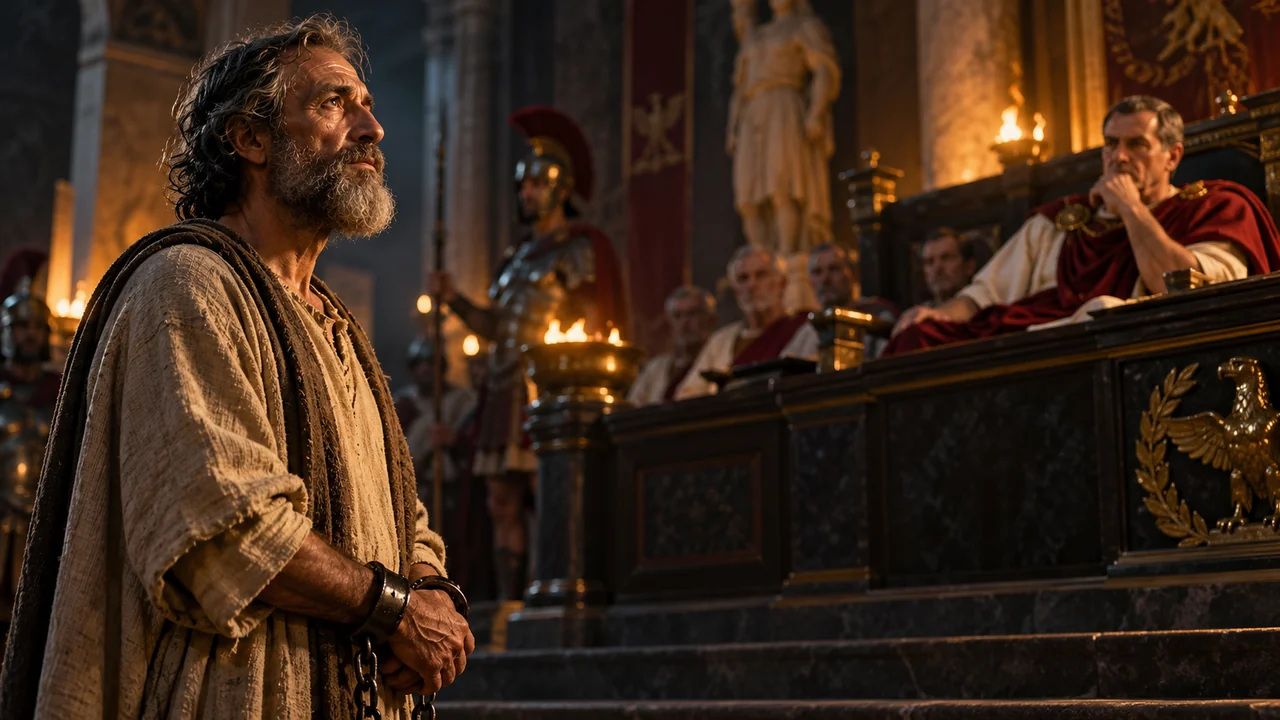
Why None of the Twelve Recanted: The Psychological Proof of the Resurrected Eyewitnesses
The Forgotten Female Apostles and Martyrs: What Inscriptions in Rome Reveal About Junia and Thecla