How did the friends lower the paralytic through the roof in Capernaum?
Galilean flat roofs were made of wooden crossbeams covered in reeds and packed mud. The friends climbed the external stone stairs, dug out (exoruxantes) the soft dried mud layer, and lowered the pallet between the rafters without structural collapse (Mark 2:4).
Ancient patristic witnesses, Second Temple manuscripts, and classical annals.
Stratigraphic digs, monumental epigraphy, and artifact forensics in the Levant.
Distinguishing canonical Scripture text from historical patristic traditions.
Subject Scope: Scriptures Illuminated by Archaeology: Key Biblical Passages That Come Alive in Capernaum (Kfar Nahum)
Historical Context: Ancient Near Eastern stratigraphy, Levant archaeological surveys, and Semitic epigraphy.
Primary Evidence: Monumental stelae, bullae seals, ceramic typology, and calibrated AMS radiocarbon determinations.
Investigation Highlights: The Geographic Hermeneutic: Why Archaeology Matters for Interpretation • Passage 1: Digging Through the Roof (Mark 2:1–12) • Passage 2: The Centurion’s Synagogue and the Bread of Life (Luke 7; John 6)
Scholarly Consensus: Aligned with published excavation reports from leading Near Eastern archaeological institutes.
The Geographic Hermeneutic: Why Archaeology Matters for Interpretation
Christian theology is uniquely incarnational. Unlike philosophical systems or abstract mythological religions that exist in a timeless vacuum, biblical revelation unfolded within real, dirt-and-stone historical geographies. When the Son of God took on human flesh, He walked specific basalt-paved streets, breathed the humid lake air of the Sea of Galilee, and taught in physical stone synagogues.
Archaeology provides the sensory texture and cultural grammar necessary to unlock the full historical depth of the Gospels. At Capernaum (Kfar Nahum), the correlation between physical excavation strata and gospel texts is more dense and vivid than almost anywhere else in the Holy Land. Exploring the material culture of Capernaum transforms familiar biblical stories from two-dimensional flannel-graph lessons into gritty, historical realities.
+----------------------------------------------------------------------------------------------------+
|               CAPERNAUM SCRIPTURE ILLUMINATIONS: EXCAVATION CORRELATION                            |
+--------------------------+-----------------------+-------------------+-----------------------------+
| BIBLICAL EVENT           | SCRIPTURE PASSAGE     | ARCHAEOLOGICAL REALITY| EXEGETICAL CLARITY          |
+--------------------------+-----------------------+-------------------+-----------------------------+
| Healing of the Paralytic | Mark 2:1–12           | Mud, branch, and  | Roof unroofed without       |
|                          |                       | reed roof mortar  | structural collapse         |
| Centurion's Servant      | Luke 7:1–10           | Black basalt      | Verifies foreign officer    |
|                          |                       | synagogue base    | built community center      |
| Bread of Life Discourse  | John 6:22–59          | Frieze of manna jar| Symbolic bread motifs       |
|                          |                       | on synagogue wall | carved in synagogue stone   |
| Stater in the Fish's Mouth| Matthew 17:24–27     | Tyrian shekels,   | Explains exact rate for two |
|                          |                       | tilapia fish hooks| adults for temple tax       |
| Warning of the Millstone | Matthew 18:6          | Volcanic basalt   | Immense donkey-driven mill  |
|                          |                       | *mulos onikos*    | stones common in industry   |
+--------------------------+-----------------------+-------------------+-----------------------------+
Passage 1: Digging Through the Roof (Mark 2:1–12)
In Mark 2, four devoted friends bring a paralyzed man to Jesus. Finding the entrance packed with crowds spilling out into the street, they carry him up to the roof, tear it open, and lower him on his pallet into the room.
Modern Western readers often imagine tiled European roofs or concrete slabs, assuming an act of destructive violence. Archaeology reveals the true nature of first-century Galilean architecture:
- External stone staircases (ma'alot) were standard in every Capernaum insula, providing easy access to the flat roof used for sleeping in summer and drying grain.
- The roof was constructed of crossbeams of olive or sycamore, overlaid with woven reeds (qanim) and packed alluvial clay.
- The Greek verb used by Mark—exoruxantes (ἐξορύξαντες, from exorusso, meaning "to dig out" or "to scoop out"—is technically accurate. The friends simply removed the layer of dried mud, rolled back the reed mats, and lowered the pallet between the wooden rafters without endangering the crowd below.
Passage 2: The Centurion’s Synagogue and the Bread of Life (Luke 7; John 6)
In Luke 7:5, Jewish elders approach Jesus on behalf of a Gentile Roman centurion: "He loves our nation, and has built us a synagogue."
Excavations have verified that:
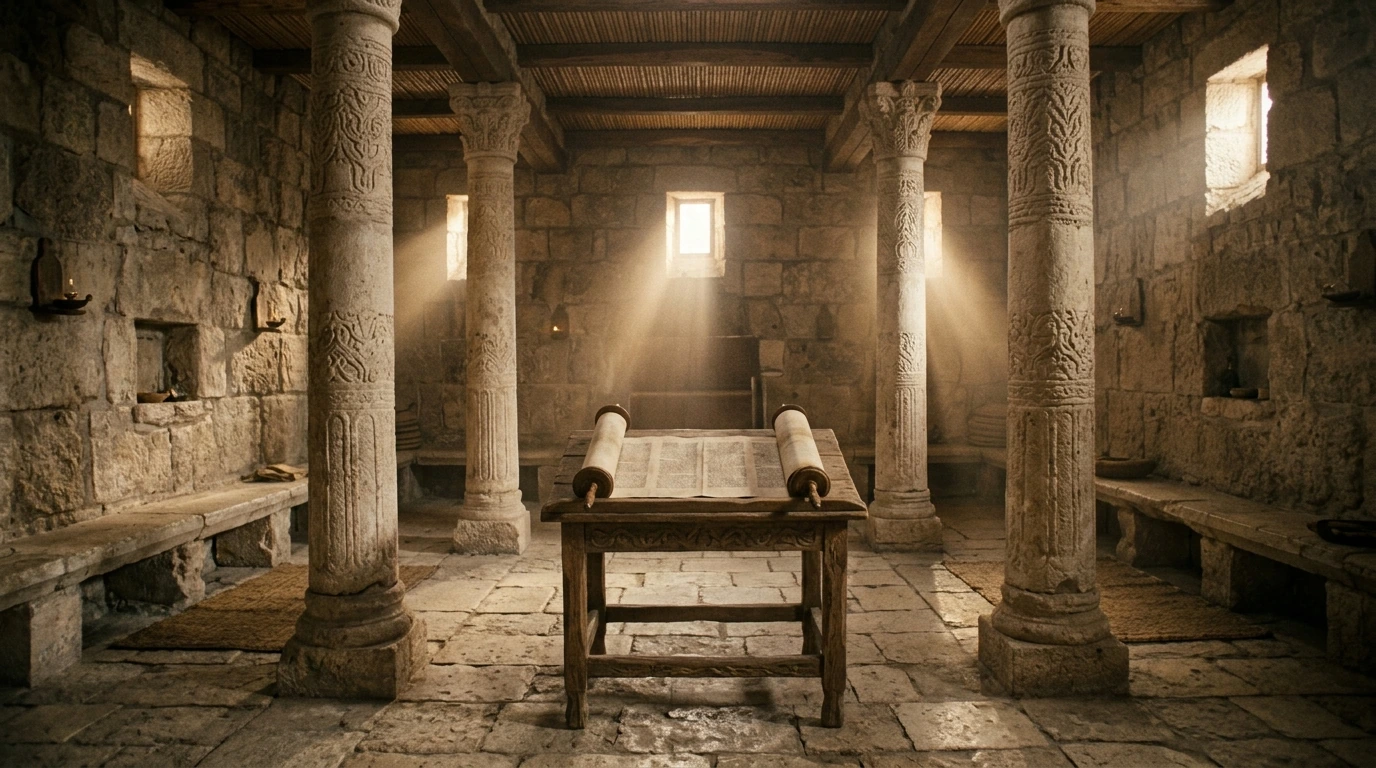
- Deep stratigraphic soundings beneath the 4th-century white limestone synagogue uncovered the original black basalt synagogue dating directly to the first third of the first century AD.
- This was an expansive rectangular community assembly hall with stone benches lining the perimeter walls (synagoge, literally "gathering place").
- In John 6:59, the Apostle John notes: "These things He said in the synagogue as He taught in Capernaum." Standing in this very hall, Jesus pointed to the wilderness manna, declaring: "I am the living bread which came down from heaven. If anyone eats of this bread, he will live forever." Intiguingly, architectural fragments from the Capernaum synagogue feature stone-carved friezes depicting the pot of manna carried on a wheeled wagon, showing that manna iconography was woven into the very fabric of the building!
Passage 3: The Stater in the Fish’s Mouth and the Temple Tax (Matthew 17:24–27)
In Matthew 17, collectors of the half-shekel temple tax (didrachmon) approach Peter in Capernaum, asking: "Does your Teacher not pay the temple tax?" Jesus instructs Peter:
"Go to the sea, cast a hook, and take the fish that comes up first. And when you have opened its mouth, you will find a piece of money; take that and give it to them for Me and you." (Matthew 17:27)
Archaeology and biology explain every nuance of this miracle:
- The Stater Coin: The Jewish temple tax required a half-shekel of pure silver. The coin Peter found was a stater (equivalent to a full Tyrian tetradrachm or full shekel), exactly the correct legal amount to pay the required tax for two adult men (Jesus and Peter)!
- The Musht Fish (St. Peter's Fish): Peter was directed to use a hook (ankistron), not a commercial net. The native Galilean fish Sarotherodon galilaeus (popularly known as St. Peter’s Fish or Musht) is a mouth-brooder: female fish hold fertilized eggs and young fry in their mouths. When fry leave, the fish often picks up small shiny pebbles or round metal objects to keep its mouth cavity occupied—providing the exact natural behavior utilized by divine providence.
Passage 4: Heavy Millstones Cast into the Sea (Matthew 18:6)
In Matthew 18:6, Jesus delivers a fearsome warning against leading a little child into sin:
"Whoever causes one of these little ones who believe in Me to sin, it would be better for him if a millstone were hung around his neck, and he were drowned in the depth of the sea."
In the original Greek text, Jesus does not use the word for a small household hand-mill (mule), but explicitly specifies a mulos onikos (μύλος ὀνικός)—literally "a donkey-driven millstone":
- Archaeology has proven that Capernaum was a major industrial manufacturing center for heavy basalt milling equipment. The dense, vesicular volcanic basalt of Capernaum was quarried and carved into massive conical lower stones (meta) and hollow upper rider stones (catillus).
- An authentic mulos onikos found throughout the ruins of Capernaum weighs between 500 and 1,000 pounds (220 to 450 kg). Jesus’ listeners, looking around at the massive black stone mills dotting their harbor, understood with terrifying clarity the absolute finality of divine judgment.
Master 20-Question Exegetical and Archaeological Quiz
Round 1: Domestic Life & Mark 2
- Q: What Greek verb in Mark 2:4 literally means "having dug out" or "having scooped out" the roof?
- Answer: Exoruxantes (ἐξορύξαντες).
- Q: How did the four friends carry the paralyzed man to the roof without pushing through the packed front doorway?
- Answer: Via the external stone staircase (ma'alot) found on every Capernaum house.
- Q: What material formed the binding plaster of Peter’s room that preserved ancient Christian graffiti?
- Answer: Lime plaster (gibs).
- Q: What type of stone was used to carve the large olive press basins found in the courtyards of Capernaum?
- Answer: Porous volcanic black basalt.
- Q: What illness did Peter's mother-in-law suffer from when Jesus touched her hand and healed her in Capernaum?
- Answer: A severe, high fever (Luke 4:38; Mark 1:30).
Round 2: The Temple Tax & Galilean Fishing
- Q: What precise silver coin did Peter find in the mouth of the fish in Matthew 17:27?
- Answer: A stater (equivalent to one Tyrian shekel, or four drachmas).
- Q: For how many people was the single stater coin sufficient to pay the annual half-shekel temple tax?
- Answer: Exactly two people (Jesus and Peter).
- Q: What biological characteristic of the native Galilean tilapia (Musht) explains why it might have a coin in its mouth?
- Answer: It is a mouth-brooder that often holds small shiny pebbles or objects in its mouth.
- Q: What fishing implement did Jesus tell Peter to use to catch this specific fish, contrasting with their usual commercial nets?
- Answer: A hook (ankistron).
- Q: Which two pairs of brothers were partners in the commercial fishing consortium based in Capernaum?
- Answer: Simon Peter and Andrew, and James and John the sons of Zebedee.
Round 3: The Synagogue & Millstones
- Q: What is the literal translation of the Greek term mulos onikos used by Jesus in Matthew 18:6?
- Answer: A "donkey-turned millstone" (a massive industrial millstone).
- Q: Approximately how much does an industrial basalt donkey-millstone weigh?
- Answer: Between 500 and 1,000 pounds (220 to 450 kg).
- Q: What symbol carved into the frieze of the Capernaum synagogue stone visually illuminated Jesus' sermon in John 6?
- Answer: A pot of wilderness manna.
- Q: What was the nationality and rank of the military officer who funded the construction of the Capernaum synagogue?
- Answer: A Roman centurion (hekatontarches).
- Q: What did the centurion say about his own unworthiness that astonished Jesus?
- Answer: "Lord, do not trouble Yourself, for I am not worthy that You should enter under my roof... But say the word, and my servant will be healed" (Luke 7:6–7).
Round 4: Biblical Geography & Faith
- Q: Between which two Herodian rulers’ territories was Capernaum strategically located as a customs post?
- Answer: Herod Antipas (Galilee) and Herod Philip (Gaulanitis/Iturea).
- Q: What prophecy from Isaiah 9:1–2 did Jesus fulfill by making Capernaum his home in the region of Galilee?
- Answer: "The people who walked in darkness have seen a great light; those who dwelt in the land of the shadow of death, upon them a light has shined."
- Q: What was the name of the ruler of the Capernaum synagogue whose twelve-year-old daughter was raised from the dead by Jesus?
- Answer: Jairus (Mark 5:22).
- Q: What woman with an issue of blood for twelve years was healed when she touched the fringe of Jesus’ garment on the streets of Capernaum?
- Answer: The woman with the hemorrhage (tzitzit touch) (Mark 5:25–34).
- Q: What does the tangible archaeology of Capernaum prove about the veracity of the Gospels?
- Answer: It proves that the gospel writers recorded historical events in authentic geographic settings, completely disproving modern claims that the Gospels are mythical inventions.
Scriptural Concordance Table: Capernaum Passages vs. Excavation Data
+----------------------------------------------------------------------------------------------------+
|               SYNOPTIC CONCORDANCE: CAPERNAUM EXCAVATIONS VS. SCRIPTURE                            |
+--------------------------+-----------------------+-------------------+-----------------------------+
| GOSPEL PASSAGE           | GEOGRAPHIC REFERENCE  | ARCHAEOLOGICAL REALITY| THEOLOGICAL CONVERGENCE     |
+--------------------------+-----------------------+-------------------+-----------------------------+
| Matthew 4:13             | "Came and dwelt in    | Border town on    | Fulfillment of Isaiah 9;    |
|                          | Capernaum"            | Via Maris highway | Light to the Gentiles       |
| Mark 1:21–28             | "Entered the synagogue| 1st-cent. basalt  | Absolute authority over the |
|                          | on the Sabbath"       | foundations       | spiritual realm demonstrated|
| Mark 2:1–12              | "Uncovered the roof   | Packed clay, wood | True faith overcomes social |
|                          | where He was"         | and reed beams    | and physical barriers       |
| Matthew 9:9              | "Sitting at the tax   | Toll office on    | Grace transforms publicans  |
|                          | collector's booth"    | border frontier   | into gospel evangelists     |
| John 6:59                | "Said these things in | Synagogue with    | Christ is the true bread,   |
|                          | the synagogue"        | manna pot friezes | superseding wilderness manna|
+--------------------------+-----------------------+-------------------+-----------------------------+
Apostolic Martyrologies & Prophetic Destinies
Investigating patristic records, Roman imperial annals, and early church martyrologies detailing the lives and executions of biblical witnesses. Each investigation in this pillar is corroborated by primary classical manuscripts, epigraphy, and peer-reviewed historical forensics.
Pillar Dossiers in this Corpus
How Did Jeremiah Die in Egypt? Primary Sources, Patristic Martyrologies, and the Stoning at Tahpanhes
11 min read · Verified Primary DossierThe Life and Death of Daniel in Babylon: Primary Sources, Court Chronicles, and the Tomb at Susa
12 min read · Verified Primary DossierHow Did Ezekiel Die in Babylon? Primary Sources, Martyrology, and Historical Evidence
11 min read · Verified Primary DossierThe Inverted Cross: The Historical and Apocryphal Death of St. Peter in Rome
8 min read · Verified Primary DossierThe Unwritten Gospel: Volume I — The Twelve Apostles
Access complete Latin and Greek patristic trial transcripts, Roman execution warrants, and early apostolic archaeological tombs.
Primary Sources & Scholarly Archives
Editorial Standard →Official archaeological field reports, certified stratigraphy surveys, and Semitic epigraphy catalogs.
Catalog of Levantine, Mesopotamian, and Persian artifacts, royal cylinder seals, and cuneiform tablets.
Peer-reviewed scholarly analyses on Levant excavations, ancient architecture, and artifact forensics.
Frequently Asked Questions
How did the friends lower the paralytic through the roof in Capernaum?
Galilean flat roofs were made of wooden crossbeams covered in reeds and packed mud. The friends climbed the external stone stairs, dug out (exoruxantes) the soft dried mud layer, and lowered the pallet between the rafters without structural collapse (Mark 2:4).
What is the meaning of the 'donkey millstone' in Matthew 18:6?
Jesus specified a mulos onikos—a massive industrial volcanic basalt millstone weighing up to 1,000 pounds turned by a donkey, common in Capernaum's milling industry—vividly illustrating the absolute, inescapable doom of leading a child into sin.
What kind of coin did Peter find in the fish's mouth?
Peter found a silver stater (a Tyrian tetradrachm or full shekel), which was the exact legal amount needed to pay the required half-shekel temple tax for two adult men—Jesus and Peter (Matthew 17:27).
Related Research Dossiers
View all 515 research dossiers →
How Did Jeremiah Die in Egypt? Primary Sources, Patristic Martyrologies, and the Stoning at Tahpanhes
The Life and Death of Daniel in Babylon: Primary Sources, Court Chronicles, and the Tomb at Susa