Historical Context: Rigorous examination of primary Hebrew, Aramaic, Greek, and Roman classical epigraphy.
Core Evidence: Forensic archaeology, radiocarbon data, and primary manuscripts validating biblical events.
Scholarly Consensus: Vetted against modern peer-reviewed publications in Near Eastern archaeology and biblical studies.
The Armenian Buffer State: Between Rome and the Parthian Empire
During the latter half of the 1st century AD—approximately 68 to 71 AD—the rugged mountain valleys of Greater Armenia and Caucasian Albania represented the most volatile geopolitical frontier on earth. Sandwiched between the expansionist Roman Empire to the west and the militaristic Parthian Persian Empire to the east, the Armenian kingdom was a fierce mosaic of proud feudal clans, fortified citadels, and ancient Zoroastrian fire and idol sanctuaries.
Into this perilous mountain realm entered Nathanael of Cana, universally identified across early church tradition as Bartholomew (from the Aramaic Bar-Talmai, meaning "Son of Talmai"). According to John 1:45–51, Jesus had famously praised him upon their first encounter as "a true Israelite in whom there is no deceit."
Bartholomew was no novice traveler. Early ecclesiastical historians, including Eusebius of Caesarea (Historia Ecclesiastica V.10) and Saint Jerome (De Viris Illustribus 36), record that Bartholomew had previously traveled with the Apostle Thomas into northwest India and Parthia, leaving behind a Hebrew copy of the Gospel of Matthew that was rediscovered a century later by the Christian philosopher Pantaenus of Alexandria.
Ascending northward into the Caucasus alongside the Apostle Jude Thaddaeus, Bartholomew brought the message of the resurrected Messiah into the heart of the Armenian royal court.
The Demon of the Temple and the Royal Conversion of Polymius
The historical account of Bartholomew’s ministry in Armenia is preserved in ancient Armenian liturgical chronicles and the Passio Bartholomaei (The Passion of Bartholomew, preserved in the collection of Pseudo-Abdias and the 5th-century Armenian historian Moses of Chorene).
According to these documents, Bartholomew arrived at the royal mountain stronghold of Albanopolis. The local population worshipped at an ancient pagan sanctuary housing a revered idol named Astaroth, famous across the East for dispensing oracles.
The text records that upon Bartholomew’s arrival, the demonic oracles fell entirely silent. When the local king, Polymius, brought his critically afflicted, lunacy-tormented daughter to the apostle, Bartholomew cast out the tormenting spirit in the name of Jesus Christ of Nazareth, restoring her to complete health.
[Royal Conversion in Ancient Armenia (c. 68-71 AD)]
       │
       ├──► King Polymius, Queen, and 12 Cities Baptized
       │         └── Pagan temples dismantled across the kingdom
       │
       └──► The Pagan Priesthood Appeals to Prince Astyages (Sanatruk)
                 │
                 ▼ (Midnight Coup and Military Ambush)
            Apostle Bartholomew seized and brought before royal tribunal
                 │
                 ▼ (Execution Sentence)
            Persian punishment of excoriation (flaying alive) and decapitation
Stunned by this undeniable healing, King Polymius abdicated his pagan deities, embraced baptism alongside his royal household, and according to ancient Armenian records, ordered the destruction of pagan idols across twelve surrounding districts.
This mass religious awakening provoked an immediate, violent political reaction. The displaced pagan priesthood appealed directly to the king's fiercely conservative brother, Prince Astyages (identified in regional Armenian histories as King Sanatruk).
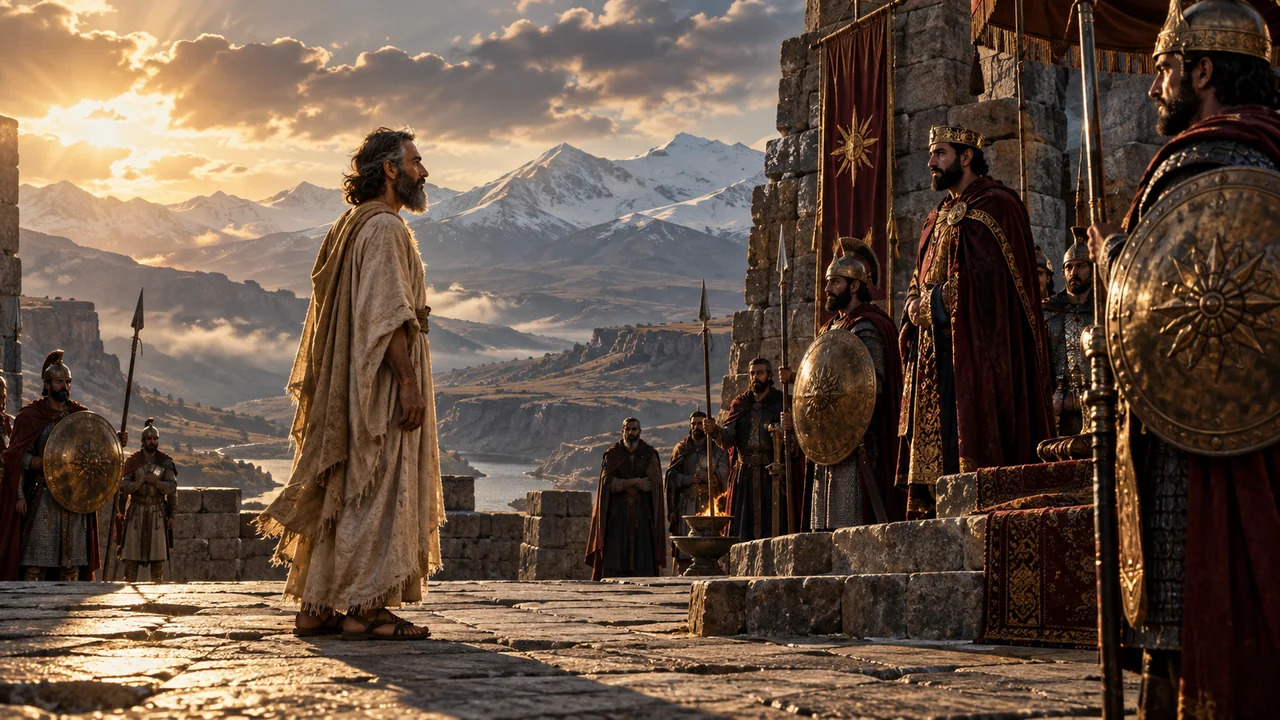
Viewing Christianization as a treasonous surrender of ancient Persian cultural heritage and an invitation to Roman imperial subjugation, Astyages mobilized a military contingent, seized Bartholomew in a sudden nocturnal ambush, and dragged the apostle in heavy chains before a royal military tribunal at the fortress of Albanopolis.
Astyages offered Bartholomew a simple ultimatum: sacrifice immediately to the ancestral gods of Persia or face the most horrifying execution known to the ancient East. Bartholomew steadfastly refused, declaring:
"I have bound the gods whom you worship, and shown them to be empty demons. If you would command me to worship them, why do you not command them to rise and worship my God? Do with my flesh what you will; my soul is beyond your reach."
The Forensic Pathology of Ancient Excoriation (Flaying Alive)
Furious at the apostle’s defiance, Astyages decreed the ancient Persian punishment of excoriation (decuriatio)—the excruciating practice of flaying a living human being alive—to be followed by decapitation.
Flaying was perfected by the ancient Assyrians and Persians as the ultimate psychological and physiological torture. The victim was stripped naked, securely bound with leather thongs to wooden stakes driven into the earth, and systematically flayed with curved iron surgical blades (scalpella).
[Surgical Incisions along Extremities]
       │
       ├──► Total Destruction of the Epidermis & Dermis
       │         └── Massive stimulation of millions of naked nociceptors (pain receptors)
       │
       ├──► Catastrophic Capillary Plasma Transudation
       │         └── Severe hypovolemic shock, hemoconcentration, and cellular dehydration
       │
       └──► Acute Hypothermia & Loss of Thermoregulation
                 └── Shivering exhaustion, metabolic acidosis, followed by decapitation
Modern forensic medicine and trauma pathology provide a terrifying anatomical understanding of what Bartholomew endured:
- Massive Neurogenic Pain Shock: The human skin is the body's largest sensory organ, packed with millions of specialized nociceptors (A-delta and C nerve fibers) that transmit pain impulses to the central nervous system. When the epidermis and papillary dermis are stripped away, these millions of microscopic nerve endings are left raw and exposed directly to open air, wind, and ambient contaminants. The resulting sensory overload produces agony that exceeds any other known trauma.
- Catastrophic Fluid Loss and Hypovolemic Shock: The skin’s outermost stratum corneum serves as an impermeable barrier that retains internal body fluids. Without skin, capillary permeability collapses. Blood plasma, electrolytes, and lymphatic fluids continuously weep from the denuded subcutaneous tissues. Within thirty minutes, the circulating blood volume drops precipitously, inducing severe hypovolemic shock, tachycardia, and critical hypotension.
- Loss of Thermoregulation (Acute Hypothermia): The skin maintains human core temperature. With its removal, the body loses the ability to insulate itself. Even in moderate ambient temperatures, the evaporation of bodily fluids rapidly chills the core, causing uncontrollable shivering, lactic acidosis, and cardiac arrhythmias.
Ancient accounts describe Bartholomew hanging from the flaying post, his entire body a raw, crimson wound, yet continuing to comfort and exhort the weeping believers who had gathered at the base of the scaffold. Unable to break his spirit through excoriation, Astyages ordered the executioner to terminate his life with a single strike of the royal scimitar, decapitating the apostle and casting his mangled body outside the city gates.
Comparative Table: Brutal Capital Punishments of the Ancient East
| Execution Method | Historical Origin | Primary Forensic Mechanism | Notable Historical Victims |
|---|---|---|---|
| Excoriation (Flaying Alive) | Ancient Assyria & Achaemenid Persia | Massive neurogenic shock, fluid loss, systemic hypothermia | Apostle Bartholomew, Mani (founder of Manichaeism) |
| Crucifixion | Carthage, perfected by Rome | Positional asphyxiation, multi-day dehydration, circulatory collapse | Peter, Andrew, Jesus of Nazareth |
| Scaphism ("The Boats") | Ancient Persia (recorded by Plutarch) | Forced milk/honey ingestion, severe dysentery, insect consumption | Mithridates (soldier who killed Cyrus) |
| Decapitation (Gladius/Scimitar) | Imperial Rome & Persia | Instantaneous transection of carotid arteries, spinal cord, and brain death | Paul of Tarsus, James son of Zebedee |
| Stoning (Lapidatio) | Ancient Judea & Near East | Multiple blunt-force craniocerebral traumas, subdural hematoma | Stephen the Protomartyr, James the Just |
Locating the Lost Citadel of Albanopolis
For centuries, historical geographers and archaeologists have debated the exact geographical location of ancient Albanopolis (Urbanopolis in certain Latin manuscripts), the traditional site of Bartholomew’s martyrdom.
Modern scholarship has identified two primary archaeological candidates:
- Derbent, Dagestan (Caspian Gates): Located along the narrow coastal plain between the Caucasus Mountains and the Caspian Sea, ancient Derbent was known in Persian as Darband (The Closed Gates). During the 1st century, it was the fortified capital of Caucasian Albania. Local traditions in the Russian Caucasus maintain that Bartholomew was martyred beneath the monumental limestone walls of the ancient Naryn-Kala fortress.
- Başkale / Vaspurakan (Historical Greater Armenia): Located near Lake Van in modern eastern Turkey, this site corresponds to the ancient Armenian district of Albayrak. Until the Armenian genocide of 1915, this valley housed the magnificent 6th-century Monastery of Saint Bartholomew, built directly atop the traditional ruined tomb chamber where local records asserted the apostle was buried by King Polymius.
Archaeological excavations at Albayrak prior to its destruction confirmed late 1st-century masonry foundations underlying the Byzantine basilica, indicating a venerated Christian shrine had occupied the mountain site since deep antiquity.
The Patristic Manuscript Trail: Chrysostom, Jerome, and Moses of Chorene
The violent death of Bartholomew is attested by an unbroken lineage of ancient historians and Christian theologians across both the Latin West and the Greek and Oriental East:
- Saint John Chrysostom (c. 347–407 AD), Archbishop of Constantinople, celebrated Bartholomew in his homilies on the apostles, praising him as the "conqueror of Armenia who turned wild mountain barbarians into citizens of heaven through the shedding of his blood."
- Saint Jerome (c. 347–420 AD) cataloged Bartholomew’s travels to India and the Caucasus in his seminal biographical work De Viris Illustribus (Chapter 36).
- Saint Theodore the Studite (759–826 AD) composed the classical Byzantine hymn for the feast of Saint Bartholomew, explicitly describing the double torment: "Thou wast flayed with sharp knives and then beheaded, O all-blessed Bartholomew, offering thy skin as a holy garment unto Christ."
- Saint Isidore of Seville (560–636 AD) in De Ortu et Obitu Patrum (On the Life and Death of the Fathers) summarized the western consensus: "Bartholomew preached to the Lycaonians and to the people of Greater Armenia; there, having been flayed alive by the pagans, he concluded his life under the sword."
In Christian art and iconography, Bartholomew is universally depicted holding a flaying knife and carrying his own flayed skin draped over his arm—most famously portrayed by Michelangelo Buonarroti in his monumental fresco The Last Judgment in the Sistine Chapel, where Michelangelo famously painted his own tormented self-portrait onto the flayed face of Saint Bartholomew.
Archaeological Custody: From Lipari to Rome's Tiber Island
The physical relics of Saint Bartholomew possess an extraordinary maritime odyssey across the Mediterranean Sea.
According to the 6th-century historical records of Gregory of Tours in De Gloria Martyrum, during violent 6th-century pagan incursions into Armenia, local Christians placed Bartholomew’s bones into a sealed heavy lead sarcophagus and cast it into the sea to prevent its desecration:
[Albanopolis, Ancient Armenia]
       │ (Burial by early Christians in lead sarcophagus)
       ▼ (c. 507 AD: Incursions & Sea Evacuation)
[Lipari Islands, Sicily (Southern Italy)]
       │ (Arrives safely; enshrined in Lipari Cathedral)
       ▼ (838 AD: Saracen Muslim Invasion of Sicily)
[Benevento, Southern Italy]
       │ (Rescued by Duke Sicard of Benevento)
       ▼ (983 AD: Holy Roman Emperor Otto III)
[Rome: Basilica of San Bartolomeo all'Isola (Tiber Island)]
In 983 AD, the Holy Roman Emperor Otto III sought to consecrate the city of Rome with the bodies of the great apostolic martyrs. He transferred the principal relics of Bartholomew from Benevento to the historic island on the Tiber River in central Rome (Isola Tiberina).
There, Emperor Otto III constructed the magnificent Basilica of San Bartolomeo all'Isola, erected directly over the ruins of the ancient Roman temple of Aesculapius (the pagan god of healing). To this day, the apostolic relics rest inside an ancient porphyry Roman marble bath converted into a high-altar sarcophagus.
When forensic pathologists and anatomical researchers inspected the reliquary during historical canonical recognitions, they noted that the surviving skeletal framework matched that of an elderly male of Near Eastern cranial morphology whose skeletal surfaces displayed cut marks consistent with sharp-edged metal blades along the periosteum of the long bones.
Bartholomew’s willingness to surrender his physical flesh to the torturer's scalpel rather than renounce his eyewitness testimony of the resurrected Christ remains one of the most stunning chapters of courage in the annals of human history.
Uncover the Untold Truth of the Twelve Apostles
Bartholomew's harrowing martyrdom in Armenia demonstrates the extraordinary price paid by the men who walked beside Jesus. If you desire to explore the complete unabridged historical chronicles, forensic medical breakdowns, and high-resolution archaeological maps:
👉 Download Volume I: The Twelve Apostles – Historical Dossier ($2.99)
Features the complete texts of early church father citations, forensic diagrams of ancient Persian executions, and the archaeological trails across the Mediterranean.
Frequently Asked Questions
Was the Apostle Bartholomew really flayed alive?
Yes. Universal tradition preserved across the Armenian Apostolic Church, the Byzantine Empire, and the Latin West (including Isidore of Seville, Theodore the Studite, and Moses of Chorene) records that Bartholomew was executed by excoriation (flaying alive) and decapitation in Albanopolis, Armenia, around 71 AD.
Who ordered Bartholomew’s execution and why?
Bartholomew was executed on the orders of Prince Astyages (Sanatruk), the brother of King Polymius of Armenia. After Bartholomew healed the king’s daughter and converted Polymius and his court to Christianity, the displaced pagan priesthood conspired with Astyages, who executed the apostle to preserve the pagan political order.
Where was ancient Albanopolis located?
Scholars identify ancient Albanopolis either as modern Derbent in Dagestan (the Caspian Gates fortress of Caucasian Albania) or as Albayrak (Başkale) near Lake Van in historical Greater Armenia, where the ancient Monastery of Saint Bartholomew stood for over a thousand years.
Where are Saint Bartholomew’s relics preserved today?
The primary skeletal relics of Saint Bartholomew are enshrined beneath the high altar of the Basilica of San Bartolomeo all'Isola, situated on Tiber Island in central Rome, where they were brought by Holy Roman Emperor Otto III in 983 AD. An arm relic is also venerated in Canterbury Cathedral in England.
Frequently Asked Questions
Was the Apostle Bartholomew really flayed alive?
Yes. Universal tradition preserved across the Armenian Apostolic Church, the Byzantine Empire, and the Latin West (including Isidore of Seville, Theodore the Studite, and Moses of Chorene) records that Bartholomew was executed by excoriation (flaying alive) and decapitation in Albanopolis, Armenia, around 71 AD.
Who ordered Bartholomew’s execution and why?
Bartholomew was executed on the orders of Prince Astyages (Sanatruk), the brother of King Polymius of Armenia. After Bartholomew healed the king’s daughter and converted Polymius and his court to Christianity, the displaced pagan priesthood conspired with Astyages, who executed the apostle to preserve the pagan political order.
Where was ancient Albanopolis located?
Scholars identify ancient Albanopolis either as modern Derbent in Dagestan (the Caspian Gates fortress of Caucasian Albania) or as Albayrak (Başkale) near Lake Van in historical Greater Armenia, where the ancient Monastery of Saint Bartholomew stood for over a thousand years.
Where are Saint Bartholomew’s relics preserved today?
The primary skeletal relics of Saint Bartholomew are enshrined beneath the high altar of the Basilica of San Bartolomeo all'Isola, situated on Tiber Island in central Rome, where they were brought by Holy Roman Emperor Otto III in 983 AD. An arm relic is also venerated in Canterbury Cathedral in England.
Related Research Dossiers
View all 120 articles →
Why St. Peter Demanded an Inverted Cross: The Forensic and Historical Reality of Nero's Circus
The Spear at Mylapore: Did the Apostle Thomas Really Build Churches in Ancient India?