Historical Context: Rigorous examination of primary Hebrew, Aramaic, Greek, and Roman classical epigraphy.
Core Evidence: Forensic archaeology, radiocarbon data, and primary manuscripts validating biblical events.
Scholarly Consensus: Vetted against modern peer-reviewed publications in Near Eastern archaeology and biblical studies.
Capernaum: The Town of Jesus
Matthew 4:13 records that Jesus left Nazareth and made Capernaum (Kfar Nahum, "Village of Nahum") his ministry headquarters along the northern shore of the Sea of Galilee.
For centuries, the precise location of Peter's house—where Jesus healed Peter's mother-in-law (Mark 1:29-31) and healed the paralytic lowered through the roof (Mark 2:1-12)—remained unknown. Excavations conducted by Franciscan archaeologists Fathers Virgilio Corbo and Stanislao Loffreda between 1968 and 1991 uncovered one of the most astonishing archaeological sites in biblical history.
The 1st-Century Basalt Insula Sacra
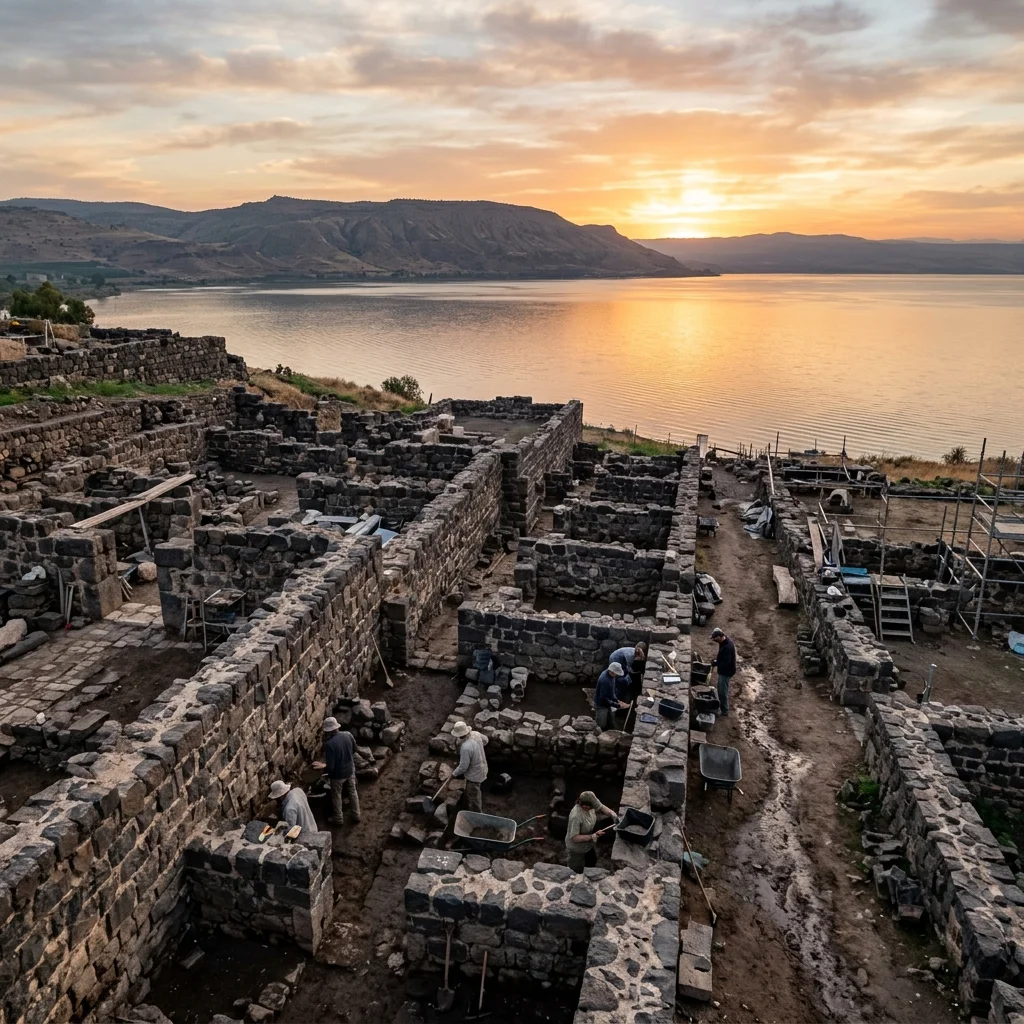
Excavating beneath ancient ruins, archaeologists uncovered a 1st-century AD residential neighborhood composed of coarse black basalt stone structures called insulae.
Among these ordinary domestic dwellings, one specific room standing in Insula I showed unique architectural transformations dating to the mid-1st century AD (c. 50–70 AD):
- Unlike surrounding domestic rooms filled with cooking hearths, loom weights, and storage jars, this central room had its walls plastered smooth.
- The floor was repeatedly re-paved with fresh coats of white plaster, and domestic pottery disappeared completely, replaced by oil lamps and communal storage vessels.
This indicates that as early as the mid-1st century, this private residence was converted from a family home into a public christian house-church (domus-ecclesia).
Plaster Graffiti: PETRUS and Early Christian Inscriptions
Archaeologists carefully peeled back 12 layers of ancient wall plaster inside this venerated room, discovering 131 Christian graffiti inscriptions scratched in Greek, Aramaic, Syriac, and Latin.
Epigraphers identified clear Christian symbols and words:
- CHRISTOS (Christ)
- KYRIE ELEISON (Lord have mercy)
- Clear references to PETRUS (Peter), identifying the room as the venerated home of Apostle Peter.
Furthermore, fishhooks and fishing equipment were excavated from the 1st-century floor layer, confirming the dwelling belonged to a Galilee fisherman.
The 5th-Century Octagonal Church Structure
In the 5th century AD (Byzantine era), Christian pilgrims built a magnificent octagonal church directly over this exact room.
Why an octagonal design? In Byzantine architecture, octagonal churches (such as the Church of the Nativity in Bethlehem) were reserved exclusively to monumentize holy sites of supreme historic importance. The center of the octagonal church was positioned directly over the plastered 1st-century room of Peter’s house, preserving it untouched beneath a glass viewing floor today.
The White Limestone Synagogue Over 1st-Century Basalt Foundations
Just 30 meters north of Peter’s house stands the iconic 4th-century White Limestone Synagogue of Capernaum.
When Franciscan excavators dug beneath the ornate white limestone floor, they made a critical discovery: the white synagogue sat directly atop a dark black basalt stone foundation dating precisely to the 1st century AD.
This lower basalt foundation is the physical floor of the 1st-century synagogue where Jesus preached the Bread of Life discourse (John 6:59) and healed the man with the withered hand (Mark 3:1).
The proximity of Peter’s house to the synagogue—separated by barely 100 feet of basalt alleyway—matches the exact narrative flow of Mark 1:29: "As soon as they left the synagogue, they went with James and John to the home of Simon and Andrew."
Frequently Asked Questions
Has Peter’s house actually been found in Capernaum?
Yes, Franciscan excavations uncovered a 1st-century house converted into a house-church in 50 AD, featuring wall plaster with graffiti naming Peter and Christ, beneath a 5th-century octagonal church.
Did Jesus preach in the synagogue visible at Capernaum today?
Jesus preached in the 1st-century black basalt synagogue directly beneath the floor of the 4th-century white limestone synagogue visible today.
Why was an octagonal church built over Peter’s house?
Byzantine Christians built octagonal churches exclusively over major holy sites to protect and honor sacred locations like Peter’s home.
Related Research Dossiers
View all 120 articles →
The Death of King Herod Agrippa I: First-Century Medical Accounts in Acts and Josephus
Jezebel’s Tragic End: Prophetic Judgment and Archaeology in Jezreel