Historical Context: Rigorous examination of primary Hebrew, Aramaic, Greek, and Roman classical epigraphy.
Core Evidence: Forensic archaeology, radiocarbon data, and primary manuscripts validating biblical events.
Scholarly Consensus: Vetted against modern peer-reviewed publications in Near Eastern archaeology and biblical studies.
Hierapolis the "Holy City": Mineral Terraces and the Gate to the Underworld
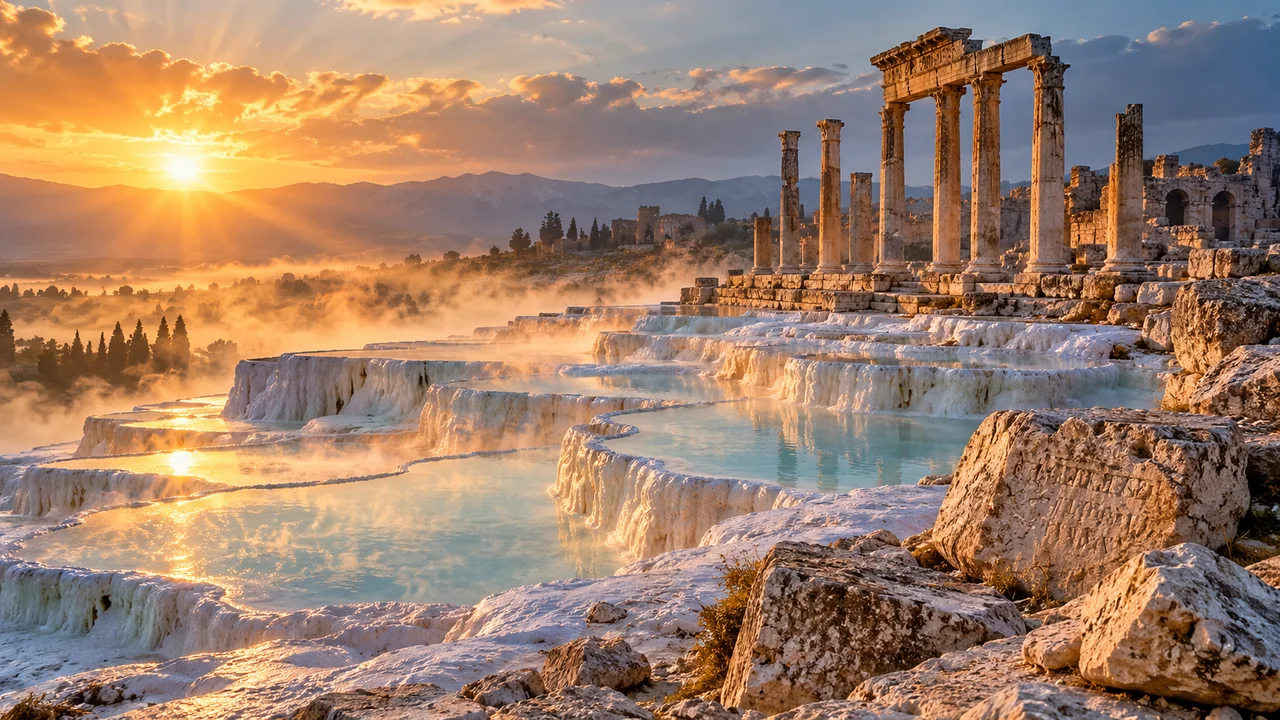
In the Lycus River Valley of southwestern Asia Minor (modern Denizli, Turkey), approximately six miles north of Laodicea and ten miles west of Colossae, stood the magnificent Greco-Roman spa city of Hierapolis (literally, the "Holy City"). Built atop dramatic, gleaming white travertine terraces formed by cascading calcium-rich geothermal hot springs, Hierapolis was renowned throughout antiquity as a premier thermal healing sanctuary.
However, beneath its resort facade lay an ominous pagan reputation.
Hierapolis was home to the Plutonium—a subterranean cave sanctified to Pluto (Hades), the god of the underworld. Ancient geographers like Strabo (Geography XIII.4) and historians like Pliny the Elder recorded that this cavernous opening emitted a deadly, invisible vapor that instantly suffocated any living creature entering its threshold:
"This space is full of a vapor so misty and dense that one can scarcely see the ground... Any animal that passes inside meets instant death. Bulls led into it fall down and are dragged out dead."
[Geological & Pagan Landscape of Hierapolis]
       │
       ├──► The Plutonium: Volcanic fissure venting lethal concentrations of CO₂ (Gas of Hades)
       │         └── Eunuch priests of Cybele (Galli) performed death-defying demonstrations
       │
       └──► The Temple of the Viper: Worship of Echidna and Sacred Serpents
                 │
                 ▼ (Apostolic Arrival c. 80 AD)
            Apostle Philip, his sister Mariamne & Bartholomew
                 │
                 ▼ (Clash with the Civic Elite & Priesthood)
            Mass conversions lead to pagan financial collapse
Modern geophysicists have confirmed Strabo’s account: the Plutonium sits directly atop a deep seismic fault line that discharges volcanic carbon dioxide ($CO_2$) in concentrations exceeding 91%, creating a lethal, oxygen-deprived ground layer. The eunuch priests of the Phrygian mother-goddess Cybele exploited this phenomenon, holding their breath while leading bulls inside to die, convincing superstitious pilgrims that they possessed supernatural immunity from the god of death.
It was into this hotbed of occult theatricality and civic paganism that Philip the Apostle, originally of Bethsaida in Galilee (John 1:43–44), entered to proclaim the resurrected Christ around 80 AD.
The Serpent Sanctuary: Confronting the Echidna of Phrygia
According to both ancient patristic traditions and the apocryphal Acts of Philip, the religious elite of Hierapolis were dedicated to the veneration of a gigantic sacred viper known as Echidna (the serpentine mother of monsters in Greek mythology), alongside widespread worship of Apollo Pythios.
Philip was accompanied on his Phrygian mission by his formidable ascetic sister Mariamne and his companion Bartholomew. Together, they proclaimed that the serpentine oracles of Hierapolis were deceitful demonic illusions powerless before the name of Jesus of Nazareth.
The ancient text records that through apostolic prayer, the principal serpent idol was struck dead, and hundreds of residents were healed of paralysis, blindness, and demonic afflictions:
[Apostolic Preaching in Hierapolis]
       │
       ├──► Radical Healing: Nicanor, Wife of the Roman Proconsul, Converted
       │         └── Renounces temple prostitution and pagan offerings
       │
       └──► The Pagan Priesthood Stirs a Civic Riot
                 ├── Loss of pilgrim revenue at the Plutonium and Serpent Temple
                 └── Proconsul orders military arrest of Philip, Bartholomew, and Mariamne
The turning point occurred when Nicanor, the wife of the Roman proconsul Tyrannus (or Lysias), approached the apostles seeking healing from a chronic, agonizing illness. Upon her instantaneous restoration, she rejected her husband's pagan household gods, embraced Christian baptism, and refused to participate in the civic imperial banquets.
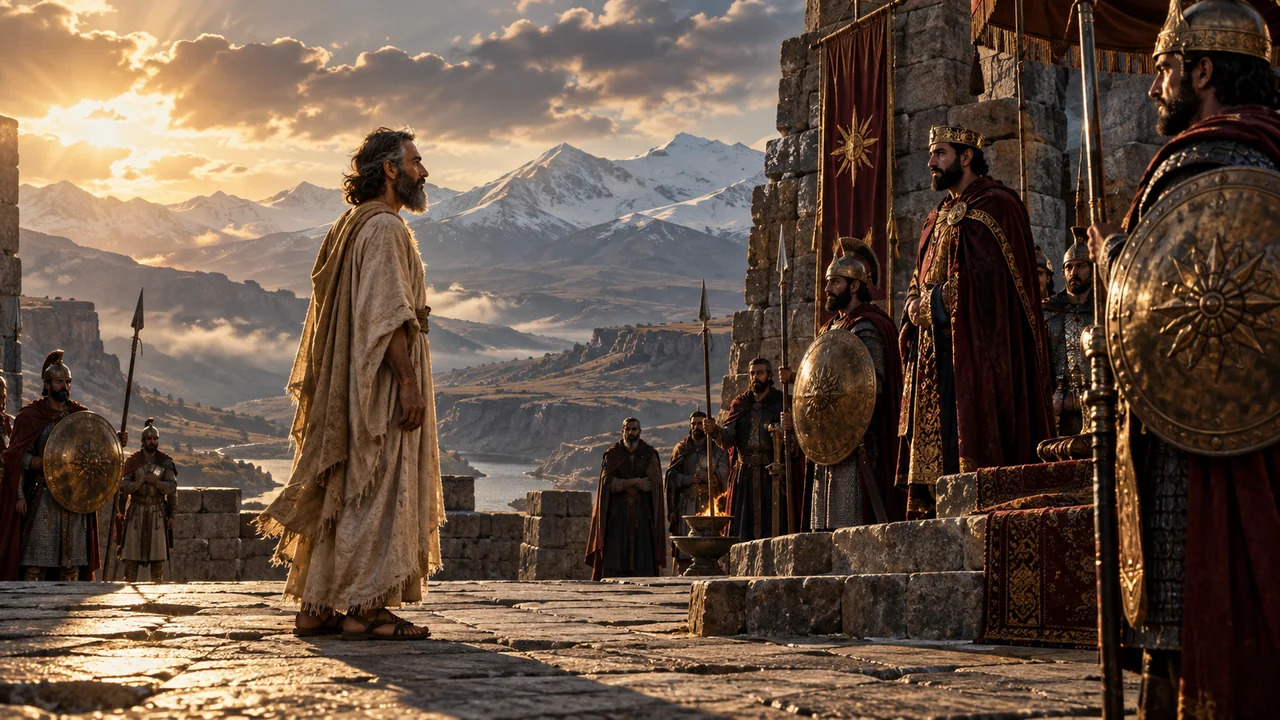
Enraged by his wife's public conversion and pressured by the furious pagan priesthood whose temple revenues had collapsed, the proconsul ordered his soldiers to seize Philip, Bartholomew, and Mariamne, dragging them by their hair through the marble agora to the public execution square.
The Acts of Philip and the Discovery at Mount Athos
For over a millennium, modern scholars possessed only fragmentary snippets of the Acts of Philip (Acta Philippi). However, in 1974, a monumental discovery occurred at the remote monastic republic of Mount Athos in northern Greece.
Harvard New Testament scholar Professor François Bovon was cataloging manuscripts in the library of Xenophontos Monastery. There, tucked away within a 14th-century parchment codex (Codex Xenophontos 32), Bovon identified the long-lost, unabridged Greek text of the Acts of Philip—specifically Chapters 11 through 15, which narrated the complete, authentic account of Philip’s trial, execution, and burial in Hierapolis.
The unabridged manuscript revealed vivid details of the Roman judicial sentence:
- Bartholomew was bound to a wooden crossbeam facing the temple.
- Philip was subjected to a specialized, excruciating punishment designed to mock the serpent cult he had overturned.
The Forensic Biomechanics of Inverted Pillar Suspension
The proconsul’s magistrates decreed that Philip should not merely be crucified; he was to be suspended upside down from a colossal iron pillar erected in the public esplanade facing the Temple of Apollo and the entrance to the Plutonium.
According to the Acts of Philip (Chapter 14):
"The executioners took iron hooks and pierced the tendons of Philip's heels and ankles, binding him with iron chains, and they suspended him with his head downward from a high pillar outside the sanctuary."
[Execution on the Iron Pillar]
       │
       ├──► Transfixion of the Calcaneal (Achilles) Tendons with Iron Hooks
       │         └── Massive laceration of sural nerves and posterior tibial arteries
       │
       ├──► Total Gravitational Suspension of 140+ lbs Body Weight by Lower Extremities
       │         └── Avulsion of ankle ligaments, extreme traction shock
       │
       └──► Acute Inverted Positional Asphyxia & Cerebral Edema
                 └── Suffocation and heart failure over hours of inverted hanging
From a forensic and biomechanical perspective, suspension from an iron pillar by the calcaneal tendons represents one of the most agonizing torments in ancient history:
- Traumatic Neuro-Orthopedic Shock: The human Achilles tendon and surrounding flexor retinaculum are densely innervated by branches of the tibial and sural nerves. Driving curved iron spikes through these soft tissues under full gravitational tension triggers catastrophic sensory overload, sending relentless, excruciating pain signals into the lumbar spinal cord.
- Extreme Ligamentous Traction: Unlike crucifixion where crossbeams support the wrists and chest, suspending the entire human mass (approximately 140 to 180 lbs) by the ankles puts immense shearing stress on the talocrural joints. The anterior talofibular and calcaneofibular ligaments suffer severe avulsion tears, causing the ankle bones to dislocate while the victim remains conscious.
- Cardiopulmonary Collapse Under Inversion: As analyzed in Peter's martyrdom, an inverted posture forces the massive abdominal viscera (liver, intestines, stomach) against the respiratory diaphragm. In Philip's case, the added torment of iron hooks ripping through his ankles prevented any compensatory muscular bracing. Over hours of public exposure under the scorching Anatolian sun, acute hypercapnia, severe intracranial venous hypertension, and terminal cardiogenic shock brought about death.
The text records that as Philip hung from the pillar, an earthquake shook Hierapolis, opening a fissure in the earth. The terrified crowd, recognizing divine retribution, demanded the release of the apostles. Bartholomew and Mariamne were cut down alive, but Philip, having reached the threshold of eternity, commanded them not to deliver him from his crown:
"Let me finish my course, for the Master awaits me; do not weep for me, but weep for yourselves and for those who have not known the light."
Comparative Table: Pagan Sanctuaries Confronted by Apostolic Missions
| Ancient City | Province | Dominant Pagan Cult | Apostolic Evangelist | Historical / Archaeological Evidence |
|---|---|---|---|---|
| Hierapolis | Phrygia (Turkey) | Serpent Cult (Echidna), Apollo & the Plutonium | Apostle Philip, Mariamne, Bartholomew | Plutonium gas vents, Octagonal Martyrion, 2011 Tomb excavation |
| Ephesus | Asia Proconsularis | Temple of Artemis (Diana of the Ephesians) | Paul of Tarsus, John the Apostle | Great Theater of Ephesus (Acts 19), ruins of the Artemision |
| Athens | Achaea (Greece) | The Areopagus, Pantheism & the "Unknown God" | Paul of Tarsus | Mars Hill stone platform (Acts 17), bilingual inscriptions |
| Rome | Italia | Imperial Emperor Cult & Capitoline Triad | Peter & Paul | Circus of Nero, Mamertine Prison, Ostian Way |
| Alexandria | Aegyptus | Serapis & Isis Mysteries | John Mark the Evangelist | Serapeum ruins, Catacombs of Kom El Shoqafa |
The 2011 Archaeological Triumph: Francesco D’Andria Unearths Philip’s Tomb
For centuries, Western historians debated whether the tradition of Philip’s burial in Hierapolis was historical fact or late Byzantine folklore. Early 4th-century church historian Eusebius of Caesarea (Historia Ecclesiastica III.31) had explicitly quoted Polycrates of Ephesus (c. 190 AD), who wrote to Pope Victor of Rome:
"For in Asia also mighty luminaries have fallen asleep, who shall rise again at the last day... I speak of Philip, one of the twelve apostles, who fell asleep in Hierapolis; and his two aged virgin daughters, and another daughter who lived in the Holy Spirit and rests at Ephesus."
In the 1950s, Italian archaeological teams discovered the magnificent 5th-century Martyrion of Saint Philip—a colossal octagonal pilgrimage basilica constructed on a hill overlooking Hierapolis. However, when excavators cleared the central chamber of the Martyrion, it was completely empty. Skeptics declared that the tomb was purely symbolic.
Then, in August 2011, after thirty-two years of continuous excavation, Italian archaeologist Professor Francesco D’Andria of the University of Salento announced a historic discovery that shook the biblical world.
[2011 Archaeological Breakthrough in Hierapolis (Pamukkale)]
       │
       ▼
[Discovery of a 1st-Century Roman Gabled Tomb]
       │ Located 40 meters from the Byzantine Martyrion along an ancient sacred road
       │
       ├──► 1st-Century Graffiti: "Saint Philip the Apostle" etched into stone lintel
       │
       ├──► Pilgrim Infrastructure: Marble baths, stepped walkways, baptismal font
       │
       └──► Bronze Bread-Stamp: Depicts Saint Philip with cross between two churches
D’Andria’s team discovered that the 5th-century Byzantines had not built the Martyrion over the tomb; rather, they had built the Martyrion adjacent to an already-existing, venerated 1st-century Roman barrel-vaulted tomb chamber.
The physical evidence confirmed:
- The Tomb Date: Constructed in the late 1st century AD, featuring Roman opus caementicium masonry.
- Epigraphic Verification: Byzantine and Roman graffiti scratched into the plaster by ancient pilgrims, invoking the intercession of "Saint Philip, the Holy Apostle."
- Pilgrim Architecture: The entire hillside had been landscaped with wide marble staircases, public pilgrim purification baths (frigidarium and caldarium), and a three-aisled church built directly around the 1st-century tomb.
- The Bread-Stamp of Philip: In 2012, archaeologists recovered an ancient bronze eulogia bread-stamp depicting Apostle Philip standing in robes holding a cross, flanked by two churches with the inscription identifying Hierapolis.
D’Andria concluded that the tomb had originally held the skeletal remains of Philip until the relics were transferred to Constantinople in 560 AD and subsequently to the Basilica of the Twelve Holy Apostles (Santi Apostoli) in Rome.
The Daughters of Philip: Prophetesses of the Sub-Apostolic Era
The martyrdom of Philip in Hierapolis cannot be isolated from his remarkable domestic legacy. Luke records in Acts 21:8–9 that when Paul visited Caesarea, he stayed at the home of Philip the Evangelist, who "had four unmarried daughters who prophesied."
While certain early writers conflated Philip the Apostle with Philip the Deacon/Evangelist, 2nd-century patristic records, including Papias, Bishop of Hierapolis (c. 60–130 AD)—who personally lived in Hierapolis and spoke with Philip’s surviving daughters—confirmed that the daughters resided in Hierapolis until their old age.
Papias records in his lost five-volume work Expositions of the Oracles of the Lord (preserved in Eusebius, Hist. Eccl. III.39):
"Papias mentions that he heard a wonderful tale from the daughters of Philip; for he relates that in their time a man was raised from the dead, and again another miracle, how Justus surnamed Barsabbas drank a deadly poison and yet, by the grace of the Lord, suffered no harm."
Philip’s daughters served as living apostolic bridges between the eyewitness generation of Jesus of Nazareth and the early Greek Church Fathers, preserving oral traditions of Christ’s sayings, eyewitness accounts of the apostolic missions, and the memory of their father’s steadfast witness upon the iron pillar.
Philip’s heroic death in the shadow of the Plutonium demonstrated that the true power over death belonged not to Pluto, the serpent of Phrygia, or the Roman proconsul, but to Jesus of Nazareth, the conqueror of the grave.
Deepen Your Knowledge with the Complete Apostolic Dossier
The discovery of Saint Philip's tomb in Hierapolis is concrete physical proof that the Gospels and patristic records describe real men in real history. To explore high-resolution archaeological site plans, translated texts of the Acts of Philip, and forensic trauma analyses:
👉 Download Volume I: The Twelve Apostles – Historical Dossier ($2.99)
Includes architectural schematics of the Hierapolis Martyrion, Greek transcription plates from Codex Xenophontos 32, and complete guides to early church archaeological sites.
Frequently Asked Questions
How did the Apostle Philip die?
According to ancient church tradition preserved in the Acts of Philip and patristic writers, Philip was martyred around 80 AD in Hierapolis, Phrygia (modern Turkey). He was suspended upside down from a high iron pillar by iron hooks driven through his ankles and heels after confronting the local pagan viper cult.
Has the tomb of Saint Philip been discovered by archaeologists?
Yes. In 2011, an Italian archaeological expedition led by Professor Francesco D’Andria discovered the authentic 1st-century Roman tomb of Saint Philip in Hierapolis (Pamukkale, Turkey). The site features 1st-century Roman masonry, pilgrim walkways, purification baths, and ancient graffiti confirming the veneration of the apostle.
What was the Plutonium in Hierapolis?
The Plutonium was an ancient pagan sanctuary in Hierapolis believed to be an entrance to the underworld. It featured a deep cavernous fissure venting lethal concentrations of volcanic carbon dioxide ($CO_2$). Pagan priests exploited this deadly natural gas to demonstrate their supposed supernatural power before crowds.
Did Philip the Apostle have daughters who prophesied?
Yes. Early church records from Papias of Hierapolis, Polycrates of Ephesus, and Eusebius record that Philip’s daughters lived in Hierapolis until their old age, serving as revered prophetesses and preserving early apostolic oral traditions for the next generation of church fathers.
Frequently Asked Questions
How did the Apostle Philip die?
According to ancient church tradition preserved in the Acts of Philip and patristic writers, Philip was martyred around 80 AD in Hierapolis, Phrygia (modern Turkey). He was suspended upside down from a high iron pillar by iron hooks driven through his ankles and heels after confronting the local pagan viper cult.
Has the tomb of Saint Philip been discovered by archaeologists?
Yes. In 2011, an Italian archaeological expedition led by Professor Francesco D’Andria discovered the authentic 1st-century Roman tomb of Saint Philip in Hierapolis (Pamukkale, Turkey). The site features 1st-century Roman masonry, pilgrim walkways, purification baths, and ancient graffiti confirming the veneration of the apostle.
What was the Plutonium in Hierapolis?
The Plutonium was an ancient pagan sanctuary in Hierapolis believed to be an entrance to the underworld. It featured a deep cavernous fissure venting lethal concentrations of volcanic carbon dioxide (CO2). Pagan priests exploited this deadly natural gas to demonstrate their supposed supernatural power before crowds.
Did Philip the Apostle have daughters who prophesied?
Yes. Early church records from Papias of Hierapolis, Polycrates of Ephesus, and Eusebius record that Philip’s daughters lived in Hierapolis until their old age, serving as revered prophetesses and preserving early apostolic oral traditions for the next generation of church fathers.
Related Research Dossiers
View all 120 articles →
Bound for Two Days: The Unspoken Agony of St. Andrew on the Crux Decussata in Greece
The Cauldron of Boiling Oil in Rome: Why the Apostle John Could Not Be Executed