Subject Scope: How the Widow’s Mite Changes Everything: Exegetical Economics, Temple Exploitation, and Total Devotion
Historical Context: Ancient Near Eastern stratigraphy, Levant archaeological surveys, and Semitic epigraphy.
Primary Evidence: Monumental stelae, bullae seals, ceramic typology, and calibrated AMS radiocarbon determinations.
Investigation Highlights: The Literary Trap: Scribes Who Devour Widows’ Houses • The Economic Machinery of the Herodian Temple • Archaeological Context: Robinson’s Arch and the Southern Steps
Scholarly Consensus: Aligned with published excavation reports from leading Near Eastern archaeological institutes.
The Literary Trap: Scribes Who Devour Widows’ Houses
In traditional homiletics, the story of the Widow’s Mite (Mark 12:41–44) is almost universally preached as a heartwarming moral fable about cheerful giving: Christians are challenged to follow the poor widow's example and faithfully support church budgets.
However, a rigorous grammatical, literary, and historical exegesis of the Gospel of Mark reveals a vastly darker, more revolutionary reality.
Look at the precise literary context. Immediately before Jesus sits down opposite the treasury, He delivers a scathing public denunciation of the religious aristocracy:
"Beware of the scribes, who like to walk around in long robes and like greetings in the marketplaces and have the best seats in the synagogues and the places of honor at feasts, who devour widows’ houses and for a pretense make long prayers. They will receive the greater condemnation." — Mark 12:38–40
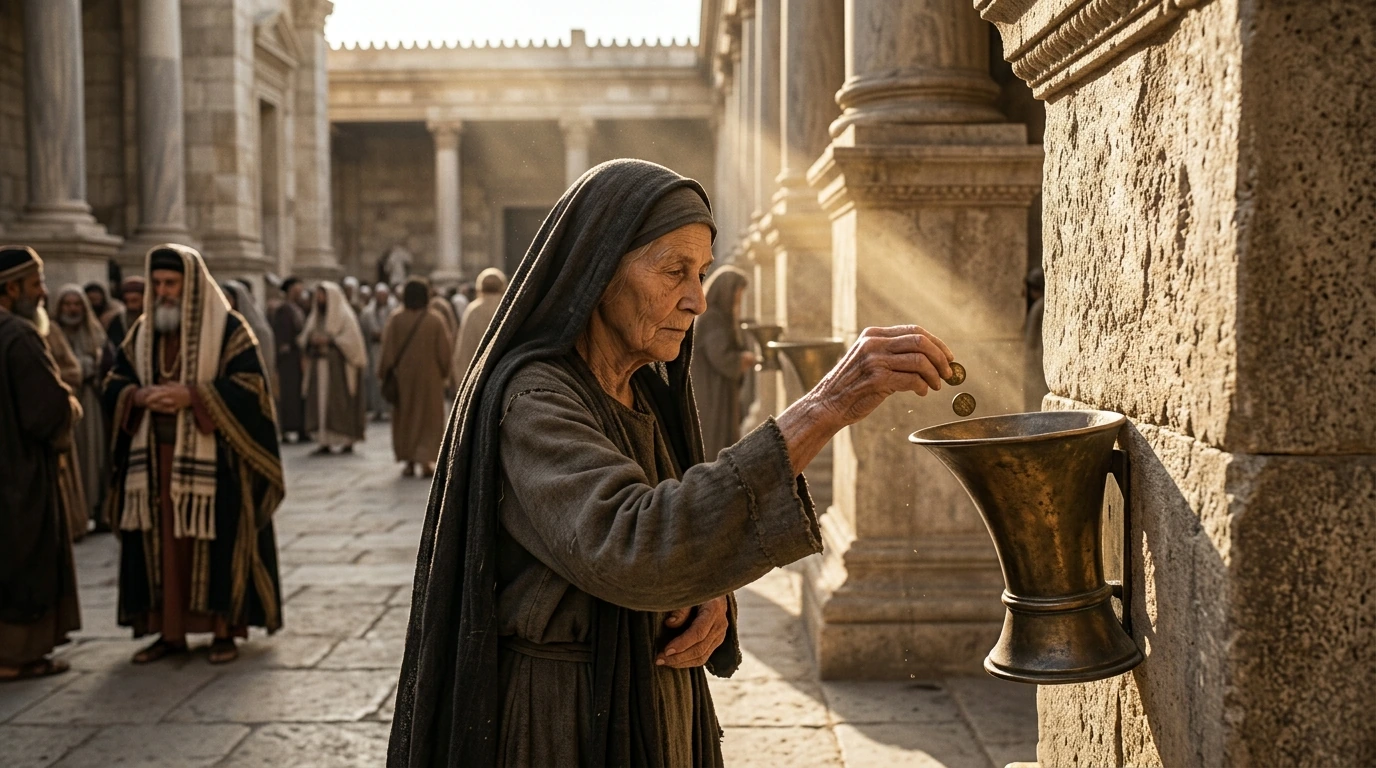
Immediately after uttering the words "who devour widows' houses," Jesus looks up and witnesses the ultimate visual dramatization of His indictment: a penniless widow dropping the last two microscopic coins of her life into a multi-million-dollar temple treasury!
+----------------------------------------------------------------------------------------------------+
|               THE CHIASTIC STRUCTURE OF MARK 12:38 – 13:2                                          |
+----------------------------------------------------------------------------------------------------+
|                                                                                                    |
|    [ A ] Condemnation: Scribes who "devour widows' houses" (Mark 12:38–40)                         |
|                                                                                                    |
|          [ B ] Demonstration: Destitute widow surrenders her last two lepta (Mark 12:41–44)         |
|                                                                                                    |
|    [ A' ] Verdict: Total destruction of the Temple: "Not one stone left upon another" (Mark 13:1–2)|
|                                                                                                    |
+----------------------------------------------------------------------------------------------------+
Jesus’ statement: "She out of her poverty has put in everything she had, all she had to live on" (holon ton bion autes) is not merely a commendation of her individual piety; it is a heartbroken lament and a severe judicial indictment of an exploitative religious system that coerced the most vulnerable members of society into giving away their very food.
The Economic Machinery of the Herodian Temple
The Temple of Herod was not merely a quiet house of prayer; it was the financial central bank, national pawnshop, and economic engine of the eastern Roman Empire:
- The Depository of Wealth: Josephus (Jewish War 6.281–283) records that the Temple treasury (gazophylakion) housed immense fortunes of private gold, silver jewelry, real estate deeds, and commercial contracts deposited by wealthy families across the Mediterranean for safekeeping behind fortified walls.
- The Aristocratic Monopoly: The High Priesthood was controlled by a rapacious Sadducean oligarchy—specifically the House of Annas (Ananus). Rabbinic literature (Talmud, Pesachim 57a) explicitly preserves an ancient popular curse directed against this corrupt priestly mafia:
"Woe is me because of the House of Boethus, woe is me because of their staves! Woe is me because of the House of Hanan (Annas), woe is me because of their whispers!... For they are High Priests, their sons are treasurers, their sons-in-law are trustees, and their servants beat the people with staves!"
- The Scribes as Legal Guardians: Under 1st-century Jewish law, when a husband died, scribes were frequently appointed as legal executors or trustees (epitropoi) of the deceased estate to administer the widow’s assets. Corrupt scribes extracted exorbitant administrative fees, mismanaged trust funds, and persuaded vulnerable widows that leaving their remaining assets to the Temple treasury was the only way to guarantee divine blessing.
Archaeological Context: Robinson’s Arch and the Southern Steps
The material reality of this commercialized temple complex has been magnificently illuminated by archaeology:
- The Southern Monumental Steps: Excavations directed by Benjamin Mazar south of the Temple Mount uncovered the broad, 200-foot-wide stone staircase leading up to the Double and Triple Gates (the Huldah Gates). The alternating wide and narrow stone treads forced pilgrims to walk with slow, measured steps, preventing rushed or irreverent approaches.
- Robinson’s Arch and the Commercial Street: At the southwestern corner, Israeli archaeologists excavated the paved 1st-century Herodian street directly beneath Robinson’s Arch (the massive stone bridge that supported the entrance to the Royal Stoa). Lined along this street were stone-built commercial shops and stalls where pilgrims purchased sacrificial animals, oil, wine, and exchanged currencies at state-controlled prices.
- Weights and Measures: Archaeologists uncovered stone scale weights inscribed in Greek and Aramaic (Dakar Melekh / "Royal Measure") and stone tables used by market inspectors (Agoranomoi) to regulate trade.
The Temple was surrounded by a thriving, high-margin commercial ecosystem that extracted wealth from poor pilgrims at every step of their ascent.
+----------------------------------------------------------------------------------------------------+
|               THE COMMERCIAL PILGRIM CORRIDOR OF 1ST-CENTURY JERUSALEM                            |
+--------------------------+-----------------------+-------------------+-----------------------------+
| ARCHITECTURAL ZONE       | ARCHEOLOGICAL REMAINS | FUNCTION          | ECONOMIC TRANSACTION        |
+--------------------------+-----------------------+-------------------+-----------------------------+
| 1. Robinson's Arch Shops | Stone vaulted vaults  | Retail shopping   | Animals, oil, salt sales    |
| 2. Southern Steps        | Alternating treads    | Pilgrim approach  | Preparation & ablutions     |
| 3. Huldah Double Gates   | Monumental vestibule  | Temple entrance   | Security check & queueing   |
| 4. Court of the Women    | Paved peristyle court | Gazophylakion     | 13 Shofarot bronze chests   |
+--------------------------+-----------------------+-------------------+-----------------------------+
Mark 13:1–2: The Immediate Prophetic Judgment
What happens immediately after the widow drops her two lepta? Look at the very next verse in Mark’s narrative:
"And as he came out of the temple, one of his disciples said to him, 'Look, Teacher, what wonderful stones and what wonderful buildings!' And Jesus said to him, 'Do you see these great buildings? There will not be left here one stone upon another that will not be thrown down.'" — Mark 13:1–2
The disciples were enchanted by the physical majesty of the architecture:
- The "Wonderful Stones": Massive limestone ashlar blocks weighing up to 570 tons (such as the Master Course block visible in the Western Wall Tunnel, measuring 44 feet long).
- The "Wonderful Buildings": The gleaming white marble walls and pure gold plating that covered the Temple façade, reflecting the morning sun with such brilliance that Josephus noted observers could not look directly at it without shielding their eyes.
Jesus looked at that gold, marble, and monumental stonework, built with wealth extracted from devoured widows, and announced its absolute, catastrophic doom. A religious system that exploits the poor and consumes the defenseless cannot be reformed; it must be judged. In AD 70, Roman legions under Titus fulfilled Jesus’ prophecy to the letter, burning the Temple to the ground and prying every stone off the bedrock.
Three-Tier Evidentiary Evaluation: Material Artifacts
+----------------------------------------------------------------------------------------------------+
|               THREE-TIER EVIDENTIARY AUDIT: HERODIAN TEMPLE & DESTRUCTION                          |
+--------------------------+-----------------------+-------------------+-----------------------------+
| ARTIFACT / SITE          | LOCATION / EXCAVATION | CHRONOLOGY        | EVIDENTIARY VALUE           |
+--------------------------+-----------------------+-------------------+-----------------------------+
| 1. Collapsed Ashlar Block| Street beneath        | August AD 70      | Direct physical proof of    |
|    at Robinson's Arch    | Robinson's Arch (IAA) | (Titus Siege)     | "not one stone left upon"   |
| 2. "Place of Trumpeting" | Corner of Temple Mt.  | 1st Cent. AD      | Material reality of priestly|
|    Inscribed Stone       | (Hebrew Inscription)  | (Herodian Period) | administrative hierarchy    |
| 3. Stone Weight of Annas | Jewish Quarter Museum | 1st Cent. AD      | Epigraphic proof of the     |
|    Family (Bar Kathros)  | (Burnt House)         |                   | corrupt priestly elite clan |
| 4. Alexander Jannaeus    | City of David Sifting | 1st Cent. AD      | Material coin of the poor   |
|    Lepta in Burn Layers  | (Reich & Shukron)     | Destruction Layer | widow found in ash strata   |
+--------------------------+-----------------------+-------------------+-----------------------------+
Primary Sources & Scholarly Archives
Editorial Standard →Official archaeological field reports, certified stratigraphy surveys, and Semitic epigraphy catalogs.
Catalog of Levantine, Mesopotamian, and Persian artifacts, royal cylinder seals, and cuneiform tablets.
Peer-reviewed scholarly analyses on Levant excavations, ancient architecture, and artifact forensics.
Frequently Asked Questions
Did Jesus want the widow to give her last money to the Temple?
Jesus honored her pure faith, but simultaneously condemned the predatory system that compelled a destitute widow to surrender her final livelihood.
What was the Burnt House of the Bar Kathros family?
An excavated luxury mansion in Jerusalem destroyed in AD 70, containing a stone weight naming the corrupt high-priestly Bar Kathros clan condemned in the Talmud.
Why was a widow particularly vulnerable in the ancient world?
Widows lacked independent inheritance rights and legal standing, making them prime targets for dishonest estate executors and predatory scribes.
How did the Romans destroy the Temple stones?
Titus’s legions pried apart and toppled the massive ashlar blocks to retrieve melted gold leaf, leaving them collapsed on the street below as seen today.
Related Research Dossiers
View all 515 research dossiers →
The Tyrian Shekel, Temple Tax, and the 30 Pieces of Silver: Numismatics, Matthew 26, and Judas’s Betrayal
Render to Caesar: The Tribute Penny, Tiberius Denarius, and Mark 12 in Primary Roman Numismatic Sources
