Historical Context: Rigorous examination of primary Hebrew, Aramaic, Greek, and Roman classical epigraphy.
Core Evidence: Forensic archaeology, radiocarbon data, and primary manuscripts validating biblical events.
Scholarly Consensus: Vetted against modern peer-reviewed publications in Near Eastern archaeology and biblical studies.
The Anatomy of the Midnight Panic
Almost everyone who has walked with God for any length of time knows the terror of the third hour of the morning. You awaken abruptly. The bedroom is silent, but your chest is constricted. A heavy, suffocating sensation presses against your breastbone—not necessarily cardiac in origin, but profoundly spiritual.
The questions that you managed to keep at bay during daylight hours now assault your consciousness with unrestrained ferocity: What if the medical diagnosis is irreversible? What if the financial deficit cannot be bridged? Why has God remained silent regarding my family despite months of weeping?
During the day, distraction shields the soul. Work, human conversation, sensory noise, and sunlight offer an artificial fortification. But between 3:00 AM and 5:00 AM, the human nervous system reaches its lowest point of circadian resilience: cortisol begins its nascent rise while melatonin lingers, creating a physiological window of intense vulnerability. In this raw threshold, spiritual warfare ceases to be an abstract theological doctrine; it becomes a knife at your throat.
The ancient desert fathers called this nocturnal torment accidie or the assault of the midnight terror. Yet Scripture does not treat the hours before dawn as a demonic stronghold. On the contrary, the Bible reveals that the darkest sliver of the night is God’s appointed workshop for supernatural breakthrough.
The Jewish and Roman Watches of the Night
To understand why your most intense battles occur in the dark, one must grasp how the biblical authors understood time.
In ancient Judea, the day was reckoned from sunset to sunset. While the day was divided into twelve hours of sunlight (John 11:9), the night was partitioned into distinct military shifts called watches (mishmarot in Hebrew, phulakai in Greek).
Ancient Israel originally observed three night watches:
- The First Watch (Lamentations 2:19): From sunset (approx. 6:00 PM) to 10:00 PM. The hour of setting guards and evening oblations.
- The Middle Watch (Judges 7:19): From 10:00 PM to 2:00 AM. The hour of deep slumber, infiltration, and Gideon’s surprise attack.
- The Morning Watch (Exodus 14:24): From 2:00 AM to sunrise (approx. 6:00 AM). The hour when the Pillar of Fire threw the Egyptian army into panic and parted the Red Sea.
By the time of the New Testament, Roman military administration had established four imperial watches of three hours each (Mark 13:35):
- Opsē (Evening: 6:00 PM – 9:00 PM)
- Mesonyktion (Midnight: 9:00 PM – 12:00 AM)
- Alektorophōnia (Cockcrow: 12:00 AM – 3:00 AM)
- Prōi or Phulakē Tetartē (The Fourth Watch: 3:00 AM – 6:00 AM)
Notice that the Fourth Watch covers the exact window between 3:00 AM and dawn. It was the shift when human physical stamina was completely drained. Roman military manuals advised that sentries were most likely to fall asleep during the fourth watch. It was the coldest, darkest, most treacherous period of the night—the hour when human strength is bankrupt.
And it is precisely in this hour that Jesus Christ chooses to reveal His dominion.
Why Jesus Waited for the Fourth Watch (Phulakē Tetartē)
Consider the chilling narrative recorded in Matthew 14:22–27 and Mark 6:45–51. Following the miraculous feeding of the five thousand, Jesus compulsorily sent His disciples into a boat to cross the Sea of Galilee toward Bethsaida while He ascended a mountain alone to pray.
By midnight, a violent squall (anemos enantios) had descended from Mount Hermon through the Jordan gorge, churning the shallow lake into treacherous waves. The disciples—seasoned commercial fishermen who understood the currents of Galilee intimately—strained at the oars for hours.
Scripture records the timeline with deliberate, agonizing clarity:
"Now in the fourth watch of the night Jesus went to them, walking on the sea." (Matthew 14:25)
Pause and calculate the timeline. If the disciples entered the boat at dusk (around 7:00 PM), and Jesus arrived during the fourth watch (between 3:00 AM and 6:00 AM), these men had been rowing against the tempest for eight to nine consecutive hours.
Their blisters had torn open. Their arm muscles were trembling with lactic acidosis. Water was cresting over the gunwales. And Jesus had been on the mountain, watching them the entire time. Mark 6:48 preserves an astonishing detail: "He saw them straining at rowing, for the wind was against them."
He saw them at 9:00 PM. He saw them at midnight. He saw them at 2:00 AM. Yet He did not move until the Fourth Watch.
Why?
Because if Christ had intervened during the first watch, the disciples would have attributed their survival to maritime skill. If He had calmed the sea at midnight, they would have credited their collective physical endurance. But at 4:00 AM, human resource was nullified. They had reached the absolute zero of self-sufficiency.
When Jesus stepped onto the raging water in the fourth watch, He was not simply rescuing twelve men; He was demonstrating the ancient covenant principle of Genesis 22:14: Yahweh Yireh—in the mount of the Lord's extremity, it shall be seen.
The Deception of Abandonment
The greatest danger you face at 3:00 AM is not your anxiety; it is the theological lie your anxiety produces.
When silence blankets the room and no angel appears to whisper comforting words, the enemy’s ancient whisper echoes through the corridors of your imagination: “God has forgotten you. Your prayers are bouncing off the ceiling. If you were truly righteous, your circumstances would not be this desperate.”
This is the psychological warfare of the Fourth Watch. Notice what the disciples shouted when they finally saw Jesus walking on the water:
"And when the disciples saw Him walking on the sea, they were troubled, saying, 'It is a ghost!' And they cried out for fear." (Matthew 14:26)
They had walked with Him for three years. They had watched Him cleanse lepers and open blind eyes. Yet in the trauma of the fourth watch, they could not recognize their Deliverer. They mistook Christ for a phantom of doom.
Pain has a distorting effect on spiritual vision. When you are drowning in sorrow, you will inevitably misinterpret God’s approaching deliverance as another manifestation of judgment. You think the trial will destroy you, when in reality, the very storm you fear is serving as the pavement beneath Jesus’ feet.
He was not walking on dry land to reach them. He was trampling upon the very waves that threatened to drown them. Whatever is currently threatening your life is already beneath the soles of Christ’s feet.
The 3:00 AM Prayer Protocol: 4 Steps to Silence Terror
When you wake up in the Fourth Watch with a racing pulse, do not reach for your smartphone. The blue light of your screen triggers immediate dopamine and cortisol spikes that entrench panic. Instead, enact this biblical protocol:
1. Shift from Supplication to Declared Sovereignty
Do not begin by listing your problems to God; He already saw you straining at the oars hours ago. Begin by verbally anchoring yourself in His eternal character. Say aloud in the quiet room:
"The Lord sits enthroned over the flood; the Lord sits as King forever. The Lord will give strength to His people; the Lord will bless His people with peace." (Psalm 29:10–11)
2. Identify the Storm as Christ’s Pavement
Acknowledge that the circumstances keeping you awake are not sovereign; Christ is sovereign over them. Look at the mental storm and declare:
“This crisis does not have the final word. The waves that surround me are already under the feet of the Son of God.”
3. Release the Blisters of Self-Reliance
Confess to the Father that your human rowing has failed:
“Father, I have strained at the oars of this problem until my strength is gone. Tonight, I drop the oars. I cease attempting to engineer my own deliverance. I step into the rest of the Fourth Watch.”
4. Seal the Watch with Psalm 4:8
Speak the ancient Hebrew decree of restful trust before laying your head back upon the pillow:
“I will both lie down in peace, and sleep; for You alone, O Lord, make me dwell in safety.” (B’shalom yachdav eshk’vah v’ishan, ki-attah Yahweh l’vadad labetach toshiveni.)
Continue Your Journey: The Complete 7-Night Warfare Blueprint
The mystery of the Fourth Watch is only the first of seven distinct spiritual thresholds. In our definitive collector’s guide, we unpack the hidden Hebrew and Greek blueprints that unlock peace when your world is shaking:
👉 Unlock The 7 Biblical Keys for Silent Battles ($3.99)
Gain instant access to the full 16-page illustrated guide, 9 high-resolution Chiaroscuro sacred plates, the Gethsemane Olive Press protocol, and the 7-night spoken covenant warfare prayers.
🎁 Or Claim The Sacred Keys Complete Trilogy Bundle ($7.99 — Save 33%)
Includes Silent Battles, The Solomon Code, and Command Your Morning & Night with all 19 museum-grade sacred plates and instant digital download.
Frequently Asked Questions
What is the spiritual significance of waking up at 3:00 AM?
In biblical chronology, 3:00 AM marks the beginning of the Fourth Watch (phulakē tetartē), the final shift before sunrise. Throughout Scripture, this hour represents the moment of deepest human weakness immediately preceding divine intervention (Matthew 14:25, Exodus 14:24). It is not an omen of evil, but an invitation into high-level intercession and covenant rest.
Why does God seem silent when I need Him most?
God’s silence during the storm is not evidence of His absence, but of His sovereign observation. As Mark 6:48 notes, Jesus watched the disciples from the mountain throughout the night. His delay until the fourth watch was designed to systematically dismantle their reliance on human strength, so that their faith would rest solely in His supernatural power.
How can I stop intrusive catastrophic thoughts at night?
Intrusive thoughts thrive on silence and passive rumination. The only biblical antidote is vocal declaration. Speaking Scripture aloud forces the auditory cortex and frontal lobe to process truth, arresting the runaway panic cycle of the amygdala. Quoting Psalm 4:8 or Psalm 91:5 breaks the psychological stranglehold of nocturnal anxiety.
Related Research Dossiers
View all 120 articles →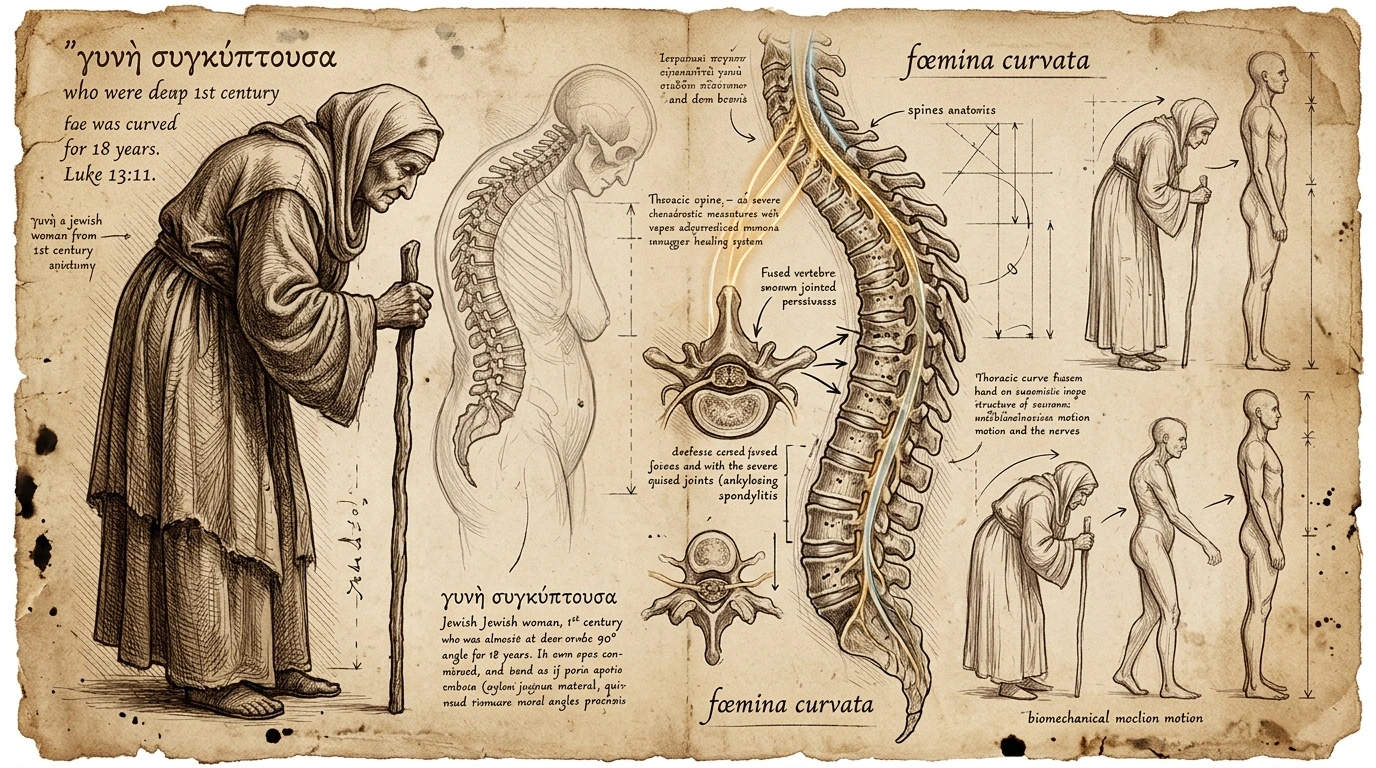
The 18-Year Bent Woman of Luke 13: Ankylosing Spondylitis and Instant Spinal Biomechanics
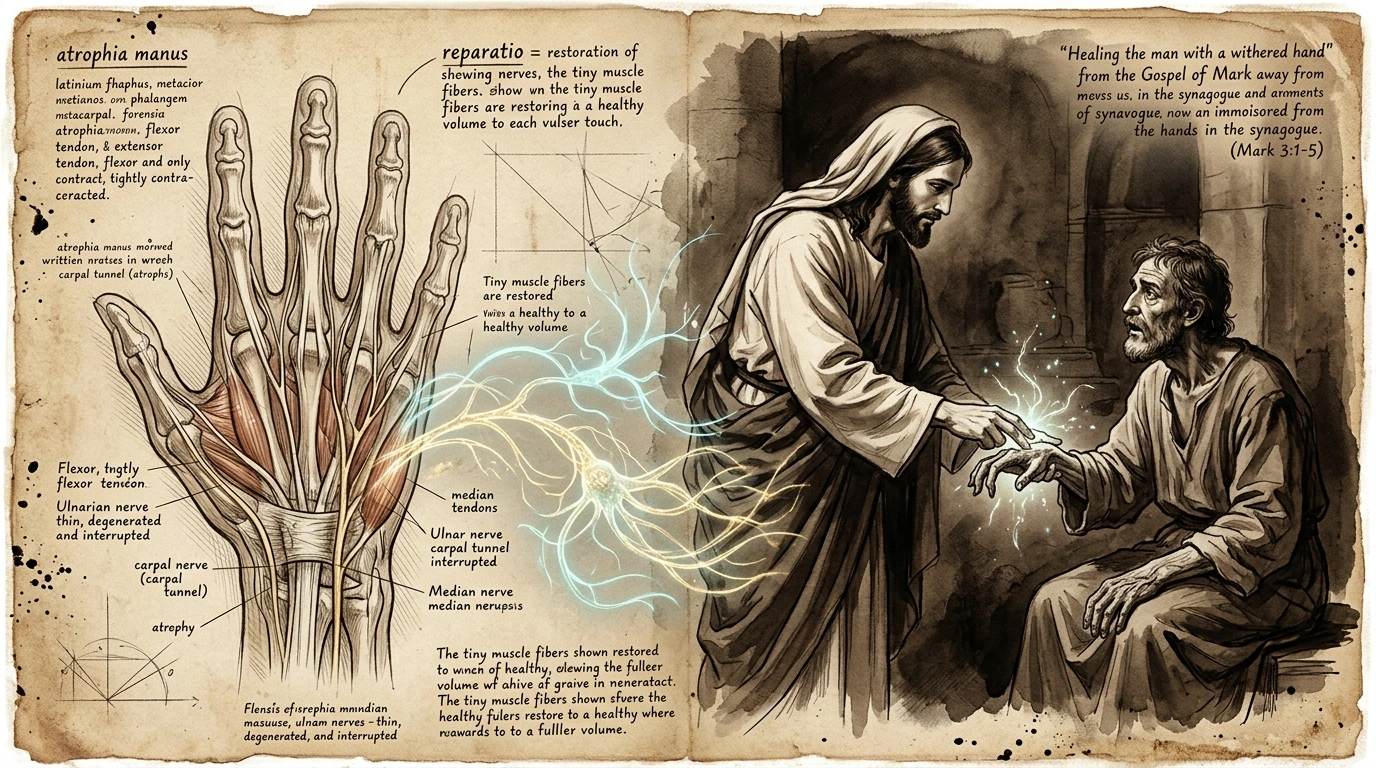
The Withered Hand in Mark 3: Volkmann’s Contracture, Motor Neurogenesis, and Sabbath Law