Historical Context: Rigorous examination of primary Hebrew, Aramaic, Greek, and Roman classical epigraphy.
Core Evidence: Forensic archaeology, radiocarbon data, and primary manuscripts validating biblical events.
Scholarly Consensus: Vetted against modern peer-reviewed publications in Near Eastern archaeology and biblical studies.
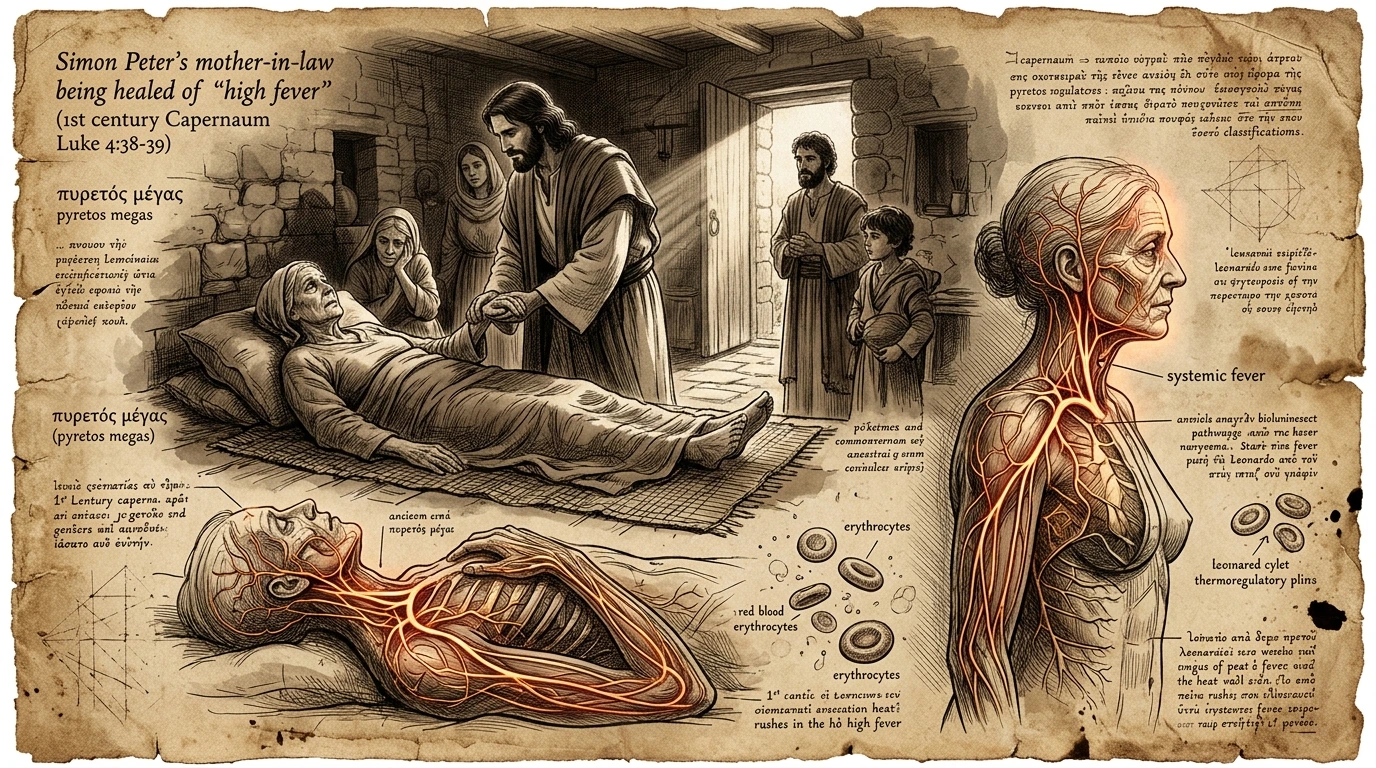
The Galenic Distinction: Great Fever (Puretos Megas)
In Luke 4:38–39, we encounter another remarkable instance where Luke’s medical training illuminates the severity of a biblical case:
"Now He arose from the synagogue and entered Simon’s house. But Simon’s wife’s mother was sick with a great fever (sunechomenē puretō megalō), and they made request of Him concerning her."
Compare Luke’s account with Matthew 8:14 (beblēmenēn kai puressousan - "lying down and sick with a fever") and Mark 1:30 (katekeito puressousa - "lying sick with a fever"). Matthew and Mark use common colloquial Greek.
Luke, however, employs the precise technical classification of Hellenistic medicine: puretos megas (πυρετὸς μέγας). Ancient Greek physicians, following Hippocrates and codified later by Galen in his treatise De Differentiis Febrium, divided fevers into two distinct clinical categories:
- Puretos mikros (Small fever): Low-grade, episodic, non-life-threatening febrile states.
- Puretos megas (Great fever): High-grade, continuous, malignant, typhoidal fevers accompanied by systemic collapse, acute delirium, organ dysfunction, and high mortality.
Furthermore, Luke uses the passive participle sunechomenē (συνεχομένη), meaning "gripped", "bound", or "tormented" by the fever—a technical term used in classical medicine for a patient completely overpowered by severe illness.
Epidemiology of the Sea of Galilee Basin
Why was severe fever so prevalent in Capernaum?
The Sea of Galilee sits in a deep depression 212 meters (696 feet) below sea level in the Jordan Rift Valley. In antiquity, the northern shoreline surrounding Capernaum, Tabgha, and the mouth of the Upper Jordan River contained extensive marshlands, slow-moving backwaters, and papyrus reeds.
This tropical microclimate was an ideal breeding ground for the Anopheles sergentii and Anopheles sacharovi mosquitoes, the primary vectors of Plasmodium falciparum malaria. Until British mandate drainage projects in the 1920s, the Hula Valley and northern Sea of Galilee were notorious for hyper-endemic, lethal autumnal fevers, recurrent typhus (Rickettsia prowazekii), and leptospirosis.
Peter’s mother-in-law was not suffering from a mild viral rhinovirus; she was in the grips of acute malignant malaria or severe typhoid sepsis.
Pathophysiology: Sepsis, Cytokines, and Febrile Delirium
A puretos megas involves catastrophic systemic activation:
- Pyrogenic Cytokine Storm: Endogenous pyrogens (Interleukin-1, Interleukin-6, and TNF-alpha) act on the anterior preoptic hypothalamus, elevating the thermal setpoint to 40°C–41°C (104°F–106°F).
- Hemodynamic Dehydration: Profuse diaphoresis, hyperventilation, and vomiting induce hypovolemia, electrolyte imbalance, and postural hypotension.
- Severe Post-Febrile Asthenia: In natural recovery from severe falciparum malaria or typhoid, once the temperature breaks (defervescence), the patient remains completely bedridden for 7 to 14 days due to muscle catabolism, profound anemia, generalized lactic acidosis, and neurological exhaustion.
The Medical Miracle of Instant Convalescence (Diēkonei)
Luke records the climax of the visit:
"So He stood over her and rebuked the fever, and it left her. And immediately she arose and served them (parachrēma de anastasa diēkonei autois)." (Luke 4:39)
From a clinical perspective, this is the most astounding detail of the entire passage:
- The fever did not "run its course" over twelve hours.
- She did not experience rigors, sweating chills, or gradual defervescence.
- She did not require convalescent bedrest or oral rehydration.
The imperfect verb diēkonei (διηκόνει) indicates continuous, active service: she stood up immediately, walked to the kitchen hearth, and began preparing a full Sabbath meal for Jesus, Peter, Andrew, James, John, and guests.
This required instantaneous physiological normalization:
- Eradication of the underlying pathogen and circulating endotoxins.
- Immediate replenishment of intracellular glycogen stores in liver and skeletal muscles.
- Complete restoration of vascular volume and blood pressure without orthostatic dizziness.
Archaeological Confirmation: The Insula of St. Peter in Capernaum
In 1968, Franciscan archaeologists Virgilio Corbo and Stanislao Loffreda excavated an ancient residential block (insula) in Capernaum just 30 meters from the synagogue.
Beneath an octagonal 5th-century Byzantine church, they uncovered a first-century basalt domestic complex dating precisely to the time of Christ. Key archaeological findings confirm the biblical setting:
- Plastered Walls with Graffiti: Unlike standard mud-mortar peasant homes, this specific room was replastered multiple times and covered in early Christian graffiti mentioning Christ, Peter, and Lord.
- Fishhooks and Storage Jars: Domestic artifacts consistent with a working commercial fishing family on the Galilee shore.
- Proximity to Marsh Areas: Situated right on the lake’s water edge, directly exposed to mosquito-borne pathogens.
Deepen Your Knowledge of Biblical Miracles
Discover the archaeological, historical, and medical foundations of the Gospels:
👉 Discover Volume IV: The Science of Biblical Miracles & Anatomy
Learn how modern pathology validates the clinical reporting of Dr. Luke across the New Testament.
🎁 Or Unlock The Sacred Keys Trilogy Master Collection ($7.99)
Reclaim physical vitality, mental clarity, and spiritual authority in your home.
Frequently Asked Questions
What is the difference between a simple fever and a "great fever"?
In classical Galenic medicine, a simple fever (puretos mikros) was mild and self-limiting. A "great fever" (puretos megas) was an acute, malignant, high-temperature infection with delirium, circulatory strain, and high mortality, commonly identified today as falciparum malaria or typhoid.
Why is her immediate service after healing medically remarkable?
Severe fevers cause massive dehydration, muscle protein breakdown, and intense fatigue. Even after a fever breaks naturally, patients remain weak and bedridden for days. Peter’s mother-in-law standing up immediately to prepare and serve a multi-course meal proves total cellular and metabolic restitution.
Does archaeology prove Peter lived in Capernaum?
Yes. Excavations at Capernaum uncovered the 1st-century basalt house of Peter beneath an early Christian domus-ecclesia and Byzantine octagonal church. Inscriptions referencing "Peter" and "Christ" dating back to the second century confirm its historic veneration as Peter’s domestic residence.
Frequently Asked Questions
What did "great fever" mean to ancient doctors?
It was the technical term (puretos megas) used by Hippocrates and Galen to describe life-threatening, continuous malignant fevers like falciparum malaria or typhoid, distinguished from common mild, low-grade fevers.
Why could she serve immediately?
Natural defervescence leaves patients exhausted, dehydrated, and weak for days. Her immediate resumption of domestic physical service (diēkonei) demonstrates instantaneous reversal of cellular shock and complete restoration of energy.
What role did the Galilee geography play?
Capernaum sat 212 meters below sea level surrounded by marshy wetlands, creating an ideal breeding habitat for malaria-carrying mosquitoes that plagued northern Galilee with severe autumnal fevers.
Related Research Dossiers
View all 120 articles →
The Beheading of John the Baptist at Machaerus: Archaeological Discovery of the Execution Chamber
Job’s Malignant Boils: A Clinical Diagnosis of Ancient Pathology (Job 2:7)