Historical Context: Rigorous examination of primary Hebrew, Aramaic, Greek, and Roman classical epigraphy.
Core Evidence: Forensic archaeology, radiocarbon data, and primary manuscripts validating biblical events.
Scholarly Consensus: Vetted against modern peer-reviewed publications in Near Eastern archaeology and biblical studies.
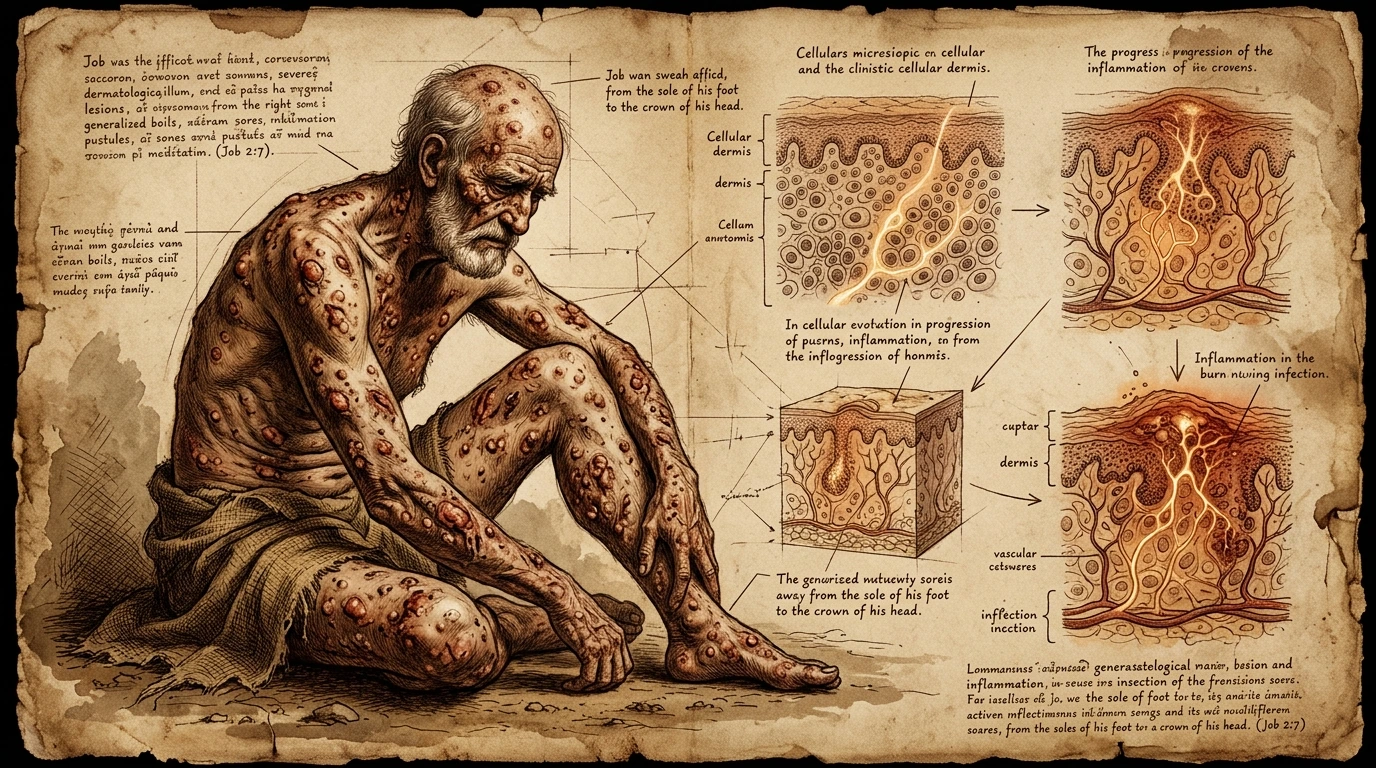
The Biblical Clinical Presentation (Shechin Ra)
The book of Job contains one of the most agonizing and clinically descriptive case studies of dermatological and systemic pathology in ancient literature. In Job 2:7, the text records:
"So Satan went out from the presence of the Lord and struck Job with malignant ulcers (shechin ra) from the sole of his foot to the crown of his head."
The Hebrew phrase shechin ra (שְׁחִין רָע) denotes not merely a common furuncle or localized skin irritation, but an aggressive, widespread, necrotizing eruption. The root shechin is identical to the term used in Exodus 9:9 for the sixth Egyptian plague of eruptive boils, and in Leviticus 13:18 in the context of leprosy and deep dermis ulceration.
Throughout the text of Job, a chilling medical picture emerges:
- Intense Pruritus & Exudation: The itching was so severe that Job scraped himself with a pottery fragment (cheres) while seated among the ashes (Job 2:8).
- Cutaneous Myiasis & Crusting: "My flesh is clothed with worms and clods of dust; my skin breaks out and festers" (Job 7:5).
- Severe Night Terrors & Neuro-Psychiatric Trauma: "When I say, ‘My bed will comfort me...’ then You scare me with dreams and terrify me with visions" (Job 7:13–14).
- Halitosis & Systemic Cachexia: "My breath is repulsive to my wife; I am loathsome to my own family" (Job 19:17), accompanied by rapid wasting where "my bone clings to my skin and to my flesh" (Job 19:20).
- Hyperpigmentation & Burning Arthralgia: "My skin turns black and falls from me, and my bones burn with fever" (Job 30:30).
Differential Diagnosis: Pemphigus, Anthrax, or Smallpox?
Modern medical clinicians and paleopathologists have proposed several retrospective diagnoses for Job’s catastrophic collapse:
1. Pemphigus Vulgaris or Bullous Pemphigoid
An autoimmune blistering disease characterized by IgG autoantibodies targeting desmoglein-3 in epidermal desmosomes. This causes intraepidermal acantholysis, leading to flaccid bullae that rupture effortlessly, leaving raw, excruciatingly painful erosions covering 80% to 90% of the body surface. Prior to corticosteroid therapy in the 20th century, systemic pemphigus vulgaris carried a mortality rate exceeding 95% within one year due to fluid loss, electrolyte collapse, and secondary bacterial sepsis.
2. Cutaneous and Systemic Anthrax (Bacillus anthracis)
Given Job’s massive livestock wealth (thousands of sheep, camels, and oxen), exposure to anthrax spores is epidemiologically plausible. Cutaneous anthrax produces painless black necrotic eschars surrounded by gelatinous edema. However, systemic anthrax typically kills within 48 to 72 hours; it does not persist across the months of theological dialogue documented in Job.
3. Ecthyma Gangrenosum or Norwegian Crusted Scabies
A hyper-infestation of Sarcoptes scabiei var. hominis occurring in severely immunosuppressed patients. The skin develops thick, odoriferous, fissure-ridden crusts teeming with millions of mites, matching Job’s description of skin "clothed with worms and dust".
The Forensic Role of the Terracotta Potsherd (Cheres)
Job 2:8 notes that Job "took a broken piece of pottery (cheres) to scrape himself while he sat among the ashes."
From a surgical and forensic standpoint, this act was not purely ritualistic. The rough, porous edge of unglazed ancient Levantine pottery served as a mechanical debridement tool to relieve relentless cutaneous tension. When extensive exudative bullae become tense with purulent edema, the intracutaneous nerve endings fire at maximum threshold, generating unbearable burning pruritus.
By puncturing and scraping the lesions, Job relieved interstitial pressure. Furthermore, sitting in wood ashes (epher) provided an ancient antiseptic alkaline barrier: wood ash contains potassium hydroxide and calcium oxide, which create a hostile pH for surface pathogens, while simultaneously absorbing weeping serosanguinous discharge.
The Lethal Triad of Sepsis in the Ancient World
Without modern intensive care units, intravenous fluid resuscitation, and broad-spectrum antibiotics, universal dermatological ulceration is virtually 100% fatal due to the Lethal Triad:
- Massive Transepidermal Evaporative Loss: Leading to hypovolemic shock and acute renal failure (prerenal azotemia).
- Catabolic Cachexia: Hyper-metabolism burning up to 4,000 calories per day to fight infection, explaining Job’s rapid skeletal emaciation (Job 19:20).
- Bacteremia & Septic Shock: Denuded skin allows Staphylococcus aureus and Pseudomonas aeruginosa to penetrate the capillary beds, causing disseminated intravascular coagulation (DIC).
Natural remission from end-stage disseminated ulceration under Bronze Age sanitary conditions is a biological contradiction.
The Divine Restitution: Spontaneous Healing vs. Cellular Regeneration
Job 42:10 records: "The Lord restored the fortunes of Job when he prayed for his friends, and the Lord doubled all that he had."
The healing of Job was not a prolonged convalescence with extensive hypertrophic scar tissue, joint contractures, and scarred alopecic skin. Job lived an additional 140 years (Job 42:16), fathered ten more children, and saw four generations of his descendants.
This required instantaneous genetic, epidermal, and immunological recreation:
- Restoration of desmosomal adhesion proteins across millions of keratinocytes.
- Complete eradication of systemic bacteremia without septic endocarditis damage.
- Reversal of metabolic wasting and restoration of renal, pulmonary, and cardiac integrity.
In biblical theology, Job’s suffering serves as the archetypal proof that neither sickness nor health operates outside the absolute jurisdiction of the Creator.
Continue Your Investigation: Ancient Pathology & Miraculous Healing
The mysteries of biblical pathology, ancient Egyptian medicine, and the medical precision of the biblical text are explored in depth across our research volumes:
👉 Discover Volume IV: The Science of Biblical Miracles & Anatomy
Explore the forensic medical examination of the crucifixion, ancient epidemics, and the biological mechanics of New Testament healings.
🎁 Or Unlock The Sacred Keys Trilogy Master Collection ($7.99)
Learn how ancient kings and prophets fought silent midnight battles and restored health, purpose, and household protection.
Frequently Asked Questions
Did Job have leprosy (Hansen’s disease)?
While historically associated with leprosy, modern medical analysis suggests Hansen’s disease (Mycobacterium leprae) is unlikely. Leprosy progresses indolently over decades and causes peripheral neuropathy (loss of sensation), whereas Job suffered from agonizing, hyper-sensitive pain and itching rather than numbness. Conditions such as Pemphigus vulgaris or Norwegian scabies align much closer with his acute clinical symptoms.
Why did Job scrape his skin with broken pottery?
The unglazed ceramic potsherd (cheres) provided a rigid, sterile-surfaced scraping edge to rupture tense blister fluid and remove necrotizing crusts. Mechanically relieving interstitial edema temporarily blunted the refractory pruritus that drove ancient patients to madness.
Could Job have survived this naturally?
From an epidemiological and physiological standpoint, universal open ulceration combined with severe emaciation and respiratory distress in an ancient dust-heavy environment inevitably leads to lethal bacterial sepsis within weeks. His complete, scarless recovery and subsequent 140-year lifespan cannot be accounted for by natural immunological mechanisms.
Frequently Asked Questions
Did Job have leprosy (Hansen’s disease)?
While historically associated with leprosy, modern medical analysis suggests Hansen’s disease is unlikely. Leprosy causes loss of sensation and slow deformity, whereas Job experienced intense burning, itching, and rapid systemic devastation, aligning closer with severe Pemphigus vulgaris or Norwegian crusted scabies.
Why did Job scrape his skin with broken pottery?
The unglazed ceramic potsherd served as an emergency debridement tool to relieve interstitial fluid pressure in tense blisters, providing temporary relief from the uncontrollable burning pruritus of deep cutaneous ulceration.
Could Job have survived this naturally?
Under ancient sanitary conditions, universal full-body ulceration led inevitably to hypovolemic shock, catastrophic bacterial sepsis, or organ failure. His total recovery and subsequent 140-year lifespan represent an absolute biological miracle.
Related Research Dossiers
View all 120 articles →
The Verified Prophecies of Ezekiel in Babylon: Tyre, Egypt, and Archaeological Excavations

The Valley of Dry Bones: Exegesis, Babylonian Archaeology, and Pastoral Application of Ezekiel