Historical Context: Rigorous examination of primary Hebrew, Aramaic, Greek, and Roman classical epigraphy.
Core Evidence: Forensic archaeology, radiocarbon data, and primary manuscripts validating biblical events.
Scholarly Consensus: Vetted against modern peer-reviewed publications in Near Eastern archaeology and biblical studies.
The Gospels vs. Flavius Josephus: A Harmonized Investigation
The arrest and execution of John the Baptist (Yochanan HaMatbil) is one of the most thoroughly corroborated events in ancient history. It is documented independently in both the New Testament Gospels (Matthew 14:1–12, Mark 6:14–29, Luke 3:19–20) and in the historical writings of the first-century Jewish historian Flavius Josephus (Antiquities of the Jews XVIII.5.2).
While the Gospels focus on the moral and spiritual confrontation—John’s public rebuke of Herod Antipas for marrying his brother’s wife Herodias—Josephus provides the broader imperial and geopolitical dimension:
"Now some of the Jews thought that the destruction of Herod’s army came from God, and that very justly, as a punishment of what he did against John, that was called the Baptist; for Herod slew him, who was a good man... Herod, who feared lest the great influence John had over the people might put it into his power and inclination to raise a rebellion... thought it best, by putting him to death, to prevent any mischief he might cause. Accordingly, he was sent a prisoner, out of Herod’s suspicious temper, to Machaerus, the castle I before mentioned, and was there put to death." (Josephus, Antiquities XVIII.5.2)
Rather than contradicting one another, the biblical and secular accounts form a seamless historical portrait:
- The Moral Trigger: John publicly denounced the incestuous, unlawful marriage of Tetrarch Herod Antipas (Leviticus 18:16).
- The Political Fear: John drew massive crowds of tens of thousands to the Jordan River; in a volatile border region, Antipas terrified of a messianic peasant insurrection that would prompt Rome to strip him of his tetrarchy.
The Dynastic Scandal: Herod Antipas, Phasaelis, and Herodias
To understand why John’s arrest was so politically combustible, one must understand the royal marriage treaty:
Herod Antipas, ruler of Galilee and Perea, had been married for over twenty years to a Nabataean princess named Phasaelis, daughter of King Aretas IV of Petra. This marriage was a vital geopolitical peace treaty guaranteeing security along the southern desert border of Perea.
However, during a diplomatic visit to Rome, Antipas stayed at the home of his half-brother Herod Philip I. There, Antipas fell infatuated with Philip’s wife, Herodias (granddaughter of Herod the Great). Antipas and Herodias struck a secret agreement: she would divorce Philip and marry Antipas, on the condition that Antipas divorce his Nabataean wife and expel her from the royal palace in Tiberias.
When Princess Phasaelis discovered the conspiracy, she secretly requested permission to visit the frontier fortress of Machaerus, from which Nabataean desert cavalry escorted her back to her father King Aretas IV in Petra.
The Nabataean War: King Aretas IV’s Revenge
The insult to King Aretas IV was an act of war: his royal daughter had been cast aside for an incestuous union.
Simultaneously, John the Baptist began preaching along the banks of the southern Jordan—the exact border territory between Antipas’ Perea and Aretas’ Nabataean kingdom. When John loudly declared: "It is not lawful for you to have your brother’s wife" (Mark 6:18), he was not merely offering marriage counseling; he was highlighting a national security disaster that was actively driving the nation into a bloody war.
In 36 AD, King Aretas IV launched a devastating military invasion against Herod Antipas, completely annihilating Antipas’ army in battle. Josephus records that the Jewish populace unanimously interpreted Antipas’ military catastrophe as direct divine retribution for his execution of John the Baptist.
The Fortress of Machaerus (Qal’at al-Mishnaqa)
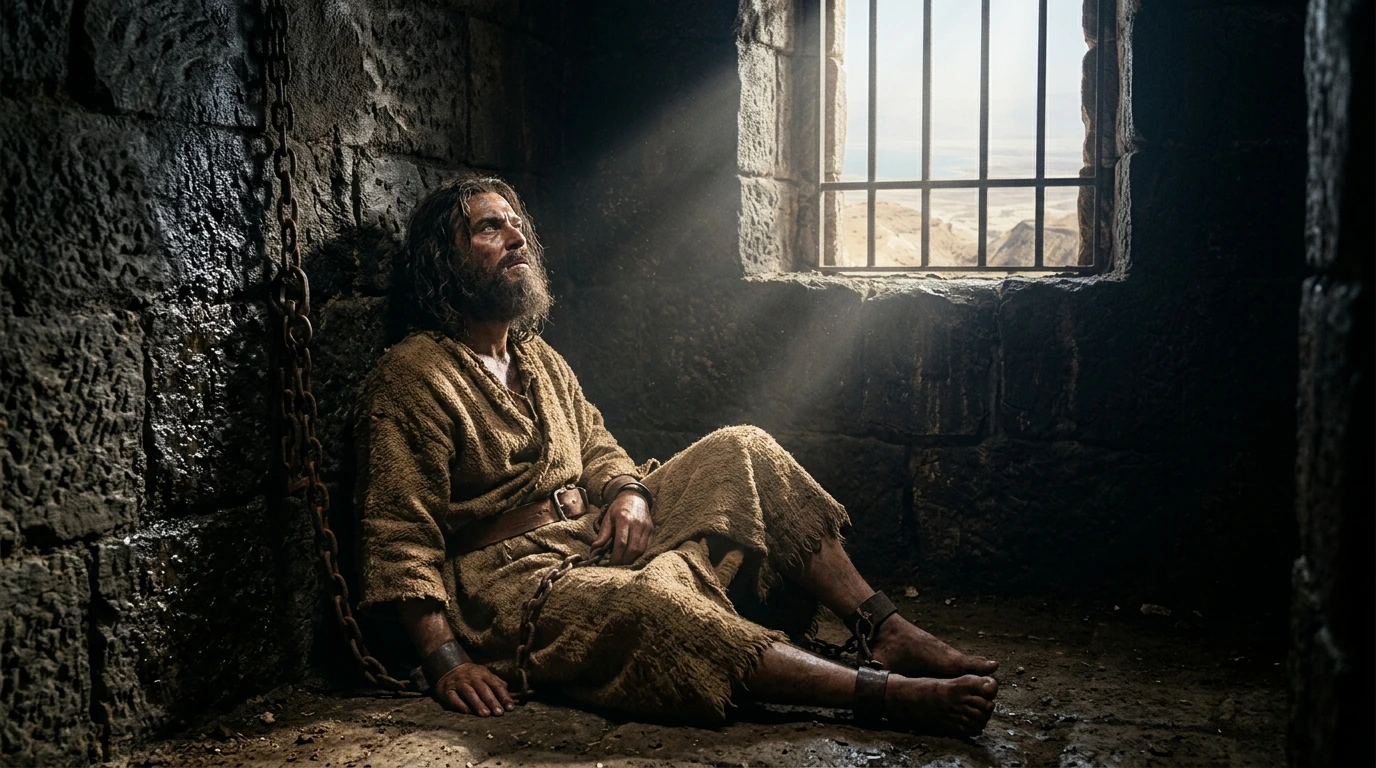
Where was John imprisoned?
Josephus explicitly names the castle of Machaerus (Makhairous, from the Greek for "sword"). Located in modern Jordan, 25 kilometers southeast of the mouth of the Jordan River, Machaerus was an eagle’s nest fortress built atop a precipitous conical basalt mountain 1,100 meters above the Dead Sea.
Originally fortified by the Hasmonean king Alexander Jannaeus around 90 BC, it was massively expanded by Herod the Great into a luxury fortified palace with:
- Immense thermal Roman bathhouses.
- Colonnaded royal banqueting courtyards.
- Deep underground rock-hewn cisterns and subterranean dungeon cells.
From the ramparts of Machaerus, one could see across the blue waters of the Dead Sea directly to the lights of Jerusalem, Bethlehem, and the Mount of Olives. It was into these suffocating desert dungeons beneath the palace floor that the prophet of the wilderness was chained.
The Voice Crying in the Wilderness: Prophetic Integrity under Imperial Pressure
John the Baptist lived by a standard of uncompromising moral courage:
- He wore rough camel’s hair and ate locusts and wild honey (Matthew 3:4).
- He refused royal patronage, political favors, and soft garments (Matthew 11:8).
- When standing before the ruler of his nation, he did not soften his rhetoric to preserve his neck.
Even Antipas, cynical politician though he was, was deeply disturbed by John. Mark 6:20 records that Antipas "feared John, knowing that he was a just and holy man, and he protected him. When he heard him, he was greatly perplexed; yet he heard him gladly."
John was the burning and shining lamp (lychnos kaiomenos kai phainōn, John 5:35) that illuminated the moral rot of his generation, proving that true prophets of God answer to the court of heaven, not the thrones of men.
Deepen Your Study of Early Christian History
Explore the historical records, archaeological sites, and eyewitness martyrologies across our library:
👉 Discover Volume I: The Twelve Apostles
Examine the authentic records of apostolic martyrdoms from Rome to the coast of India.
🎁 Or Unlock The Sacred Keys Trilogy Master Collection ($7.99)
Stand firm against intimidation, fear, and spiritual opposition through spoken scripture declarations.
Frequently Asked Questions
Did Flavius Josephus confirm that John the Baptist was a real historical person?
Yes. Josephus devoted an extensive section of Antiquities of the Jews (Book XVIII, Chapter 5) to John the Baptist, describing him as a righteous man who urged the Jews to exercise virtue, righteousness toward one another, and piety toward God through baptism.
Where was Machaerus located?
Machaerus was situated on a high desert peak in Perea (modern Jordan), on the eastern side of the Dead Sea. It was Herod Antipas’ southern military stronghold guarding against Nabataean Arabian incursions.
Why did Herod Antipas hesitate to execute John immediately?
Because John was overwhelmingly revered by the Jewish multitude as a genuine prophet of God. Antipas feared that executing him would ignite a violent popular insurrection, while also wrestling with personal superstitious dread of John’s spiritual holiness.
Frequently Asked Questions
Did Flavius Josephus confirm John the Baptist?
Yes. Josephus explicitly wrote about John the Baptist in Antiquities XVIII.5.2, confirming his title, his moral preaching, his massive popularity, his imprisonment at Machaerus, and his execution by Herod Antipas.
Why did John rebuke Herod Antipas?
John publicly condemned Antipas for divorcing his lawful wife (the daughter of King Aretas IV) to enter into an incestuous, biblically forbidden union with Herodias, the wife of his living half-brother Philip.
What was the political consequence of John’s execution?
The insult to the Nabataean princess caused King Aretas IV to wage war against Herod Antipas, utterly crushing Antipas’ army in a defeat that contemporary Jews viewed as God’s judgment for murdering John.
Related Research Dossiers
View all 120 articles →
Nathan Confronting David: 'You Are the Man!' (2 Samuel 12), The Royal Court, and Prophetic Courage

The Fall of Nineveh in Secular History: The Babylonian Chronicle, Cyaxares, and Diodorus Siculus
