Historical Context: Rigorous examination of primary Hebrew, Aramaic, Greek, and Roman classical epigraphy.
Core Evidence: Forensic archaeology, radiocarbon data, and primary manuscripts validating biblical events.
Scholarly Consensus: Vetted against modern peer-reviewed publications in Near Eastern archaeology and biblical studies.
The Diagnostic Language of Dr. Luke (Sugkuptousa)
In Luke 13:10–17, the physician-evangelist Luke records an encounter in a Galilean synagogue that presents extraordinary medical detail:
"And behold, there was a woman who had had a spirit of infirmity for eighteen years; she was bent double (sugkuptousa), and could not lift herself up at all (mē dynamenē anakupsai eis to panteles)."
Luke, educated in the Hellenistic medical tradition influenced by Hippocrates and Galen, uses precise clinical vocabulary that appears nowhere else in the New Testament:
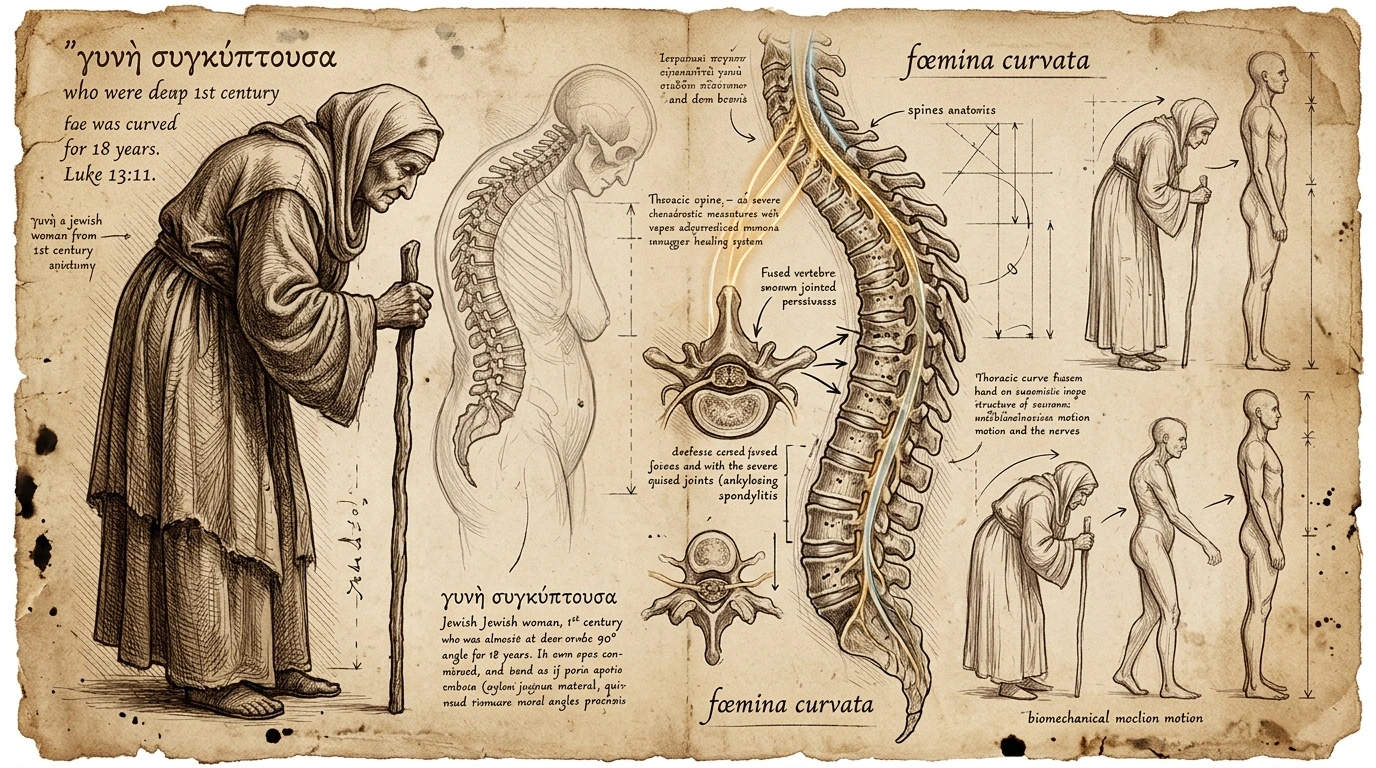
- Sugkuptousa (συγκύπτουσα): A present active participle denoting an involuntary, fixed structural curvature where the upper torso is bent forward and downward at right angles to the lower extremities.
- Mē dynamenē anakupsai eis to panteles (μὴ δυναμένη ἀνακύψαι εἰς τὸ παντελές): An absolute double negation indicating total biomechanical incapacity. The phrase eis to panteles signifies that she could not even partially extend her spine, gaze upward, or alter her horizontal gaze vector.
For eighteen years—over 6,500 consecutive days—her visual world had been restricted to the flagstone floor, dust, and the sandals of passersby.
Pathophysiology: Ankylosing Spondylitis vs. Severe Kyphosis
From a modern rheumatological and orthopaedic perspective, two primary conditions explain this clinical presentation:
1. Advanced Ankylosing Spondylitis (Bechterew’s Disease)
A chronic autoimmune inflammatory arthropathy associated with the HLA-B27 antigen. Chronic enthesitis leads to erosion of the annulus fibrosus, followed by ossification of the anterior longitudinal ligament and intervertebral syndesmophytes. Over eighteen years, the entire thoracic and lumbar spine fuses into a rigid, continuous pillar of solid bone—classically termed "bamboo spine".
2. Osteoporotic Hyperkyphosis with Multi-Level Wedge Fractures
In postmenopausal ancient women suffering from chronic nutritional deficits (calcium, vitamin D), severe osteoporosis produces multiple anterior vertebral body collapse fractures. Over nearly two decades, the thoracic kyphosis exceeds 90 to 110 degrees, creating a permanent structural wedge fixed by dense periarticular fibrous contractures and calcified ligamentum flavum.
3. Camptocormia (Bent Spine Syndrome)
A severe dystonia of the paraspinal extensor muscles, frequently secondary to Parkinsonism or neuromuscular trauma, which locks the trunk in flexion during upright posture.
The Mechanical Impossibility of Instant Extension
Luke 13:12–13 records Jesus’ immediate action and the instantaneous anatomical response:
"When Jesus saw her, He called her to Him and said to her, ‘Woman, you are loosed from your infirmity.’ And He laid His hands on her, and immediately she was made straight (parachrēma anōrthōthē), and glorified God."
The Greek verb anōrthōthē (ἀνωρθώθη) is an aorist passive indicative: she was restored to structural verticality in a single instant (parachrēma).
Orthopaedically, this is an absolute mechanical impossibility under natural laws:
- Vertebral Fracture Risk: If a fused, calcified spine is forcibly extended, the brittle syndesmophytes snap like ceramic, causing transverse fractures through the ossified disc space and catastrophic spinal cord severance (quadriplegia).
- Atrophied Musculature: Eighteen years of non-use causes severe neurogenic and disuse atrophy of the erector spinae and multifidus muscles, replaced by fibro-fatty infiltration. No patient possesses the muscular tone or motor control to hold a 100-pound torso upright after two decades of flexion.
- Thoracic & Vascular Remodeling: Longstanding kyphosis compresses the anterior ribcage, shrivels intercostal ligaments, and displaces the descending thoracic aorta. Instant extension without rupture requires instantaneous vascular elongation and thoracic wall remodeling.
Spiritual Etiology: The "Spirit of Infirmity" (Pneuma Astheneias)
Jesus provides a diagnostic commentary that confounded the religious leaders:
"Ought not this woman, a daughter of Abraham whom Satan has bound—lo, for eighteen years—be loosed from this bond on the Sabbath day?" (Luke 13:16)
Jesus does not treat the woman as a moral sinner requiring repentance, nor does He perform an exorcism with shrieks and commanding spirits. He identifies her condition as a structural captivity (desmos) initiated by spiritual oppression.
This dual etiology—a genuine organic orthopaedic disease occurring under the shadow of spiritual bondage—reveals that spiritual warfare often expresses itself through physical, chronic, debilitating infirmities designed to rob believers of dignity, worship, and vertical fellowship with God.
Sabbath Controversy and Anatomical Liberation
The ruler of the synagogue expressed indignation because the healing occurred on the Sabbath. Rabbinic halakha permitted medical intervention on Shabbat only if life was in imminent danger (pikuach nefesh). A chronic 18-year spinal curvature was considered non-urgent; waiting until Sunday was required.
Jesus shattered this hypocritical casuistry by appealing to basic livestock care: if a farmer unbinds an ox or donkey to lead it to water on Shabbat, how much more should a covenant daughter of Abraham be unbound from 18 years of postural slavery?
Her instant vertical posture was the physical incarnation of redemption: her gaze was elevated from the dust to the face of her Messiah.
Deepen Your Study of Biblical Healing
Explore the intersection of ancient medical Greek, prophetic fulfillment, and divine authority across our research collection:
👉 Explore Volume IV: The Science of Biblical Miracles & Anatomy
Analyze the medical Greek of Dr. Luke, the physiology of Christ’s passion, and archaeological excavations in Capernaum and Jerusalem.
🎁 Or Unlock The Sacred Keys Trilogy Master Collection ($7.99)
Dismantle chronic physical, emotional, and spiritual bondages through ancient scriptural protocols.
Frequently Asked Questions
What does "spirit of infirmity" mean in Luke 13:11?
The Greek phrase pneuma astheneias denotes a physical debility influenced or sustained by demonic oppression. Jesus explicitly stated in Luke 13:16 that "Satan bound her." However, she was not demonized in mind or soul; she was a faithful worshiper in the synagogue whose musculoskeletal body was physically hindered.
Could her condition have been psychological (hysterical paralysis)?
No. Luke’s explicit term sugkuptousa and the eighteen-year chronicity rule out transient conversion disorder. Conversion camptocormia resolves during sleep or under anesthesia, whereas this woman suffered fixed structural curvature witnessed by her entire community across nearly two decades.
Why did Jesus lay hands on her after declaring her loosed?
Jesus spoke the decree of release ("you are loosed") to legally break the spiritual binding, and then placed His hands upon her to impart physical, cellular recreating power, demonstrating both verbal authority and compassionate physical touch.
Frequently Asked Questions
What does "spirit of infirmity" mean in Luke 13:11?
The term pneuma astheneias signifies a physical deformity rooted in or exploited by spiritual oppression. Jesus identified her as a covenant daughter bound by Satan, proving that physical pathology can intersect with spiritual warfare.
Could her condition have been psychological?
No. The 18-year timeline and Luke’s precise anatomical terminology (sugkuptousa) point to irreversible organic skeletal pathology like Ankylosing Spondylitis or severe multi-level wedge fractures, not transient conversion disorder.
Why was instant spinal straightening medically impossible?
Extending a spine fused by 18 years of calcification naturally causes catastrophic bone fracture, severed spinal cord tissue, and vascular rupture. Furthermore, atrophied extensor muscles could not support the torso without miraculous instant neurogenesis.
Related Research Dossiers
View all 120 articles →
The Valley of Dry Bones: Exegesis, Babylonian Archaeology, and Pastoral Application of Ezekiel
John the Baptist at Machaerus: Josephus, Roman Geopolitics, and Herod Antipas