Historical Context: Rigorous examination of primary Hebrew, Aramaic, Greek, and Roman classical epigraphy.
Core Evidence: Forensic archaeology, radiocarbon data, and primary manuscripts validating biblical events.
Scholarly Consensus: Vetted against modern peer-reviewed publications in Near Eastern archaeology and biblical studies.
The Diagnostic Distinction: Luke’s "Right Hand" (Cheir Dexia)
The healing of the man with the withered hand is recorded in all three Synoptic Gospels (Matthew 12:9–14, Mark 3:1–6, Luke 6:6–11). However, only the physician Luke provides the critical anatomical detail:
"Now on another Sabbath He entered the synagogue and taught. And a man was there whose right hand was withered (hē cheir autou hē dexia ēn xēra)." (Luke 6:6)
To a general observer (like Matthew or Mark), the disability was simply a withered limb. To a practicing Greco-Roman physician, the specification of the right hand (cheir dexia) was essential. In the ancient world, the right hand was the instrument of livelihood, masonry, carpentry, scribal trade, and legal honor. A paralyzed left hand was a handicap; a paralyzed right hand was total socio-economic destruction.
The apocryphal Gospel of the Hebrews (cited by Jerome in Comm. in Matt. 12:13) preserves an ancient tradition concerning this man’s plea:
"I was a stone mason, seeking a living with my hands. I pray Thee, Jesus, to restore my health, that I may not shamefully beg for my food."
Pathophysiology of the Withered Hand (Exērammenēn)
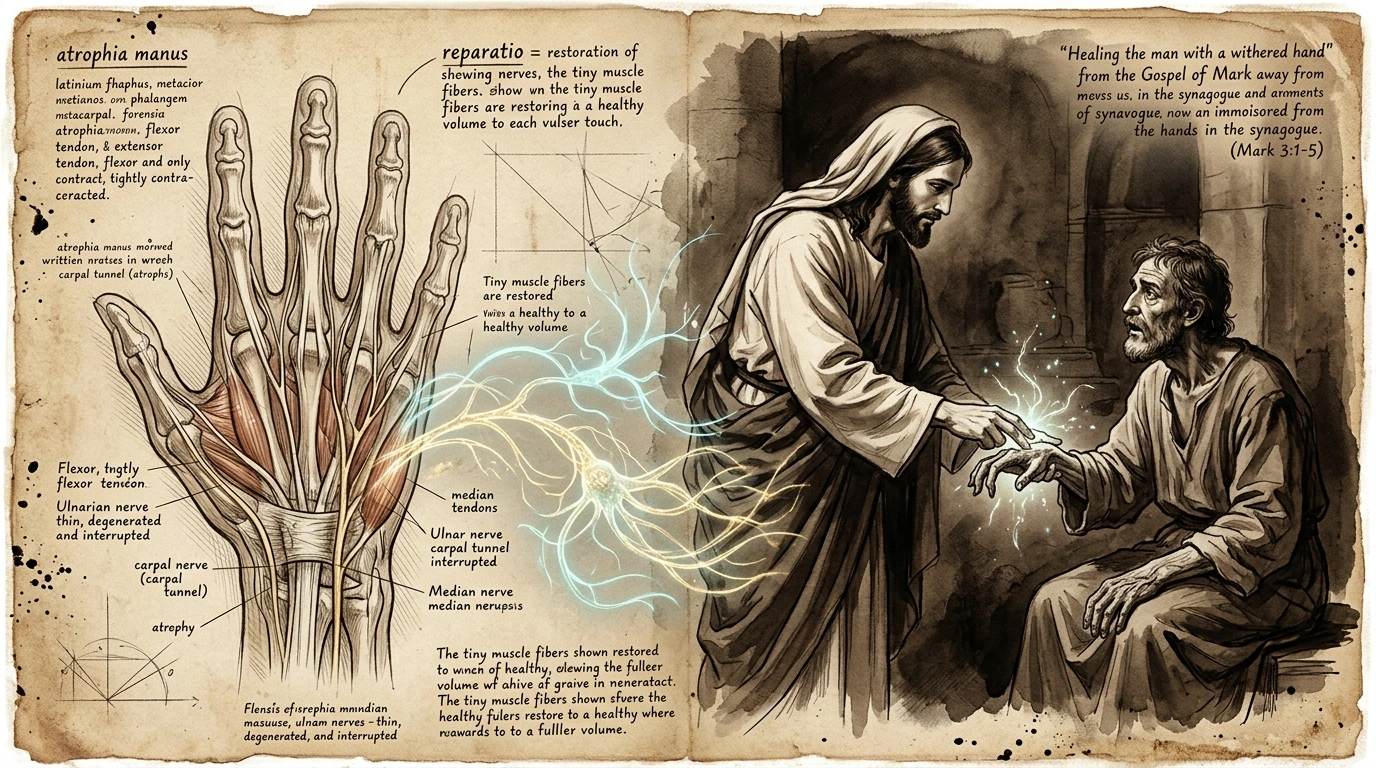
Mark 3:1 uses the perfect passive participle exērammenēn (ἐξηραμμένην), indicating a hand that had become dried up, shriveled, and atrophied—not a congenital absence, but an acquired degenerative condition.
Clinically, this presents three major diagnostic possibilities:
1. Volkmann’s Ischemic Contracture
A permanent flexion contracture of the hand and wrist caused by compartment syndrome following acute trauma (such as a supracondylar fracture of the humerus or crush injury). Increased pressure within the deep fascial compartment compromises the brachial artery, starving the flexor muscles of oxygen. Within six hours, muscle necrosis begins, replaced over subsequent months by dense, inextensible fibrous scar tissue (the classic "claw hand").
2. Complete Radial, Median, or Ulnar Nerve Transection
Severe laceration or chronic compression of the brachial plexus or peripheral nerves leading to Wallerian degeneration. The innervated muscle fibers undergo severe disuse atrophy, losing up to 80% of muscle bulk within 12 months.
3. Syringomyelia or Leprous Neuropathy
Cervical spinal cord cavitation or Mycobacterium leprae destruction of peripheral nerve trunks causing profound distal atrophy, clawing, and intrinsic muscle wasting.
The Socio-Economic Catastrophe of Upper Limb Paralysis
In first-century Roman Judea, there were no disability pensions, occupational therapy, or social safety nets. An adult male unable to grip an adze, chisel, sickle, or hammer was reduced to public begging at the city gates.
Furthermore, Jewish ceremonial purity codes viewed deformed limbs with suspicion. While not excluded from the synagogue like lepers, individuals with visible blemish were ineligible for the priesthood (Leviticus 21:18–19) and frequently stigmatized as bearing the divine curse of covert sin.
Instant Cellular Neurogenesis: The Anatomy of Restoration
Jesus commanded the man: "Stretch out your hand" (Mark 3:5).
"He stretched it out, and his hand was restored (apekatestathē) as whole as the other."
The Greek verb apokathistēmi (ἀποκαθίστημι) is a technical compound word meaning to restore something completely to its pristine, original pristine state.
Under known physiology, extending a chronically contracted, fibrotic hand requires:
- Surgical Tenotomy & Capsulotomy: Contracted tendons must be surgically lengthened and joint capsules released.
- Peripheral Nerve Regeneration: Axons regenerate at a maximum biological rate of 1 millimeter per day (approx. 1 inch per month). Regenerating a radial or median nerve from the cervical cord or elbow to the fingertips takes 12 to 18 months under optimal conditions.
- Instant Myogenesis & Synaptogenesis: Muscle fibers that had turned into collagenous scar tissue must be instantaneously replaced with viable sarcomeres, actin-myosin cross-bridges, functional motor endplates, and microvascular capillary networks.
The man did not require weeks of rehabilitation; the moment his neural impulses fired, full tensile strength and motor coordination were restored.
The Legal Trap of the Pharisees in the Synagogue
The Pharisees watched Jesus closely to see if He would heal on the Sabbath, seeking ground to accuse Him (hina katēgorēsōsin autou).
Mishnaic law (Shabbat 14:4) strictly forbade medical treatment on the Sabbath unless life was in immediate peril. A withered hand was chronic; waiting until sundown was legally mandatory.
Notice Jesus’ brilliant surgical maneuver:
- He did not touch the man.
- He applied no salves, oils, or physical manipulation.
- He performed no manual labor that could be construed as work (melakhah).
- He simply commanded: "Stretch out your hand."
By performing the miracle through spoken word alone, Jesus bypassed their legalistic trap while exposing their hardened hearts (pōrōsis). The Pharisees’ response was chilling: they immediately went out and plotted with the Herodians—their mortal political enemies—how they might destroy Him (Mark 3:6).
Continue Your Investigation: Miracles and Medical Science
Unpack the forensic rigor of biblical narratives and the scientific anomalies of Jesus’ ministry:
👉 Discover Volume IV: The Science of Biblical Miracles & Anatomy
Examine the biological mechanisms of New Testament healings, eye pathologies, and archaeological discoveries in Galilee.
🎁 Or Claim The Sacred Keys Complete Trilogy Bundle ($7.99)
Unlock divine authority, daily spiritual warfare, and supernatural restoration across your life and household.
Frequently Asked Questions
Why did Luke alone mention that it was the right hand?
As a practicing physician, Luke recognized the devastating functional, economic, and social consequences of losing the dominant right hand in an agrarian society dependent on manual labor.
Could the man have faked the withered hand?
No. Severe chronic contracture produces visible, irreversible anatomical wasting: prominent metacarpal bones, hollowed interosseous spaces, thinned shiny skin, and fixed clawed digits that cannot be simulated under close scrutiny in a public synagogue.
How did Jesus heal without violating Sabbath regulations?
Jesus performed no physical act of medical care: He applied no bandages, kneaded no ointments, and touched no limb. He simply commanded the man to move his arm. The act of moving one’s hand was not forbidden on Shabbat; God performed the internal molecular restoration without human labor.
Frequently Asked Questions
Why did Luke alone mention that it was the right hand?
Luke’s medical training prompted him to note functional dominance. Losing the right hand was an economic death sentence for an ancient artisan or stonemason, stripping him of his livelihood and reducing him to begging.
What caused the hand to wither?
The term exērammenēn suggests an acquired degenerative pathology such as Volkmann’s ischemic contracture, severe nerve transection with Wallerian degeneration, or chronic compartment syndrome leading to irreversible muscle fibrosis.
Why did the miracle infuriate the Pharisees?
Because Jesus healed on the Sabbath without violating the letter of the law. He touched no limb and applied no ointment, achieving complete biological restoration solely through spoken divine authority, exposing their legalistic hypocrisy.
Related Research Dossiers
View all 120 articles →
John the Baptist at Machaerus: Josephus, Roman Geopolitics, and Herod Antipas

The Beheading of John the Baptist at Machaerus: Archaeological Discovery of the Execution Chamber