
Subject Scope: The Tyrian Shekel: Primary Sources, Temple Tax Economics, and the Thirty Pieces of Silver of Judas Iscariot
Historical Context: Ancient Near Eastern stratigraphy, Levant archaeological surveys, and Semitic epigraphy.
Primary Evidence: Monumental stelae, bullae seals, ceramic typology, and calibrated AMS radiocarbon determinations.
Investigation Highlights: The Numismatic Profile of the Tyrian Shekel (Shekel Tsori) • The Halakhic Purity Mandate: Why Pagan Coins in the Temple? • The Moneychangers (Kollybistai) and Matthew 21:12
Scholarly Consensus: Aligned with published excavation reports from leading Near Eastern archaeological institutes.
The Numismatic Profile of the Tyrian Shekel (Shekel Tsori)
In the monetary economy of the 1st-century Roman Near East, no single coin possessed greater religious, economic, and theological significance than the Tyrian Silver Shekel (Shekel Tsori, tetradrachm) and its half-shekel counterpart (chatzi-shekel, didrachm).
Minted in the Phoenician maritime city of Tyre between 126 BC and approximately 19 BC—and subsequently produced at a clandestine imperial mint in Jerusalem under Roman procuratorial oversight from 18 BC until the outbreak of the Jewish War in AD 66—the Tyrian shekel was the universal monetary standard of the Second Temple:
- Weight and Dimensions: Weighing precisely 14.0 to 14.2 grams of solid silver, with a diameter of approximately 27 to 29 millimeters.
- Silver Fineness: An extraordinary purity of 94% to 98% silver, maintained without significant debasement for nearly two centuries.
- The Obverse Iconography: A bold, high-relief portrait of the Phoenician storm and maritime deity Melqart (worshiped by Greeks and Romans as Heracles/Hercules), adorned with a laurel wreath and lion skin around his neck.
- The Reverse Iconography: A fierce imperial eagle standing on a ship’s prow, bearing a palm branch over its shoulder, surrounded by the Phoenician club symbol and the Greek inscription: TYROY IERAS KAI ASYLOY ("Of Tyre, the Holy and Inviolable").
+----------------------------------------------------------------------------------------------------+
|               NUMISMATIC SPECIFICATIONS: THE TYRIAN SILVER SHEKEL (TETRADRACHM)                    |
+--------------------------+-----------------------+-------------------+-----------------------------+
| COIN ATTRIBUTE           | METRIC VALUE          | MATERIAL CONTENT  | RELIGIOUS / ECONOMIC ROLE   |
+--------------------------+-----------------------+-------------------+-----------------------------+
| 1. Full Shekel (Stater)  | 14.0–14.2 Grams       | 94%–98% Fine Ag   | Annual tax for 2 adult males|
| 2. Half-Shekel (Didrachm)| 7.0–7.1 Grams         | 94%–98% Fine Ag   | Annual Temple Tax per capita|
| 3. Obverse Portrait      | Pagan God Melqart     | Graven Image      | The Halakhic theological crux|
| 4. Reverse Eagle         | Ptolemaic Style Eagle | Ship's Prow       | Tyre's autonomous symbol    |
+--------------------------+-----------------------+-------------------+-----------------------------+
The Halakhic Purity Mandate: Why Pagan Coins in the Temple?
The presence of the Tyrian shekel inside the sacred precincts of the Jerusalem Temple presents one of the most intriguing paradoxes in biblical archaeology.
The Second Commandment strictly prohibits graven images of foreign deities:
"You shall not make for yourself a carved image, or any likeness of anything that is in heaven above, or that is in the earth beneath..." — Exodus 20:4
Yet the supreme rabbinic authorities of the Sanhedrin explicitly decreed that only Tyrian shekels were acceptable for the annual half-shekel Temple tax, the redemption of firstborn sons (Pidyon ha-Ben), and sacred vows:
"All silver mentioned in the Torah refers to Tyrian silver (kesef Tsori)." — Mishnah, Bekhorot 8:7; Tosefta, Ketubot 12:6
Why did the high priests and Pharisees tolerate a coin stamped with the face of the pagan god Melqart?
- The Purity of Silver Overruled the Image: In ancient financial ethics, silver was evaluated primarily by weight and metallic purity, not by its artistic stamp.
- Debasement of Imperial Currencies: Roman silver coins were notoriously debased. The Roman imperial denarius minted in Rome contained only 70% to 80% silver, while provincial tetradrachms from Antioch dropped below 60% silver. Accepting debased Roman coins would mean cheating the Lord’s treasury of pure silver.
- Clandestine Jerusalem Minting: Numismatic analysis directed by Ya'akov Meshorer proved that around 18 BC, when the mint at Tyre ceased production, Herod the Great and the Jerusalem Temple authorities quietly relocated the dies to Jerusalem. They continued minting identical Tyrian shekels (marked with the letters KP = Kratous Romaion or Koinon Phoinikes) to preserve the purity of the Temple treasury!
The Moneychangers (Kollybistai) and Matthew 21:12
This strict halakhic regulation created a massive commercial industry in Jerusalem:
"And Jesus entered the temple and drove out all who sold and bought in the temple, and he overturned the tables of the money-changers and the seats of those who sold pigeons." — Matthew 21:12
Every adult Jewish male over the age of twenty—whether living in Judea, Galilee, Rome, Alexandria, Babylon, or Corinth—was legally obligated by Torah law (Exodus 30:11–16) to pay the annual half-shekel (chatzi-shekel) before Passover:
- The Exchange Problem: Hundreds of thousands of Jewish pilgrims arrived in Jerusalem carrying diverse local currencies: Roman denarii, Greek drachmas, Syrian tetradrachms, and Egyptian copper coins.
- The Role of the Moneychanger (Kollybistes): Stationed at temporary booths throughout Judea starting on the 15th of Adar, and moving directly into the Court of the Gentiles inside the Temple Mount on the 25th of Adar, moneychangers exchanged foreign coins into kosher Tyrian half-shekels.
- The Surcharge (Kollybos): Moneychangers were legally permitted to charge a mandatory fee called the kollybos (typically 1/24th to 1/12th of the coin’s value, roughly 4% to 8%).
When Jesus overturned their tables, He was condemning the transformation of God's house of prayer into an exploitative, commercialized financial market that placed an extortionate economic barrier between worshipers and God.
+----------------------------------------------------------------------------------------------------+
|               THE EXCHANGE CYCLE IN THE COURT OF THE GENTILES                                      |
+----------------------------------------------------------------------------------------------------+
|                                                                                                    |
|    [ FOREIGN PILGRIM ] ---> Brings Debased Roman Denarii / Greek Drachmas                          |
|                                         |                                                          |
|                                         v (Mandatory Exchange + Kollybos Fee)                      |
|    [ TABLE OF MONEYCHANGER ] ---> Issues 1 Tyrian Half-Shekel (Chatzi-Shekel)                      |
|                                         |                                                          |
|                                         v (Deposit into Shofar Chest)                              |
|    [ TEMPLE TREASURY ] ---> Daily Tamid Morning and Evening Sacrifices                             |
|                                                                                                    |
+----------------------------------------------------------------------------------------------------+
Matthew 17:24–27: The Stater in the Fish’s Mouth
In Matthew 17, when the Temple tax collectors approach Peter in Capernaum asking: "Does your teacher not pay the tax?" Jesus responds with a profound lesson on divine sonship, concluding with a miraculous command:
"Go to the sea and cast a hook and take the first fish that comes up, and when you open its mouth you will find a stater. Take that and give it to them for me and for yourself." — Matthew 17:27
In New Testament Greek numismatics:
- The tax demanded was the didrachma (ta didrachma, the Greek equivalent of the half-shekel).
- The coin found in the mouth of the fish (Tilapia zillii, commonly known today as St. Peter’s Fish) was a stater.
- A stater was the exact Greek technical term for a full Tyrian Shekel (a four-drachma coin / tetradrachm), possessing the precise value needed to pay the Temple tax for exactly two adult men (Jesus and Peter).
This episode demonstrates the absolute precision of Matthew’s economic terminology.
The Thirty Pieces of Silver (Triakonta Argyria) of Judas
The most tragic financial transaction in human history is recorded in Matthew 26:
"Then one of the twelve, whose name was Judas Iscariot, went to the chief priests and said, 'What will you give me if I deliver him over to you?' And they paid him thirty pieces of silver." — Matthew 26:14–15
What specific coins were these thirty pieces of silver (triakonta argyria)?
- The Source of the Money: The funds were disbursed directly from the Temple treasury by the chief priests (Matthew 27:3–6).
- The Numismatic Standard: Because the Temple treasury held exclusively Tyrian silver shekels, the thirty pieces of silver were thirty Tyrian shekels.
- The Prophetic Typology: This exact sum fulfilled Zechariah 11:12–13: "So they weighed out as my wages thirty pieces of silver... Throw it to the potter—the lordly price at which I was priced by them."
- The Purchasing Power: Thirty Tyrian shekels was equivalent to 120 Roman denarii, representing approximately four months of wages for an agricultural laborer. Under Exodus 21:32, thirty shekels of silver was the ancient legal restitution price paid to an owner if an ox gored a servant to death.
The Son of God was betrayed for the statutory price of an injured slave, paid in coins bearing the pagan image of Melqart straight from the holy treasury of His Father’s house.
Three-Tier Evidentiary Evaluation: Numismatic Artifacts
+----------------------------------------------------------------------------------------------------+
|               THREE-TIER EVIDENTIARY AUDIT: THE TYRIAN SHEKEL IN ARCHAEOLOGY                       |
+--------------------------+-----------------------+-------------------+-----------------------------+
| ARTIFACT / HOARD         | DISCOVERY SITE        | CHRONOLOGY        | EVIDENTIARY SIGNIFICANCE    |
+--------------------------+-----------------------+-------------------+-----------------------------+
| 1. Isfiya Coin Hoard     | Mount Carmel, Israel  | Minted 40 BC–AD 53| Hoard of 4,561 Tyrian shekels|
|    (Excavated 1960)      | (IAA Collection)      |                   | gathered for Temple tax     |
| 2. Jerusalem Temple Mt.  | Sifting Project       | 1st Cent. BC–AD   | Direct finds of Tyrian      |
|    Excavations           | (Ophel & Southern Wall)|                   | shekels at Temple gates     |
| 3. Mishnah Shekalim      | Rabbinic Corpus       | Compiled ca. AD200| Halakhic documentation of   |
|    Codified Halakhah     | (Codex Kaufmann)      |                   | Tyrian silver requirement   |
| 4. Clandestine KP Dies   | Numismatic Analysis   | 18 BC–AD 65       | Proof that Jerusalem minted |
|    (Ya'akov Meshorer)    | (Israel Numismatic S.)| (Herodian Period) | Tyrian coins locally        |
+--------------------------+-----------------------+-------------------+-----------------------------+
Primary Sources & Scholarly Archives
Editorial Standard →Official archaeological field reports, certified stratigraphy surveys, and Semitic epigraphy catalogs.
Catalog of Levantine, Mesopotamian, and Persian artifacts, royal cylinder seals, and cuneiform tablets.
Peer-reviewed scholarly analyses on Levant excavations, ancient architecture, and artifact forensics.
Frequently Asked Questions
Why couldn’t Judas be paid in regular Roman denarii?
The chief priests paid the bribe directly from the Temple treasury, which accepted and held exclusively high-purity Tyrian silver shekels.
What was the Isfiya coin hoard on Mount Carmel?
Discovered in 1960, the hoard contained over 4,500 Tyrian shekels gathered as collective Temple tax funds from northern communities, buried during wartime.
How much was a Tyrian shekel worth in ancient purchasing power?
One Tyrian shekel was worth four denarii (four days of a laborer’s wage); Judas’s thirty pieces equaled 120 days of wages, enough to buy a cemetery plot.
Why did Jesus tell Peter to find a stater in a fish’s mouth?
It proved Christ’s divine sonship and sovereignty over creation, providing a four-drachma stater that covered the Temple tax for both Jesus and Peter.
Related Research Dossiers
View all 515 research dossiers →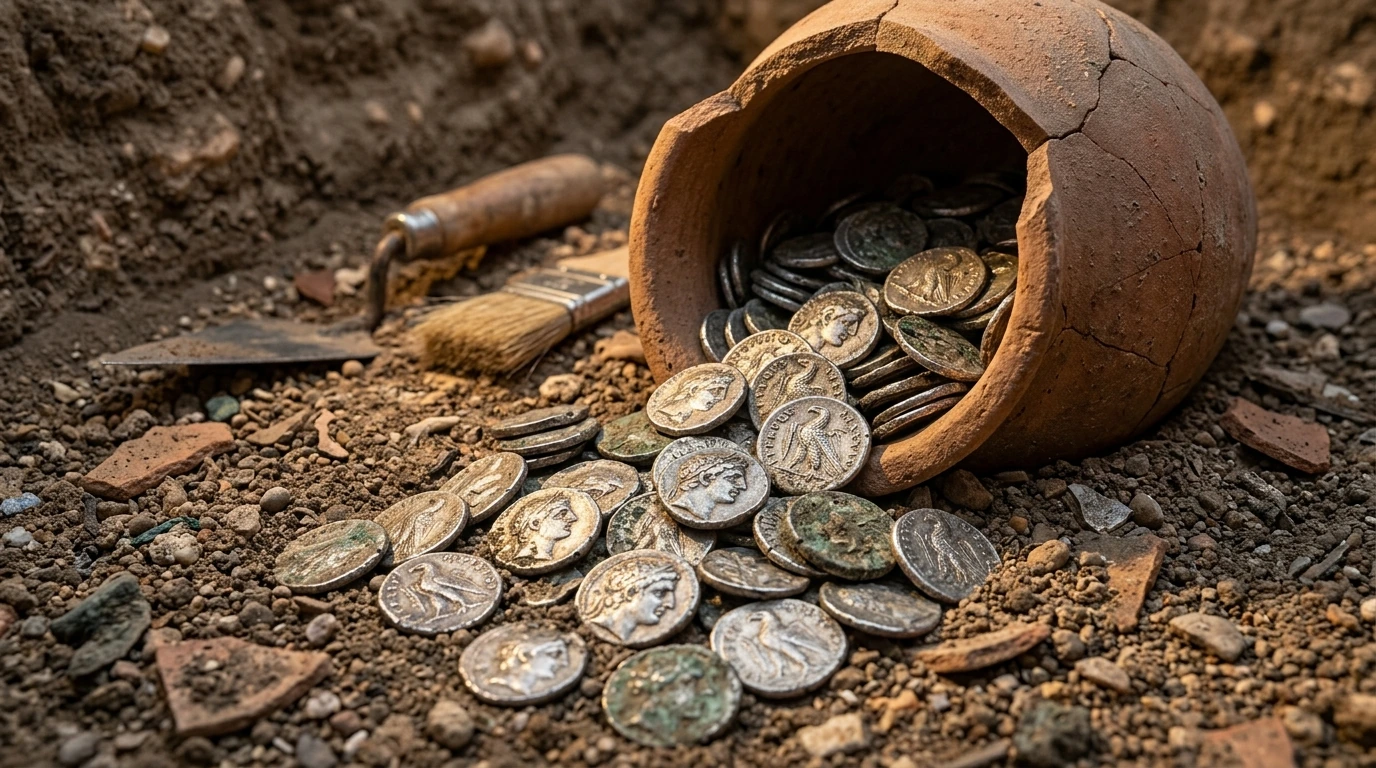
The Tyrian Shekel, Temple Tax, and the 30 Pieces of Silver: Numismatics, Matthew 26, and Judas’s Betrayal
Render to Caesar: The Tribute Penny, Tiberius Denarius, and Mark 12 in Primary Roman Numismatic Sources
