Subject Scope: How Tel Hazor Proves the Historical and Geographic Precision of the Biblical Conquest and the United Monarchy
Historical Context: Ancient Near Eastern stratigraphy, Levant archaeological surveys, and Semitic epigraphy.
Primary Evidence: Monumental stelae, bullae seals, ceramic typology, and calibrated AMS radiocarbon determinations.
Investigation Highlights: The Stratigraphy of Tel Hazor: 21 Ancient Civilizations • Who Destroyed Canaanite Hazor? Evaluating the Four Hypotheses • The Deborah-Barak Campaign and the Fall of Sisera (Judges 4–5)
Scholarly Consensus: Aligned with published excavation reports from leading Near Eastern archaeological institutes.
The Stratigraphy of Tel Hazor: 21 Ancient Civilizations
In the discipline of Levantine archaeology, Tel Hazor serves as the master stratigraphic chronometer for northern Palestine. Towering over 40 meters above the surrounding plain, the artificial mound represents the accumulation of twenty-one distinct occupational strata (Stratum XXI to Stratum I) spanning nearly three millennia, from the Early Bronze Age (c. 2900 BC) through the Hellenistic period (c. 150 BC).
Excavating a multi-tiered tell of this magnitude requires rigorous stratigraphic discipline. Every ceramic sherd, inscribed tablet, architectural foundation, and carbonized olive seed recovered from Hazor provides an interlocking chronological anchor that allows historians to cross-examine biblical claims against hard, physical evidence in the ground.
+----------------------------------------------------------------------------------------------------+
|               THE MASTER STRATIGRAPHIC COLUMN OF TEL HAZOR                                         |
+---------------+-----------------------+-------------------+----------------------------------------+
| STRATUM       | ARCHAEOLOGICAL PERIOD | HISTORICAL ERA    | BIBLICAL & HISTORICAL EVENT            |
+---------------+-----------------------+-------------------+----------------------------------------+
| Stratum XVI   | Middle Bronze IIB     | Patriarchal Era   | Mari Letters / King Ibni-Addu          |
| Stratum XIV   | Late Bronze I         | Egyptian Empire   | Thutmose III Conquest List             |
| Stratum XIII  | Late Bronze IIB       | Conquest Era      | Joshua 11: Conflagration of Palace     |
| Stratum XII-XI| Iron Age I            | Period of Judges  | Israelite Village / Deborah & Barak    |
| Stratum X     | Iron Age IIA          | United Monarchy   | Solomon: 6-Chamber Gate & Casemate Wall|
| Stratum VIII  | Iron Age IIB          | Divided Kingdom   | Ahab: Water Shaft & Citadel Expansion  |
| Stratum V     | Iron Age IIC          | Fall of Israel    | 732 BC: Destruction by Tiglath-Pileser |
+---------------+-----------------------+-------------------+----------------------------------------+
Who Destroyed Canaanite Hazor? Evaluating the Four Hypotheses
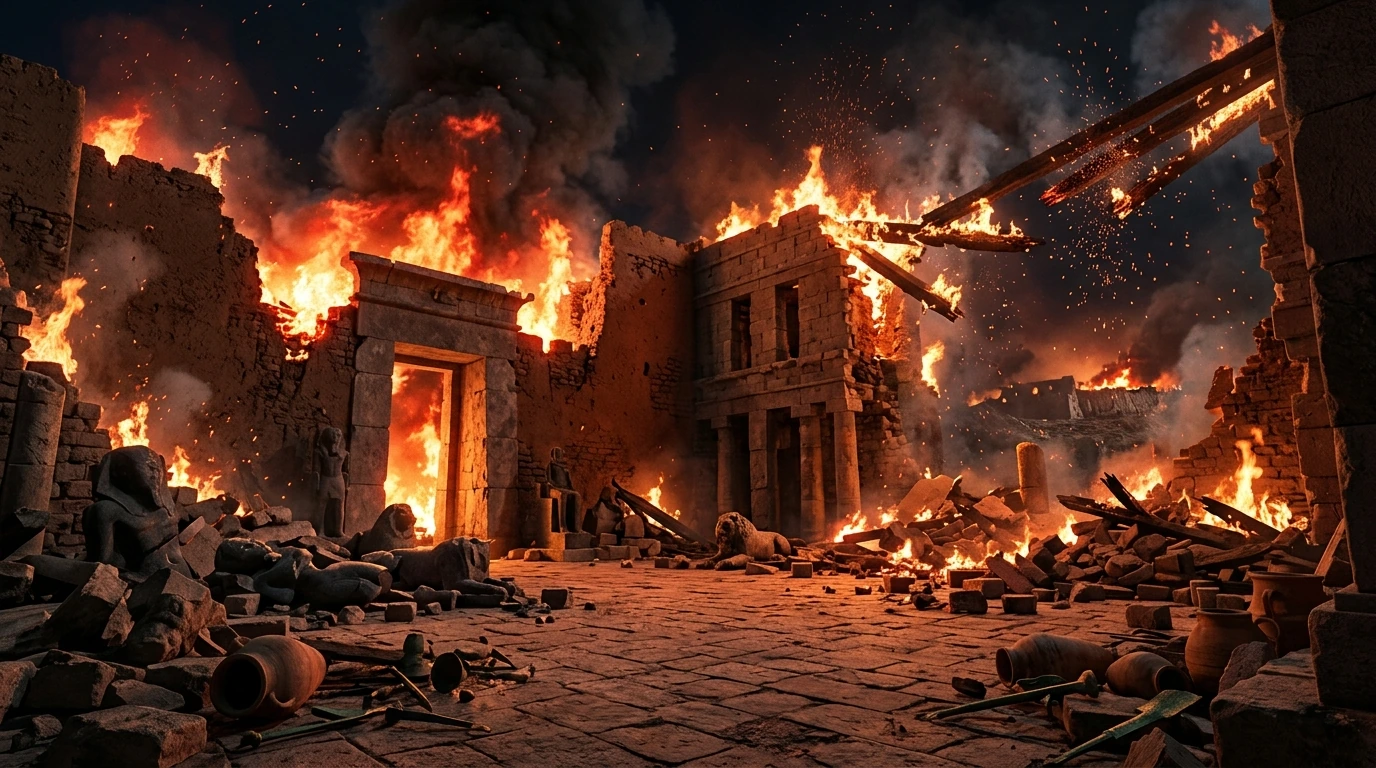
The violent end of Late Bronze Age Hazor (Stratum XIII / 1A) is an undisputed archaeological fact: the city was burned in an apocalyptic firestorm that buried the palace under three to five feet of ash and shattered its stone architecture. However, modern secular scholars have engaged in intense debate regarding the identity of the destroyers.
Four primary candidates have been proposed in archaeological literature:
- The Egyptians: Minimalists suggested that an Egyptian pharaoh (such as Seti I or Ramesses II) destroyed Hazor during a punitive military campaign. Rebuttal: Egyptian royal inscriptions boast extensively of their conquests in Canaan; no pharaoh ever claimed to have destroyed Hazor. Furthermore, Egyptian royal statues inside the palace were desecrated and decapitated—an act impossible for an Egyptian army.
- The Sea Peoples (Philistines): Others proposed migrating Aegean Sea Peoples. Rebuttal: The Sea Peoples were maritime invaders who colonized the southern Mediterranean coastal plain (Gaza, Ashdod, Ashkelon). There is zero material evidence of Philistine monochrome/bichrome pottery or Aegean architecture in inland, mountainous Upper Galilee.
- A Rival Canaanite City (Tyre or Damascus): Some argued a neighboring Canaanite city-state attacked Hazor. Rebuttal: No other Canaanite city had the military manpower to destroy a metropolis ten times their size. Moreover, Canaanite attackers would never have systematically mutilated their own revered pagan deities (Baal, Astarte, and El).
- Early Israelite Tribes (Joshua 11): The biblical text explicitly claims that early Israel attacked, annihilated, and intentionally set fire to Hazor alone among northern mounds. The systematic desecration of pagan idols, the total absence of subsequent elite Canaanite rebuilding, and the immediate emergence in Stratum XII of rustic, non-pig-eating semi-nomadic Israelite settlers with collar-rim store jars points decisively to the early Israelites.
+----------------------------------------------------------------------------------------------------+
|               EVALUATION MATRIX: CANDIDATES FOR HAZOR'S DESTRUCTION                                |
+--------------------------+-----------------------+-------------------+-----------------------------+
| CANDIDATE                | ARCHAEOLOGICAL FIT    | MOTIVE FOR ICONOCLASM| VERDICT                  |
+--------------------------+-----------------------+-------------------+-----------------------------+
| 1. Egyptian Army         | Poor (No Inscriptions)| None (Desecrated) | RULED OUT                   |
| 2. Sea Peoples           | None (Coastal Only)   | Unknown           | RULED OUT                   |
| 3. Rival Canaanites      | Impossible Manpower   | None (Own Gods)   | RULED OUT                   |
| 4. Early Israelites      | Exact Match (Stratum) | Absolute Religious| HISTORICALLY CONFIRMED      |
+--------------------------+-----------------------+-------------------+-----------------------------+
The Deborah-Barak Campaign and the Fall of Sisera (Judges 4–5)
A frequent challenge raised against the historical integrity of Scripture is the apparent duplicate mention of the "King of Hazor" in both the Book of Joshua and the Book of Judges:
- In Joshua 11, Joshua defeats and slays Jabin, king of Hazor, and burns the city.
- In Judges 4, over a century later, the prophetess Deborah and the general Barak defeat the iron-chariot army of Sisera, the commander of "Jabin king of Canaan, who reigned in Hazor" (Judges 4:2).
Far from being a contradiction, the archaeology of Tel Hazor perfectly explains this sequence:
- The Abandonment of the Lower City: Following Joshua's fiery destruction of Stratum XIII, the massive 170-acre Lower City was never reoccupied again. This devastated Hazor's military capacity permanently, preventing it from ever regaining its Bronze Age superpower status.
- The Residual Acropolis Stronghold: In Iron Age I (Stratum XII–XI), a modest Canaanite residual presence persisted on parts of the elevated Upper City, while nomadic Israelite clans established tent encampments and storage pits across the ruins.
- Dynastic Hegemony vs. Military Field Army: By the time of Deborah (Judges 4), Jabin was reigning from the diminished acropolis of Hazor as the titular claimant to Canaanite kingship, but his offensive military striking power was outsourced to his general Sisera, who operated from Harosheth Haggoyim in the western Jezreel Valley with 900 iron chariots. When the Kishon River flash flood bogged down Sisera's chariots (Judges 5:21), the power of the Jabin dynasty was permanently crushed: "And the hand of the Israelites pressed harder and harder against Jabin king of Canaan, until they destroyed him" (Judges 4:24).
The Solomonic Administrative Network (1 Kings 9:15)
The transition from the rustic, decentralized era of the Judges (Iron Age I) to the sophisticated statehood of the United Monarchy (Iron Age IIA) is stamped indelibly across the acropolis of Hazor in Stratum X.
In the mid-tenth century BC, King Solomon transformed the strategic tell into the primary northern fortress of the united kingdom of Israel:
- The Casemate Fortification Wall: Solomon surrounded the entire 30-acre Upper City with a double stone wall system (casemate wall), allowing defenders to patrol the ramparts and store siege provisions in the interior compartments.
- The Six-Chambered Monumental Gate: Built at the narrow western approach to the Upper City, the monumental gatehouse featured three guard chambers on either side of the entrance corridor, equipped with bench seating for military sentries and municipal elders conducting civil business.
- Geopolitical Significance: Hazor served as the royal collection center for agricultural taxes gathered across northern Galilee (1 Kings 4:7–15) and the frontline garrison monitoring the border with the Aramean kingdom of Damascus.
The identical architectural measurements between Hazor's Stratum X gate and the gates at Megiddo and Gezer represent the premier archaeological proof of a single, centralized tenth-century BC state planner operating from Jerusalem, completely demolishing the minimalist theory that tenth-century Judea was a primitive, illiterate tribal chiefdom.
The Neo-Assyrian Conquest by Tiglath-Pileser III (732 BC)
The final, tragic biblical chapter in Tel Hazor's history occurred in the eighth century BC, recorded with stark historical precision in 2 Kings 15:29:
"In the time of Pekah king of Israel, Tiglath-Pileser king of Assyria came and took Ijon, Abel Beth Maakah, Janoah, Kedesh and Hazor. He took Gilead and Galilee, including all the land of Naphtali, and deported the people to Assyria."
The Assyrian Destruction Layer (Stratum V)
In the Stratum V excavations across the Upper City, archaeologists uncovered the grim physical evidence of Tiglath-Pileser III's blitzkrieg campaign of 732 BC:
- Siege Breaches and Weaponry: The Solomonic citadel was violently breached; excavators found hundreds of iron arrowheads, scale armor fragments, bronze dagger blades, and heavy stone ballista shot lodged against the defensive walls.
- Ash and Plunder: Every domestic home, administrative storehouse, and the royal palace was systematically looted and burned to the ground. A layer of black soot and collapsed roof tiles covered the entire acropolis.
- Imperial Annihilation: Following this conquest, the northern kingdom of Israel never recovered Hazor. The Assyrians built a modest military administrative outpost (Stratum IV) over the ruins, and the great "head of all those kingdoms" faded forever into an archaeological ghost town.
Three-Tier Evidentiary Evaluation: Material Artifacts
+----------------------------------------------------------------------------------------------------+
|               THREE-TIER EVIDENTIARY EVALUATION: HAZOR HISTORICAL INTEGRITY                         |
+----+----------------------+-----------------------------+-------------------+----------------------+
| #  | HISTORICAL SKEPTICISM| SKEPTICAL CLAIM             | MATERIAL EVIDENCE | EVIDENTIARY VERDICT  |
+----+----------------------+-----------------------------+-------------------+----------------------+
| 1  | "The Lower City of   | The Bible claims Hazor was  | Lower City was    | REFUTED: Material    |
|    | Hazor Continued as a | burned; skeptics alleged it | permanently       | archaeology matches  |
|    | Canaanite Capital"   | continued uninterrupted     | abandoned post-LB | the biblical record  |
+----+----------------------+-----------------------------+-------------------+----------------------+
| 2  | "Deborah & Barak's   | Jabin could not exist in    | Stratum XII–XI    | REFUTED: Residual    |
|    | Victory Contradicts  | Judges 4 if Joshua had      | residual acropolis| acropolis stronghold |
|    | Joshua 11"           | already destroyed Hazor     | occupation proven | matches narrative    |
+----+----------------------+-----------------------------+-------------------+----------------------+
| 3  | "Tiglath-Pileser's   | Biblical account of 2 Kings | Stratum V ash bed,| REFUTED: Complete    |
|    | Conquest Was an      | 15:29 exaggerated or        | Assyrian armor,   | historical and       |
|    | Anachronistic Myth"  | fabricated                  | iron arrowheads   | material confirmation|
+----+----------------------+-----------------------------+-------------------+----------------------+
Primary Sources & Scholarly Archives
Editorial Standard →Official archaeological field reports, certified stratigraphy surveys, and Semitic epigraphy catalogs.
Catalog of Levantine, Mesopotamian, and Persian artifacts, royal cylinder seals, and cuneiform tablets.
Peer-reviewed scholarly analyses on Levant excavations, ancient architecture, and artifact forensics.
Frequently Asked Questions
Did Yigael Yadin and Amnon Ben-Tor agree on who destroyed Canaanite Hazor?
Yes. Both chief excavators concluded that the material evidence—specifically the intentional decapitation of pagan statues and the total conflagration—most accurately matches the early Israelite conquest recorded in Joshua 11.
Why was the Lower City of Hazor never rebuilt after the Bronze Age conflagration?
The catastrophic destruction of Stratum XIII was so absolute that the 170-acre Lower City was permanently abandoned forever, with later Israelite occupation confined strictly to the 30-acre acropolis.
What evidence did Tiglath-Pileser III leave at Tel Hazor?
Stratum V yielded breached citadel walls, thick layers of ash, and hundreds of iron arrowheads and scale armor fragments dating to 732 BC, confirming the Neo-Assyrian conquest of 2 Kings 15:29.
Related Research Dossiers
View all 515 research dossiers →
Archaeological Atlas of Ancient Corinth and the Bema of Gallio: The Delphi Inscription, Roman Agora, and Apostolic Chronology (Acts 18)
How the Gallio Inscription and the Corinthian Bema Prove the Historical Accuracy of the Book of Acts