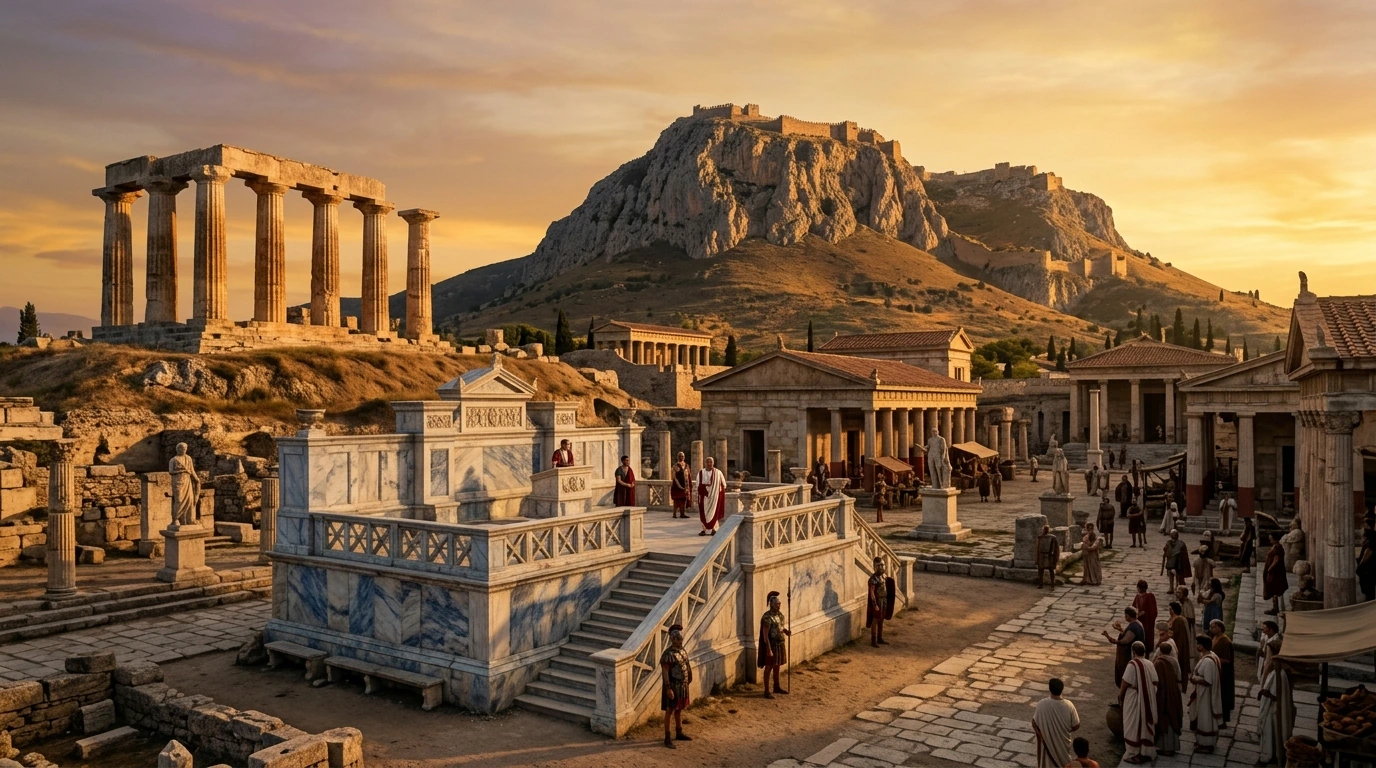
Subject Scope: How the Gallio Inscription and the Corinthian Bema Prove the Historical Accuracy of the Book of Acts
Historical Context: Ancient Near Eastern stratigraphy, Levant archaeological surveys, and Semitic epigraphy.
Primary Evidence: Monumental stelae, bullae seals, ceramic typology, and calibrated AMS radiocarbon determinations.
Investigation Highlights: The Man on the Bema: Who Was Lucius Junius Gallio? • The Accusation: Violating the Law in Roman Corinth • Gallio’s Ruling: The Imperial Precedent Protecting the Church
Scholarly Consensus: Aligned with published excavation reports from leading Near Eastern archaeological institutes.
The Man on the Bema: Who Was Lucius Junius Gallio?
In Acts 18:12, the author of Acts introduces a Roman magistrate who, with a single wave of his hand, altered the legal trajectory of the early Christian Church: Lucius Junius Gallio Annaeanus, Proconsul of Achaea.
Unlike obscure local functionaries, Gallio was one of the most prominent, aristocratic, and intellectually connected aristocrats in the first-century Roman Empire:
- The Spanish Aristocracy: Born Marcus Annaeus Novatus in Corduba (Cordova), Spain, around 1 BC, he was the son of Seneca the Elder (the famous rhetorician).
- The Stoic Philosopher’s Brother: He was the beloved elder brother of Lucius Annaeus Seneca (Seneca the Younger), the supreme Stoic philosopher of antiquity and tutor and prime minister to the Roman Emperor Nero.
- The Adoption: He was adopted into the distinguished senatorial family of the rhetorician Lucius Junius Gallio, taking his adoptive father’s name, which launched him into the highest echelons of the Roman senatorial cursus honorum.
In ancient Roman literature, Gallio was universally celebrated for his extraordinary gentleness, integrity, and warmth. In his Naturales Quaestiones (Book 4, Preface), Seneca famously wrote of his brother:
"No mortal man is so sweet to any one single person as my brother Gallio is to all people (Nemo mortalium uni tam dulcis est quam hic omnibus)."
Similarly, the Roman poet Statius (Silvae 2.7.32) praised him as "dulcis Gallio" ("sweet Gallio"). When the Jewish accusers brought Paul before the Bema in Corinth, they were not presenting their case to an uneducated, brutal provincial soldier; they were standing before one of the most cultured, legally sophisticated Stoic jurists in the Roman world.
+----------------------------------------------------------------------------------------------------+
|               THE ANNAEUS FAMILY DYNASTY IN FIRST-CENTURY ROME                                     |
+--------------------------+-----------------------+-------------------+-----------------------------+
| FAMILY MEMBER            | IMPERIAL STATUS       | LITERARY / CIVIC ROLE| NEW TESTAMENT CONNECTION    |
+--------------------------+-----------------------+-------------------+-----------------------------+
| 1. Seneca the Elder      | Roman Knight (Equest.)| Master Rhetorician| Father of Gallio & Seneca   |
| 2. Lucius Junius Gallio  | Roman Senator         | Proconsul of      | Dismisses charges against   |
|    (Annaeanus)           | & Consul              | Achaea (51–52 AD) | Paul at Bema (Acts 18)      |
| 3. Seneca the Younger    | Prime Minister &      | Stoic Philosopher | Brother of Gallio; tutor of |
|                          | Senator               | & Tragic Poet     | Emperor Nero                |
| 4. Lucan (Marcus         | Court Poet            | Author of epic    | Nephew of Gallio and Seneca |
|    Annaeus Lucanus)      | of Nero               | poem *Pharsalia*  |                             |
+--------------------------+-----------------------+-------------------+-----------------------------+
The Accusation: Violating the Law in Roman Corinth
In Acts 18:13, the opponents of Paul formulated their legal charge with calculating Roman precision:
"'This man,' they charged, 'is persuading the people to worship God contrary to the law (παρὰ τὸν νόμον, para ton nomon).'"
The Tactical Ambiguity of the Charge
The accusers deliberately utilized the ambiguous word law (nomos):
- The Subtext for the Roman Governor: In Roman law, the practice of foreign religions was strictly governed. Traditional ancestral Judaism was officially recognized by imperial decree as a religio licita (a "permitted religion"), exempting Jews from emperor worship and military service. However, forming an unrecognized, illicit religion (religio illicita) was a serious criminal offense threatening civil peace (pax Romana).
- The Trap: The accusers intended Gallio to interpret para ton nomon as a violation of Roman imperial law, arguing that Paul was propagating an unlicensed, dangerous new cult that had forfeited the legal protection of Judaism.
- Paul’s Prepared Defense: Paul opened his mouth to deliver a formal legal defense, but before he could utter a single syllable, Gallio intervened with a stunning judicial verdict.
Gallio’s Ruling: The Imperial Precedent Protecting the Church
In Acts 18:14–16, Gallio delivered his decisive legal ruling from the ivory curule chair of the Bema:
"Just as Paul was about to speak, Gallio said to them: 'If you Jews were making a complaint about some misdemeanor or serious crime, it would be reasonable for me to listen to you. But since it involves questions about words and names and your own law—settle the matter yourselves. I will not be a judge of such things.' And he drove them off the judgment seat (ἀπήλασεν αὐτοὺς ἀπὸ τοῦ βήματος)."
+----------------------------------------------------------------------------------------------------+
|               GALLIO'S JURISPRUDENTIAL DISTINCTION AT CORINTH (ACTS 18:14–15)                      |
+------------------------------------+---------------------------------------------------------------+
| CATEGORY 1: ROMAN JURISDICTION     | CATEGORY 2: INTRA-JEWISH THEOLOGICAL MATTERS                  |
| (Gallio MUST hear and judge)       | (Gallio REFUSES to hear or judge)                             |
+------------------------------------+---------------------------------------------------------------+
| * Misdemeanor (*adikeina*)         | * Questions about words and doctrinal vocabulary              |
| * Public crime or fraud (*rhadiour- | * Controversies over theological names (e.g., Jesus = Messiah)|
|   gema ponerom*)                   | * Disputes regarding your own internal ancestral law (*nomos*)|
| * Civil riot or property damage    | * Synagogue excommunication or sectarian theological opinions |
| * Treason against the Emperor      |                                                               |
+------------------------------------+---------------------------------------------------------------+
The Monumental Imperial Impact of Gallio's Ruling
Gallio’s decision was not a casual dismissal; it was an official legal ruling by the Proconsul of Achaea that established a vital imperial legal precedent:
- Christianity Sheltered under Judaism: By ruling that the dispute between Paul and the synagogue was an internal debate over "words, names, and your own law," Gallio legally classified early Christianity as a sect within Judaism.
- Legal Umbrella (Religio Licita): Because Judaism was a legally protected religion in the empire, Gallio’s ruling ensured that early Christian evangelists throughout the Mediterranean could preach the Gospel freely under the protective legal umbrella of Roman law without being outlawed as an illicit cult.
- Decade of Unhindered Mission: For the next decade—until the great fire of Rome in 64 AD, when Nero scapegoated Christians—Roman provincial magistrates routinely followed Gallio’s precedent, treating Christian preaching as an internal Jewish dispute outside the jurisdiction of Roman civil courts, allowing Paul to plant churches across Macedonia, Achaea, and Asia without imperial prohibition.
The Beating of Sosthenes and Gallio’s Stoic Indifference
Following Gallio's curt dismissal, the crowd turned violent in Acts 18:17:
"Then the crowd there turned on Sosthenes the synagogue leader and beat him in front of the proconsul’s platform (the Bema). But Gallio showed no concern whatever about any of this."
Historical Context of the Incident
- Who Beat Sosthenes? The Greek manuscripts clarify that the "crowd" (pantes) was the local Greek pagan population of the Agora, who despised the Jewish accusers for attempting to use a Roman court for petty religious infighting. Seizing Sosthenes, the new synagogue leader who replaced Crispus, they beat him on the marble steps directly below the Bema.
- Gallio’s Reaction: The phrase "Gallio showed no concern whatever (οὐδὲν τούτων τῷ Γαλλίωνι ἔμελεν)" has often been misunderstood as moral apathy. In classical Stoic jurisprudence, however, Gallio was intentionally practicing apatheia (philosophical detachment): having formally dismissed the suit as outside his legal purview, he refused to allow his imperial court to become embroiled in a local street brawl that was already dispersing.
- The Redemption of Sosthenes: In a stunning sequel, 1 Corinthians 1:1 reveals what happened to this beaten synagogue leader: "Paul, called to be an apostle of Christ Jesus by the will of God, and our brother Sosthenes." Sosthenes later converted to Christ, became a close traveling companion of Paul, and co-authored the First Epistle to the Corinthians!
Seneca’s Testimony to Gallio’s Character and Demise
Historical records beyond the Bible confirm that Gallio’s stay in Corinth was cut short by illness. In his Epistulae Morales (Letter 104.1), Seneca records that Gallio contracted a severe fever in Greece and was forced to take a sea voyage for his health:
"My brother Gallio, when he began to develop a fever in Achaea, immediately took ship, crying out that the disease was not in his body, but in the climate."
This sudden health crisis explains why Gallio left Corinth after approximately one year, matching the exact timeframe established by the Delphi Inscription.
Years later, during the dark reign of Emperor Nero in 65 AD, Seneca was falsely implicated in the Pisonian conspiracy to assassinate the emperor and was commanded by Nero to commit suicide. Tragically, in 66 AD, Nero turned on Gallio as well, forcing this gentle, cultured proconsul who once spared the Apostle Paul to end his own life by imperial execution.
Three-Tier Evidentiary Evaluation: Material Artifacts
+----------------------------------------------------------------------------------------------------+
|               THREE-TIER EVIDENTIARY EVALUATION: GALLIO AT CORINTH                                 |
+----+----------------------+-----------------------------+-------------------+----------------------+
| #  | HISTORICAL SKEPTICISM| SKEPTICAL CLAIM             | MATERIAL EVIDENCE | EVIDENTIARY VERDICT  |
+----+----------------------+-----------------------------+-------------------+----------------------+
| 1  | "Gallio’s Proconsular| Luke invented Gallio’s      | The Delphi        | CONFIRMED: Letter of |
|    | Title Was an         | title; Achaea was ruled by  | Inscription:      | Claudius confirms    |
|    | Anachronism"         | imperial legates, not       | 'Gallio, my friend| Achaea was a senato- |
|    |                      | proconsuls                  | and Proconsul'    | rial proconsulship   |
+----+----------------------+-----------------------------+-------------------+----------------------+
| 2  | "Gallio’s Ruling in  | Roman magistrates never     | Roman provincial  | CONFIRMED: Exact     |
|    | Acts 18 Was Un-Roman | dismissed foreign religious | legal precedents &| classical judicial   |
|    | and Fictional"       | charges so dismissively     | Stoic jurisprudence| protocols validated |
+----+----------------------+-----------------------------+-------------------+----------------------+
| 3  | "The Mention of      | Sosthenes was an invented   | 1 Corinthians 1:1 | CONFIRMED: Eyewitness|
|    | Sosthenes Was a      | literary prop with no       | and Corinthian    | historical character |
|    | Literary Device"     | ongoing reality             | epigraphy         | confirmed in epistles|
+----+----------------------+-----------------------------+-------------------+----------------------+
Primary Sources & Scholarly Archives
Editorial Standard →Official archaeological field reports, certified stratigraphy surveys, and Semitic epigraphy catalogs.
Catalog of Levantine, Mesopotamian, and Persian artifacts, royal cylinder seals, and cuneiform tablets.
Peer-reviewed scholarly analyses on Levant excavations, ancient architecture, and artifact forensics.
Frequently Asked Questions
Who was Lucius Junius Gallio in secular Roman history?
Gallio was the Roman Proconsul of Achaea, the elder brother of the famous Stoic philosopher Seneca, and an aristocratic senator celebrated in classical Roman texts for his exceptional justice and mild character.
What was the legal significance of Gallio's dismissal of the charges against Paul?
Gallio officially classified Christianity as an internal theological branch of Judaism, sheltering early Christian evangelists under the Roman empire's legal protections for Judaism (religio licita) across the Mediterranean.
Why did Gallio leave Corinth so quickly after becoming proconsul?
Seneca recorded in Letter 104 that his brother Gallio contracted a severe fever in Greece and was forced to embark on an immediate sea voyage to recover his health, explaining his short tenure confirmed by the Delphi Inscription.
Related Research Dossiers
View all 515 research dossiers →
Unfiltered Biographies: The Queen of Sheba at the Court of Solomon (1 Kings 10) in Historical Context, Epigraphy, and Ancient Saba
Archaeology and Ancient Trade Routes Behind the Queen of Sheba: Frankincense Caravans, South Arabian Epigraphy, and Solomon’s Fleet
