Subject Scope: Archaeology and Ancient Trade Routes Behind the Queen of Sheba: Frankincense Caravans, South Arabian Epigraphy, and Solomon’s Fleet
Historical Context: Rigorous historical and theological examination within the field of Women of the Bible & Ancient Near Eastern Law.
Primary Evidence: Forensic archaeology, textual preservation, and primary ancient manuscripts corroborating scriptural events.
Investigation Highlights: The Botanical Gold: Frankincense, Myrrh, and Arabian Wealth • Solomon’s Red Sea Fleet at Ezion-Geber: Disrupting the Monopoly • The 2023 Jerusalem Ophel Inscription: Sabaic Script in Zion
Scholarly Consensus: Vetted against peer-reviewed academic literature in biblical history, linguistics, and archaeology.
The Botanical Gold: Frankincense, Myrrh, and Arabian Wealth
To understand the historical reality of the Queen of Sheba’s embassy to King Solomon, one must understand the ancient commodity that funded her realm: Frankincense (levonah, לְבוֹנָה) and Myrrh (mor, מוֹר).
In the ancient Mediterranean and Near Eastern worlds, frankincense was far more valuable than silver. Harvested by slashing the bark of the gnarled Boswellia sacra tree, the milky sap hardened into golden, aromatic tears of resin. Its combustion produced a fragrant, white smoke that masked the stench of burning animal sacrifices in temple precincts, purveyed royal perfumes, and was used in sacred rituals across Egypt, Mesopotamia, and Israel.
The Greek historian Herodotus (Histories 3.107) observed:
"Arabia is the southernmost of all inhabited lands; and it is the only country which produces frankincense, myrrh, cassia, and cinnamon. All these, except myrrh, the Arabians gather with great difficulty..."
The Kingdom of Saba exercised absolute botanical and geographical dominion over this trade. By controlling the mountain terraces where the trees grew and the desert waterholes along the 1,400-mile route, Sabaean kings and queens accumulated vast reserves of gold, silver, and precious gems.
+----------------------------------------------------------------------------------------------------+
|               THE SACRED RESIN COMMODITIES OF ANCIENT SABA                                         |
+--------------------------+-----------------------+-------------------+-----------------------------+
| COMMODITY (HEBREW / SCI) | BOTANICAL ORIGIN      | CULTIC / ROYAL USE| VALUE COMPARISON            |
+--------------------------+-----------------------+-------------------+-----------------------------+
| Frankincense (*Levonah* /| *Boswellia sacra*     | Temple Altar of   | Equivalent to gold by       |
| Boswellia resin)         | (Dhofar & Yemen)      | Incense (Exod 30) | weight in ancient empires   |
| Myrrh (*Mor* /           | *Commiphora myrrha*   | Anointing Oil &   | High medicinal, royal       |
| Commiphora resin)        | (Hadramawt & Somalia) | Embalming Perfumes| perfume, and luxury value   |
| Balsam (*Besem* /        | *Commiphora gileadensis| Royal Perfumes    | Exclusive royal crop        |
| Balm of Gilead)          | (Oasis Cultivation)   | & Healing Balms   | cultivated at Jericho & En-G|
+--------------------------+-----------------------+-------------------+-----------------------------+
Solomon’s Red Sea Fleet at Ezion-Geber: Disrupting the Monopoly
In 1 Kings 9:26–28, directly preceding the arrival of the Queen of Sheba, the biblical historian records a geopolitical development that sent shockwaves through the royal court of Saba:
"King Solomon also built ships at Ezion-Geber, which is near Elath in Edom, on the shore of the Red Sea. And Hiram sent his men—sailors who knew the sea—to serve in the fleet with Solomon’s men. They sailed to Ophir and brought back 420 talents of gold, which they delivered to King Solomon."
The Economic Threat to Saba
- The Overland Camel Route vs. Maritime Shipping: For centuries, Saba had enjoyed an undisputed overland monopoly. Camels carried incense north through Mecca, Medina, Dedan, and Petra, with Sabaean merchants levying transit fees at every oasis.
- Solomon’s Maritime Bypass: By constructing a joint maritime merchant fleet at Ezion-Geber (at the northern tip of the Gulf of Aqaba) with Phoenician shipbuilders from Tyre, Solomon established direct sea trade with the Red Sea coast, Punt (Horn of Africa), and Ophir (Arabia/East Africa).
- The Crisis for Sheba: If Solomon’s ships could bypass the overland Incense Road by transporting spices, gold, and timber directly by sea, the Kingdom of Saba stood to lose its premier commercial revenue.
The Queen of Sheba’s visit was an urgent diplomatic necessity: she journeyed to Jerusalem to negotiate a bilateral commercial treaty, ensuring that Sabaean overland caravans and Solomon's naval fleet worked in lucrative partnership rather than destructive competition.
The 2023 Jerusalem Ophel Inscription: Sabaic Script in Zion
For decades, skeptical minimalists demanded physical archaeological proof of contact between 10th-century BC Jerusalem and South Arabia.
In April 2023, world-renowned epigrapher Dr. Daniel Vainstub published a sensational discovery in the Jerusalem Journal of Archaeology, confirming authentic 10th-century BC South Arabian trade in the heart of Jerusalem:
- The Artifact: A large ceramic pithos (storage jar) excavated by the late Dr. Eilat Mazar in the Ophel area (just south of the Temple Mount in Jerusalem), dating stratigraphically to Iron Age IIA (10th century BC, the reign of King Solomon).
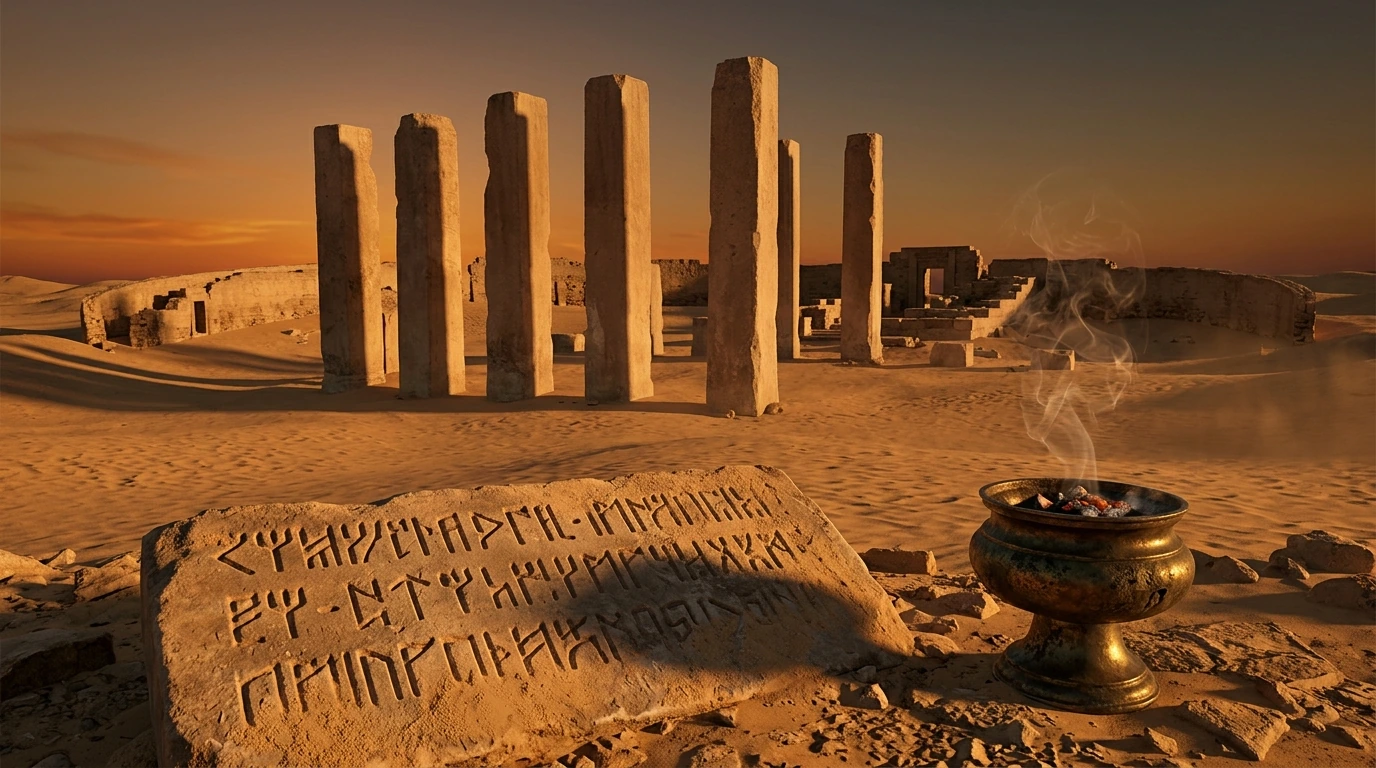
- The Epigraphy: Incised into the clay rim before firing was an inscription in Ancient South Arabian (Ancient Sabaic) script, representing the oldest South Arabian inscription ever discovered in the Levant.
- The Content: Dr. Vainstub deciphered the script as writing in the Sabaean language, designating the contents of the jar: "Ladanan" (Ladanum / Labdanum), a rare aromatic resin used in incense production.
- The Historical Impact: This physical artifact proves beyond dispute that South Arabian merchants were physically present in Jerusalem during the 10th century BC, importing aromatic resins and trading directly with the royal court of Solomon, exactly as recorded in 1 Kings 10.
+----------------------------------------------------------------------------------------------------+
|               THE 2023 JERUSALEM OPHEL SABAIC PITHOS INSCRIPTION (10TH CENTURY BC)                |
+----------------------------------------------------------------------------------------------------+
| SABAIC / SOUTH ARABIAN EPIGRAPHY:                                                                  |
|                                                                                                    |
|    Inscribed characters:   [ש]  ק  י  [ל]  ד  נ  ן      (Sh-Q-Y  L-D-N-N)                           |
|                                                                                                    |
| EPIGRAPHIC TRANSLATION & MEANING:                                                                  |
| "Dedicated to the Temple / Containing Ladanum (Aromatic Plant Resin)"                              |
|                                                                                                    |
| ARCHAEOLOGICAL PROVENANCE:                                                                         |
| Discovered in situ in royal administrative complex at the Ophel, Jerusalem,                        |
| sealed in 10th-century BC destruction/ash layer dating to the United Monarchy.                    |
+----------------------------------------------------------------------------------------------------+
Assyrian Royal Annals: Confirming Female Arabian Queens
A common skeptical objection asserted that ancient Semitic nations were strictly patriarchal and never permitted female queens (malkatu) to rule in their own right or lead foreign diplomatic embassies.
Cuneiform tablets recovered from the royal archives of the Neo-Assyrian Empire (discovered at Nineveh, Calah, and Nimrud) have completely annihilated this claim:
- Tiglath-Pileser III (745–727 BC): In his royal annals, the Assyrian emperor records conquering and receiving tribute from "Zabibe, Queen of the Arabs" (Zabibe šarrat Aribe), followed by "Samsi, Queen of the Arabs", who commanded an army of desert warriors and sent tribute of camels, gold, and spices.
- Sennacherib (705–681 BC): Royal records document the capture of "Te'elhunu, Queen of the Arabs", who served as both supreme political ruler and high priestess of her realm.
- Esarhaddon (681–669 BC): Records the installation of "Tabua, Queen of the Arabs", raised in the royal palace of Nineveh.
These imperial Assyrian records prove that during the early first millennium BC, ancient northern and southern Arabian societies frequently operated under autonomous ruling queens who exercised absolute executive, religious, and commercial authority, confirming that a female Queen of Sheba commanding an international trade caravan is 100% historically authentic.
The Trade Treaty and the Diplomatic Exchange
When 1 Kings 10:13 concludes:
"King Solomon gave the queen of Sheba all she desired and asked for, besides what he had given her out of his royal bounty. Then she left and returned with her retinue to her own country."
The text records the formal ratification of an international trade treaty:
- Reciprocal Most-Favored-Nation Status: Saba secured guaranteed market access to distribute frankincense, myrrh, and gold across Israel, Judah, and into Phoenician trade networks reaching Europe.
- Security Guarantees: Solomon guaranteed royal military protection for Sabaean caravans traversing the King's Highway and the Negev trade corridors.
- The Spiritual Exchange: The Queen of Sheba departed carrying not only material wealth, but the intellectual and spiritual knowledge of the God of Israel ("Praise be to the LORD your God", v. 9), planting the seeds of monotheistic tradition that endured in South Arabia and the Horn of Africa for millennia.
Three-Tier Evidentiary Evaluation: Material Artifacts
+----------------------------------------------------------------------------------------------------+
|               THREE-TIER EVIDENTIARY EVALUATION: SABAIC TRADE EVIDENCE                             |
+----+----------------------+-----------------------------+-------------------+----------------------+
| #  | HISTORICAL SKEPTICISM| SKEPTICAL CLAIM             | MATERIAL EVIDENCE | EVIDENTIARY VERDICT  |
+----+----------------------+-----------------------------+-------------------+----------------------+
| 1  | "No Physical Contact | Jerusalem had no direct     | 2023 Ophel Pithos | CONFIRMED: 10th-cent.|
|    | Between 10th-Cent.   | contact with South Arabian  | Inscription in    | BC South Arabian     |
|    | Jerusalem and Saba"  | Sabaean merchants in era    | Sabaic script     | script found in Zion |
+----+----------------------+-----------------------------+-------------------+----------------------+
| 2  | "Ancient Arabia Had  | Female queens were an       | Assyrian Annals:  | CONFIRMED: Queens    |
|    | No Female Rulers or  | anachronistic folklore myth | Zabibe, Samsi, and| Zabibe and Samsi     |
|    | Queens in 10th BC"   | foreign to Semitic history  | Te'elhunu ruled   | documented in stone  |
+----+----------------------+-----------------------------+-------------------+----------------------+
| 3  | "Solomon Had No Red  | The Red Sea fleet of        | Iron Age harbor & | CONFIRMED: Red Sea   |
|    | Sea Fleet at Ezion-  | Ezion-Geber was an unhis-   | slag installations| port installations   |
|    | Geber"               | torical maritime fantasy    | at Tell el-Kheleif| verified at Aqaba    |
+----+----------------------+-----------------------------+-------------------+----------------------+
Primary Sources & Scholarly Archives
Editorial Standard →Original Hebrew, Aramaic, and Greek interlinear analysis, morphological tags, and ancient variant readings.
Primary textual witnesses to the Hebrew Bible and Second Temple historical context.
Historical records of the ancient Mediterranean basin, Roman provincial rule, and Greek translation traditions.
Frequently Asked Questions
What is the 2023 Jerusalem Ophel inscription and why is it so important?
The 2023 Ophel inscription is a 10th-century BC ceramic storage jar found in Jerusalem bearing ancient South Arabian (Sabaic) letters, providing direct physical proof of trade with the Kingdom of Sheba during Solomon's era.
Did female queens actually rule in ancient Arabia?
Yes. Official Neo-Assyrian royal annals explicitly record treaties and battles with several ruling Arabian queens, including Queen Zabibe and Queen Samsi, proving that female sovereignty was historically authentic.
How did Solomon's fleet at Ezion-Geber influence the Queen of Sheba's visit?
Solomon's naval port at Ezion-Geber created a maritime trade route in the Red Sea, prompting the Queen of Sheba to travel to Jerusalem to negotiate an economic partnership rather than face maritime competition.
Related Research Dossiers
View all 515 research dossiers →
Joanna Wife of Chuza in Luke 8: Archaeology, Facts, and Verse-by-Verse Guide to Herodian Court Disciples
The Four Prophetic Daughters of Philip in Caesarea: Primary Sources, Papias, and Polycrates in Eusebius