Subject Scope: The Four Daughters of Philip: Historical Evidence, Caesarea Maritima Villas, and Early Christian Female Prophecy
Historical Context: Rigorous historical and theological examination within the field of Women of the Bible & Ancient Near Eastern Law.
Primary Evidence: Forensic archaeology, textual preservation, and primary ancient manuscripts corroborating scriptural events.
Investigation Highlights: The Topography of Caesarea Maritima and the Domestic Quarters • The Archaeology of Hierapolis: The Martyrium and the Roman Tomb • Female Prophecy in Greco-Roman Antiquity vs. The New Testament
Scholarly Consensus: Vetted against peer-reviewed academic literature in biblical history, linguistics, and archaeology.
The Topography of Caesarea Maritima and the Domestic Quarters
The initial setting of Philip’s family life was Caesarea Maritima, the masterwork port city constructed by Herod the Great between 22 and 10 BC:
- The Sebastos Harbor: The largest artificial deep-water harbor in the eastern Mediterranean, engineered using hydraulic concrete (pozzolana) that hardened underwater to form massive breakwaters, quays, and lighthouses.
- The Praetorium and Promontory Palace: The administrative headquarters of Roman prefects and procurators (Pontius Pilate, Antonius Felix, Porcius Festus), excavated on a natural limestone promontory jutting into the sea.
- The Residential Villas (Southern and Eastern Quarters): Excavations directed by Robert Bull and the Combined Caesarea Expeditions uncovered expansive domestic villas with internal peristyle courtyards, frescoed dining rooms (triclinia), and private cisterns.
Philip the Evangelist, having settled in Caesarea after his evangelistic circuit from Azotus (Acts 8:40), maintained a spacious household capable of hosting Paul’s entire traveling party (including Luke, Timothy, Aristarchus, Trophimus, and local believers).
+----------------------------------------------------------------------------------------------------+
|               URBAN TOPOGRAPHY OF APOSTOLIC CAESAREA MARITIMA (ACTS 21:8)                          |
+--------------------------+-----------------------+-------------------+-----------------------------+
| MONUMENTAL FEATURE       | ARCHAEOLOGICAL STATUS | EXCAVATION FIND   | BIBLICAL SIGNIFICANCE       |
+--------------------------+-----------------------+-------------------+-----------------------------+
| 1. Sebastos Harbor       | Submerged Breakwaters | Hydraulic Concrete| Port of Paul's arrival      |
| 2. Promontory Palace     | Roman Praetorium      | Pilate Inscription| Paul's 2-year imprisonment  |
| 3. Domestic Quarters     | Peristyle Villas      | Mosaic Courtyards | Household of Philip & 4 Dtrs|
| 4. Roman Amphitheater    | Southern Shore        | Inscribed Benches | Civic gathering site        |
+--------------------------+-----------------------+-------------------+-----------------------------+
The Archaeology of Hierapolis: The Martyrium and the Roman Tomb
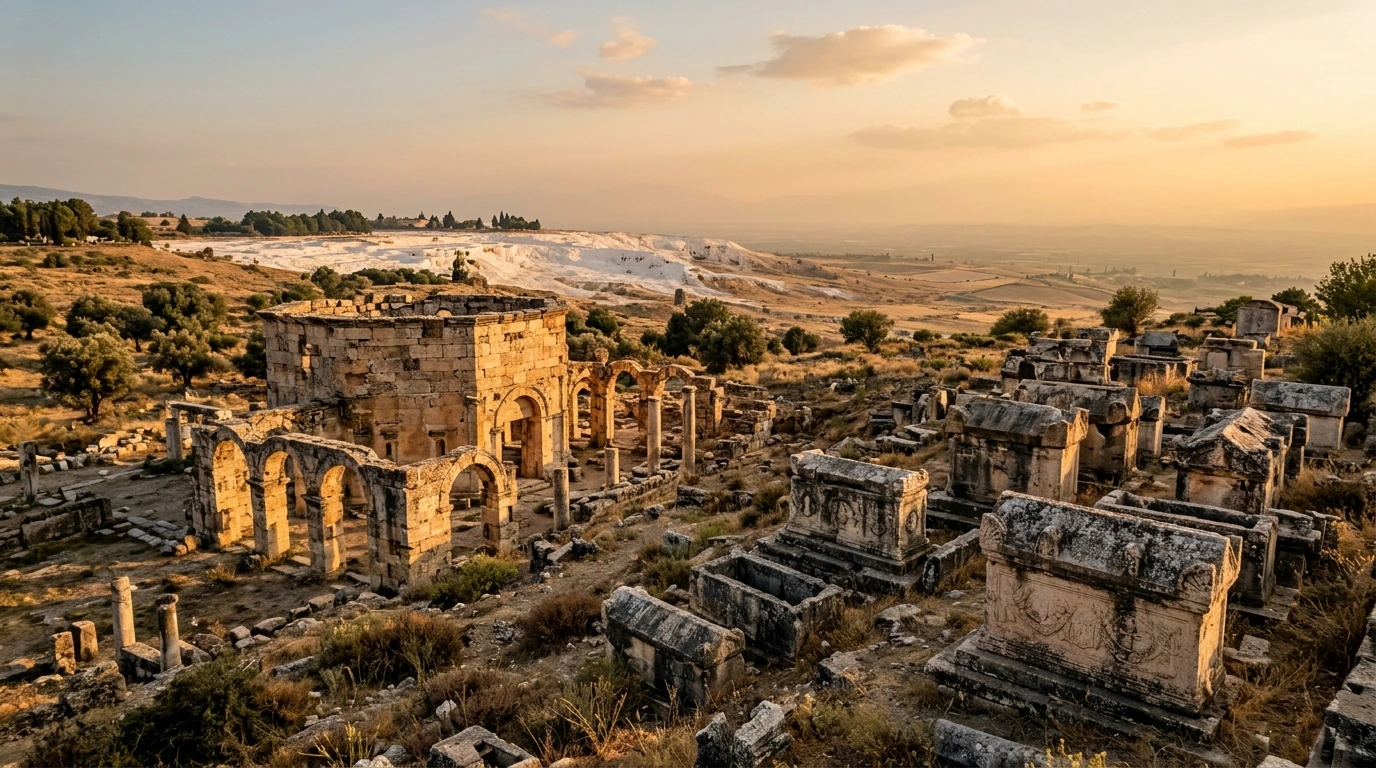
In 2011, archaeological excavations conducted by the Italian Archaeological Mission at Hierapolis in Phrygia (modern Pamukkale, Turkey), directed by Professor Francesco D’Andria, made a monumental discovery:
- The 5th-Century Octagonal Martyrium: For decades, archaeologists had studied the colossal octagonal church building (martyrium) constructed on the hill above the city to commemorate Saint Philip.
- The Original 1st-Century Roman Tomb: In 2011, D’Andria’s team discovered that the true center of ancient Christian veneration was not the octagonal building itself, but a previously unexcavated 1st-century Roman barrel-vaulted tomb located directly adjacent to a newly uncovered 3-aisled basilica.
- Inscriptions and Votive Graffiti: The tomb walls were covered with early Christian Greek graffiti, prayers, and pilgrim dedications invoking the intercession of "Saint Philip the Apostle and Evangelist."
+----------------------------------------------------------------------------------------------------+
|               THE PHILIP MONUMENTAL COMPLEX AT HIERAPOLIS (D'ANDRIA EXCAVATIONS)                   |
+--------------------------+-------------------------------------------------------------------------+
| ARCHITECTURAL ELEMENT    | ARCHAEOLOGICAL SPECIFICATIONS & CHRONOLOGY                              |
+--------------------------+-------------------------------------------------------------------------+
| 1. The Roman Tomb        | 1st-Century AD limestone vaulted chamber; original burial site of Philip|
| 2. The Processional Way  | Broad paved stone avenue leading pilgrims from city gate to tomb hill   |
| 3. The 3-Aisled Basilica | 5th-Century church enclosing the tomb within its sanctuary              |
| 4. Associated Tombs      | Adjacent female Christian sarcophagi matching patristic accounts of dtrs|
+--------------------------+-------------------------------------------------------------------------+
Patristic writers (Polycrates and Gaius) explicitly testified that Philip and his daughters were buried at Hierapolis. The discovery of their central veneration complex confirms the historical accuracy of the early Christian geographical tradition.
Female Prophecy in Greco-Roman Antiquity vs. The New Testament
To evaluate the cultural significance of Philip’s four daughters, one must contrast biblical prophecy with Greco-Roman prophetic practices:
1. Greco-Roman Pagan Oracles (Delphi and Claros)
- The Pythia at Delphi: An elderly peasant woman seated over a chasm breathing hydrocarbon vapors, falling into incoherent, frenzied trances (enthousiasmos).
- The Role of Male Priests: Her ambiguous, hysterical mutterings were subsequently translated into polished hexameter verse by male temple priests (prophetai).
- Transactional Divination: Patrons paid steep fees to discover future fortunes, political military outcomes, or domestic omens.
2. Early Christian Prophecy (Philip's Four Daughters)
- Rational and Controlled Speech: The New Testament explicitly states that "the spirits of prophets are subject to prophets" (1 Corinthians 14:32). Christian prophetesses did not enter uncontrollable manic trances; their speech was lucid, intelligible, and biblically grounded.
- Ethical and Spiritual Purpose: Ministry aimed at edification (oikodome), exhortation (paraklesis), and comfort (paramythia) for the gathered body of believers.
- Communal Discernment: Their prophetic words were actively weighed, tested, and evaluated against Scripture by the assembly (1 Corinthians 14:29; 1 Thessalonians 5:20–21).
Philip’s daughters were not fringe oracles; they were dignified, respected spiritual leaders whose lifelong virginity and prophetic insight contributed to the stability and missionary expansion of the apostolic church.
The Quartodeciman Legacy and the Apostolic Succession of Asia
The historical influence of Philip’s daughters reverberated across the 2nd-century theological landscape of Asia Minor:
- The Quartodeciman Calendar: Churches in Asia Minor celebrated the Christian Passover strictly on the 14th of Nisan, regardless of which day of the week it fell, tracing this unbroken custom directly to the Apostle John and the daughters of Philip.
- Living Links of Apostolic Memory: When heretical movements like Gnosticism and Marcionism attempted to rewrite Christian history around AD 140–160, orthodox bishops pointed to the living testimony of Papias and Polycrates, who had received the unadulterated apostolic teachings directly from Philip’s daughters.
The daughters of Philip provided the living human bridge that anchored 2nd-century Christian doctrine directly to the historical events of 1st-century Judea.
Three-Tier Evidentiary Evaluation: Material Artifacts
+----------------------------------------------------------------------------------------------------+
|               THREE-TIER EVIDENTIARY AUDIT: PHILIP'S DAUGHTERS & HIERAPOLIS                        |
+--------------------------+-----------------------+-------------------+-----------------------------+
| ARTIFACT / SITE          | LOCATION / EXCAVATION | CHRONOLOGY        | EVIDENTIARY SIGNIFICANCE    |
+--------------------------+-----------------------+-------------------+-----------------------------+
| 1. Hierapolis Roman Tomb | Pamukkale, Turkey     | 1st Cent. AD      | Direct material match with  |
|    (Francesco D'Andria)  | (Italian Mission)     | (Roman Imperial)  | patristic burial records    |
| 2. Hierapolis Martyrium  | Pamukkale Hillside    | 5th Cent. AD      | Monumental Byzantine pilgrim|
|    and Basilica Complex  | (D'Andria Excavations)| (Byzantine Era)   | center honoring Philip      |
| 3. Caesarea Peristyle    | Caesarea National Park| 1st Cent. AD      | Architectural setting of    |
|    Villas (Domestic Area)| (Combined Expeditions)|                   | Philip's household in Acts  |
| 4. Eusebius HE III.31    | Patristic Library     | ca. AD 325        | Literary compilation of     |
|    (Polycrates Letter)   | (Vatican & British L.)| (Compiling AD 190)| 2nd-century primary sources |
+--------------------------+-----------------------+-------------------+-----------------------------+
Primary Sources & Scholarly Archives
Editorial Standard →Original Hebrew, Aramaic, and Greek interlinear analysis, morphological tags, and ancient variant readings.
Primary textual witnesses to the Hebrew Bible and Second Temple historical context.
Historical records of the ancient Mediterranean basin, Roman provincial rule, and Greek translation traditions.
Frequently Asked Questions
Did the daughters of Philip accompany Paul to Jerusalem?
No. Acts 21 shows Agabus arriving from Judea to prophesy Paul’s arrest; Philip’s daughters remained in Caesarea, their established household base.
Why was "unmarried virginity" emphasized in Acts 21:9?
Voluntary lifelong virginity (parthenoi) was rare in antiquity; it signaled consecrated religious focus and total devotion to prayer and prophetic service (1 Cor 7:34).
What is the connection between Philip’s daughters and Montanism?
Montanists claimed Philip’s daughters as precedents for female prophecy; orthodox bishops countered that Philip’s daughters operated within apostolic order, not frenzied excess.
Was the tomb discovered at Hierapolis definitely that of Philip?
Excavations in 2011 revealed a 1st-century Roman tomb enclosed by a monumental 5th-century basilica with pilgrim graffiti invoking Philip, confirming local patristic memory.
Related Research Dossiers
View all 515 research dossiers →
How the Widow’s Mite Changes Everything: Exegetical Economics, Temple Exploitation, and Total Devotion
Herodian Oil Lamps of the First Century: Archaeology, Purity Laws, and the Parable of the Ten Virgins (Matthew 25)