Subject Scope: Joanna Wife of Chuza in Luke 8: Archaeology, Facts, and Verse-by-Verse Guide to Herodian Court Disciples
Historical Context: Rigorous historical and theological examination within the field of Women of the Bible & Ancient Near Eastern Law.
Primary Evidence: Forensic archaeology, textual preservation, and primary ancient manuscripts corroborating scriptural events.
Investigation Highlights: Luke 8:1: The Itinerant Circuit Across Galilee and Samaria • Luke 8:2–3: Aristocratic Wealth and the Epitropos Office • Jewish Property Law: Melog and Nedunya Assets
Scholarly Consensus: Vetted against peer-reviewed academic literature in biblical history, linguistics, and archaeology.
Luke 8:1: The Itinerant Circuit Across Galilee and Samaria
The eighth chapter of the Gospel of Luke opens with an explicit geographic and administrative overview of Jesus’ mission:
"Soon afterward he went on through cities and villages, proclaiming and bringing the good news of the kingdom of God. And the twelve were with him..." — Luke 8:1
In historical and logistical terms, moving an itinerant entourage of thirteen adult men—alongside an expanding circle of female disciples, traveling inquirers, and sick individuals seeking healing—across Galilee required substantial organizational infrastructure:
- The Galilean Circuit: Traveling continuously between rural agricultural villages (Nain, Cana, Nazareth), fishing hubs along the lake (Capernaum, Magdala, Bethsaida), and decapolis border markets.
- Daily Caloric Logistics: A traveling company of 20 to 30 individuals required approximately 50 to 75 pounds of grain, legumes, dried fish, oil, and clean drinking water each day, representing a significant monetary cost.
- Hospitality Limits: While ancient Near Eastern customs encouraged short-term hospitality for traveling prophets (philoxenia), sustained multi-month itinerant evangelism could not rely solely on poor peasant charity without causing severe economic strain on local hosts.
Luke reveals that the sustained mobility of the Jesus movement was made possible through dedicated private financial backing.
+----------------------------------------------------------------------------------------------------+
|               THE LOGISTICAL PROFILE OF JESUS' GALILEAN ITINERANT MISSION                          |
+--------------------------+-----------------------+-------------------+-----------------------------+
| OPERATIONAL NEED         | ESTIMATED SCALE       | HISTORICAL SOURCE | FUNDING MECHANISM           |
+--------------------------+-----------------------+-------------------+-----------------------------+
| 1. Daily Sustenance      | 20–30 Individuals     | Luke 8:1–3        | Private estates of women    |
| 2. Marine Transport      | 2–3 Fishing Boats     | Mark 4:36, Luke 5 | Peter & Zebedee enterprise  |
| 3. Accommodations        | Caravanserais/Rooms   | Luke 9:52, 10:38  | Mary, Martha & Joanna       |
| 4. Poor Relief Funds     | Common Purse (Bag)    | John 12:6, 13:29  | Regular administrative alms |
+--------------------------+-----------------------+-------------------+-----------------------------+
Luke 8:2–3: Aristocratic Wealth and the Epitropos Office
In Luke 8:2–3, Luke introduces the specific women who underwrote this mission:
"And also some women who had been healed of evil spirits and infirmities: Mary, called Magdalene, from whom seven demons had gone out, and Joanna, the wife of Chuza, Herod’s household manager (epitropos), and Susanna, and many others, who provided for them out of their means." — Luke 8:2–3
The term epitropos carried immense legal and political weight throughout the Roman and Hellenistic East:
- Official Rank: The epitropos (procurator/chancellor) ranked among the supreme civilian administrative officers of Tetrarch Herod Antipas. While military officers commanded the royal guard, the epitropos managed the sovereign's personal revenues, tax receipts, royal agricultural estates in the Jezreel Valley, and state monopolies on balsam and fishing rights.
- The Seat of Power (Tiberias): Founded by Herod Antipas in AD 19 and named in honor of Roman Emperor Tiberius, the lakeside capital of Tiberias was a thoroughly Greco-Roman royal city. Excavations directed by Yizhar Hirschfeld uncovered the monumental royal palace terrace on Mount Berenice, adorned with multi-colored mosaic pavements, marble revetments, and luxury Roman tableware.
Chuza was not a minor clerk; he sat at the financial nerve center of Antipas's government. Joanna’s discipleship meant that wealth extracted from imperial taxation and royal estates was funneled directly into the proclamation of the Kingdom of God.
+----------------------------------------------------------------------------------------------------+
|                     THE ADMINISTRATIVE STRUCTURE OF HEROD ANTIPAS'S COURT                          |
+--------------------------+-------------------------------------------------------------------------+
| COURT TITLE              | FUNCTION AND HISTORICAL CORROBORATION                                   |
+--------------------------+-------------------------------------------------------------------------+
| 1. Tetrarch (Antipas)    | Client ruler of Galilee and Perea (4 BC – AD 39)                        |
| 2. Epitropos (Chuza)     | Chief Financial Administrator and royal estate procurator               |
| 3. Syntrophos (Manaen)   | Royal foster-brother and court companion (Acts 13:1)                     |
| 4. Chiliarchs & Nobles   | Military commanders and Galilean aristocracy (Mark 6:21)                |
+--------------------------+-------------------------------------------------------------------------+
Jewish Property Law: Melog and Nedunya Assets
A critical legal question arises: How could a married woman in 1st-century Roman Galilee disburse substantial financial assets independently without her husband’s legal veto?
Under ancient Jewish matrimonial jurisprudence, as codified in early tannaitic halakhah (preserved in Mishnah, Ketubot 8:1–9:1):
- Dowry Assets (Nedunya): Property brought by the bride into the marriage that the husband managed and from which he derived agricultural usufruct, while remaining financially liable for its baseline capital value.
- Independent Property (Nikhsei Melog - Usufruct Assets): Assets inherited by the woman independently (e.g., from her father's estate) or received as personal gifts during marriage. While the husband enjoyed usufruct rights during their cohabitation, the principal ownership remained strictly hers.
- The Marriage Contract (Ketubah): Upper-class Jewish and Herodian marriage contracts excavated in the Judean desert (such as the Babatha Archive and the Salome Komaise Archive from the Cave of Letters) demonstrate that wealthy aristocratic women maintained independent bank deposits, purchased and leased date palm orchards, made personal commercial loans, and exercised significant independent financial discretion.
Joanna possessed personal wealth—whether inherited from high-priestly family lines in Jerusalem or personal marriage settlements—which she deployed with sovereign autonomy to bankroll Jesus’ mission.
Luke 24:10: Eyewitness of the Resurrection at the Rock-Cut Tomb
Joanna’s dedication did not end with financial contributions; she was an intrepid eyewitness of the climax of the Gospel narrative:
"Now it was Mary Magdalene and Joanna and Mary the mother of James and the other women with them who told these things to the apostles." — Luke 24:10
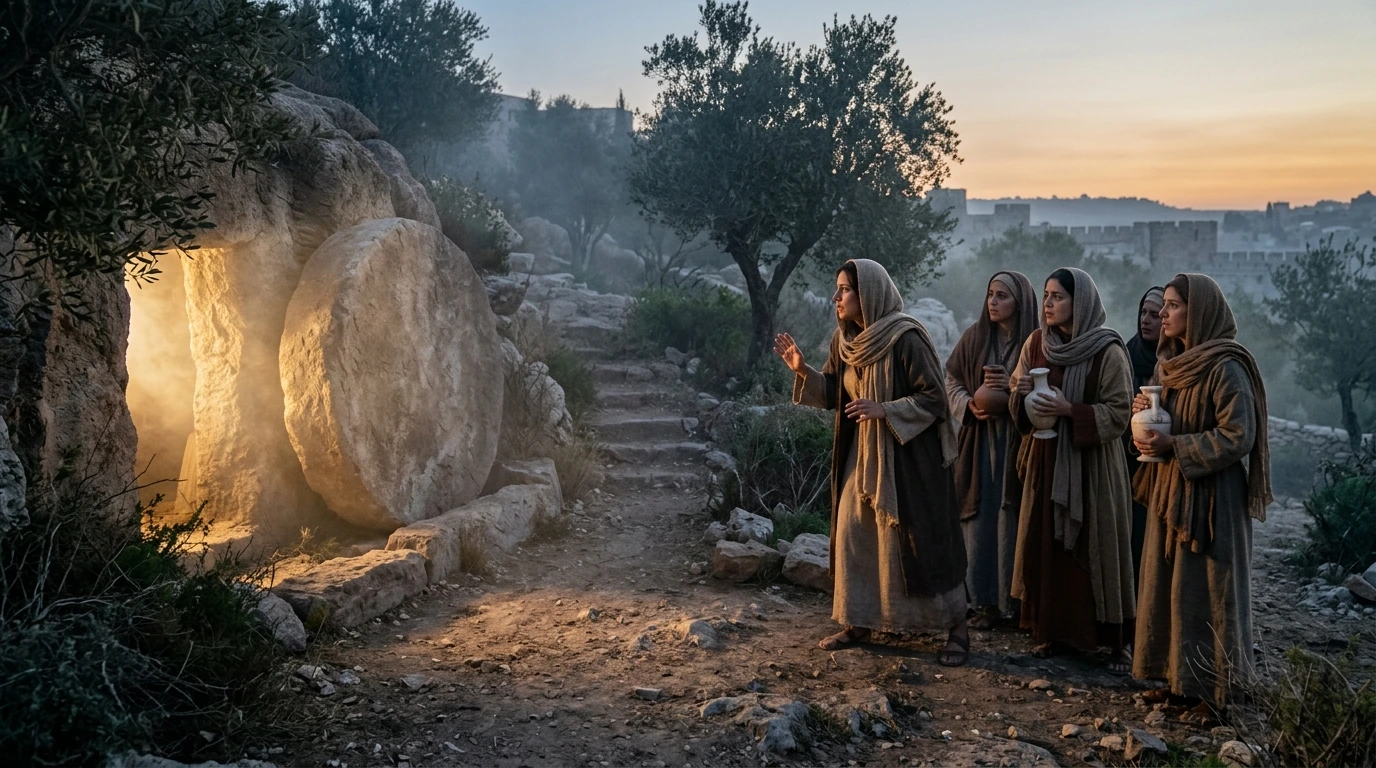
On Sunday morning at dawn, Joanna accompanied Mary Magdalene to the rock-cut tomb of Joseph of Arimathea outside the walls of Jerusalem. They carried expensive prepared spices (aromata) and oils (myra) for the burial rites:
- The Cost of Spices: Aristocratic burial spices (aloes, myrrh, frankincense) were luxury imports brought by Nabataean trade caravans from Southern Arabia, requiring substantial financial resources to purchase in bulk.
- The Empty Tomb Discovery: When the women discovered the stone rolled away from the tomb entrance, two angels in dazzling apparel announced: "Why do you seek the living among the dead? He is not here, but has risen" (Luke 24:5).
- The First Evangelists: When the women returned to announce the resurrection to the Eleven, the male apostles initially dismissed their report as "an idle tale" (leros, medical Greek for delirious talk).
Joanna stood as an unshakeable primary historical link connecting the high court of Tiberias, the Cross at Golgotha, and the historical reality of the empty tomb.
Archaeological Comparison Matrix: Herodian Court vs. Gospels
+----------------------------------------------------------------------------------------------------+
|               CORRELATION MATRIX: HERODIAN ARCHAEOLOGY & THE GOSPEL OF LUKE                       |
+--------------------------+-----------------------+-------------------+-----------------------------+
| BIBLICAL DATA POINT      | MATERIAL DISCOVERY    | ARCHAEOLOGICAL ERA| CONFIRMATORY STATUS         |
+--------------------------+-----------------------+-------------------+-----------------------------+
| 1. Herodian Tiberias     | Mount Berenice Palace | AD 19–39          | Direct material match with  |
|    (Luke 8:3, 9:7)       | (Hirschfeld Excav.)   | (Herod Antipas)   | capital of Antipas & Chuza  |
| 2. Machaerus Palace      | Royal Banquet Hall    | 1st Cent. BC–AD   | Fortress where Antipas held |
|    (Mark 6:21, Luke 3:19)| (Vörös Excavations)   |                   | banquet & executed Baptist  |
| 3. High-Priestly Joanna  | Limestone Ossuary     | 1st Cent. AD      | Epigraphic confirmation of  |
|    (Luke 8:3, 24:10)     | (Peace Forest Tomb)   |                   | aristocratic Joanna name    |
| 4. Nabataean Name Chuza  | Inscriptions at Madaba| 1st Cent. BC–AD   | Onomastic proof of Chuza    |
|    (Luke 8:3)            | and Hauran Basalt     |                   | in Herodian border regions  |
+--------------------------+-----------------------+-------------------+-----------------------------+
Primary Sources & Scholarly Archives
Editorial Standard →Original Hebrew, Aramaic, and Greek interlinear analysis, morphological tags, and ancient variant readings.
Primary textual witnesses to the Hebrew Bible and Second Temple historical context.
Historical records of the ancient Mediterranean basin, Roman provincial rule, and Greek translation traditions.
Frequently Asked Questions
Did Chuza face political danger due to Joanna following Jesus?
Yes. Antipas viewed popular prophetic figures with suspicion; having his chief administrator’s wife visibly financing Jesus created significant political friction in Tiberias.
Where did Joanna obtain the money to fund Jesus’ ministry?
Under Jewish law (melog assets) and Roman civil statutes, upper-class women controlled independent inheritances and dowries that they could disburse without marital veto.
Why is the ossuary inscribed "Joanna granddaughter of Theophilus" so significant?
It confirms that women named Joanna occupied the upper echelon of 1st-century Judean aristocracy, connecting to the House of Annas and Theophilus cited in Luke 1:3.
How did Luke acquire such intimate information about Herod Antipas’s court?
During Paul’s two-year stay in Caesarea, Luke had direct personal access to Herodian court believers including Joanna and Manaen (Acts 13:1).
Related Research Dossiers
View all 515 research dossiers →
The Tyrian Shekel, Temple Tax, and Judas’s Silver: 10 Verified Biblical Facts vs. Common Myths
The Widow’s Mite (Lepton of Alexander Jannaeus): Primary Sources, Numismatic Archaeology, and Mark 12:42