Subject Scope: The Four Prophetic Daughters of Philip in Caesarea: Primary Sources, Papias, and Polycrates in Eusebius
Historical Context: Rigorous historical and theological examination within the field of Women of the Bible & Ancient Near Eastern Law.
Primary Evidence: Forensic archaeology, textual preservation, and primary ancient manuscripts corroborating scriptural events.
Investigation Highlights: The Encounter in Caesarea: Acts 21:8–9 • Papias of Hierapolis: Oral Eyewitness Traditions (Eusebius HE III.39) • Polycrates of Ephesus and the Great Luminaries of Asia (HE III.31)
Scholarly Consensus: Vetted against peer-reviewed academic literature in biblical history, linguistics, and archaeology.
The Encounter in Caesarea: Acts 21:8–9
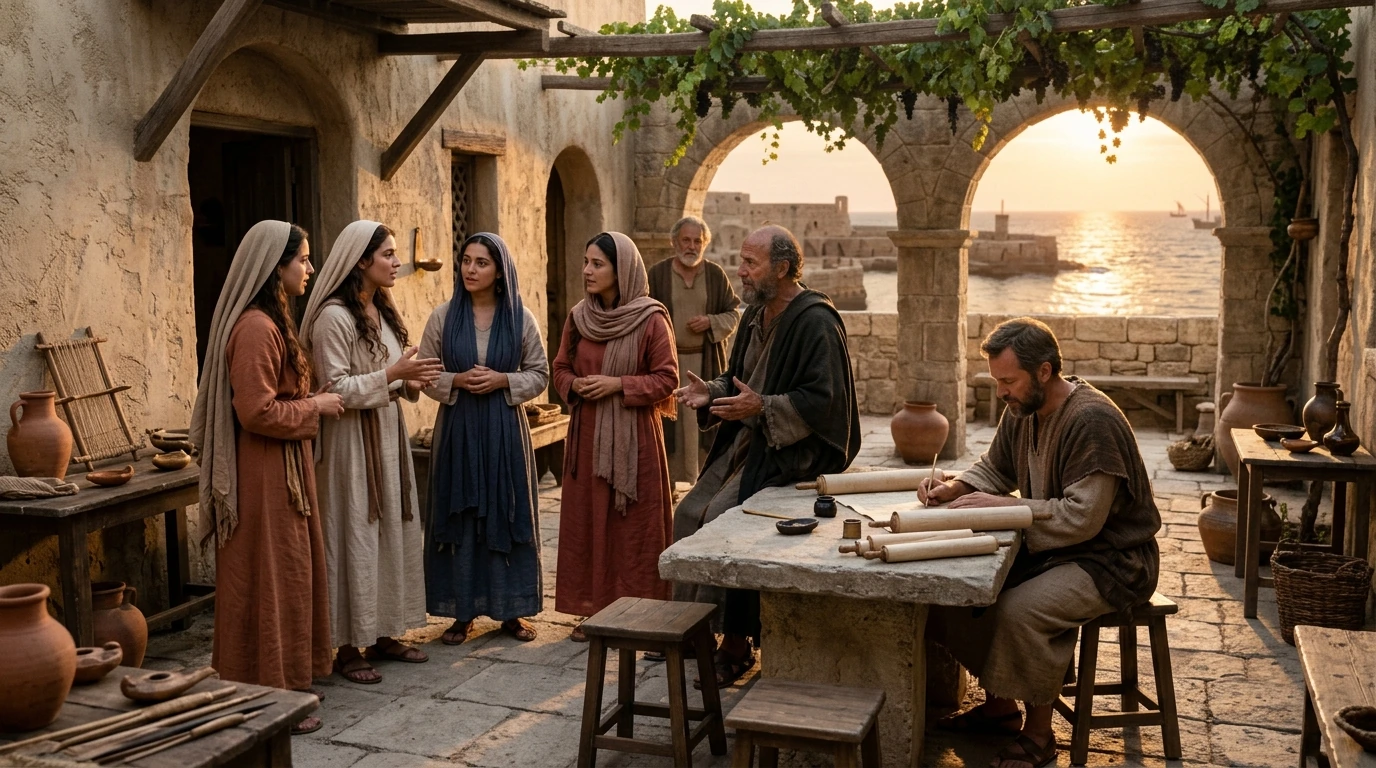
In Acts 21, the apostle Paul and his traveling companion Luke were journeying toward Jerusalem at the conclusion of Paul’s third missionary expedition. Arriving at the maritime metropolis of Caesarea Maritima, they sought lodging in the house of a veteran Christian pioneer:
"On the next day we departed and came to Caesarea, and we entered the house of Philip the evangelist, who was one of the seven, and stayed with him. He had four unmarried daughters, who prophesied." — Acts 21:8–9
This concise biblical reference establishes several vital historical facts:
- Philip the Evangelist: One of the original "Seven" appointed by the apostles in Jerusalem to oversee the Hellenistic deaconate (Acts 6:5). Following the martyrdom of Stephen, Philip pioneered the Christian revival in Samaria (Acts 8:5–13) and baptized the high-ranking Ethiopian royal treasurer on the desert road to Gaza (Acts 8:26–40), before establishing his permanent family residence in Caesarea.
- The Four Virgin Daughters (parthenoi): Philip’s four daughters chose dedicated lifelong celibacy to devote themselves entirely to prayer, prophetic ministry, and teaching within the apostolic church.
- The Prophetic Gift (propheteuousai): The present active participle indicates a continuous, recognized ministry of charismatic inspired utterance, operating in direct fulfillment of the Pentecost prophecy: "Your daughters shall prophesy" (Acts 2:17; Joel 2:28).
+----------------------------------------------------------------------------------------------------+
|                  THE HISTORICAL PROFILE OF PHILIP AND HIS FOUR DAUGHTERS                           |
+--------------------------+-----------------------+-------------------+-----------------------------+
| DATA POINT               | GREEK TERMINOLOGY     | ECCLESIAL ROLE    | HISTORICAL PROVENANCE       |
+--------------------------+-----------------------+-------------------+-----------------------------+
| 1. Father                | Philippos Euangelistes| One of the Seven  | Jerusalem, Samaria, Caesarea|
| 2. Four Daughters        | Tessares Parthenoi    | Lifelong Celibacy | Household prophets          |
| 3. Spiritual Office      | Propheteuousai        | Inspired Speech   | Recognized apostolic voice  |
| 4. Later Residence       | Hierapolis (Phrygia)  | Elder Matriarchs  | Buried beside their father  |
+--------------------------+-----------------------+-------------------+-----------------------------+
Papias of Hierapolis: Oral Eyewitness Traditions (Eusebius HE III.39)
The historical reality of Philip’s daughters extends far beyond the Book of Acts into early 2nd-century patristic literature. In Book III of his Ecclesiastical History (Historia Ecclesiastica), church historian Eusebius of Caesarea quotes directly from the lost five-volume treatise of Papias, Bishop of Hierapolis (Exposition of the Oracles of the Lord, written ca. AD 110–130):
"That Philip the apostle resided at Hierapolis with his daughters has been shown above. But how Papias, who was contemporary with them, mentions his having received an account of a wonderful tale from the daughters of Philip must now be pointed out. For he tells that a resurrection of a dead person occurred in his time, and another wonderful thing concerning Justus, surnamed Barsabbas, how he drank a deadly poison and yet suffered no harm through the grace of the Lord." — Eusebius, HE III.39.9
+----------------------------------------------------------------------------------------------------+
|                 PAPIAS'S HISTORICAL CHAIN OF CUSTODY (HIERAPOLIS, CA. AD 110)                      |
+----------------------------------------------------------------------------------------------------+
|                                                                                                    |
|    [ PHILIP THE EVANGELIST & APOSTLE ] ---> [ HIS FOUR PROPHETIC DAUGHTERS ]                       |
|                                                              |                                     |
|                                                              v (Oral Testimony & Eyewitness Data)  |
|                                                   [ PAPIAS OF HIERAPOLIS ]                         |
|                                                              |                                     |
|                                                              v (Written Expositions, ca. AD 120)   |
|                                                   [ EUSEBIUS OF CAESAREA ]                         |
|                                                                                                    |
+----------------------------------------------------------------------------------------------------+
Papias explicitly states that he did not rely on secondhand gossip, but personally questioned those who had walked with the elders, including the surviving daughters of Philip who lived to advanced old age in Hierapolis. They served as living archives of the apostolic era.
Polycrates of Ephesus and the Great Luminaries of Asia (HE III.31)
Around AD 190, a fierce theological controversy erupted across the Roman Empire regarding the proper date for celebrating Easter (the Quartodeciman Controversy). Polycrates, Bishop of Ephesus, wrote a formal synodical letter to Bishop Victor of Rome, defending the apostolic traditions of Asia Minor:
"For in Asia great luminaries (megala stoicheia) have fallen asleep, who shall rise again on the day of the Lord’s coming... Among these is Philip, one of the twelve apostles, who fell asleep in Hierapolis, and two of his daughters who grew old in virginity, and another daughter who, having lived in the Holy Spirit, rests at Ephesus." — Eusebius, HE III.31.3
Polycrates lists Philip and his daughters alongside the Apostle John as the supreme foundational authorities of early Christian orthodoxy in Asia Minor.
Furthermore, in early 3rd-century Rome, an orthodox churchman named Gaius recorded a formal debate against the Montanist heretic Proclus:
"After this there were four prophetesses, the daughters of Philip, at Hierapolis in Asia. Their tomb is there, and that of their father." — Eusebius, HE III.31.4
These converging independent testimonies from Rome, Caesarea, Ephesus, and Hierapolis demonstrate that the four daughters of Philip were revered throughout the ancient Mediterranean world as venerable pillars of early Christianity.
The Daughters of Philip as Luke’s Historical Archive
When Paul arrived in Jerusalem in Acts 21, he was arrested in the Temple courts, transferred to Caesarea Maritima under military escort, and held in protective custody in Herod’s Praetorium for two full years (AD 57–59) under Roman Governors Antonius Felix and Porcius Festus (Acts 24:27).
Where was Luke during these two years?
- As Paul’s constant traveling companion, Luke resided in the region of Caesarea and Judea.
- Luke had daily, unhindered access to the home of Philip the Evangelist and his four prophetic daughters in Caesarea.
+----------------------------------------------------------------------------------------------------+
|                 THE CAESAREA RESEARCH LABORATORY: LUKE'S ORAL SOURCES (AD 57–59)                   |
+--------------------------+-----------------------+-------------------------------------------------+
| HISTORICAL EPISODE       | SCRIPTURAL PASSAGE    | DIRECT FIRSTHAND SOURCE IN CAESAREA             |
+--------------------------+-----------------------+-------------------------------------------------+
| 1. Appointment of Seven  | Acts 6:1–7            | Philip (one of the original Seven Deacons)      |
| 2. Samaria Revival       | Acts 8:4–25           | Philip (the pioneer evangelist who led it)      |
| 3. Ethiopian Eunuch      | Acts 8:26–40          | Philip (who baptized the royal treasurer)       |
| 4. Cornelius' Conversion | Acts 10:1–48          | Caesarean Believers (site of Cornelius' home)   |
| 5. Early Church Prophecy | Acts 11:27, 21:10     | Philip's Four Prophesying Daughters             |
+--------------------------+-----------------------+-------------------------------------------------+
The home of Philip and his daughters functioned as Luke’s historical research headquarters. It was within this household that Luke compiled, cross-checked, and recorded the foundational oral histories that formed the structural core of the Book of Acts and the Gospel of Luke.
Three-Tier Evidentiary Evaluation: Patristic Texts
+----------------------------------------------------------------------------------------------------+
|               THREE-TIER EVIDENTIARY AUDIT: THE FOUR DAUGHTERS OF PHILIP                           |
+--------------------------+-----------------------+-------------------+-----------------------------+
| SOURCE / WITNESS         | PROVENANCE            | CHRONOLOGY        | EVIDENTIARY VALUE           |
+--------------------------+-----------------------+-------------------+-----------------------------+
| 1. Acts 21:8–9           | Luke's Travelogue     | ca. AD 58–62      | Primary eyewitness record   |
| 2. Papias of Hierapolis  | Expositions (5 vols.) | ca. AD 110–125    | Direct contemporary oral    |
|    (Quoted in Eusebius)  | (Hierapolis, Phrygia) |                   | interview with daughters    |
| 3. Polycrates of Ephesus | Letter to Victor Rome | ca. AD 190        | Historical confirmation of  |
|    (Quoted in Eusebius)  | (Ephesus Archives)    |                   | tombs and virginity in Asia |
| 4. Dialogue of Gaius and | Rome Debate Record    | ca. AD 200–210    | Independent Roman patristic |
|    Proclus (Montanism)   | (Vatican Archives)    |                   | testimony to their tombs    |
+--------------------------+-----------------------+-------------------+-----------------------------+
Frequently Asked Questions
Was Philip the Evangelist the same person as Philip the Apostle?
In the New Testament, they are initially distinguished: Philip the Apostle was one of the Twelve from Bethsaida (Matthew 10:3, John 1:43), while Philip the Evangelist was one of the Seven Deacons chosen in Jerusalem (Acts 6:5, 21:8). However, by the 2nd century, patristic authors such as Papias, Polycrates, and Clement of Alexandria frequently conflated or combined their traditions, noting that both were buried in Hierapolis. Whether two distinct individuals or a single unified leader, the historical memory of Philip and his daughters remains solid.
What was the nature of New Testament prophecy exercised by women?
In the apostolic church, prophecy (propheteia) was not bizarre ecstatic frenzy or pagan fortune-telling, but the Spirit-empowered communication of divine truth, encouragement, exhortation, and ethical guidance (oikodome, paraklesis, paramythia, 1 Corinthians 14:3). Philip’s daughters exercised this recognized charismatic ministry in full accordance with Paul’s apostolic instructions (1 Corinthians 11:5).
Why did Philip and his daughters migrate from Caesarea to Hierapolis?
Following the outbreak of the First Jewish-Roman War in AD 66 and the escalating violence in Caesarea between Jews and Greeks, thousands of Jewish Christians migrated northward into Asia Minor. Philip and his family relocated to Hierapolis in Phrygia, a major Greco-Roman thermal spa city with a thriving Jewish and Christian community.
Did the daughters of Philip leave any written documents?
No written documents authored directly by the daughters have survived. Their primary historical contribution was oral and institutional: they served as venerable living links to the earthly ministry of Jesus and the apostolic church, transmitting firsthand eyewitness traditions to Papias, Polycrates, and the early Christian communities of Asia Minor.
Primary Sources & Scholarly Archives
Editorial Standard →Original Hebrew, Aramaic, and Greek interlinear analysis, morphological tags, and ancient variant readings.
Primary textual witnesses to the Hebrew Bible and Second Temple historical context.
Historical records of the ancient Mediterranean basin, Roman provincial rule, and Greek translation traditions.
Frequently Asked Questions
Was Philip the Evangelist the same person as Philip the Apostle?
The NT distinguishes Philip the Deacon (Acts 6, 21) from the Apostle (John 1); early 2nd-century writers like Polycrates often merged their traditions in Hierapolis.
What was the nature of New Testament prophecy exercised by women?
NT prophecy was the Spirit-led speaking of God’s truth for encouragement, edification, and consolation (1 Cor 14:3), fulfilling Joel 2:28 and Acts 2:17.
Why did Philip and his daughters migrate from Caesarea to Hierapolis?
The outbreak of the Jewish War in AD 66 prompted Jewish-Christian flight from Judea to peaceful centers in Asia Minor like Hierapolis and Ephesus.
Did the daughters of Philip leave any written documents?
No written texts survive; their impact was oral transmission of apostolic events to early church leaders like Papias and Luke during his stay in Caesarea.
Related Research Dossiers
View all 515 research dossiers →
The Widow’s Mite (Lepton of Alexander Jannaeus): Primary Sources, Numismatic Archaeology, and Mark 12:42
How the Widow’s Mite Changes Everything: Exegetical Economics, Temple Exploitation, and Total Devotion